A strong slogan can do more than sound catchy; it can define how your brand is perceived before anyone reads your press release.
In Malaysia’s fast-moving media environment, attention is split across social platforms, chat apps, and news portals. That competition is intensified by just how connected the country is: by the end of 2025, Malaysia’s internet penetration was reported at 98%, and there were 30.7 million social media user identities (about 85% of the population, as of October 2025). In other words, your message is rarely competing with one “main channel” anymore; it’s competing everywhere, all at once.
That is where slogans come in. They compress your message into something instantly recognisable, easy to repeat, and simple enough for both audiences and journalists to carry forward.
For businesses aiming to improve their PR campaigns in 2026, slogans are not just creative lines. They are strategic assets that influence visibility, credibility, and narrative control.
What Counts As A Slogan (And What Doesn’t)?
A slogan is a short, memorable phrase designed to communicate a specific brand message or campaign idea quickly and effectively.
It is often confused with other brand elements, which can lead to unclear messaging. Here is how they typically differ:
Slogan
- Purpose: Campaign or messaging-driven phrase
- Example: “Just Do It”
- Key difference: Flexible and can evolve
Tagline
- Purpose: Long-term brand identity statement
- Example: “I’m Lovin’ It”
- Key difference: More permanent (but can overlap with a slogan)
Mission Statement
- Purpose: Internal purpose and direction
- Example: “To empower communities…”
- Key difference: Not designed for public recall
Value Proposition
- Purpose: Functional benefit explanation
- Example: “Next-day delivery nationwide”
- Key difference: More descriptive than emotional
Important Caveat
In practice, the distinction is not always strict. Some phrases start as slogans and evolve into long-term taglines, effectively becoming both.
McDonald’s: “I’m Lovin’ It”
- Originally launched as a campaign slogan
- Became a long-term brand tagline
- Now functions as both identity and messaging anchor
Why this matters in PR
From a PR perspective, the label matters less than usability. Whether you call it a slogan or a tagline, what matters is:
- Can it be quoted easily by the media?
- Does it clearly represent your brand?
- Is it memorable enough to stick?
If the answer is yes, then it is doing its job.
Why Slogans Matter In PR
Slogans act as narrative shortcuts that shape how your brand is understood in public conversations.
They help because:
- They simplify complex messaging into one clear idea
- They can increase the odds of media reuse by giving journalists a ready-made, quotable line (when it’s actually meaningful)
- They strengthen brand recall, especially in crowded industries
- They create emotional connection, which supports trust over time
- They improve consistency across campaigns, channels, and spokespeople
In Malaysia, where brands compete across multilingual audiences and high-content platforms, simplicity is not optional. It is a competitive advantage.
Core Aspects Of A High-Impact PR Slogan
The best slogans are not accidental. They combine clarity, emotional depth, and cultural intelligence.
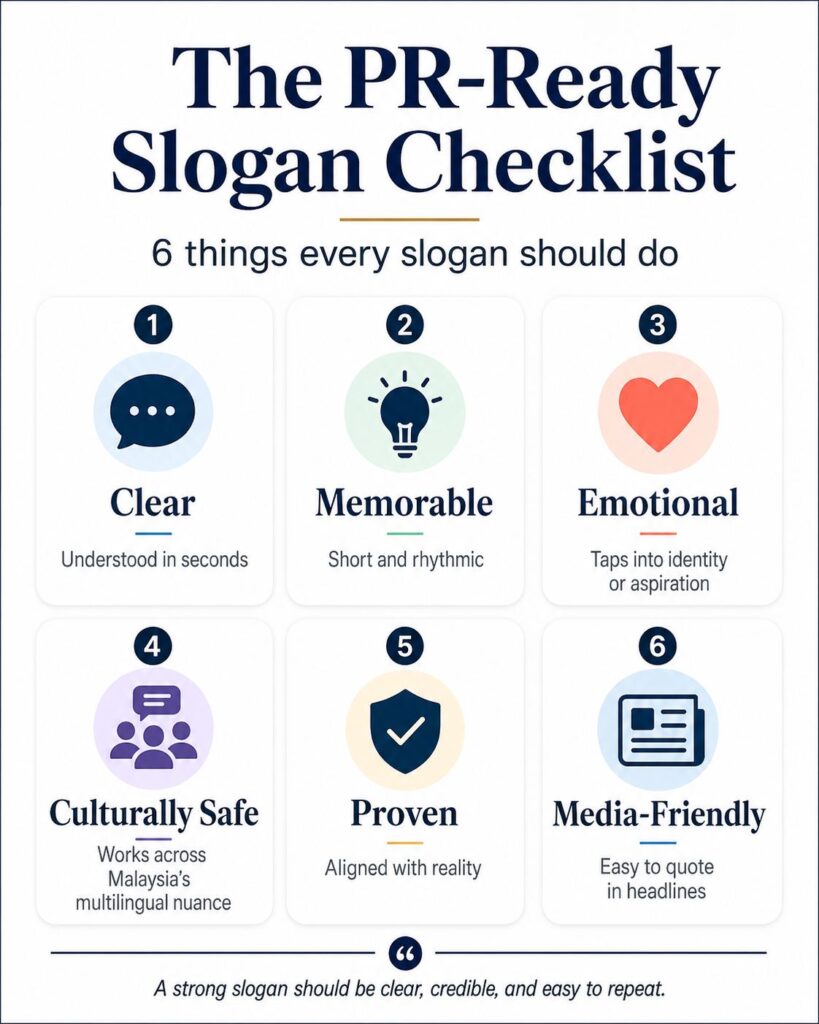
A PR-ready slogan tends to be:
- Clear: understood within seconds
- Memorable: short, rhythmic, easy to repeat
- Emotionally resonant: tied to aspirations, identity, or relief of a pain point
- Culturally relevant: suitable across Malaysia’s diverse demographics
- Consistent: aligned with actual brand behaviour (not just intention)
- Media-friendly: easy to quote without losing meaning
A slogan that achieves these becomes part of how people talk about your brand, not just how you describe it.
The Psychology Behind Why Slogans Work
Slogans work because they align with how people process information quickly.
Key drivers:
- Cognitive shortcuts: people prefer simple messages over complex explanations
- Familiarity through repetition: repeated phrases become easier to recognise and remember
- Perceived truth effect: research shows repeated statements can feel more accurate simply because they’re familiar; one reason slogans must stay grounded in reality
- Emotional triggers: words tied to identity or aspiration stick longer
- Social sharing: punchy phrases spread easily across platforms
A short, well-crafted slogan can outperform detailed messaging in early brand impressions, especially when attention is limited.
Examples Of Powerful Slogans In PR
Nike — “Just Do It”
- Focuses on action and empowerment
- Broad enough to apply across campaigns
- Builds an identity-driven narrative rather than a product-only claim
AirAsia — “Now Everyone Can Fly”
- Communicates affordability and accessibility instantly
- Supports a purpose-led message about making travel more reachable
- Strong regional relevance for a wide audience base
McDonald’s — “I’m Lovin’ It”
- Emotion-driven rather than product-focused
- Adaptable across cultures and markets
- Reinforces a positive lifestyle association
Key insight: the most effective slogans do not list features. They express meaning.
How Slogans Shape Media Narratives
In PR, the way your message is framed often determines how it is remembered.
Slogans influence media narratives because:
- Journalists and editors often look for clean “hooks” that fit a headline or lead paragraph
- Consistent slogans reinforce the same narrative across channels
- Strong phrasing can shape how audiences interpret brand actions
- A campaign backed by a clear slogan is more likely to produce consistent coverage, while a weak one can result in fragmented messaging
This is not magic, it’s momentum. The easier your message is to repeat accurately, the more consistently it shows up.
When Slogans Fail (And Create PR Risk in Malaysia)
Not all slogans succeed. A poorly crafted one can cause a PR crisis, and create confusion, backlash, or credibility damage, because in public, slogans are often read as promises.
In Malaysia, that risk moves faster because a slogan can jump from TikTok to news portals to WhatsApp groups in hours, often without the full context.
Common failure points:
- Overpromising: bold words like “guaranteed,” “confirm,” “lulus,” “fastest,” or “no.1” can trigger complaints if the experience doesn’t match
- Generic messaging: sounds like everyone else, so it gets ignored
- Cultural or religious misalignment: unintended meaning across Bahasa Malaysia, Mandarin, Tamil, and English, or sensitive cues around halal, modesty, or community norms
- Lack of clarity: people can’t repeat it accurately, so your message gets distorted
- Mismatch with delivery reality: service levels vary by location (KL vs luar bandar), peak periods (Raya), eligibility, stock, or T&Cs, but the slogan implies it’s the same for everyone
A quick safeguard before launch
- Remove absolute claims unless you can prove them consistently (especially “guarantee/confirmed/no.1”)
- Check implied promises around approvals, savings, delivery speed, safety, or results
- Test language and tone locally (direct translations can change meaning or sound overly harsh)
- Run “headline mode”: if a news portal quoted only the slogan, would it still feel fair and defensible?
Also check whether the slogan could be seen as a misleading claim under local consumer expectations, especially for promos, pricing, and ‘guaranteed outcome’ services.
A good rule: if you need a long explanation to defend it, rewrite it. The strongest slogans in Malaysia still feel bold, they’re just bold in a way you can back up everywhere you operate.
How To Measure Slogan Effectiveness In PR
A slogan is most useful in PR when you can connect it to measurable outcomes, not just creativity.
Track both visibility and perception:
Visibility (Reach + Presence)
- Media mentions: how often the slogan appears in coverage
- Social reach and shares: how often it’s repeated by the public
- Search behaviour: whether branded searches and related queries increase
Perception (Trust + Meaning)
- Brand recall surveys: whether people remember it and connect it to your brand
- Sentiment analysis: whether it lands positively or creates confusion
- Message association: whether people understand the intended meaning
Using a mix of these metrics helps PR teams understand both reach and resonance.
How To Create A PR-Ready Slogan (Step-By-Step Framework)
Strong slogans are built through structured thinking, not guesswork.
- Define your core message clearly: What do you want people to believe about you in one sentence?
- Identify your audience’s emotional drivers: What do they want to become, avoid, or feel?
- Simplify the message into one concise phrase: Remove jargon. Remove filler. Remove anything you have to explain.
- Test for cultural fit across Malaysian audiences: Check meaning, tone, and potential double meanings across key languages.
- Ensure it is easy for media to quote: If it looks awkward in a headline, it won’t travel far.
- Validate through feedback before scaling: Run small tests with real people (not just internal teams).
This ensures your slogan works not just creatively, but strategically in PR execution.
The Role Of Culture In Malaysian Slogans
Malaysia’s diversity makes cultural sensitivity a key success factor.
What to watch:
- Language differences can shift meaning significantly
- Tone must align with cultural expectations (what feels confident in one community may feel aggressive in another)
- Local context influences emotional resonance
- A slogan that works in English may need adaptation for Bahasa Malaysia or Mandarin audiences to maintain its intended impact
The goal isn’t “one slogan for everyone.” The goal is one message that stays true, even when adapted.
Slogans In The AI And Search Era (2026)
AI-generated search summaries are changing how people discover information. Some search experiences now provide an AI-written snapshot and then point users to sources to explore further.
This raises the bar for brand messaging:
- Clarity matters more: ambiguous slogans are easier to misinterpret
- Consistency matters more: mismatched claims across pages create confusion
- Proof matters more: AI summaries can surface or repeat what’s written, so slogans that overpromise can backfire fast
In practice, slogans still don’t “win” search on their own. But in 2026, a slogan that is clear, consistent, and evidence-backed is more likely to be repeated accurately, by people, media, and systems.
Slogans Vs Brand Narrative: Why Both Matter
A slogan is not your entire story. It is the entry point.
- The slogan captures attention
- The narrative builds depth
- PR strategy connects everything together
Without a strong slogan, your message may not be noticed. Without a strong narrative, your slogan may lack substance.
Using Slogans Well in PR
Slogans have evolved into strategic PR tools that shape how brands are perceived, discussed, and remembered. In Malaysia’s diverse and competitive media landscape, a well-crafted slogan can bridge the gap between brand intention and public understanding.
If your brand messaging feels unclear or inconsistent, refining your slogan is often the fastest way to improve perception and media impact. At PRESS PR Agency, your trusted Malaysian PR partner, we help businesses develop messaging strategies that are built for real-world visibility, so your brand is not just seen, but clearly understood. Get in touch with PRESS to learn more.
Sources
- DataReportal / Kepios — Digital 2026: Malaysia (Published 8 Nov 2025)
- Google Search Central — AI features and your website (accessed 2026)
- Google Search Help — AI Overviews in Google Search (accessed 2026)
- Pennycook, Cannon & Rand — Prior exposure increases perceived accuracy of fake news (2018; peer-reviewed)
- AirAsia Newsroom — About us (accessed 2026)
Frequently Asked Questions About How Brand Slogans Can Be Effective
What Makes A Slogan Effective In PR?
A strong slogan is clear, memorable, emotionally engaging, and aligned with your brand’s actual positioning and actions.
How Is A Slogan Different From A Tagline?
A slogan is often campaign-specific and flexible, while a tagline is usually long-term, though in practice the two can overlap.
Can A Bad Slogan Affect Brand Reputation?
Yes, especially if it overpromises or feels disconnected from reality, which can lead to negative coverage or public distrust.
Should Malaysian Brands Use Multiple Languages In Slogans?
It depends on the audience, but multilingual adaptation can improve reach as long as meaning and tone remain consistent.
How Long Should A Good Slogan Be?
Ideally short enough to remember easily (often under eight words) while still conveying a clear message.
How Do You Test If A Slogan Works Before Launch?
Use audience feedback, pilot campaigns, and internal reviews to assess clarity, emotional response, and cultural relevance.