

“Walao” is a Malaysian slang expression used to react emotionally, not something you translate word-for-word.
If you’ve spent time in Malaysia, especially in places like Kuala Lumpur, Penang, or Johor Bahru, you’ve probably heard “walao” pop up in daily conversation. You’ll hear it at mamak stalls, while queuing for food, during shopping trips, and in casual chats between friends.
Many people assume it simply means “oh my gosh.” That’s not totally wrong, but it doesn’t capture how locals actually use it. “Walao” works more like a verbal reaction: it sets the emotional tone before the rest of the sentence even arrives.
What Does “Walao” Mean in Malaysian Slang?
“Walao” works as an emotional signal that frames what comes next.
Instead of fully explaining how they feel, Malaysians often lead with a reaction word. “Walao” tells you the speaker’s mood instantly, then the sentence lands with that mood already established.
You’ll hear it in everyday speech like:
- Walao, this place damn crowded
- Walao eh, so cheap
- Walao, cannot like that
Same word, different feeling. That’s why a direct one-to-one translation doesn’t really work.
When Do Malaysians Use “Walao”?
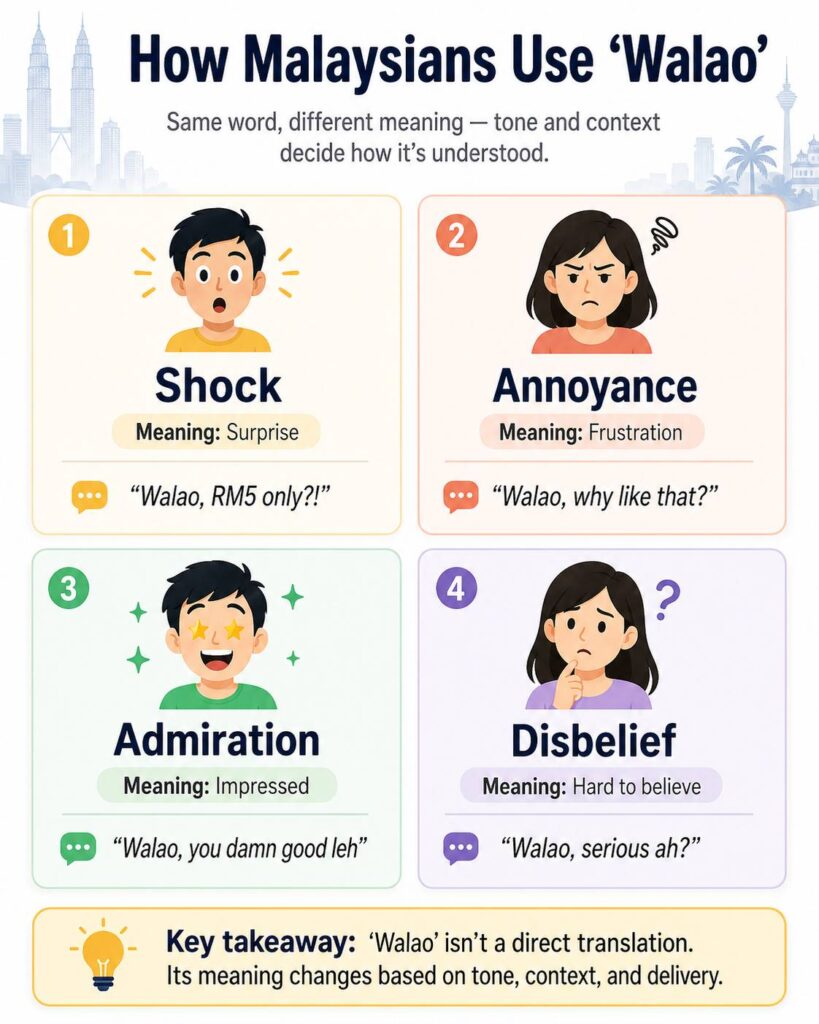
Context determines meaning more than the word itself.
| Situation | Meaning | Example |
|---|---|---|
| Shock | Surprise | “Walao, RM5 only?!” |
| Annoyance | Frustration | “Walao why like that?” |
| Admiration | Impressed | “Walao you damn good leh” |
| Disbelief | Hard to accept | “Walao serious ah?” |
Locals aren’t thinking “definition.” They’re reacting.
A pasar malam (night market) moment usually pulls “walao” toward excitement. A traffic jam on Federal Highway pulls it toward frustration. The situation does half the work.
Read More: Fuyoh Meaning in Malaysia: Origin, Usage & Real-Life Examples
“Walao”, “Walao Eh”, “Walao Wei”: What’s the Difference?
These variations mostly adjust intensity and social vibe.
- Walao: Neutral baseline. Works in most casual situations.
- Walao eh: Stronger emotional emphasis. Often used when reacting more intensely.
- Walao wei: More direct. Depending on tone and relationship, it can sound sharper.
Examples:
- Walao, your new phone damn nice
- Walao eh, this queue like never ending
- Walao wei, you forgot again ah?
These differences are subtle, but Malaysians pick up the vibe quickly, especially through tone and familiarity.
How “Walao” Fits Into Malaysian Grammar
“Walao” blends into Manglish sentence structure rather than standing alone.
It usually appears at the start of a sentence, then flows into local phrasing:
- Walao, traffic jam again
- Walao, you serious ah
- Walao eh, so expensive meh
What makes these sound “local” is the rhythm and the particles. Linguists who study Malaysian English often highlight how discourse particles carry social meaning, softening, intensifying, or turning a statement into a question.
Common ones you’ll hear around “walao”:
- Ah: softens or turns it into a question (“serious ah?”)
- Meh: adds doubt or disbelief (“like that meh?”)
- Lah: adds emphasis or casual finality (“cannot lah”)
- Leh: adds a persuasive/insistent tone (“can leh”)
- Lor: signals resignation (“like that lor”)
Even if your sentence is grammatically understandable without them, it won’t always sound natural.
The Hidden Rule: Tone Changes Everything
Tone is what actually determines how “walao” is understood.
Think of “walao” as a mood marker:
- Higher, excited tone → amazement / impressed
- Flatter tone → tired annoyance / disappointment
- Sharper tone → irritation (sometimes borderline scolding)
Two people can say the same words and mean totally different things:
- “Walao ehhhh” (laughing) → impressed or playful
- “Walao eh.” (flat) → annoyed, done with it
- “WALAO.” (sharp) → warning shot, stop pushing
If you’re learning, this is the part to pay attention to: tone first, words second.
Where Does “Walao” Come From?
Most references treat “walao” as a variant of “wah lau,” an exclamation linked to Chinese dialect influence in the region.
According to lexicographic references like Wiktionary, “walao” is generally treated as a variant spelling/pronunciation of “wah lau.” These are commonly associated with dialect-influenced interjections used in Singapore and Malaysia. Some sources describe the roots as Hokkien/Teochew-related, but the exact original form is not always presented as perfectly settled.
What’s consistent is the function: it’s a quick exclamation that became a normal part of informal speech in the broader Singlish/Manglish space.
Is “Walao” Singaporean or Malaysian?
You’ll hear it in both, but how it “feels” depends on the full sentence around it.
Some references discuss “wah lau / walao” under Singlish because it’s widely documented in Singaporean English contexts. In Malaysia, it’s also common in informal talk, especially in urban settings and mixed-language friend groups.
In real life, it doesn’t matter who “owns” it. What matters is whether you sound natural in the moment. In Malaysia, “walao” often comes bundled with Manglish-style phrasing and particles (like lah, meh, mah, leh), plus local context words (“mamak”, “tapau”, “jam”, “aiyo”, “alamak”).
How to Use “Walao” Naturally (A Practical Mini-Guide)
If you want to sound natural (and not like you’re forcing slang), follow these rules:
- Use it as a reaction, not decoration. Say it when something genuinely surprises/annoys/impresses you.
- Put it at the start. “Walao, …” is the most natural placement.
- Match your intensity. Big reaction → “walao eh”; smaller reaction → plain “walao”.
- Let the sentence do the explaining. Don’t overthink the “meaning”; the next phrase carries it.
A good mental model: “walao” works like an emotional headline before the details.
When NOT to Use “Walao”
“Walao” is informal and can sound unprofessional in formal settings.
Avoid using it in:
- Work presentations or formal meetings
- Emails, proposals, or client communication
- Conversations with authority figures (unless you’re close and it’s clearly casual)
If you need a safer alternative in professional settings, Malaysians typically switch to neutral reactions like “oh”, “wah”, “seriously?”, or just a laugh.
Common Mistakes People Make When Using “Walao”
Most mistakes come from treating it like a fixed dictionary definition.
- Using it too often makes it feel performative
- Wrong tone can flip the meaning
- Using it in formal settings can feel childish or out of place
- Over-translating it misses the point; it’s a reaction word
- Forcing it with the wrong rhythm (Manglish is about flow, not perfect grammar)
Best approach: listen first, then use it lightly until it feels natural.
Examples of Usage (More Malaysia-Coded, Still Easy to Understand)
Mamak scenario
Walao eh, this roti canai damn crispy lah (Admiration)
Tapau moment
Walao, you tapau for me also ah? Best lah (Grateful surprise)
Pasar malam reaction
Walao, RM3 only?! Cheap siao (Surprise/excitement)
Friend complaint
Walao why you late again? Jam ah? (Mild frustration)
Casual disbelief
Walao serious ah? You got promoted? (Shock)
Annoyed but not angry
Walao eh, the line so long leh (Resigned frustration)
Sharper “walao wei” (close friends only)
Walao wei, you never reply my message again (Pointed / a bit confrontational depending on tone)
Light joking version
Walao eh, you so drama lah (Teasing)
Why “Walao” Is More Than Just Slang
“Walao” reflects how Malaysians communicate quickly and emotionally.
Instead of long explanations, a single reaction word signals mood immediately. It makes conversations faster, more expressive, and more human.
It also functions socially: using it naturally signals familiarity with local communication patterns. Using it awkwardly stands out fast, especially if the tone doesn’t match the situation.
And there’s a cultural layer too: Malaysian everyday speech often blends Malay, English, and Chinese dialect influences into something practical. That’s why reaction words + particles do so much work. You don’t need to sound “perfect.” You just need to sound like you understand the vibe.
Read More: FFK in Malaysian Slang: What Does “Fong Fei Kei” Really Mean?
Understanding “Walao” Is About Context, Not Translation
“Walao” isn’t something you memorise like vocabulary. It’s something you learn by listening, noticing tone, context, and the way locals build sentences.
Once you get that, everything clicks: the same word can mean surprise, annoyance, admiration, or disbelief, and all of them can be “correct” depending on delivery.
If you’re creating content or campaigns that need to connect with Malaysians, these nuances matter. At PRESS PR Agency, we help brands communicate in ways that feel locally relevant through culturally grounded PR strategies. Partner with PRESS, Malaysia’s top PR firm today, to boost your content for the right audience.
Sources
- Wiktionary (entries for “walao” and “wah lau”) — for variant forms and etymology notes
- Wikipedia: Singlish — for regional usage context and common interjections
- Tay, Li Chia; Chan, Mei Yuit; Yap, Ngee Thai (2016) — research discussing discourse particles in Malaysian English (supports the “ah/meh/lah/leh/lor” explanation)
- Traveloka — general Malaysian slang usage examples (supports conversational contexts and common variants)
Frequently Asked Questions About What Walao Means & How To Use It
What Does “Walao” Mean In Malaysia?
It’s a flexible slang expression used to show surprise, frustration, admiration, or disbelief depending on tone and context.
What Is The Difference Between “Walao” And “Walao Eh”?
“Walao eh” adds stronger emotional emphasis and is usually used when the reaction is more intense.
Is “Walao” Considered Rude?
Usually not among friends. But it can sound inappropriate in formal or professional settings.
Can Tourists Use “Walao” Naturally?
Yes, but use it casually and match the tone so it doesn’t feel forced.
Why Does “Walao” Have Multiple Meanings?
Because its meaning depends on tone and context rather than a fixed definition.
Is “Walao” Part Of Formal Malaysian Language?
No. It’s informal slang used mainly in casual conversations.