

If your PR campaign gets media mentions, social posts, and engagement, the next question is simple: are you actually winning attention, or just appearing in the noise?
That is where Share of Voice comes in.
Share of Voice helps PR campaigns measure how much visibility a brand owns compared to competitors. In Malaysia, this matters even more because conversations happen across news portals, TikTok, Facebook, LinkedIn, forums, and multiple languages. People often switch between them in the same thread.
Instead of only asking, “How many mentions did we get?”, a better question is: How much of the relevant conversation do we own, and is that attention helping or hurting us?
What Is Share of Voice?
Share of Voice (SOV) is a way to express how much category visibility your brand has compared to competitors, usually as a percentage.
But SOV doesn’t have one single universal meaning across every discipline, so you should define what you mean in your report:
- In classic advertising measurement, SOV often refers to share of media spend in a category (your spend versus total category spend).
- In PR and social reporting, SOV is commonly used as share of conversation or mentions (your mentions versus total category mentions across your tracking set).
A common PR/social formula is: Your Brand Mentions ÷ Total Category Mentions × 100 = Share of Voice (%)
For example, if your brand receives 300 mentions and the total mentions across your brand and competitors is 1,000, your Share of Voice is 30%.
In modern PR, however, SOV should go beyond mention counting. A stronger analysis also asks:
- Who mentioned the brand (journalist, influencer, customer, analyst, ordinary account)
- Where it happened (news site, TikTok, Facebook, LinkedIn, search, forum, community group)
- What the sentiment was (positive, neutral, negative, sarcastic, complaint-driven)
- How influential the source was (high-authority outlet, niche expert, low-impact repost)
For industries using Malaysian PR teams, this matters because high visibility can mean campaign success, but it can also mean a viral complaint.
Why Share of Voice Matters in PR
Share of Voice matters because it shows whether your brand is visible enough to compete in public conversations, and where you’re winning or losing attention.
It helps PR teams understand:
- Whether campaigns are cutting through: a rising SOV can indicate your campaign gained attention
- Whether competitors are outperforming you: if another brand dominates, your distribution or messaging may need work
- Which channels matter most: visibility can look very different across earned media, social, and search
- Whether reputation is improving: positive SOV is very different from negative or crisis-driven SOV
- Where your brand has white space: weak competitor visibility on a topic can create a PR opportunity
Share of Voice vs Share of Market
Share of Voice measures visibility, while Share of Market measures sales or business share.
Related metrics you may report alongside SOV:
- Share of Search: percentage of branded searches for your brand compared to competitors/category (a demand and interest signal)
- Share of Sentiment: distribution of positive/neutral/negative conversation within your tracked set (reputation quality)
A brand can have high SOV but low market share if people talk about it often but don’t buy. A brand can also have strong sales but low SOV if it relies on existing customers, offline distribution, or word-of-mouth.
Key Aspects of Share of Voice
A stronger SOV analysis looks beyond raw mention counts. The main aspects include:
- Volume: how many times your brand is mentioned
- Reach or potential exposure: how many people could have seen those mentions (estimated)
- Sentiment: whether the attention is positive, neutral, or negative
- Influence: whether the mention came from a trusted outlet, creator, expert, or low-impact source
- Platform: news sites, TikTok, Facebook, LinkedIn, search, forums
- Language: Bahasa Malaysia, English, Chinese-language content, and mixed local slang
- Topic ownership: whether your brand is linked to the topics you want to own
This is where PR reporting moves from “how many mentions did we get?” to “what does this visibility actually mean?”
Share Of Voice Measurement Layers For Malaysian PR Teams
A Malaysia-ready SOV report usually layers multiple signals so the final insight is more than a mention count.
Measurement layers to include:
- Mention volume: baseline visibility
- Media quality: credibility, relevance, and placement strength
- Sentiment: whether visibility helps or hurts reputation
- Platform source: where the conversation is happening (news, TikTok, Facebook, LinkedIn, forums, search)
- Language context: multilingual and mixed-language mentions
- Competitor comparison: whether you are gaining or losing attention
- Narrative theme: what topics and messages get linked to your brand
Types of Share of Voice
SOV can be measured across PR, social, search, and paid channels. The key is to define the metric input you’re using.
- PR and Media SOV: earned media visibility via articles, interviews, press mentions, and industry commentary
- Social SOV: share of public discussion across social platforms and online communities
- SEO / Search SOV: includes share of search and organic visibility indicators such as impressions, clicks, and rankings. Some teams also track visibility in AI-powered answer experiences, but definitions vary by tool, so document your method.
- Paid Media SOV: typically measured as share of spend or impression share, depending on the platform and what’s available.
- Integrated SOV: combines PR, social, search, and paid visibility into one broader view (useful for executive reporting, but only if definitions stay consistent)
How To Measure Share of Voice
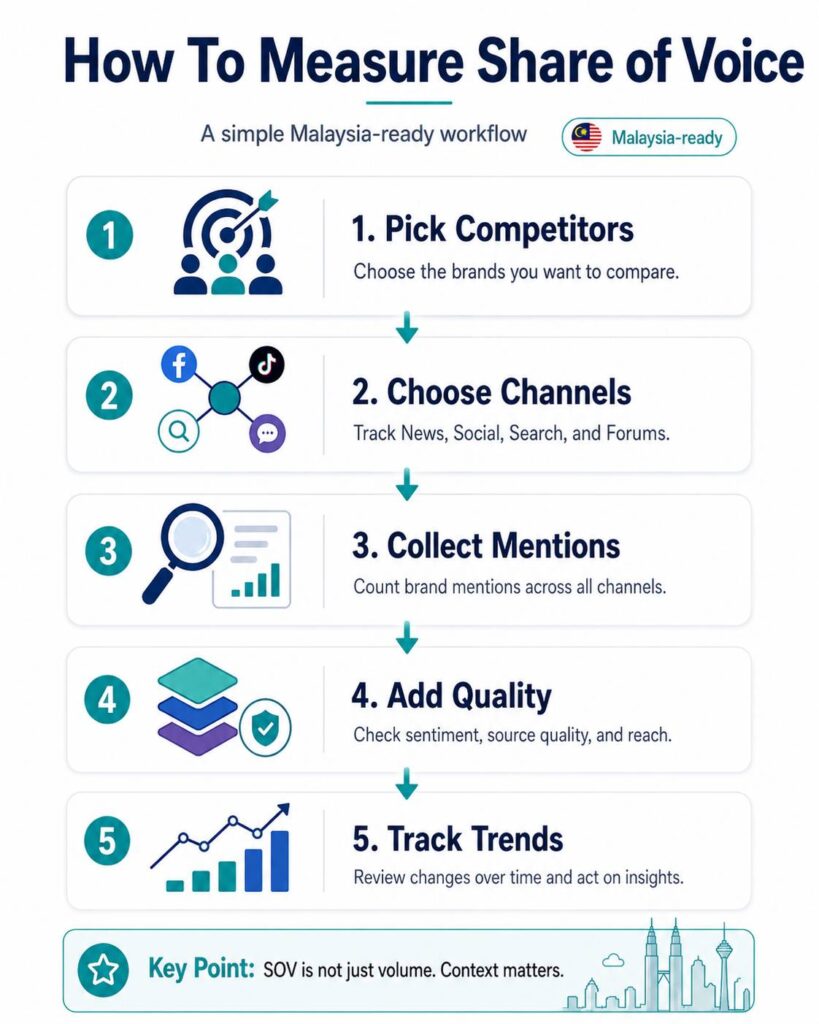
The formula is simple, but the setup determines whether the data is useful.
1) Define Your Competitors
Choose brands that compete for the same audience or category attention:
- Direct competitors
- Indirect competitors
- Regional competitors
- Category leaders
Keep the list focused. Too many competitors can make the analysis messy and dilute insights.
2) Choose Your Channels
Common PR channels include:
- Online news portals
- Print and broadcast media
- TikTok
- X
- Forums and community groups
- Google search
For Malaysia, avoid relying on only one channel. A brand can be strong in news coverage but weak in social discussion, or highly visible on TikTok but invisible in business media.
3) Collect Brand Mentions (and Variants)
Track consistent terms across your brand and competitors. Include:
- Brand names
- Product names
- Campaign names
- Spokesperson names
- Hashtags
- Common misspellings
- Malay, English, and Chinese-language variations where relevant
This matters because people refer to brands differently depending on platform, language, or slang.
4) Calculate SOV
Add your mentions and competitor mentions together, then calculate your percentage.
Example:
- Brand A: 400 mentions → 40%
- Brand B: 300 mentions → 30%
- Brand C: 200 mentions → 20%
- Brand D: 100 mentions → 10%Total: 1,000 mentions → 100%
In this example, Brand A has the highest SOV, but that does not automatically mean Brand A has the best reputation.
5) Add Sentiment and Weighting
To make the data more useful, break mentions into:
- Positive
- Neutral
- Negative
Then consider weighting by:
- Source authority and credibility
- Audience relevance
- Reach (estimated)
- Engagement quality
- Industry influence
One feature in a major business publication can carry more PR value than dozens of low-quality reposts.
6) Track Trends Over Time
Measure SOV:
- Monthly (ongoing monitoring)
- Quarterly (strategic reporting)
- Before and after campaigns (campaign lift)
- During a crisis (negative visibility tracking)
A single snapshot tells you what happened. A trend tells you what is changing.
Malaysia-Specific SOV Factors
Malaysia’s PR environment benefits from more local context than a standard global dashboard.
PR teams should consider:
- Multilingual conversations: public discussion is often multilingual and mixed-code, which affects keyword design and sentiment interpretation.
- Platform behaviour: different channels often play different roles. TikTok can accelerate reach quickly, Facebook can concentrate discussion in communities, LinkedIn is commonly used for professional and B2B messaging, and news coverage can signal credibility. Treat these as tendencies and validate with your own data.
- Cultural interpretation: humour, sarcasm, slang, and local sensitivities can affect sentiment accuracy.
- Community spread: groups and niche forums can amplify narratives quickly.
- Crisis sensitivity: high SOV during a complaint, boycott, service issue, or backlash can signal reputational risk, not success.
This is why Malaysia-focused SOV reporting should combine numbers with local interpretation.
Examples of Share of Voice in Malaysia
E-Wallet Campaigns
If four e-wallet brands run Raya campaigns, one may dominate TikTok, another may win news coverage, and another may gain more search demand.
A useful SOV report would compare:
- Which brand owned the most conversation
- Which brand had the best sentiment
- Which platform drove the biggest visibility spike
- Which campaign message was most repeated or associated with the brand
Property Launch Visibility
For a property developer, SOV may come from business news, property portals, Facebook ads, influencer visits, and buyer discussions.
A useful analysis may compare media coverage, search visibility, pricing sentiment, and discussion in local community spaces.
Crisis-Driven SOV
A brand may become highly visible because of a complaint, service failure, or controversial statement.
In this case, the report should highlight:
- Negative sentiment growth
- Main complaint themes
- Influential voices driving the conversation
- Recovery after official statements
Why Raw Share of Voice Can Be Misleading
Raw SOV is useful as a starting point, but it can lead to the wrong conclusions when used alone.
Common problems include:
- High volume, low value: many mentions from low-impact sources may not shift perception
- Positive-looking numbers, negative reality: a crisis can create high visibility but damage trust
- Platform distortion: one viral post can inflate SOV for a short period
- Poor competitor selection: comparing against the wrong brands makes results less useful
- Missing language variants: ignoring multilingual and mixed-language mentions can undercount real visibility
- No sentiment layer: mention volume alone can’t show whether the conversation is favourable
The goal is not just to get a bigger number. The goal is to understand what the number means.
How To Improve Share of Voice Strategically
Growing Share of Voice requires more than posting more content or sending more press releases.
Focus on:
- Stronger media angles: timely, relevant stories journalists can actually use
- Search-friendly PR content: explainers, reports, thought leadership, FAQ pages, campaign landing pages
- Relevant influencers: choose creators based on audience fit, trust, engagement quality, and category relevance
- Competitor narrative tracking: monitor what competitors get associated with (innovation, affordability, sustainability, customer service)
- Faster crisis response: watch for sentiment shifts, complaint themes, media pickup, and influential accounts during spikes
A good SOV strategy is not just about being louder. It is about being more visible in the right places, with the right message, to the right audience.
How To Report Share of Voice Clearly
A good SOV report should explain what changed, why it changed, and what to do next.
Include:
- Overall SOV percentage
- Competitor comparison
- Sentiment breakdown
- Top performing channels
- Most mentioned themes
- Positive and negative drivers
- Recommended next steps
This keeps the report useful for both communications teams and decision-makers.
A Practical Measurement Method
Share of Voice is more than a visibility metric. For Malaysian PR professionals, it is a practical way to understand how much attention your brand owns, how that attention compares with competitors, and whether the conversation is helping or hurting your reputation.
The strongest SOV analysis combines numbers with context: volume, sentiment, platform behaviour, source quality, language, and competitor movement together.
If your brand wants to move beyond surface-level media tracking, PRESS PR Agency can help turn Share of Voice insights into smarter PR strategy. PRESS, Malaysia’s number one PR agency, supports brands in building stronger visibility, better sentiment, and more meaningful media presence. Don’t miss this chance to partner with us!
Sources
Use this list as your bibliography and to back key definitions in the article:
- Nielsen — “Need to know: What is share of voice?” (2025)
- Brandwatch — “Share of voice (SOV) | Social Media Glossary” (Last updated: March 13, 2026)
- Meltwater — “Share of Voice: definition and measurement” (Apr 10, 2026)
- Talkwalker — “Share of Voice: Definition + How to Measure…” (Apr 28, 2025)
- Sprout Social — “Share of voice definition: How to measure it” (accessed Apr 29, 2026)
- Google Ads Help — “About impression share” (Help documentation)
- Search Engine Land — “Share of search: Measure your brand’s visibility in the SERPs” (Sept 29, 2025)
- DataReportal — “Digital 2026: Malaysia” (Nov 8, 2025)
Frequently Asked Questions About Share of Voice and Measurement
What Is Share Of Voice In Simple Terms?
Share of Voice is the percentage of total visibility your brand owns compared to competitors, based on the channels and metric you choose (mentions, spend, impression share, or search demand).
What Is The Share Of Voice Meaning In PR?
In PR, SOV usually means how much media coverage or public discussion your organisation gets compared to competing brands, often measured as share of mentions across selected sources.
How Do You Measure Share Of Voice?
Choose your channel and metric, then calculate: your brand metric ÷ total category metric × 100. For PR/social, the metric is often mentions. For paid media, it may be spend share or impression share.
Why Is Share Of Voice Important For Malaysian Brands?
Because attention in Malaysia is spread across multiple platforms and languages, SOV helps brands benchmark visibility, track campaigns, and monitor reputation shifts across the channels people actually use.
Is A Higher Share Of Voice Always Better?
Not always. High SOV can be driven by complaints or controversy, so you need sentiment and context to know whether visibility is helping or hurting.
How Often Should PR Teams Track Share Of Voice?
Many teams track monthly or by campaign. Brands in fast-moving or crisis-sensitive categories may track weekly or even daily during spikes.