
Most businesses believe they are consistent because they have a logo, a few colours, and maybe a Canva template or two. On the surface, everything looks aligned.
But when you actually experience the brand across channels, things start to break:
- The website sounds corporate, but social media is casual and inconsistent
- Shopee listings feel transactional, while Instagram tries to be lifestyle-driven
- Customer service tone on WhatsApp does not match marketing messaging
This disconnect is more common than most realise.
In Malaysia, where customers jump between Google, TikTok, marketplaces, and messaging apps within minutes, brand consistency is no longer just a design function. It is an operational system that governs how your brand behaves everywhere.
In this guide, we break down:
- What brand consistency really means in 2026
- Why it impacts trust, conversion, and AI-driven discoverability
- A practical system Malaysian businesses can implement immediately
- How to stay consistent without becoming rigid
What Is Brand Consistency (And What It Is Not)
Brand consistency is the ability to present a unified identity, message, and experience across every customer touchpoint.
This includes:
- Visual identity such as logos, colours, and typography
- Verbal identity including tone, voice, and messaging style
- Customer experience from marketing to support
But here is where many brands get it wrong.
They assume consistency means repeating the same content everywhere. That approach usually leads to content fatigue and platform mismatch.
What brand consistency is not:
- Copy-pasting the same captions across platforms
- Using the same visuals without context
- Locking your brand into a rigid, inflexible style
Consistency is not repetition. It is recognition. Your brand should feel familiar, even when the format changes.
Why Brand Consistency Matters More in 2026
Brand consistency is no longer just a branding best practice. It directly affects business performance.
Trust and Credibility
When customers encounter a brand that feels consistent across platforms, it signals reliability. Inconsistent messaging, on the other hand, creates friction and doubt.
Consistent branding is widely associated with higher perceived professionalism and trust because people recognise the brand faster and know what to expect, especially when they bounce between channels. (Sources: Forbes Communications Council; Adobe Express)
Revenue and Conversion Performance
Consistency reduces cognitive load. When customers recognise your brand quickly, they make decisions faster.
Some industry research and vendor reports associate consistent brand presentation with revenue uplift ranges (commonly reported around 10–20%), though results vary by business and execution. (Sources: Adobe Express; Lucidpress)
That is not because of design alone. It is because consistency removes uncertainty.
AI and AEO Visibility
In 2026, AI-driven search experiences (like Google’s AI Overviews) can influence how content is discovered, summarised, and linked. (Source: Google AI Overviews PDF)
Practically, pages that are easy to parse (clear headings, helpful main content, and consistent on-page information) tend to be easier for search and AI features to understand and surface. (Source: Google Search Central – AI features and your website)
If your messaging and on-page information varies wildly across key pages and profiles, it can be harder for your target audience (and systems that summarise content) to understand what you’re known for. (Source: Google AI Overviews PDF)
Malaysia’s Multi-Channel Reality
Malaysian consumers do not interact with brands in a single funnel.
They might:
- Discover you on TikTok
- Validate you on Google
- Compare you on Shopee
- Contact you on WhatsApp
If your brand feels different at each stage, trust breaks before conversion happens.
Who Needs Brand Consistency (And Who Struggles Most)
Every business benefits from brand consistency, but some feel the impact more than others.
Common High-Impact Scenarios
- SMEs scaling their marketing across multiple channels
- eCommerce brands operating on Shopee, Lazada, and social media
- Service businesses relying on WhatsApp for conversions
- Brands expanding beyond Klang Valley into broader Malaysian markets
Where Most Brands Fail
The issue is rarely awareness. It is execution.
Common breakdown points include:
- No single owner of brand consistency
- Different teams producing content independently
- External agencies working without unified guidelines
- Rapid scaling without systems
Consistency does not fail because brands do not care. It fails because there is no system enforcing it.
Where Brand Consistency Must Exist (Channel Breakdown)
Not all platforms require the same execution, but they require the same identity.
Consistency Matrix (Malaysia Edition)
Channel | What Must Stay Consistent | What Can Adapt |
Website | Positioning, tone, visuals | Content structure |
TikTok | Core message | Style, delivery |
Shopee/Lazada | Product branding, visuals | Copywriting format |
Tone, responsiveness | Message length | |
Brand voice, structure | Personalisation |
Rule to follow: Adapt format, not identity.
How to Maintain Brand Consistency (Step-by-Step System)
If you want brand consistency to actually work in Malaysia’s multi-channel reality, you need a simple system you can repeat, not a “perfect” brand document that nobody opens.
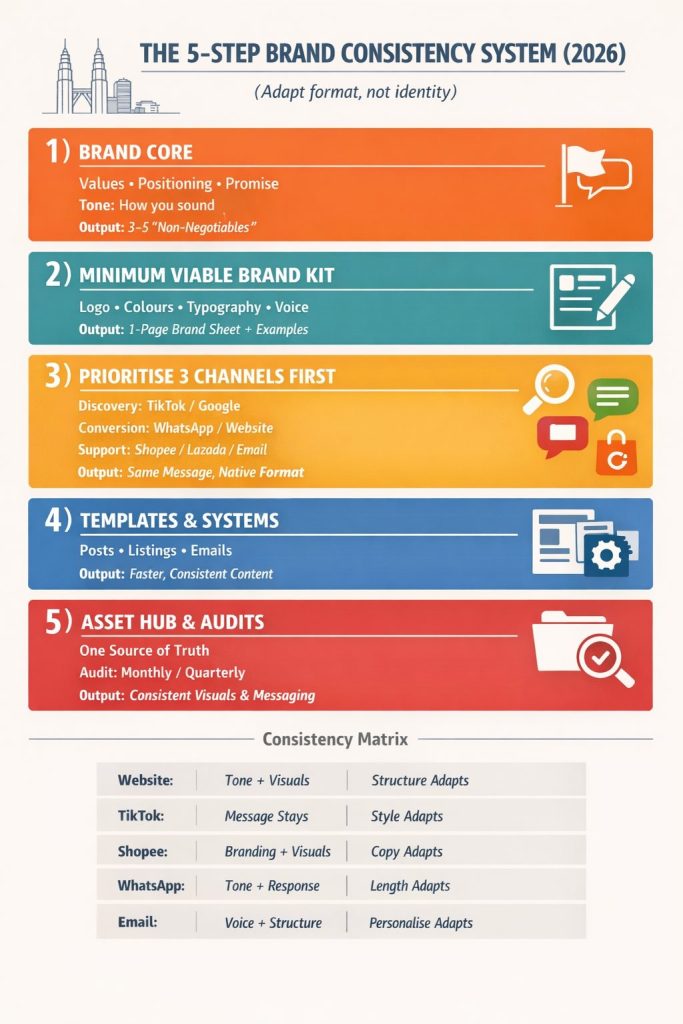
The infographic below is the overview: it shows the five moving parts that keep your identity stable while your formats change across TikTok, Shopee, WhatsApp, and your website. Use it as a checklist, then follow Steps 1–7 to implement it.
Step 1: Define Your Brand Core
This is the part most brands skip because it feels “fluffy”, but it’s the only way to stop random execution.
Lock down:
- Your one-sentence positioning (who you help + what you do + why you’re different)
- 3–5 brand values you actually act on (not generic ones)
- Your tone rules (e.g. direct, friendly, premium, playful, and what you avoid)
If two people write copy for your brand and it sounds like two different companies, your brand core isn’t clear enough.
Step 2: Build a Minimum Viable Brand Kit
You don’t need a big “brand bible.” You need a usable kit that prevents bad decisions.
Include:
- A simple logo usage page (what’s allowed / what’s not)
- Colour + typography rules (with real hex codes + font alternatives)
- A short voice guide with example lines (headline style, CTA style, do/don’t)
Keep it practical: if someone new joins your team, they should be able to create on-brand content within 30 minutes.
Step 3: Lock Your Primary Channels First
Most inconsistency happens because brands expand too fast.
Pick three channels and make them “tight” before adding more:
- Discovery (TikTok or Google)
- Conversion (WhatsApp or website)
- Support (Shopee/Lazada or email)
Then define what stays the same across all three:
- Your positioning line
- Your top 3 benefits
- Your brand vocabulary (words you always use vs never use)
This is how you scale without drifting.
Step 4: Create Templates and Systems
Templates aren’t a “nice-to-have.” They are what make consistency happen on busy weeks.
Create templates for:
- Content structures (hook → value → proof → CTA)
- Product listing formats (headline order, benefit order, image order)
- Customer replies (FAQ answers, delivery questions, warranty, pricing)
Templates should guide structure, not kill creativity. You can swap the examples, but keep the system.
Step 5: Centralise Assets and Access
If assets are spread across laptops, old folders, and random chats, your brand will drift.
Set up one source of truth:
- Latest logos and brand colours
- Product images and approved creatives
- Copy blocks (positioning line, short bio, top value props, FAQs)
Make it easy to use:
- Clear folder naming
- “FINAL” actually means final
- One person owns updates and version control
This is the difference between “we try to be consistent” and “we are consistent.” (Source: Templafy)
Step 6: Train Your Team Across Functions
Brand consistency breaks fastest outside marketing, usually in sales and customer support.
To keep it aligned:
- Give sales/support a tone guide in plain language (how we greet, how we explain price, how we handle complaints)
- Create approved response banks for common WhatsApp questions (delivery, warranty, pricing, stock, returns)
- Run quick role-play drills once a month: “premium response vs discount response” to keep positioning consistent
- Make sure teams know the top 3 brand promises and can repeat them naturally
Simple test: If someone screenshots your WhatsApp chat, does it feel like the same brand as your landing page?
Step 7: Run Regular Brand Audits
Consistency isn’t something you “set.” It’s something you maintain as content volume increases.
Use a lightweight audit that takes 30–60 minutes:
- Pick 10 real touchpoints (website page, TikTok posts, Shopee listing, WhatsApp chat, email)
- Check three things: message (what you’re known for), visuals (does it look like you), tone (does it sound like you)
- Track the same 5–7 checks every time (so you can see drift early)
- Log fixes in a shared sheet: what changed, who owns it, and by when
Run it monthly if you publish frequently, or quarterly if you publish less. (Source: Siteimprove)
Challenges Malaysian Brands Face (And How to Solve Them)
Multilingual Market Complexity
Malaysia is multilingual. Bahasa Malaysia is the national language, and many customers also use English, Chinese languages, and Tamil (among others). (Sources: Malaysia Government Portal; Malaysia Constitution Article 152)
Solution: Keep your core message consistent, but adapt phrasing carefully across languages. The goal is meaning and brand personality, not direct word-for-word translation.
Platform Fragmentation
Each platform behaves differently.
Solution: Use a consistency matrix instead of forcing uniform execution. Your TikTok can be casual and fast-paced while still sounding unmistakably like your brand.
Limited Resources
Many SMEs do not have dedicated branding teams.
Solution: Focus on templates and prioritisation, not perfection. A simple system executed weekly beats a complex playbook ignored for months.
Agency Misalignment
Different vendors often produce inconsistent outputs.
Solution: Enforce a single source of truth and clear guidelines. If agencies, freelancers, and internal staff all use different references, inconsistency becomes guaranteed.
Costs of Maintaining Brand Consistency
Consistency requires investment, but inconsistency costs more.
Direct Costs
- Brand development
- Content systems
- Tools and platforms
Hidden Costs of Inconsistency
- Lower conversion rates
- Confused brand positioning
- Reduced customer trust
Long-Term Gains
- Faster content production
- Higher marketing efficiency
- Better ROI over time
When to Adapt vs Stay Consistent
One of the biggest misconceptions is that consistency means rigidity.
Stay Consistent With
- Brand values
- Core messaging
- Visual identity
Adapt When Needed
- Platform behaviour differs
- Content format changes
- Campaigns require experimentation
A TikTok video can feel casual, while still being unmistakably your brand.
How Brand Consistency Impacts SEO and AI Visibility
Brand consistency is now part of how search engines and AI systems understand your business.
Why It Matters
AI-driven search features tend to reward content that is:
- Easy to scan
- Structured clearly
- Consistent in how it describes who you are and what you do (Source: Google Search Central – AI features and your website)
This doesn’t mean “gaming the algorithm.” It means making your identity obvious and repeatable.
Key Signals That Matter
- Consistent brand descriptions across key pages
- Repeated value propositions (without sounding robotic)
- Structured formatting (headings, FAQs, clear sections) (Source: Google Search Central – AI features and your website)
2026 Insight
AI features can surface a wider and more diverse set of supporting links than classic results, creating opportunities for more types of sites to appear, especially when content is relevant and helpful. (Source: Google Search Central – AI features and your website)
This creates an advantage for brands that prioritise consistency and clarity.
Read More: How Global Brands Can Localize Their Message in Malaysia (2026)
Real-World Example (Malaysia Context)
Scenario: eCommerce Brand Selling Across Multiple Platforms
Initial situation:
- Website positioned as premium
- Shopee focused heavily on discounts
- TikTok content inconsistent in tone
Result:
- Customers confused about positioning
- Reduced trust and lower conversion
Fix implemented:
- Unified brand positioning across all channels
- Adjusted tone per platform, not message
- Standardised visual identity
Outcome:
- Stronger recognition
- Improved conversion rates
- Better customer retention
Brand Consistency Is a System, Not a Design Choice
Brand consistency is no longer optional. It is a foundational system that determines how customers perceive, trust, and choose your business.
If your brand feels different depending on where customers encounter you, the issue is not creativity. It is lack of structure.
At PRESS PR Agency, your trustworthy Malaysian PR agency, we help businesses build structured brand and content systems that stay consistent across channels while adapting to modern search and AI environments. Through our SEO strategies, we ensure your brand is not only visible, but recognisable and trusted at scale. Work together with PRESS today, to get your business seen.
Disclaimer: This guide is for informational purposes only and reflects general best practices, not specific advice for your business. Results will vary depending on your industry, resources, and execution, so test, measure, and adapt the recommendations to your context.