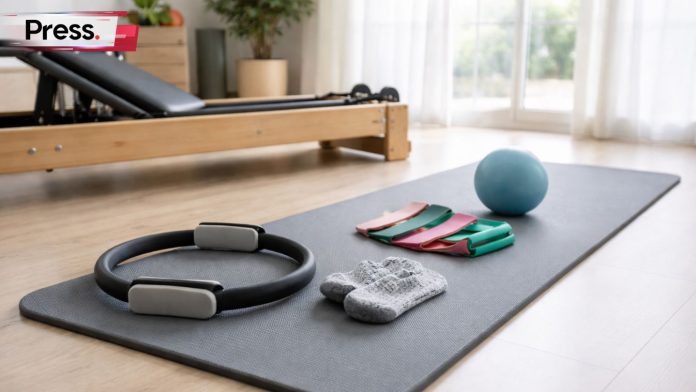
Pilates equipment refers to specialised tools such as mats, rings, reformers, chairs, and Cadillacs designed to improve core strength, posture, flexibility, and muscle control. Unlike traditional gym equipment, Pilates machines use spring-based resistance, making workouts lower-impact and suitable for beginners, rehabilitation, and long-term fitness training.
Quick Decision Guide: Which Pilates Equipment Fits Your Situation?
Equipment | Best For | Space Need | Budget Tier | Best First Buy? |
Mat | Beginners, home practice, basics | Very low | Low | Yes |
Ring | Mat users wanting more feedback | Very low | Low | After mat |
Resistance bands | General home fitness + Pilates support | Very low | Low | Yes, if variety matters |
Chair | Compact apparatus training | Moderate | Medium-high | Usually not first |
Reformer | Frequent users, guided apparatus work | High | High | Only if committed |
Cadillac / Barrel | Studio or advanced setups | High | High | No |
The simplest buying logic:
Start with a mat, then add compact tools, and only consider large apparatus when you clearly understand your goals.
This approach:
- Protects your budget
- Saves space in Malaysian homes
- Builds proper technique first
- Reduces risk of expensive mistakes
You may also compare Pilates vs yoga in Malaysia to decide which training style suits your goals before investing in equipment.
Read more on other Pilates equipment, such as:
These compact tools often provide 80% of foundational Pilates benefits without requiring large equipment.
What Is Pilates Equipment?
Pilates equipment ranges from simple 15mm-thick mats and resistance rings to complex spring-loaded apparatus like the Reformer and Cadillac. These tools were originally developed by Joseph Pilates in the 1920s to help injured patients regain mobility and strength safely.
Today, Pilates equipment is widely used across Malaysia in:
- Boutique Pilates studios
- Physiotherapy centres
- Home fitness setups
- Rehabilitation programs
- Athlete conditioning training
If you have attended a Reformer Pilates class in Malaysia, you will likely notice that studios look very different from traditional gyms. Instead of heavy dumbbells and treadmills, you see wooden frames, straps, springs, and sliding platforms designed to support controlled, low-impact movement.
“Pilates is not defined by the equipment you own, but by the quality of movement you practise.”
Why Pilates Equipment Is Different From Gym Equipment
Traditional gym machines rely on gravity and fixed weight resistance.
For example:
- A 10kg dumbbell weighs 10kg throughout the movement
- Resistance remains constant
- Movements rely mainly on brute force
Pilates equipment works differently.
Heavy Pilates apparatus use variable spring tension.
This means:
- Resistance increases as springs stretch
- Muscles work during movement and return
- More control is required
- Less joint stress occurs
This is known as eccentric muscle contraction, which helps create:
- Leaner muscle tone
- Better joint stability
- Improved posture
- Reduced injury risk
This is also why Pilates is widely recommended for rehabilitation, posture correction, and aging populations.
Because the resistance is smoother and low-impact, Pilates equipment is suitable for:
- Office workers
- Beginners
- Seniors
- Post-injury recovery
- Prenatal and postnatal exercise
Small Pilates Equipment: Budget-Friendly Home Essentials
You do not need a large machine to benefit from Pilates. In fact, Mat Pilates is often harder because you rely entirely on your body weight.
This makes compact accessories ideal for Malaysian homes, especially condos and apartments.
1. Pilates Mat
The Pilates mat is the most important beginner tool.
Unlike yoga mats, Pilates mats are:
- Thicker
- Denser
- Designed for rolling exercises
Recommended thickness:
10mm to 15mm
This protects:
- Spine
- Hips
- Shoulders
Especially important on hard Malaysian tile flooring.
Estimated Cost
RM50 — RM150
Best for:
- Beginners
- Home workouts
- Small space living
If you’re unsure which mat to buy, refer to the Pilates mat buying guide for Malaysian homes which compares thickness, materials, and pricing.
2. Pilates Ring (Magic Circle)
The Pilates ring is one of the best beginner accessories.
It is:
- Lightweight
- Compact
- Affordable
It provides light resistance and muscle activation.
Helps target:
- Inner thighs
- Chest
- Arms
- Core
- Pelvic floor
The ring also improves proprioception — awareness of muscle engagement.
Estimated Cost
RM25 — RM120
Best for:
- Beginners
- Home users
- Small space workouts
You may also read:
- Reformer Pilates Malaysia Guide
- Pilates Class Malaysia
- Cadillac Pilates Malaysia
For a detailed breakdown, refer to the Pilates ring Malaysia guide for beginners which explains exercises and benefits.
3. Pilates Grip Socks
Grip socks are commonly required in Pilates studios in Malaysia.
Benefits:
- Hygiene
- Better traction
- Reduced slipping
- Increased stability
Useful for:
- Reformer classes
- Chair Pilates
- Mat workouts
Estimated Cost
RM15 — RM60 per pair
If you’re attending studio sessions, consider reading the Pilates grip socks guide in Malaysia to understand materials and features.
4. Pilates Ball (Mini Stability Ball)
The Pilates ball is a small inflatable ball used for support.
Uses include:
- Back support
- Core engagement
- Hip alignment
- Stability training
Very beginner-friendly and easy to store.
Estimated Cost
RM10 — RM30
You can read the Pilates ball buying guide in Malaysia to understand sizing and usage.
Heavy Pilates Equipment: Studio-Level Machines
If you attend a Pilates studio in Malaysia, you will encounter large apparatus designed to provide both:
- Resistance
- Assistance
These machines are typically more expensive and space-intensive.
1. Pilates Reformer
The Reformer is the most popular Pilates machine.
It features:
- Sliding carriage
- Springs
- Footbar
- Ropes
- Shoulder rests
Exercises can be done:
- Lying down
- Sitting
- Kneeling
- Standing
Benefits:
- Full-body workout
- Core stability
- Strength training
- Flexibility
Estimated Cost
Home reformer: RM2,500 — RM5,000
Studio-grade reformer: RM10,000 — RM15,000+
Best for:
- Regular Pilates practitioners
- Home studio users
- Fitness enthusiasts
If you are considering using a reformer, you may want to read the Reformer Pilates guide in Malaysia to understand how classes work.
2. Cadillac (Trapeze Table)
The Cadillac is a stationary frame with multiple spring attachments.
It includes:
- Arm springs
- Leg springs
- Hanging straps
- Push-through bar
Originally designed for:
- Rehabilitation
- Injured patients
- Elderly users
Best for:
- Physiotherapy
- Rehabilitation
- Mobility training
3. Wunda Chair
The Wunda Chair is compact but challenging.
Features:
- Spring-loaded pedal
- Small base
- Stability training
Benefits:
- Balance training
- Athletic conditioning
- Core strength
Best for:
- Advanced users
- Athletes
- Sports conditioning
You can also explore the Wunda Chair Pilates guide in Malaysia for more advanced training concepts.
4. Spine Corrector (Barrel)
The Spine Corrector helps improve posture.
Designed for:
- Chest opening
- Shoulder mobility
- Hip flexibility
Especially useful for:
- Desk workers
- Tech neck
- Poor posture
Building A Home Pilates Studio In Malaysia
Choosing Pilates equipment depends on:
- Budget
- Space
- Experience level
Home Setup Comparison Table
Setup Tier | Equipment | Cost | Space | Best For |
Budget Setup | Mat + Ring + Overball | RM100–RM250 | 20 sqft | Beginners |
Mid-Tier | Foldable Reformer + Props | RM2,500–RM5,000 | 25 sqft | Regular users |
Premium Studio | Studio Reformer + Chair | RM15,000+ | 100 sqft | Instructors |
Important:
Studio reformers weigh 80kg or more Professional delivery is recommended.
Should You Rent, Buy New, Or Buy Used?
For reformers, renting is often the best bridge between curiosity and commitment. It reduces the risk of overspending before you know whether home apparatus training fits your routine. Malaysian rent-vs-buy content highlights three recurring rental advantages: lower upfront cost, flexibility, and maintenance handled by the rental provider.
Option | Upfront Cost | Main Advantage | Main Risk | Best For |
Rent | Low-medium monthly | Test home use first | Long-term cost adds up | Curious but unsure users |
Buy new | High | Warranty, condition, longevity | Big upfront spend | Committed users or studios |
Buy used | Medium | Lower purchase price | Hidden wear, scams, repairs | Confident buyers who can inspect well |
Buying new suits long-term users. The same Malaysia-based comparison says buying suits frequent users better over time, especially if you already know you enjoy reformer work.
Buying used can be worthwhile, but only with a strict checklist. Real user discussion on Reddit shows how frustrating reformer buying can become when condition, parts, delivery, or seller reliability are unclear. That forum signal matters because it reflects the exact kind of post-purchase regret polished vendor pages rarely discuss.
Check these points before buying used:
- carriage glide should feel smooth
- springs should not feel uneven or noisy
- upholstery should not be badly cracked
- frame stability matters more than cosmetic scratches
- spare parts and servicing should be realistically available
- seller history, delivery terms, and payment safety should be clear
Common Mistakes When Buying Pilates Equipment
 Buying Cheap Bungee Reformers
Cheap machines use elastic cords instead of springs.
Problems:
- Uneven resistance
- Poor durability
- Reduced workout quality
Using Heavy Ankle Weights
Pilates is designed for controlled movement.
Heavy ankle weights may:
- Strain joints
- Cause injury
- Reduce effectiveness
 Test Before Buying
Before spending RM15,000:
- Try studio classes
- Hire instructor
- Test equipment
Maximising Your Pilates Equipment Investment
Start small:
- Begin with mat
- Add small props
- Try studio classes
- Upgrade gradually
This ensures:
- Better technique
- Lower risk
- Smarter investment
Pilates equipment is powerful — but only when used correctly.
A reformer does not replace technique. Control, breathing, and alignment remain the foundation.
Final Thoughts: Choosing Pilates Equipment That Actually Fits Your Lifestyle
Pilates equipment can look impressive, but the best setup is not always the biggest or most expensive. For most people in Malaysia, starting with a mat and small accessories is enough to build strength, improve posture, and develop proper technique.
Larger equipment like the reformer, chair, or Cadillac becomes more useful only when you practise regularly and understand your goals. Jumping straight into expensive machines often leads to unused equipment, especially in smaller Malaysian homes.
Start small, build consistency, and upgrade gradually. Ultimately, Pilates is about control, alignment, and movement quality — equipment should support your progress, not complicate it.
For more info, follow PR agency Malaysia.
Disclaimer: All of the content was thoroughly fact-checked and verified by our editorial team to ensure accuracy, clarity, and reliability.
Legal Disclaimer: All brand names, trademarks, and logos displayed on this website are the intellectual property of their respective owners. Their use herein is solely for identification purposes without written consent or direct affiliation from the respective owner.