

If you are a Malaysian business thinking about overseas growth, one of the biggest SEO questions is whether to strengthen visibility across Malaysia first or move straight into international SEO.
Both fall under the SEO services umbrella, but they solve different growth problems. National SEO focuses on one country market, while international SEO targets users across multiple countries and/or language-region variants. For Malaysian businesses, that distinction matters because the local market is already highly digital, and many brands can still grow nationwide before taking on the added complexity of international SEO. (Source: Google Search Central; DataReportal; DOSM)
Quick Comparison Table
Area | National SEO (Malaysia) | International SEO |
Main Goal | Rank across Malaysia | Rank in multiple countries or regions |
Main Audience | Malaysian searchers nationwide | Overseas searchers by country or language |
Language Scope | Often BM, English, sometimes other locally relevant languages | Multiple language-country combinations |
Keyword Research | Malaysia-wide and city/state intent | Country-specific and language-specific intent |
Content Approach | Malaysia-relevant content and landing pages | Localised content for each target market |
Technical Complexity | Moderate | High |
Google Business Profile | Often useful | Limited unless tied to local entities in each market |
Time And Cost | More manageable | More resource-heavy |
Best For | National service brands, local SaaS, eCommerce, B2B firms | Exporters, global eCommerce, regional SaaS, multinational brands |
Biggest Risk | Staying too domestic for too long | Poor localisation and technical errors |
(Source: Google Search Central; Google Business Profile Help)
What Is National SEO In A Malaysian Context?
National SEO is about improving visibility across Malaysia, not just one city or neighbourhood.
It suits businesses that can serve customers nationwide through shipping, remote delivery, multi-state services, or a broader national presence. Instead of relying mainly on map-based visibility, national SEO targets wider commercial searches such as “seo malaysia” or “payroll software malaysia.” (Source: Google Business Profile Help)
Typical signs you are doing national SEO include:
- Targeting Malaysia-wide keywords.
- Publishing content for nationwide search intent.
- Building service or product pages for broader domestic demand.
- Supporting English and BM content where relevant.
- Expanding beyond one state or metro area.
What Is International SEO, Really?
International SEO helps search engines show the right version of your site to the right audience in the right market.
It goes far beyond translating your existing pages. A proper international SEO setup usually includes market-specific localisation, separate URLs or page versions, hreflang where appropriate, and clear country or language targeting. (Source: Google Search Central)
International SEO usually involves:
- Separate page versions for different markets.
- Localised messaging, not just translated text.
- Different keyword research by country and language.
- Technical signals that help search engines understand language or regional targeting.
- Stronger quality control across multiple audiences.
Why Malaysian Businesses Often Start With National SEO First
National SEO is usually the easier and smarter first step for brands still building domestic scale.
Malaysia already has very high internet usage, so the domestic market is digitally mature enough to justify serious nationwide SEO work before overseas expansion. Before moving into international SEO, many brands still need to test what messaging works, which pages convert, and whether their internal systems can support broader demand. (Source: DataReportal; DOSM; SME Corp Malaysia)
National SEO often helps businesses:
- Build stronger authority at home.
- Learn which offers and landing pages convert.
- Improve content and reporting systems.
- Expand from one city into nationwide lead generation.
- Reduce the risk of spreading resources too thin.
National SEO Vs International SEO: The Core Differences
Geographic Reach
National SEO targets one country market: Malaysia. International SEO targets multiple countries or country-language combinations. (Source: Google Search Central)
Search Intent Complexity
National SEO still operates within one broad market context. International SEO has to account for different buying behaviours, search phrasing, and SERP expectations in each target market. (Source: Google Search Central)
Content Model
National SEO can often grow from one strong content ecosystem tailored to Malaysian users. International SEO usually needs separate market-aware landing pages, examples, and trust signals. (Source: Google Search Central)
Technical Requirements
National SEO needs strong site structure, internal linking, and content depth. International SEO adds hreflang, separate URLs, localisation rules, and more technical QA. (Source: Google Search Central)
Cost And Resource Load
National SEO is often more manageable for SMEs. International SEO usually requires more budget, more planning, and more coordination across content and technical teams. (Source: SME Corp Malaysia; MATRADE)
How Keyword Strategy Changes
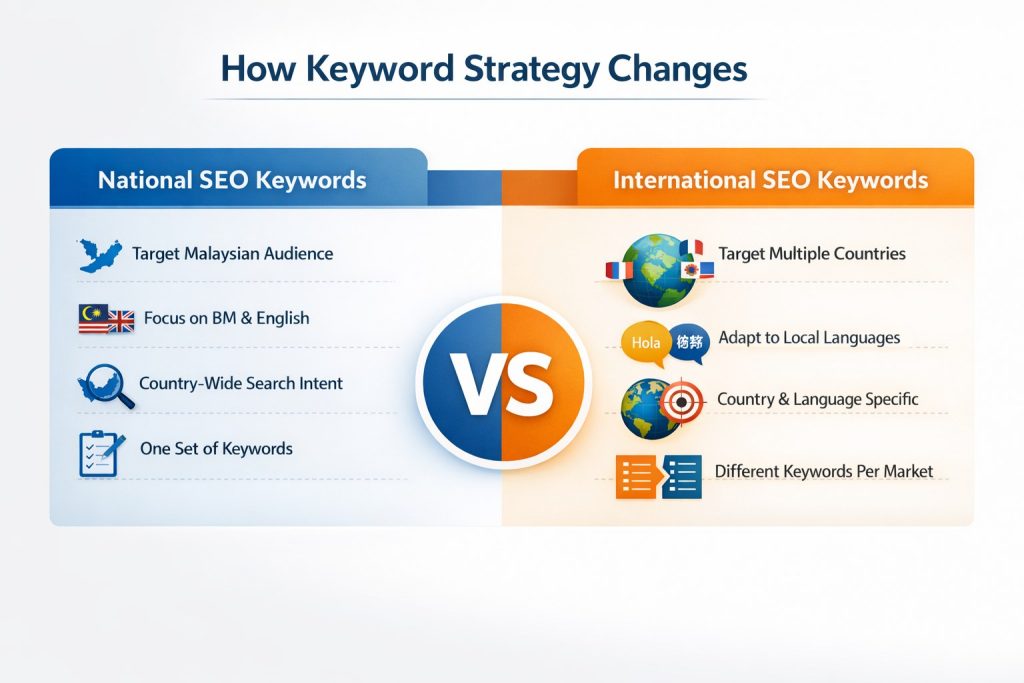
This is where many businesses realise the two models are not interchangeable.
For national SEO, keyword research usually focuses on Malaysia-wide demand, plus selected city or state modifiers when they reflect real search behaviour.
For international SEO, keyword research has to be split by country and often by language. Even if two markets use English, the commercial phrasing, buying language, and search expectations may still differ. (Source: Google Search Central)
A useful way to compare them:
- National SEO keywords often target one country context.
- International SEO keywords must match each market’s language and search behaviour.
- Direct translation is rarely enough for international growth.
- Search intent can shift even when the product stays the same.
How Content Strategy Should Differ
National SEO is usually about depth within one market. International SEO is about fit across many markets.
For national SEO, a Malaysian business can build a strong domestic content ecosystem using local SEO and examples, pricing realities, and familiar business context.
For international SEO, that same content usually needs heavier adaptation. Testimonials, case studies, calls to action, and examples may all need to change by market. (Source: Google Search Central; MATRADE)
A simple comparison:
National SEO Content
- Malaysia-focused pillar pages.
- BM and English support where relevant.
- Domestic examples and use cases.
- Industry content tailored to local buyers.
International SEO Content
- Separate market-aware landing pages.
- Country-specific proof points.
- Localised tone and examples.
- Market-by-market content planning.
The Technical SEO Gap Most Businesses Underestimate
International SEO gets harder quickly when technical foundations are weak.
Google recommends separate URLs for language or regional versions and advises careful implementation of hreflang where appropriate. It also warns that locale-adaptive content can create crawling and indexing problems if the setup is unclear. (Source: Google Search Central)
This is why international SEO often requires stronger governance around:
- URL structure.
- Hreflang.
- Canonicals.
- Content duplication control.
- Page version management.
National SEO still needs technical SEO, of course, but the setup is usually less complex and easier to maintain.
Where Google Business Profile Fits, And Where It Does Not
Google Business Profile can support national SEO, but it is not the centre of international SEO.
For national SEO, GBP remains useful for multi-location brands, service-area businesses, showrooms, clinics, and branch-based companies. Google says local results are mainly based on relevance, distance, and prominence-related signals, which is why profiles, reviews, and local presence still matter. (Source: Google Business Profile Help)
For international SEO, GBP may support local entities in a given country, but it does not replace localised site content, international targeting, or technical setup.
Why Malaysia’s Multilingual Context Matters
Multilingual SEO inside Malaysia is not the same as international SEO.
Because Malaysia serves multiple language audiences, some businesses choose to publish in more than one language, but that is still mainly a domestic strategy unless the business is actively targeting other countries. (Source: DOSM; Google Search Central)
This matters because some brands overestimate their global readiness. Managing multiple languages in one country can be useful preparation, but international SEO also requires:
- Country-specific search intent.
- Different trust signals.
- Localised landing pages.
- Market prioritisation.
- Stronger technical structure.
When National SEO Is The Better Choice
National SEO is usually the better move when your business is still building domestic scale, authority, or systems.
You will often benefit more from national SEO first if:
- Your brand is still concentrated in one city or region.
- You want to expand visibility across Malaysia first.
- Your operations are not yet ready for overseas demand.
- You still need stronger proof of what converts.
- Your domestic search visibility is still uneven. (Source: SME Corp Malaysia; DataReportal)
When International SEO Starts Making Sense
International SEO becomes more worthwhile when the business is already seeing real signs of cross-border demand and can support that growth properly.
That usually includes:
- Clear overseas enquiries or distributor interest.
- A shortlist of priority markets.
- A product or service that can be localised properly.
- Analytics showing qualified traffic from specific countries.
- A team and site structure that can handle multiple markets. (Source: MATRADE; Google Search Central)
Which Businesses Usually Benefit From Each Model?
Businesses That Usually Benefit From National SEO First
- Service providers expanding from one city to nationwide leads.
- Malaysia-focused SaaS brands.
- Domestic eCommerce businesses.
- B2B companies serving national buyers.
- Agencies building authority around terms like “seo malaysia.”
Businesses That Often Have A Stronger Case For International SEO
- Export-ready manufacturers.
- Cross-border eCommerce brands.
- Regional SaaS companies.
- Education, tourism, or specialist services targeting foreign audiences.
- Businesses already seeing traction in one or two overseas markets.
Businesses That May Need A Hybrid Approach
Some businesses need strong domestic visibility and selected international landing pages at the same time. In these cases, the real challenge is phasing both without weakening execution. (Source: MATRADE; SME Corp Malaysia)
Common Mistakes Businesses Make
A lot of SEO budget gets wasted when businesses treat these two models as more similar than they really are.
Common mistakes include:
- Treating national SEO as “small-scale SEO.”
- Treating international SEO as a translation project.
- Expanding into too many countries at once.
- Using one generic page for very different markets.
- Ignoring technical setup until late.
- Assuming multilingual Malaysia automatically prepares a brand for global SEO.
- Chasing overseas visibility before operations are ready. (Source: Google Search Central; MATRADE)
How Malaysian Businesses Should Decide
A simple way to make the decision is to ask three practical questions:
Are We Already Visible Across Malaysia?
If not, national SEO may still offer the better return.
Do We Already See Real Demand From Specific Overseas Markets?
If yes, that is a strong signal for phased international SEO.
Can We Localise Pages, Offers, And Trust Signals Properly?
If not, global expansion may be premature from an SEO point of view.
For many brands, the best answer is not “pick one forever.” It is “sequence them properly.” Build stronger national visibility first, then expand into international SEO when priorities and readiness are clearer.
Choosing the Right Kind of SEO
National SEO and international SEO may both fall under SEO, but they support very different stages of business growth. For many Malaysian businesses, the smarter path is to build stronger nationwide visibility first, then expand into international SEO once the business has clearer market priorities, stronger conversion signals, and the operational readiness to support global growth.
If your brand is deciding whether to scale across Malaysia first or prepare for international search growth, PRESS PR Agency, Malaysia’s best PR agency, can help you choose the path that fits your stage and goals. Our SEO services help Malaysian businesses build stronger visibility at home, then expand into the right overseas markets with a more structured strategy.