

Affiliate marketing has moved well beyond “paste a link and earn money.” In 2026, the affiliate space in Malaysia is more content-driven and more competitive, with stronger emphasis on credibility, creator-led commerce, and visibility across both search and social platforms.
At its core, affiliate marketing allows individuals or businesses to earn commissions by recommending products, services, or platforms online. Instead of creating inventory or managing fulfilment, affiliates focus on producing helpful content, generating traffic, and influencing buying decisions.
The appeal is straightforward: a student using TikTok, a blogger publishing comparisons, or a YouTuber reviewing gadgets can all start. But affiliate marketing is rarely instant passive income. It typically requires time, consistency, platform knowledge, and content that genuinely helps people make decisions.
Read More: Starting a New Business in Malaysia: What to Know
What Is Affiliate Marketing?
Affiliate marketing is a performance-based marketing model where a publisher promotes another company’s product or service using a unique tracking link.
When a user clicks that link and completes a valid action (such as a purchase or a sign-up) the affiliate may receive a commission. In most cases, affiliates do not handle inventory, shipping, customer support, or fulfilment.
How the affiliate process works (typical flow)
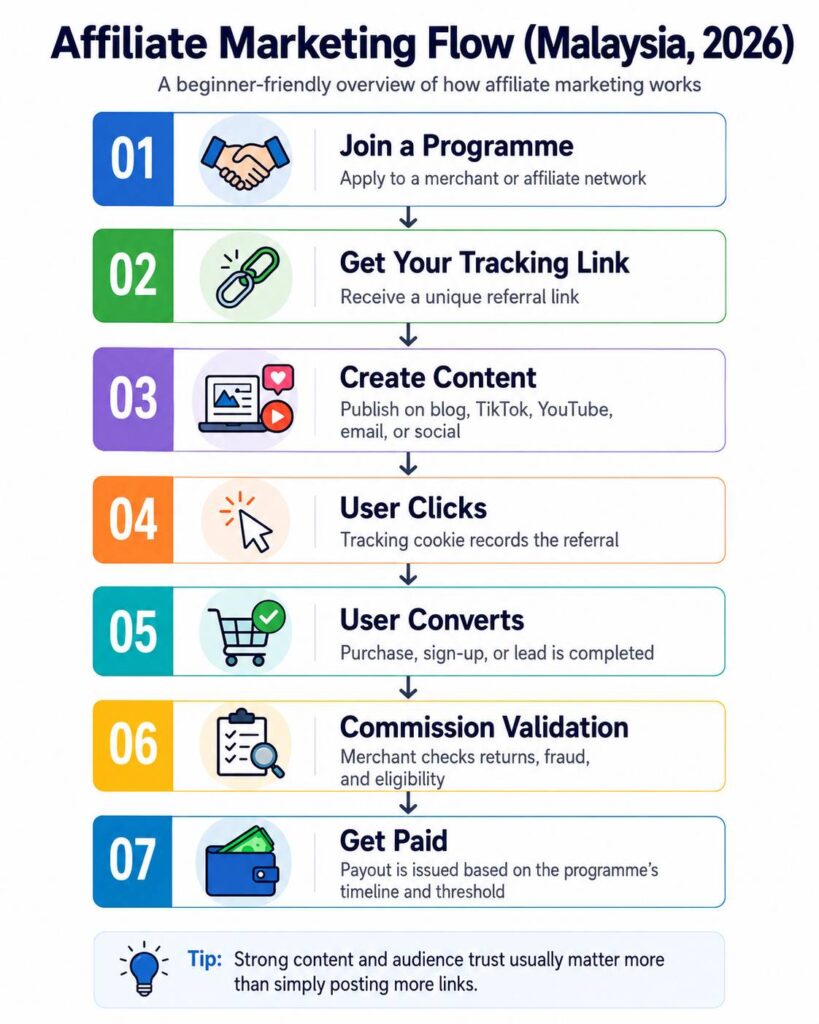
In Malaysia, affiliate marketing often overlaps with marketplace affiliate programmes, creator-led short videos, product comparison blogs, coupon/deal communities, and SaaS referral programmes.
Why Affiliate Marketing Is Growing in Malaysia
Malaysia’s digital economy continues to expand, and a larger share of consumer activity happens online. That matters because affiliate marketing depends on online discovery and buying behaviour.
DOSM’s Malaysia Digital Economy releases report e-commerce income/revenue by establishment, including year-on-year changes and annual totals. For example, DOSM reported 1.3% year-on-year growth in 3Q2025, and noted that 2024 e-commerce revenue was RM1,230.1 billion (up 3.9% vs 2023).
This doesn’t automatically mean every affiliate will earn more, but it supports the broader idea that online commerce remains a meaningful channel.
| Growth driver | Why it matters for affiliates |
|---|---|
| Social commerce | Short-form video, livestreams, and creator-led content speed up product discovery and impulse-friendly purchases. |
| Mobile-first behaviour | Many Malaysians research and buy on mobile, so fast, scannable content and clear CTAs matter more. |
| Marketplace habits | Shoppers often compare vouchers, reviews, and seller ratings—good comparison content fits this behaviour well. |
| Search + AI features | Helpful, experience-based content is more likely to be surfaced than thin promotional pages. |
| Low barriers to entry | You can start without inventory, warehousing, or fulfilment, and scale mainly through content and distribution. |
Who Should Consider Affiliate Marketing?
Affiliate marketing can work for many people, but some beginners tend to find it easier because they already have a distribution channel or a content skill.
Profiles that often fit well
- Students: flexible schedule + willingness to learn content skills
- Bloggers / writers: SEO-driven content can compound over time
- TikTok creators: strong discovery potential for demo-friendly products
- YouTubers: tutorials and reviews can convert well when done credibly
- Small business owners: can monetise informational content relevant to customers
- Community owners (FB groups / Telegram): existing trust can support conversions
- Freelancers: additional income stream alongside service work
Many successful beginners aren’t aggressive promoters. They usually win by explaining products clearly, comparing options fairly, and building trust over time.
When Is the Right Time to Start?
A practical time to start is before your chosen niche becomes crowded, and while you can still publish helpful content gaps.
In Malaysia, affiliate traffic often increases around major sale periods and seasonal events, especially for price-sensitive categories.
Common seasonal peaks include 11.11 / 12.12, Hari Raya, Chinese New Year, back-to-school, and travel seasons. Still, waiting for the “perfect campaign period” usually slows progress. SEO content and audience trust take time, so starting earlier is often more effective.
Where Can Malaysians Promote Affiliate Products?
A common beginner mistake is assuming affiliate marketing only works through blogs. Blogs are strong for long-term search traffic, but social platforms can be faster for discovery, especially in product categories that benefit from demos.
Platforms and what they’re good for
- Blog (SEO): reviews, comparisons, buying guides (medium difficulty; slower start, longer runway)
- TikTok: demos, short reviews, “how it looks” content (low–medium; depends on consistency)
- YouTube: tutorials, deep reviews, testing (medium; higher effort, strong trust potential)
- Instagram: lifestyle recommendations, story-based product sharing (medium)
- Email newsletter: deal curation and retention (medium; best when you already have an audience)
- Facebook groups: community recommendations (medium; requires trust/moderation)
- Telegram channels: flash deals and promos (low; risk of low-quality traffic if spammy)
No platform is permanently stable. Algorithms change and programme rules update. Over time, it’s safer to diversify rather than rely on one source of traffic.
How to Start Affiliate Marketing in Malaysia
1) Choose a niche first
Beginners often struggle when they promote random products across unrelated categories. A niche helps with audience targeting, content relevance, SEO authority, and conversion consistency.
Examples of niches that can work (if you can produce credible content):
- Beauty & skincare (repeat purchase potential)
- Gadgets (high search interest; higher competition)
- Web hosting / SaaS (often higher commissions; needs trust)
- Travel (offer-dependent; seasonal)
- Parenting (comparison-heavy)
- Fitness (social-driven)
- Education (tools, courses, apps)
Read More: Is Tertiary Education in Malaysia Worth It in 2025?
When choosing a niche, don’t pick based on commission rate alone. Consider your ability to create content consistently, whether you can add real value (testing, comparisons, local context), the competition level, and “evergreen” potential (search demand beyond campaigns).
2) Join affiliate programmes or networks
Affiliates can join merchant programmes directly or use networks that aggregate brands.
Common options Malaysians explore:
- Involve Asia (multi-brand access)
- Shopee Affiliate
- Lazada Affiliate
- Exabytes Affiliate (hosting-related)
- impact.com (partnership management platform)
- Amazon Associates (for global audiences; availability and eligibility vary)
Before joining, check details that matter in practice:
- Commission structure: rate, category differences, caps, bonuses
- Cookie duration: how long attribution lasts after a click
- Validation window: commissions can stay pending until return/refund windows pass
- Payout rules: schedule, minimum thresholds, required payment method
- Promotional restrictions: where and how you’re allowed to share links
- Geography/eligibility: some offers require Malaysia traffic or specific user actions
3) Create helpful content instead of spamming links
Affiliate marketing tends to work best when your content genuinely helps someone decide.
| Content type | Example angle/title |
|---|---|
| Product review | “Is This Laptop Worth Buying in Malaysia?” |
| Comparison article | “Brand A vs Brand B: Which One Should You Pick?” |
| Buying guide | “Best Budget Smartphones Under RM1000” |
| Tutorial | “How To Set Up WordPress Hosting (Step-by-Step)” |
| Deal roundup | “Best 11.11 Tech Deals Worth Checking” |
| Experience-based review | Real usage notes, what surprised you, who it’s best for (and who should skip) |
E-E-A-T is a useful quality framework, but Google has stated E-E-A-T is not a specific ranking factor. In practice, content that demonstrates real experience and reliability is still more likely to perform well than thin promotional pages, especially for topics that affect money, health, or safety.
Weak vs strong affiliate content (practical differences):
- Copies merchant descriptions → Adds real observations, context, and comparisons
- Generic praise → Balanced pros/cons and who it’s not for
- No local pricing context → Malaysia-specific pricing ranges and availability notes
- Thin structure → Clear sections, decision criteria, FAQs
- No visuals → Screenshots, photos, demos, proof of use where possible
4) Learn basic SEO for affiliate marketing
SEO remains a strong long-term channel because rankings can continue sending clicks long after you publish if your content stays useful and updated.
SEO areas worth learning early:
- Keyword research (what people actually search)
- Search intent (what the searcher expects to see)
- Internal linking (site structure and topical coverage)
- On-page SEO (titles, headings, clarity, schema where appropriate)
- Technical basics (crawlability, speed, mobile)
- Credibility signals (author info, disclaimers, original experience)
Malaysia-specific gaps that can still work:
- Bahasa Melayu comparisons and buying guides
- Local pricing and availability context (RM ranges, local brands)
- SME-focused software explainers
- “Best for Malaysians” guides that are actually localised (not generic)
SEO growth is rarely immediate. New sites often take months to see meaningful search visibility, but consistent publishing and updating can compound.
How Much Does Affiliate Marketing Cost?
Affiliate marketing can be low-cost compared to inventory-based businesses, but it’s not always “free” if you want to do it seriously.
Typical costs (rough range estimate)
Domain name: commonly around RM45–RM120+/year, depending on extension and promotions
Web hosting (shared): entry plans can start around ~RM143/year, and many plans run a few hundred RM/year depending on features and term length
Tools (optional): SEO tools, editing tools (e.g., Canva), email platform, analytics tools
Paid ads (optional): can scale faster, but risky without tracking and conversion knowledge
You can start with TikTok, Instagram, Facebook, free blogging platforms, or YouTube Shorts, then later move into “owned platforms” like a website and email list for stability.
For complete beginners, paid ads often cause losses when tracking or targeting is weak. It’s usually safer to learn organic content + conversion basics first.
Common Challenges Beginners Face
Getting traffic takes time
Affiliate commissions rarely appear immediately. SEO can take months to build. Social traffic can fluctuate heavily.
High competition
Popular niches (gadgets, hosting, beauty, finance) often have entrenched players. Beginners often do better by narrowing down.
Broad niche → narrower angle examples:
- Smartphones → budget gaming phones
- Fitness → home workout tools
- Beauty → sensitive skin routines
- Travel → budget family travel
- Hosting → SME website hosting for local service businesses
Rejected commissions
Not every conversion gets approved. Common reasons include:
- Refunds/returns
- Cookie expiration
- Duplicate referrals
- Invalid traffic
- Violating promotional rules
Burnout from content creation
Chasing trends without a system can be exhausting. A smaller amount of high-quality content often outperforms frequent low-quality posts over time, especially for SEO.
How to Track Affiliate Performance Properly
Tracking is often the difference between casual posting and sustainable growth.
Metrics to watch include:
- Clicks (interest)
- Conversion rate (how well traffic converts)
- Earnings per click (profitability)
- Approved commissions (real earnings)
- Rejected commissions (quality issues or rule problems)
- Traffic sources (where buyers come from)
- Top pages/videos (what’s working)
More traffic doesn’t always mean more money. Smaller audiences with high intent can outperform larger low-intent views.
Realistic Expectations for Beginners
Affiliate marketing can generate income, but outcomes vary based on niche, traffic, content quality, trust, and offer fit.
What stages often look like
- First few months: learning tools, content practice, testing platforms
- Early growth: occasional commissions, clearer data on what converts
- Consistency phase: more stable traffic as content library grows
- Authority phase: better conversions and higher trust; more repeat visitors
- Advanced phase: multiple traffic sources and potentially recurring commissions (where offers allow)
Example:
One beginner posts random affiliate links daily with no niche focus. Another builds a niche around budget tech for Malaysian students, publishes comparisons, creates short demos, and improves SEO gradually. The second may grow slower at first but is more likely to build durable traffic and consistent conversions.
Learning the Basics
Affiliate marketing in Malaysia remains an approachable digital model for beginners, but sustainable results usually come from fundamentals: useful content, credibility, niche focus, and consistent traffic-building. As competition increases and search continues evolving (including AI-driven experiences), affiliates who invest in real value and long-term visibility are more likely to see stable outcomes than those chasing shortcuts.
If you’re a business, creator, or publisher trying to improve long-term search presence, working with an experienced PR agency like PRESS PR Agency can also help strengthen content strategy, digital PR, and topical authority. Don’t miss this chance, contact PRESS today!
Sources
- Department of Statistics Malaysia (DOSM) — Malaysia Digital Economy 2025 (release page)
- Department of Statistics Malaysia (DOSM) — Malaysia Digital Economy 2024 (release page)
- DataReportal — Digital 2025: Malaysia
- DataReportal — Digital 2026: Malaysia
- Google Search Central — “Creating helpful, reliable, people-first content”
- Exabytes Malaysia — Domain pricing page (domain name search)
- Shinjiru Malaysia — “A Beginner’s Guide to Web Hosting in Malaysia” (plus hosting pricing references)
Frequently Asked Questions About Affiliate Marketing for Beginners in Malaysia
Is Affiliate Marketing Legal in Malaysia?
Yes, affiliate marketing is generally legal. However, affiliates should avoid misleading or deceptive claims, fake testimonials, and spam tactics, and should follow programme rules and applicable consumer protection principles (especially in finance/health topics).
Can Beginners Start Affiliate Marketing Without a Website?
Yes. Many beginners start on TikTok, Instagram, YouTube, Facebook, or Telegram. A website can improve long-term stability and SEO control, but it’s not required on day one.
How Much Money Can Beginners Earn From Affiliate Marketing?
Income varies widely. Some beginners earn little at first while learning. More established affiliates with strong SEO or social audiences can earn consistent commissions, depending on niche demand, traffic quality, and conversion rates.
Which Affiliate Programme Is Best for Malaysians?
There isn’t one best programme for everyone. Networks like Involve Asia are popular for access to multiple brands, while Shopee and Lazada are common for product-focused content. The best choice depends on your niche and audience.
Is SEO Important for Affiliate Marketing?
Often, yes. SEO can drive sustained traffic over time. For many affiliates, it becomes a stable channel once content ranks, particularly for comparisons and buying guides.
What’s the Most Common Beginner Mistake?
Prioritising affiliate links over usefulness. If your content doesn’t help someone decide, it’s harder to build traffic, trust, and consistent conversions.