

For Malaysian job seekers, software engineering may offer more routes towards the RM10,000 monthly salary mark, but current salary data cannot tell us definitively which profession gets there faster in years.
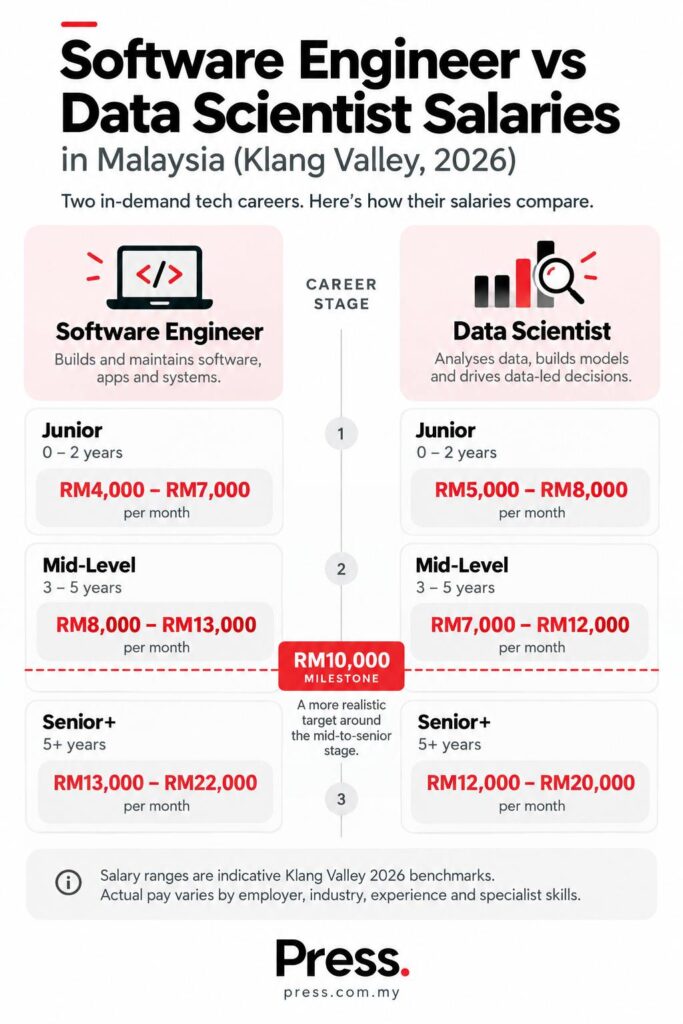
Current Klang Valley salary benchmarks put mid-level software engineers at around RM8,000 to RM13,000 per month, while mid-level data scientists sit around RM7,000 to RM12,000.
That means RM10,000 is realistically within reach for both once you move beyond junior-level pay.
The biggest difference is the breadth of the market. Software engineering has pathways into backend engineering, cloud, DevOps, platform engineering, technical leadership, architecture and other specialist positions.
Data science has fewer roles overall, but specialists working with machine learning, predictive modelling and AI can command strong salaries.
So if your question is, “Which gives me more pathways towards RM10K?”, software engineering has an advantage.
If your question is, “Which can offer particularly high specialist salaries?”, experienced data and AI roles are highly competitive.
The important distinction is that more opportunities do not automatically mean a faster salary timeline. A software engineer in a lower-paying company could take longer to reach RM10,000 than a data scientist who moves quickly into a specialised role at a bank, fintech or regional technology company.
Read More: Grab Driver vs. Junior Technician: Who Earns More After Expenses?
How Do Data Scientist and Software Engineer Salaries Compare in Malaysia?
| Career Stage | Software Engineer | Data Scientist |
|---|---|---|
| Junior | RM4,000 to RM7,000 | RM5,000 to RM8,000 |
| Mid-Level | RM8,000 to RM13,000 | RM7,000 to RM12,000 |
| Senior+ | RM13,000 to RM22,000 | RM12,000 to RM20,000 |
| RM10K Usually Becomes Realistic | Mid to senior level | Mid to senior level |
These Klang Valley ranges come from aggregated 2026 Malaysian technology salary benchmarks. Actual compensation varies by industry, employer, experience and specialist skills.
Randstad Malaysia also benchmarks software engineers at RM7,000 to RM14,000 monthly and data scientists at RM15,000 to RM25,000. These are basic monthly salary benchmarks excluding bonuses and equity, not guaranteed salaries for a particular experience level.
That matters because job titles can cover very different responsibilities.
A data scientist producing dashboards and basic reporting may earn very differently from one building commercial machine learning models or working on advanced AI systems. Likewise, a general software developer may not earn the same as an engineer working on distributed systems, cloud infrastructure or high-volume financial applications.
Salary guides are therefore most useful as a market reference, rather than a promise of what everyone with a particular title will earn.
Why Can Software Engineers Reach RM10,000 Relatively Quickly?
The main advantage of software engineering is breadth.
Fresh graduates can enter through frontend, backend, full-stack or general software-development roles, then specialise as their experience grows.
That flexibility creates several higher-value paths:
- Full-stack → backend: Build deeper expertise in APIs, databases and system design.
- Software → cloud: Add infrastructure, containers and deployment skills, then move towards cloud engineering or architecture.
- Software → DevOps: Develop stronger skills in CI/CD, Kubernetes, monitoring and reliability.
- Software → cybersecurity: Build knowledge in secure coding, application security, identity and cloud security.
Randstad identifies software engineering as an in-demand technology area in Malaysia in 2026, driven by legacy-system modernisation, cloud adoption, APIs and scalable applications.
Software engineers can also increase their value through:
- Technical progression: Move into staff engineer, technical lead or software architect roles.
- Employer mobility: Transfer skills across banking, ecommerce, telco, fintech and other industries.
- Greater ownership: Take responsibility for architecture, performance, reliability or security rather than only implementation.
NodeFlair’s August 2026 data places the median software engineer base salary in Malaysia at around RM6,500 per month, with a reported range of approximately RM3,000 to RM14,000.
RM10,000 is above the overall market median, but software engineering gives ambitious professionals several possible routes towards that level.
Read More: Private vs Public Hospital Pay In Malaysia for Doctors & Nurses
Why Can Specialised Data Scientists Command Higher Salaries?
Specialised data science can attract strong salary premiums.
A strong data scientist may need a combination of statistics, programming, machine learning, experimentation, business understanding and communication.
This is one reason the field can become particularly valuable at the specialist end of the market. Companies are not simply paying someone to analyse data. They may be paying for the ability to design models, evaluate uncertainty, work with large datasets and turn technical findings into decisions that affect revenue, risk or operations.
Randstad’s 2026 benchmark places data scientists at RM15,000 to RM25,000 per month, compared with RM7,000 to RM14,000 for software engineers.
However, studying data science does not automatically result in those salaries.
Glassdoor’s Kuala Lumpur data currently shows median total pay for data scientists at around RM6,000 per month, showing how widely compensation varies by experience, company and job scope.
A current Randstad Kuala Lumpur Senior Data Scientist vacancy requiring at least 3.5 years of experience advertises RM10,000 to RM15,000 per month.
The strongest earning potential tends to appear when professionals develop valuable specialist capabilities, such as production-grade machine learning, recommendation systems, predictive modelling or commercially important AI applications.
That is why two people with the same “data scientist” title can sit in very different salary categories.
How Long Could It Take to Reach RM10,000?
There is no reliable rule saying software engineers hit RM10,000 after a certain number of years while data scientists need longer.
Salary guides show market ranges, but they do not track individuals over time.
For many professionals, RM10,000 becomes more realistic around the mid-to-senior transition.
| Stage | Software Engineering | Data Science |
|---|---|---|
| Early Career | Learn production coding and development fundamentals | Build statistics, Python, SQL and analytics foundations |
| Developing Career | Own larger systems and specialise | Handle more complex models and business problems |
| RM10K Territory | Senior developer, backend, cloud, DevOps or specialist roles | Experienced data scientist, ML-focused or commercial analytics roles |
| Higher-Level Progression | Staff engineer, tech lead, architect, engineering manager | Senior data scientist, ML engineer, AI specialist, data science lead |
Career progression varies considerably by employer and specialisation.
Two people graduating in the same year can end up with very different salaries five years later. One may stay in the same organisation receiving steady increments, while another moves into a higher-paying industry, changes employers and specialises in a more valuable area.
Hays Malaysia’s 2026 research found that a majority of Malaysian professionals who changed employers secured salary increases above 10%, showing how employer mobility can influence pay growth.
That does not mean job hopping automatically produces better outcomes, but it does show why career decisions can matter as much as years of experience.
Read More: Is A Higher Salary Always Worth It? Evaluating Malaysian Jobs
Which Skills Can Help You Reach RM10,000 Faster?
For fresh graduates and career switchers, the goal should not be to collect as many technologies as possible.
A better approach is to build a strong foundation, then add skills that lead to more valuable responsibilities.
For Aspiring Full-Stack Developers
Focus first on:
- Frontend development
- Backend APIs
- Databases
- Version control
- Testing
- Deployment
Then deepen your skills in backend systems, architecture or cloud.
Randstad lists Java, Go, React.js, Node.js, Docker, Kubernetes, microservices and CI/CD among relevant software-engineering skills in Malaysia.
For Cloud-Focused Careers
A useful progression might be:
Backend development → cloud platforms → containers → infrastructure → architecture
Skills such as AWS, Azure or Google Cloud, Kubernetes, CI/CD and system design can help create a pathway towards cloud engineering and, later, cloud architecture.
For Cybersecurity-Oriented Careers
Software and cloud skills can provide a strong technical foundation.
Useful areas include:
- Secure coding
- Authentication and access control
- Application security
- Cloud security
- Identity and access management
- Security monitoring
For Data and AI Careers
Strong foundations include Python, SQL, R and Spark.
Machine-learning and AI roles may also involve:
- TensorFlow
- PyTorch
- MLOps
- Model deployment
- Production data pipelines
The Bigger Skill Advantage
The strongest combinations often look like this:
- Software + cloud
- Software + security
- Software + DevOps
- Data science + engineering
- Technical skills + business knowledge
- Technical skills + communication
For higher-paying roles, employers are usually looking for more than tool knowledge.
The more important question is: Can you take ownership of something important?
Does AI Change Which Career Has Better Salary Potential?
Yes, but AI is affecting both professions.
Software engineers increasingly use AI-assisted coding tools while also building AI-enabled applications. Data scientists face automation in areas such as data preparation and basic modelling, but businesses still need people who understand model design, data quality, validation and commercial applications.
Hays Malaysia reported in 2026 that roles including data scientists and AI engineers are exposed to AI-driven changes. Its analysis suggests AI is more likely to reshape technical tasks than eliminate entire professions, with human oversight and problem-solving remaining important.
That means the safer career strategy is not simply to avoid whichever job looks most exposed to automation.
For job seekers, it is more useful to become comfortable using AI tools while retaining the technical fundamentals needed to judge their output, identify mistakes and apply them to real business problems.
Is Data Science or Software Engineering Easier to Enter?
For most fresh graduates and career switchers, software engineering generally offers the broader entry path.
Common entry roles include:
- Junior frontend developer
- Junior backend developer
- Full-stack developer
- Software developer
- Graduate software engineer
Candidates can also demonstrate their ability through GitHub projects, internships, freelance work and coding assessments.
Another advantage is flexibility. You do not need to decide your final specialisation immediately.
A junior developer can later move towards:
- Full-stack development
- Backend engineering
- DevOps
- Cloud engineering
- Cloud architecture
- Security engineering
Data science can be harder to enter directly.
Employers may expect a mix of:
- SQL
- Python
- Statistics
- Machine learning
- Business analysis
Some professionals therefore enter through adjacent roles such as data analytics, business intelligence, data engineering or software development before moving into data science.
Cybersecurity also has multiple entry routes. Professionals may start in networking, IT operations, systems administration or software development before moving into security operations, cloud security or application security.
The advantage of software engineering is not that it is easy. It is that there are more ways to enter, prove your ability and specialise later.
Which Career Should Malaysian Job Seekers Choose?
If RM10,000 is the goal, think about the career ladder behind the title.
Choose Software Engineering If You Like:
- Building products
- Coding systems
- Debugging
- Architecture
- Understanding how applications work end to end
It can lead into full-stack, backend, DevOps, cloud and security-focused roles.
Choose Data Science If You Like:
- Statistics
- Modelling
- Experiments
- Working with data
- Turning analysis into business decisions
Consider Cloud-Focused Engineering If You Like:
- Infrastructure
- Scalability
- Architecture
- Deployment
- Production systems
This path often grows naturally from backend, DevOps or systems experience.
Consider Cybersecurity If You Like:
- Risk
- Vulnerabilities
- System behaviour
- Protecting applications and infrastructure
Software and cloud experience can be a strong foundation for technical security roles.
There is also plenty of overlap.
Machine learning engineering, data engineering, AI engineering, platform engineering, cloud engineering and security engineering all sit somewhere between traditional job categories.
Randstad’s 2026 Malaysian guide benchmarks AI engineers at RM10,000 to RM18,000 monthly and machine learning engineers at RM15,000 to RM23,000.
The key point is simple: your first job does not have to be your final identity.
A fresh graduate might start as a full-stack developer and later become a cloud architect. A backend engineer might move into platform or security engineering. A data analyst might move into data engineering and then machine learning.
So, Who Wins the Race to RM10,000?
Based on current market breadth, software engineering appears to offer more pathways into RM10,000-plus roles in Malaysia.
For fresh graduates and career switchers, that matters because one starting point can lead into several higher-value areas:
- Full-stack development
- Backend engineering
- DevOps
- Cloud architecture
- Security engineering
However, current salary data still does not prove that software engineers reach RM10,000 in fewer years than data scientists.
Data scientists can also build strong earning potential once they move into advanced modelling, machine learning, AI or commercially important analytics roles.
The bigger lesson is that RM10,000 rarely comes from choosing the “right” title on day one. It usually comes from building a strong foundation, developing a valuable specialisation and taking ownership of work that matters to the business.
There Is No Singular Winner, It Depends on Your Choices
The data scientists vs software engineers debate has no runaway winner.
Software engineering currently offers a broader Malaysian job market, which may create more opportunities to move into RM10,000-plus roles. Specialised data science, meanwhile, can command particularly strong salary benchmarks.
What the available data cannot tell us is exactly which career reaches RM10,000 faster in years. Employer, industry, specialisation and individual career decisions all have too much influence for a precise timeline.
For companies competing for skilled technology talent, salary is only one part of attracting attention. Strategic PR can help employers communicate their expertise, workplace achievements and industry positioning more effectively, while PRESS PR Agency, your trusted Malaysian PR partner, can help turn those stories into credible media visibility.
Sources
- Randstad Malaysia, Emerging Technology Jobs in Malaysia 2026
- Randstad Malaysia, 2026 Job Market Outlook & Salary Guide
- Seekers Malaysia Tech Salary Guide 2026
- NodeFlair Software Engineer Salary Malaysia 2026
- Glassdoor Kuala Lumpur Data Scientist Salaries
- Hays Malaysia, AI Is Reshaping Tech Roles in Malaysia
- Hays Asia Salary Guide 2026
- JobStreet Malaysia
Frequently Asked Questions About Salary for Data Scientists vs Software Engineers
Can A Software Engineer Earn RM10,000 A Month In Malaysia?
Yes. Current Malaysian salary benchmarks show that RM10,000 falls within the range of many mid-level, senior and specialist software-engineering positions. Backend, cloud, DevOps and architecture skills can strengthen earning potential further.
Can A Data Scientist Earn RM10,000 A Month In Malaysia?
Yes. RM10,000 falls within current salary ranges for some experienced data-science positions, while specialised machine-learning and AI roles may pay considerably more.
Which Pays More In Malaysia, Data Science Or Software Engineering?
Neither career always pays more. Software engineering has a broad salary range and many high-paying specialisations, while some current salary guides benchmark specialised data-science and machine-learning roles at higher levels.
Is Data Science Harder Than Software Engineering?
They are difficult in different ways. Data science requires stronger statistics, modelling and analytical skills, while software engineering generally requires deeper knowledge of application development, architecture, testing and production systems.
Which Is Better For Fresh Graduates, Data Science Or Software Engineering?
Software engineering generally offers a broader range of entry-level opportunities. Data science can still be a strong career choice, but junior candidates may need a more specialised mix of programming, SQL, statistics and machine-learning skills.
What Tech Skills Can Help Me Earn RM10,000 Faster In Malaysia?
Cloud computing, backend systems, DevOps, Kubernetes, AI, machine learning, data engineering and production-grade software development can strengthen earning potential. Industry knowledge and communication skills also become increasingly important in higher-paying roles.