

Malaysian doctors, nurses and allied health professionals are increasingly looking beyond public hospitals because differences in pay, workload and career progression can become difficult to ignore. For some, that means moving to a private hospital. For others, especially in southern Malaysia, it means looking across the Causeway at Singapore.
Malaysia’s public healthcare system offers valuable training, clinical exposure and job stability, but the challenge comes after years of high-pressure work, when experienced healthcare professionals realise similar skills may command considerably more elsewhere. Burnout adds to the pressure.
A 2025 study of 382 healthcare professionals at a Malaysian public hospital found that 54.7% experienced moderate burnout, alongside substantial personal, work-related and patient-related burnout.
The study was conducted in one public-hospital setting, so it should not be treated as nationally representative. Still, it reflects wider concerns about workload and retention.
How Much Do Healthcare Workers Earn in Malaysia’s Public Sector?
There is no single “hospital salary”. Pay differs by profession, grade, seniority, qualifications and allowances.
Malaysia’s Public Service Commission lists a starting basic salary of RM3,130 per month for a UD9 Medical Officer, with specialist appointment grade UD15 starting at RM7,030.
For nurses, SPA lists starting salaries of RM1,974 for diploma-qualified U5 nurses and RM2,580 for degree-qualified U9 nurses.
Medical laboratory technologists appointed at U5 also have a starting basic salary of RM1,974.
These are basic starting salaries, not total take-home pay. Allowances, seniority, overtime, location and on-call payments can significantly change actual remuneration.
What Does the Pay Picture Look Like?
| Role | Public-Sector Reference | Broader Market Indicator |
|---|---|---|
| Medical Officer | UD9 starts at RM3,130 | Some Jobstreet Resident MO estimates in KL are around RM9,000-RM11,000 |
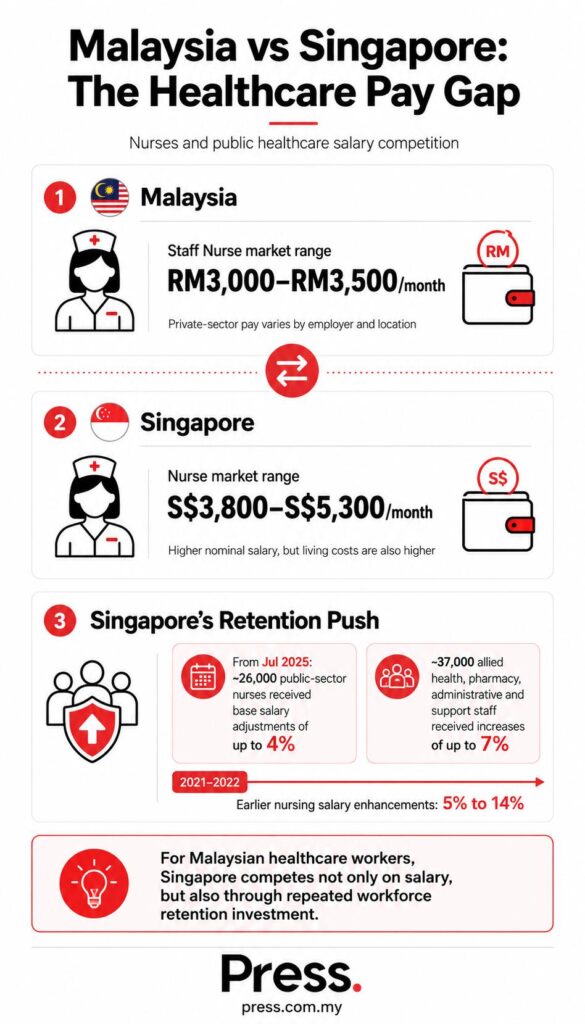
| Staff Nurse | U5 starts at RM1,974 | Jobstreet range around RM3,000-RM3,500 |
| Degree Nurse | U9 starts at RM2,580 | Private salaries vary |
| Selected Allied Health Roles | U5 starts around RM1,974 | Depends on profession and employer |
| Government Specialist | One 2026 physician commentary estimated RM12,000-RM16,000 total monthly income, including allowances and on-call payments | Private specialist models vary widely |
Jobstreet’s 2026 data suggests Medical Officer and nursing salaries vary considerably by location and employer.
These figures are market indicators, not official salary scales or guaranteed earnings.
For specialists, a physician writing in CodeBlue in March 2026 estimated total monthly government income of around RM12,000 to RM16,000, including allowances and on-call payments, using a subspecialist with roughly 15 years of training as an example.
That was commentary rather than an official national salary scale, but it illustrates why compensation becomes a bigger issue after lengthy specialist training.
Read More: How Much Do TVET Graduates Earn After Graduating in 2026?
Do Private Hospitals Pay More?
Often, but not always.
Private healthcare employers generally have more flexibility to offer higher basic salaries, incentives or negotiable packages.
Current doctor advertisements around Kuala Lumpur have shown salaries of approximately RM8,000 to RM15,000 per month, depending on the role and responsibilities.
Jobstreet’s Malaysia data places Staff Nurse salaries around RM3,000 to RM3,500, with some higher-paying locations approaching RM5,000.
But higher pay does not automatically mean a better job.
Healthcare workers also consider:
Career progression: Is there a clear specialist or professional pathway?
Working hours: Does higher pay come with manageable shifts?
Benefits: What happens to leave, pensions, bonuses or insurance?
Clinical experience: Will moving affect training or credentialing?
Location: Will relocation or commuting increase living costs?
The best offer is not always the highest offer.
Why Is Locum Pay Part of the Conversation?
Locum work gives some doctors a way to supplement their permanent salary.
Eligible Medical Officers working specified after-hours sessions in government health facilities can receive a locum allowance of RM80 per hour.
Private locum rates are less standardised and depend on location, hours, patient volume and type of practice.
Locum work can provide flexibility and extra income. But if doctors regularly need side work after demanding hospital shifts to reach their preferred income level, it can add to fatigue rather than relieve it.
How Much Does Singapore Change the Equation?
This is where the salary difference becomes harder to ignore.
Jobstreet’s 2026 data places nurse salaries in Singapore at approximately S$3,800 to S$5,300 per month.
That should not simply be converted into ringgit. Singapore has different housing, transport and living costs.
Still, the earning difference can be significant, particularly for Malaysians who live in Johor or are willing to relocate.
Singapore has also continued adjusting public healthcare salaries.
From July 2025, around 26,000 nurses received base salary adjustments of up to 4%, while about 37,000 allied health, pharmacy, administrative and support employees received increases of up to 7%.
The Ministry of Health said the nursing adjustment followed earlier salary enhancements of 5% to 14% implemented across 2021 and 2022.
Singapore is therefore actively competing for healthcare talent, not simply benefiting from exchange-rate differences.
Is Malaysia Really Losing Healthcare Workers Overseas?
Yes, although the numbers need to be described carefully.
Malaysia’s Health Ministry reported that 2,445 nurses applied to work abroad in 2023, including 1,553 from the private sector and 892 from the public sector.
That figure refers to applications, not confirmed resignations or departures.
Not everyone goes to Singapore. Malaysian healthcare professionals also move to Australia, the Middle East and other markets.
But Singapore has a unique advantage: it is nearby, medically advanced and offers salaries in Singapore dollars.
For some Johoreans, working overseas can mean crossing a bridge rather than moving across the world.
Read More: How Much Can a Civil Servant in Malaysia Earn Per Month?
Is Burnout Making the Salary Gap Feel Bigger?
Yes, because pay dissatisfaction rarely exists in isolation.
Two people can earn the same salary but have very different working experiences.
One may have predictable leave, supportive supervisors and enough staff. Another may constantly cover shortages, work exhausting calls and have little visibility on promotion.
The 2025 burnout study cited earlier reinforces this concern, although it should not be treated as a national prevalence estimate. Malaysian nursing research has also linked workload, working conditions and quality of work life with burnout.
That is why retention cannot be solved by salary adjustments alone.
Which Workers Feel the Pull Most Strongly?
Different professions face different pressures.
Medical Officers: Private GP, corporate, occupational health or Singapore roles may become attractive after years of heavy workloads and calls.
Specialists: After 10 to 15 years of training, compensation and professional recognition can carry greater weight.
Staff Nurses: Nursing skills are highly transferable internationally, and Singapore’s proximity makes overseas recruitment especially relevant.
Allied Health Professionals: Physiotherapists, radiographers, laboratory technologists and others also face concerns about pay progression, workload and overseas demand.
Would Higher Salaries Alone Stop the Brain Drain?
Probably not.
Higher pay would help, particularly where compensation feels out of step with responsibility and living costs.
But retention also depends on manageable staffing, career progression, protected rest, better workforce planning and flexibility.
Singapore’s approach reflects this broader strategy. Its salary adjustments sit alongside retention programmes such as the Award for Nurses’ Grace, Excellence and Loyalty (ANGEL), designed to encourage nurses to build longer careers in the sector.
Malaysia does not need to copy Singapore scheme for scheme.
But it does need to recognise that healthcare retention is now a labour-market competition.
What Does This Mean for Malaysia’s Healthcare System?
Brain drain creates more than a recruitment problem.
When experienced nurses leave, hospitals also lose institutional knowledge, mentoring capacity and experienced patient care. When experienced MOs or specialists leave, remaining staff may inherit more patients and calls.
That can create a vicious cycle of staff shortages, leading to heavier workloads and higher burnout. This causes more resignations, leading to a greater staff shortage.
A 2016 Ministry of Health projection estimated that Malaysia would need more than 260,000 nurses by 2030. Because that projection is now a decade old, it is better treated as historical context rather than a current forecast. More recent reporting still points to serious nursing shortages and workforce pressures.
Recruiting new graduates is only part of the solution. Keeping experienced people matters just as much.
So, Is Public, Private or Singapore Healthcare Better?
There is no universal winner.
A young MO pursuing specialist training may value public-sector clinical exposure more than an immediate salary increase.
An experienced nurse might see a Singapore offer differently, especially if it improves savings or family support.
A specialist may decide private practice offers better long-term returns.
An allied health professional may value predictable hours over maximum income.
The better question is not “Which hospital pays more?”, but “Which career path gives me the best combination of income, development, workload, stability and life outside work?”
What Is the Bottom Line?
Malaysia’s healthcare brain drain cannot be reduced to workers simply “chasing Singapore dollars”. The issue is whether compensation, workload, career progression and professional recognition still feel balanced after years of training and service.
Public hospitals remain essential training grounds. Private hospitals can offer more market-driven compensation. Singapore adds another level of competition through higher nominal salaries and active retention investment.
Healthcare organisations that want to retain talent also need to communicate what they are doing differently.
PRESS PR Agency can help healthcare organisations turn workforce initiatives, leadership perspectives and industry developments into credible PR stories that reach the audiences that matter.
Strong communication will not solve healthcare brain drain by itself, but it can help organisations show that they understand the problem and are taking meaningful action.
Disclaimer: This article is for general informational purposes only. Salary figures, employment conditions and workforce trends may vary by employer, role, experience, location and time, and should not be treated as career, financial or professional advice.
Sources
- Suruhanjaya Perkhidmatan Awam Malaysia: Official salary and appointment information for Medical Officers, nurses and allied health positions.
- Singapore Ministry of Health: Public healthcare salary adjustments and the ANGEL retention programme.
- Jobstreet Malaysia and Singapore: 2026 salary indicators for doctors and nurses.
- Malaysian Family Physician: 2025 burnout study involving 382 healthcare professionals.
- CodeBlue: Reporting on overseas nurse applications, specialist remuneration and workforce pressures.
- New Straits Times: Reporting on government locum allowances.
Frequently Asked Questions About Private VS Public Hospitals in Malaysia
Do Private Hospitals Pay More Than Public Hospitals in Malaysia?
They can, but not always. Private employers may offer higher salaries, while public hospitals may provide stronger training pathways, benefits and clinical exposure.
What Is the Salary of a Medical Officer in Malaysia?
SPA lists the starting basic salary for a UD9 Medical Officer at RM3,130 per month. Actual earnings can be higher after allowances and other payments.
How Much Do Nurses Earn in Malaysia?
SPA lists starting salaries of RM1,974 for U5 diploma-qualified nurses and RM2,580 for U9 degree-qualified nurses. Private-sector pay varies by employer, location and experience.
Why Do Malaysian Nurses Work in Singapore?
Higher salaries are a major attraction, along with structured career pathways, repeated pay adjustments and Singapore’s proximity to Malaysia.
How Much Can Nurses Earn in Singapore?
Jobstreet Singapore lists a typical nurse salary range of approximately S$3,800 to S$5,300 per month in 2026.
Is Healthcare Worker Burnout a Serious Problem in Malaysia?
Research suggests it is a significant concern. A 2025 study of 382 healthcare professionals at a Malaysian public hospital found that 54.7% experienced moderate burnout, although the result should not be treated as a national prevalence estimate.