

Is a higher salary always worth it? Sometimes, yes. But not always.
Many Malaysian workers automatically assume that a higher-paying job is the better opportunity. After all, more money should mean a better lifestyle, greater financial security, and faster progress toward personal goals.
Yet reality is often more complicated. A job that pays RM1,500 or RM2,000 more each month may also come with longer working hours, expensive commuting costs, higher tax and statutory deductions, greater stress, and less time for family or personal interests. In some cases, workers discover that their quality of life actually declines despite earning more.
Before accepting your next job offer, it is worth looking beyond the salary figure. The best career decisions are usually based on a combination of pay, flexibility, benefits, growth opportunities, and overall well-being.
Why We Naturally Focus On Salary
Salary is one of the easiest job factors to compare. When presented with two offers, most people immediately look at the monthly figure.
| Job Offer | Monthly Salary |
|---|---|
| Job A | RM5,500 |
| Job B | RM7,000 |
At first glance, the answer appears obvious. Still, salary only tells part of the story.
A job offer also includes factors such as:
Workload: How demanding is the role?
Commute: How much time and money will travel require?
Benefits: What additional financial protection is provided?
Career Growth: Will the role help you progress professionally?
Work-Life Balance: How much personal time will remain outside work?
These factors often have a greater impact on long-term happiness than a salary increase alone.
How Much Of Your Salary Increase Will You Actually Keep?
One of the most overlooked aspects of changing jobs is the hidden cost of earning more.
Many workers focus on gross salary but fail to calculate how much of the increase will remain after new expenses, income tax, EPF, and other statutory deductions are considered. Malaysia uses progressive individual income tax rates, so a higher salary may also affect how much tax you pay depending on your chargeable income.
Consider a hypothetical example.
| Monthly Expenses | Current Job | New Job |
|---|---|---|
| Salary | RM5,500 | RM7,000 |
| Petrol & Tolls | RM150 | RM500 |
| Parking | RM0 | RM200 |
| Meals Outside | RM100 | RM300 |
| Total Work-Related Costs | RM250 | RM1,000 |
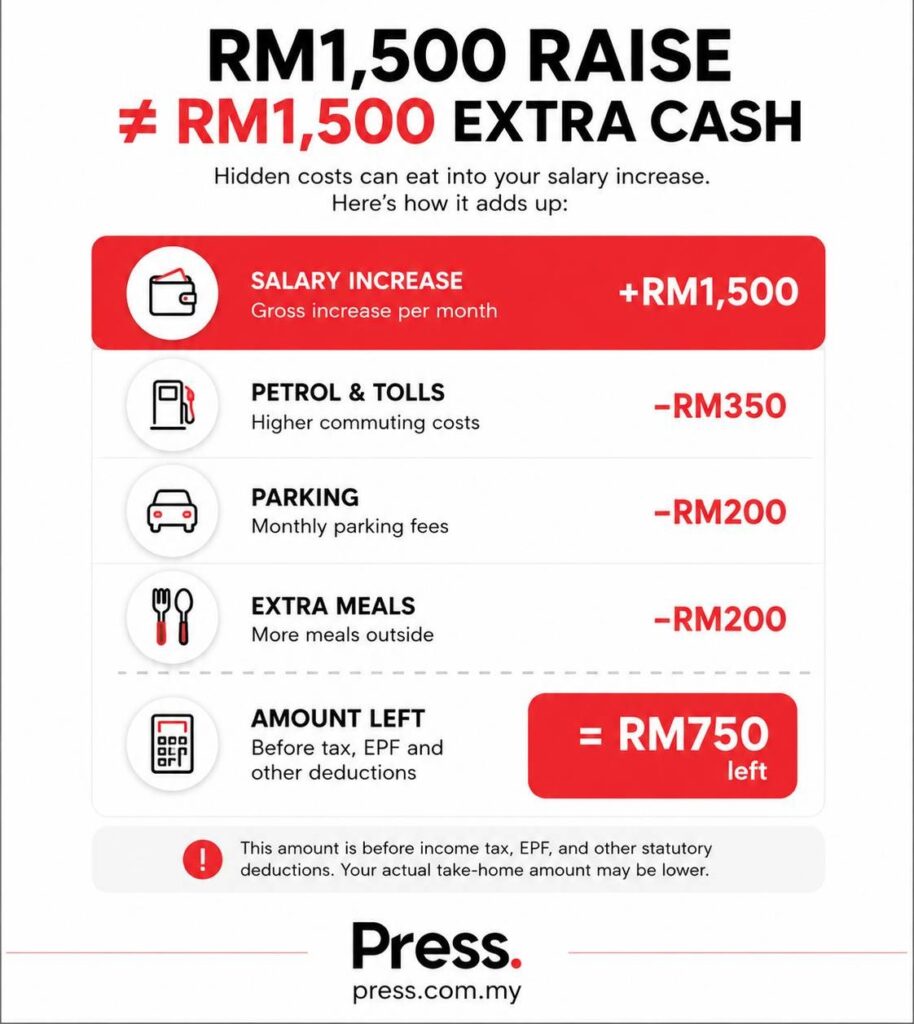
While the new role offers an additional RM1,500 per month, RM750 may be offset by higher commuting and work-related expenses before income tax, EPF, and other statutory deductions are considered.
Suddenly, the pay raise does not seem quite as significant.
This situation is particularly relevant for workers commuting into major urban areas such as Kuala Lumpur, Petaling Jaya, Cyberjaya, and Johor Bahru, where transportation costs can add up quickly.
The Cost Of Commuting In Malaysia
For many workers, commuting is one of the largest hidden expenses associated with a new job.
Daily travel may involve:
- Petrol
- Highway tolls
- Parking fees
- Vehicle wear and tear
- Public transportation costs
The financial impact is obvious, but what’s less obvious is the time cost.
Assuming a five-day workweek, an additional hour of commuting each working day equals five hours per week, roughly twenty hours per month, and more than ten full 24-hour days per year.
That is time that could otherwise be spent with family, exercising, resting, studying, or pursuing personal interests. A higher salary may compensate for these sacrifices, but they should still be factored into the decision.
And if you drive to work in Malaysia, it’s also worth factoring in the time, fatigue, and mental load of sitting in traffic jams, which are becoming increasingly frequent particularly in the Klang Valley. Ask yourself whether getting stuck in jams for hours daily is worth the extra salary.
Calculate Your Real Hourly Earnings
Monthly salary alone can be misleading. A better way to compare job offers is to calculate your effective hourly income.
Scenario A
Monthly Salary: RM6,000
Weekly Hours: 40
Approximate Hourly Value: RM34.60
Scenario B
Monthly Salary: RM8,000
Weekly Hours: 65
Approximate Hourly Value: RM28.40
Despite earning RM2,000 more per month, the second job pays less for every hour worked.
For Malaysian employees, it is also important to compare expected working hours with your employment contract and applicable employment rules. Under Malaysia’s Employment Act 1955, normal working hours are subject to legal limits, including the 45-hour weekly framework, while overtime is regulated separately. Overtime is also subject to a prescribed limit of 104 hours in any one month.
This simple calculation often changes how workers evaluate opportunities. A higher salary may not represent better value if significantly more time is required to earn it.
Can A Higher Salary Improve Your Financial Future?
Of course, there are many situations where pursuing a higher-paying role is absolutely the right move.
A meaningful salary increase can help workers:
- Build emergency savings faster
- Pay off debts sooner
- Increase investments
- Save for a home deposit
- Improve retirement readiness
Higher salaries can also affect EPF savings. Employee EPF contributions generally rise with salary because they are percentage-based. Employer contributions also depend on statutory rates. For Malaysian citizens and permanent residents below age 60, EPF lists the employee contribution rate at 11%, while the employer contribution rate is 13% for monthly wages of RM5,000 and below, and 12% for monthly wages above RM5,000.
This means workers should check the latest EPF contribution schedule when comparing offers, rather than assuming every contribution percentage increases in the same way.
For workers focused on financial goals, accepting a more demanding role may be worthwhile if it significantly accelerates wealth-building efforts.
The key is ensuring that the higher income creates meaningful progress rather than simply funding higher spending.
Why Lifestyle Creep Can Make A Salary Increase Feel Smaller
Many workers expect a substantial pay raise to dramatically improve their lives. Instead, they often find that the extra money disappears surprisingly quickly.
This phenomenon is commonly known as lifestyle creep, where spending gradually rises as income increases.
Examples include:
Upgrading Vehicles: Moving to a more expensive car.
Frequent Dining Out: Spending more on restaurants and food delivery.
Lifestyle Upgrades: New subscriptions, gadgets, or luxury purchases.
Higher Commitments: Larger loans or additional financial obligations.
As income rises, spending often rises as well.
This is one reason why workers earning significantly different salaries may still feel similar financial pressure. The salary increase itself is not enough. What matters is how the additional income is used.
Remote Work May Be Worth More Than You Think
The rise of hybrid and remote work has changed how many professionals evaluate jobs.
Consider the following example.
| Factor | Offer A | Offer B |
|---|---|---|
| Salary | RM6,500 | RM7,500 |
| Work Arrangement | Fully Remote | Office-Based |
| Commute Cost | Minimal | High |
| Travel Time | Minimal | Significant |
Although Offer B pays RM1,000 more, Offer A may deliver similar or even better overall value once commuting expenses and time savings are considered.
For parents, caregivers, and workers with long commutes, flexibility can become a major quality-of-life advantage. A joint Eurofound and ILO report found that telework can shorten commuting time and improve working-time autonomy and work-life balance, although the impact depends on how work is managed.
In some cases, remote work effectively functions as a hidden pay increase.
The Hidden Cost Of Stress And Burnout
Money is important, but so is mental health.
A role that consistently requires excessive overtime, unrealistic expectations, or constant pressure may eventually affect:
- Physical Health: Fatigue, headaches, and sleep problems.
- Mental Well-Being: Anxiety, stress, and burnout.
- Relationships: Less time with family and friends.
- Performance: Reduced productivity and motivation.
The World Health Organization (WHO) describes burnout as an occupational phenomenon caused by chronic workplace stress that has not been successfully managed. It is not classified as a medical condition, but it should still be taken seriously when evaluating a job.
WHO also notes that safe and healthy working environments can support mental health, improve work performance, and reduce workplace tension, while poor support at work can affect attendance and a person’s ability to do their job well.
While some workers are willing to make short-term sacrifices for career advancement, burnout should never be ignored as part of the decision-making process. You may end up spending even more on your health in the long run, if you suffer from physical and mental burnout.
When Taking The Higher Salary Makes Sense
The higher-paying opportunity is often the better choice when several factors align.
The Salary Increase Is Significant
A small pay bump may not justify major lifestyle sacrifices. A substantial increase may.
The Career Growth Is Better
Some jobs offer skills, experience, and advancement opportunities that create long-term earning potential.
The Industry Has Strong Future Demand
A move into a growing sector can improve future job security and career progression.
The Additional Workload Is Reasonable
Higher pay often comes with greater responsibility, but the workload should remain sustainable and consistent with your employment contract and applicable labour rules.
In these situations, accepting a higher-paying role can be a smart strategic decision.
When Turning Down More Pay May Be The Smarter Move
Sometimes the lower-paying role offers greater overall value.
Common examples include:
Better Work-Life Balance
More personal time can improve health, relationships, and overall happiness.
Flexible Working Arrangements
Hybrid or remote work can significantly reduce expenses and stress.
Strong Workplace Culture
Supportive managers and positive colleagues often contribute to long-term job satisfaction.
Better Long-Term Learning Opportunities
The role may provide skills that eventually lead to even higher earnings.
In these situations, rejecting the highest salary can still be a rational and beneficial decision.
A Simple Framework Before Accepting Any Job Offer
Before saying yes to a new opportunity, ask yourself these five questions:
| Question | Why It Matters |
|---|---|
| Will I actually keep most of the pay increase? | Evaluates hidden costs |
| Does this job support my long-term goals? | Assesses future value |
| What benefits are included? | Measures total compensation |
| How will this affect my well-being? | Protects quality of life |
| Would I still want this role if the salary difference were smaller? | Reveals true motivations |
If the answers are largely positive, the opportunity is probably worth serious consideration.
A Higher Salary Isn’t Necessarily Better (Or Worse)
A higher salary can be a powerful tool for improving your financial future, but it is not automatically the best career decision.
The smartest job choices consider not only pay, but also time, flexibility, career growth, mental health, and long-term quality of life. Looking beyond the salary figure often leads to better career decisions and greater satisfaction over time.
This guide was brought to you by PRESS PR Agency, Malaysia’s trustworthy PR partner. If your organisation wants to create content that answers real workplace questions and attracts the right audience, PRESS PR Agency can help your business improve visibility through strategic SEO and PR services designed for long-term growth.
Disclaimer: The article is for general information only and should not be taken as personal financial advice. Consider your own circumstances before making major career or financial decisions.
Sources
- Employees Provident Fund Malaysia — Mandatory Contribution / Who Can Contribute.
- Lembaga Hasil Dalam Negeri Malaysia — Individual Tax Rate.
- Department of Labour Peninsular Malaysia — Employment Act 1955.
- Employment (Limitation of Overtime Work) Regulations 1980.
- World Health Organization — Burn-out as an occupational phenomenon.
- World Health Organization — Mental health at work.
- Eurofound and International Labour Organization — Working anytime, anywhere: The effects on the world of work.
Frequently Asked Questions About Evaluating Higher Salary In a Job
Is A Higher Salary Always Better?
No. A higher salary may come with longer working hours, greater stress, increased commuting costs, higher deductions, or reduced flexibility that affects overall quality of life.
How Much Of A Salary Increase Makes A Job Switch Worthwhile?
There is no fixed amount. Workers should evaluate the net financial gain after accounting for transportation, taxes, statutory deductions, and additional work-related expenses.
Should I Consider EPF Contributions When Comparing Jobs?
Yes. EPF contributions can affect long-term retirement savings. However, employees should check the latest EPF contribution schedule because employer contribution rates may differ depending on salary level and employee category.
Does Remote Work Have Financial Benefits?
Yes. Remote work can reduce fuel, toll, parking, and meal expenses while also saving commuting time. However, its value depends on the role, company expectations, and how well remote work is managed.
How Can I Compare Two Job Offers Fairly?
Look beyond salary and compare total compensation, benefits, work-life balance, growth opportunities, commuting costs, and effective hourly earnings.
Can A Lower-Paying Job Be The Better Choice?
Absolutely. A role with stronger benefits, better flexibility, healthier working conditions, or greater career development opportunities may provide more value overall.