
A Grab Driver can potentially earn more than a junior technician in the short term, but that advantage may shrink once vehicle expenses are deducted.
Someone driving full-time might see RM4,000 or more flowing through their Grab account and assume they are earning far more than a junior mechanic on a RM2,000-plus salary. But a Grab Driver is effectively operating a small business on wheels. Fuel, servicing, tyres, insurance, tolls and vehicle depreciation all reduce actual take-home income.
A junior technician usually starts with a smaller headline salary, but most workplace operating costs belong to the employer.
That makes the real comparison less about headline income and more about cash today versus earning power tomorrow.
| Factor | Grab Driver / E-Hailing | Junior Technician |
|---|---|---|
| Income structure | Variable trip earnings | Fixed monthly salary |
| Indicative income | Reported examples around RM4,000 gross for some full-time drivers | Recent junior vacancies around RM1,800-RM2,500 |
| Main work costs | Fuel, maintenance, insurance, tyres, depreciation, tolls | Mainly commuting and personal costs |
| Income stability | Lower | Higher |
| Cash access | Potentially daily | Usually monthly |
| Flexibility | High | Low to medium |
| Skill progression | Limited specialist progression | Clearer technical pathway |
| Best suited for | Immediate income and flexibility | Long-term technical career building |
Actual earnings vary by location, working hours, employer, experience and operating costs.
How Much Can a Grab Driver Earn in Malaysia?
There is no fixed monthly salary for a Grab Driver because e-hailing drivers are gig workers whose earnings depend on demand, hours, location, incentives and trip volume. Grab allows driver-partners to choose when they work and offers daily cash-out options, which can be useful for people who need faster access to earnings.
Reported income varies widely. A Grab Driver interviewed by the New Straits Times in 2025 said he earned around RM4,000 gross per month. That is an individual example, not a national average.
In March 2026, The Star reported that another e-hailing driver said she considered herself lucky to make RM200 to RM250 in clean profit in a day, but she also described working roughly from 7 a.m. until midnight.
These examples show why Grab income should be treated carefully.
The key distinction is gross earnings versus actual profit.
Read More: How Much Do TVET Graduates Earn After Graduating in 2026?
What Expenses Reduce a Grab Driver’s Real Earnings?
A Grab Driver needs to account for more than fuel.
Common costs include:
- Fuel
- Servicing and repairs
- Tyres
- E-hailing insurance
- Vehicle depreciation
- Tolls and parking
- Mobile data and other operating costs
Grab’s current daily e-hailing insurance options include rates around RM7 to RM7.50 per day across several participating insurers.
Vehicle depreciation is also easy to overlook. Driving high annual mileage can reduce a car’s resale value even when no cash leaves your wallet immediately.
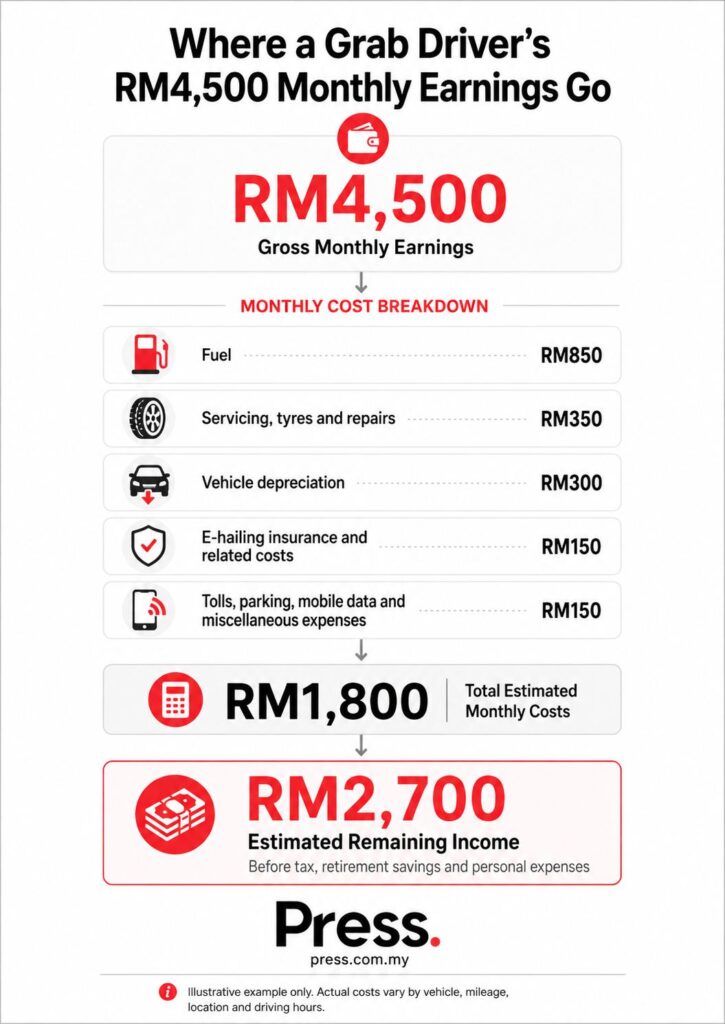
Consider a purely illustrative example.
A driver earns RM4,500 gross in one month and spends:
- RM850 on fuel
- RM350 on servicing, tyres and repairs
- RM300 on vehicle depreciation
- RM150 on insurance and related costs
- RM150 on tolls, parking, data and miscellaneous expenses
That leaves around RM2,700 before personal tax, retirement savings and other personal expenses.
The exact result will vary from driver to driver, but the lesson is simple: a Grab Driver’s RM4,500 gross income should not be compared directly with a salaried employee’s RM2,400 pay.
How Much Does a Junior Technician Earn in Malaysia?
As of August 2026, Indeed places the average Malaysian Automotive Technician salary at approximately RM2,380 per month.
That figure covers automotive technicians generally rather than juniors specifically.
Recent junior automotive technician vacancies have advertised salaries around RM1,800 to RM2,500 per month, depending on employer, location and experience.
The salary may look modest beside a driver’s gross e-hailing income.
However, the technician is not personally paying for workshop rental, major diagnostic equipment, lifts or most business operating expenses.
The employee mainly provides labour and skills.
The Grab Driver provides both labour and the vehicle used to generate income.
Can a Technician Eventually Earn More?
Potentially, yes.
Department of Statistics Malaysia data for 2024 placed the median monthly salary and wage for the broad Technicians and Associate Professionals occupational group at RM3,541, with a mean of RM4,077.
This category includes many technical occupations, not automotive technicians alone, so it should be treated as general labour-market context. Malaysia’s formal-sector median monthly wage was RM3,027 in March 2026.
Technicians can improve their earning potential by developing skills in areas such as:
- Diagnostics
- Electrical systems
- Air-conditioning
- Hybrid and EV systems
- Automation
- Specialist maintenance
Possible career paths include Senior Technician, Specialist Technician, Supervisor, Service Advisor or Technical Support.
These promotions are not guaranteed, but technical experience can create access to more specialised roles over time.
With Grab, earning more still depends heavily on hours worked, demand, trip volume and vehicle operating costs.
Read More: How Much Can a Civil Servant in Malaysia Earn Per Month?
What About Working in Retail?
Retail offers another entry-level option.
Indeed reported an average Malaysian Retail Sales Associate salary of approximately RM2,128 per month as of August 2026, based on more than 10,000 reported salaries.
Retail provides more predictable income than gig work and can build transferable skills in customer service, sales, stock management and store operations.
Progression into supervisory or store management roles is possible, although technical careers generally offer a clearer pathway into specialist work.
Why Does Grab Feel Like It Pays More?
Because the money is more visible.
You complete rides, the balance increases, and you may be able to cash out daily.
That can feel more rewarding than waiting several weeks for a monthly salary.
There is also more immediate control. A driver who wants to try to earn more can work longer, target busy periods or drive at weekends.
The risk is confusing cash flow with profit.
If your vehicle needs a RM1,800 repair three months later, some of the money you thought you had earned was effectively covering future operating costs.
Which Job Offers Better Security?
Traditional employment generally provides more predictable monthly income.
Eligible employees may also receive employer-linked EPF contributions, social-security coverage and statutory leave, depending on their employment status and applicable Malaysian labour laws.
Gig workers operate under a different structure.
E-hailing drivers fall within PERKESO’s Self-Employment Social Security Scheme, while eligible e-hailing and p-hailing workers can also contribute through EPF’s i-Saraan Plus programme.
A technician can usually estimate their next base salary more easily.
A Grab Driver cannot guarantee next month’s demand, trip volume, incentives or vehicle reliability.
Which Option Gives You More Freedom?
Grab has the advantage in flexibility.
Drivers can generally decide when to go online and when to stop, making e-hailing attractive for students, parents, freelancers and people combining several income sources.
But when you stop driving, income usually stops too.
An eligible salaried employee may be able to take paid annual leave, while a gig worker taking a week off will usually complete fewer trips and earn less.
So Grab offers greater time flexibility, while traditional employment usually offers greater income predictability.
What Happens After Five Years?
This is where the long-term difference becomes clearer.
A full-time Grab Driver may become highly efficient at choosing profitable locations and peak periods. But the vehicle will also accumulate mileage, and income still depends heavily on being available to drive.
A junior technician with five years of repair and diagnostic experience may no longer be competing for apprentice-level jobs.
That experience can become career capital: skills that make the worker eligible for more specialised or responsible roles.
Your first salary matters.
What your skills allow you to earn later matters too.
So Who Should Choose Grab?
Grab can make sense if your main priority is cash flow, flexibility or temporary income.
It may work particularly well if you already own a suitable vehicle and understand its operating costs.
Just treat driving like a business.
Instead of saying:
“I made RM200 today.”
Think:
Earnings minus fuel minus operating costs minus vehicle wear = actual profit.
That number matters more.
Who Should Choose a Junior Technician Job?
A junior technician role may suit someone who wants to build a trade or technical career.
The starting salary may not look impressive, but the quality of the experience matters.
A RM2,200 job where you learn diagnostics, electrical systems or modern vehicle technology may become more valuable over time than a job where your responsibilities barely change.
A useful question is:
What will I know how to do after two years that I cannot do today?
Grab Driver vs. Technician: Which One Wins?
For immediate access to earnings, Grab can have an advantage.
For predictable monthly income, salaried employment usually wins.
For time flexibility, Grab is stronger.
For building specialised skills, technician work offers a clearer pathway.
For long-term career progression, technical employment can create routes into senior, specialist or supervisory roles, although future salaries depend on qualifications, performance and industry demand.
There is also no rule saying you must choose only one.
A junior technician could drive on selected evenings or weekends. Someone doing Grab full-time could pursue technical training before gradually moving into salaried work.
Comparing Earnings and Other Factors
A Grab Driver may look like the higher earner when you compare daily cash with a junior technician salary, but the gap can shrink considerably after fuel, maintenance, insurance and vehicle wear are deducted.
Technical jobs usually start more slowly, but they can build specialised skills that create opportunities for more senior work over time.
The better option depends on what matters most to you: cash flow and flexibility now, or structured skill development and career progression later.
For companies competing to attract Malaysian workers, how an employer communicates its career opportunities matters almost as much as the salary itself. PRESS PR Agency can help businesses strengthen employer visibility and tell credible workplace stories through our strategic PR services that reach the right audience.
Sources
- Department of Statistics Malaysia: Employee Wages Statistics, Formal Sector, First Quarter 2026.
- Department of Statistics Malaysia: Salaries & Wages Survey Report 2024.
- Indeed Malaysia: Automotive Technician salary data.
- Indeed Malaysia: Junior Automotive Technician vacancy data.
- Indeed Malaysia: Retail Sales Associate salary data.
- Grab Malaysia: Driver-partner flexibility, cash-out and e-hailing insurance information.
- PERKESO: Self-Employment Social Security Scheme.
- EPF / KWSP: Employer contribution and i-Saraan Plus information.
- New Straits Times: 2025 Grab Driver earnings profile.
- The Star: March 2026 e-hailing driver earnings report.
Frequently Asked Questions About Grab Driver vs Junior Technician Income and Expenses
How Much Can a Grab Driver Earn Per Month in Malaysia?
There is no fixed Grab Driver salary because earnings depend on hours, demand, location and trip volume. Some drivers report earning several thousand ringgit per month, but fuel, maintenance, insurance and depreciation must be deducted before calculating real profit.
How Much Does a Junior Automotive Technician Earn in Malaysia?
Indeed reported an average Automotive Technician salary of approximately RM2,380 per month in Malaysia as of August 2026. Recent junior vacancies have advertised salaries around RM1,800 to RM2,500 per month.
What Expenses Do Grab Drivers Have?
Common expenses include fuel, servicing, tyres, repairs, e-hailing insurance, tolls, parking, mobile data and vehicle depreciation.
Can Technicians Earn More Than Grab Drivers?
Yes, but it depends on experience, specialisation and the driver’s actual net earnings. DOSM reported a median monthly wage of RM3,541 for the broad Technicians and Associate Professionals category in 2024, although this is not an automotive-specific salary figure.
Is Grab Good as a Side Income in Malaysia?
It can be. Grab’s flexible hours make it suitable for supplementary income, but drivers should calculate all vehicle costs before deciding whether the extra hours are worthwhile.
Is Being a Grab Driver Better Than Working Full-Time?
Grab is generally stronger for flexibility and faster access to earnings, while full-time employment usually provides more predictable monthly income and a different structure of statutory protections and benefits. The better choice depends on whether flexibility, immediate cash flow, skills development or longer-term stability matters more to you.