
Businesses can increase the likelihood of virality through strong storytelling, emotional appeal, strategic distribution, and good timing, but no brand can guarantee that a piece of content will spread across the internet.
Virality is influenced by factors that are often outside a marketer’s control, including audience behaviour, platform algorithms, cultural trends, and sometimes pure luck.
That may sound disappointing, but it’s also why viral content remains so powerful. If there were a guaranteed formula, every brand would be producing viral campaigns every week.
So what actually makes content go viral? More importantly, what can Malaysian businesses realistically do to improve their chances of earning attention, media coverage, and shares, without falling into the trap of chasing virality for its own sake?
Read More: The Power of Slogans: How Brands Win Attention in Malaysia
What Is Virality?
Virality refers to the rapid spread of content through audience-driven sharing.
Unlike traditional advertising, viral content does not rely solely on paid promotion. Instead, people actively distribute it through social media, messaging apps, online communities, media coverage, and word-of-mouth.
A piece of content is generally considered viral when:
- Large numbers of people voluntarily share it
- Growth accelerates rapidly over a short period
- Discussion expands beyond the creator’s existing audience
- Media outlets, influencers, or communities amplify the conversation
Importantly, virality is not measured solely by views.
A video with 50,000 highly engaged shares may be more “viral” than a video with 500,000 passive views. The defining characteristic is that audiences become part of the distribution process.
The Psychology Behind Viral Content
People rarely share content simply because it exists.
Research by Jonah Berger (and colleagues) found that content triggering high-arousal emotions (such as awe, anger, or anxiety) tends to be shared more than content associated with low-arousal emotions like sadness. In other words, people are more likely to share content that excites, surprises, inspires, or even provokes them than content that leaves them feeling neutral.
You can usually see it in the pattern:
- Awe
- Excitement
- Surprise
- Inspiration
- Anger
However, emotion alone is not enough. People also share content because it reflects something about themselves.
When someone shares a piece of content, they may be communicating:
- “I discovered something interesting.”
- “I understand this topic.”
- “This reflects my values.”
- “This is relevant to my industry.”
- “I want others to see this.”
This concept is often referred to as social currency.
In many cases, people are not sharing content to help the creator but because it helps express their own identity.
What Makes Content Go Viral?
Although there is no guaranteed formula, most viral content tends to contain a combination of several recurring ingredients.
Strong Emotional Triggers
Emotion is often the spark that starts the sharing process.
Think about the last piece of content you sent to a colleague or friend. It probably made you laugh, surprised you, impressed you, or taught you something useful.
Emotional reactions create momentum.
Stories Instead Of Information
Facts are useful. Stories are memorable.
A company announcing a new service may receive little attention. A story about how a customer overcame a significant challenge using that service is much more likely to be shared.
Stories give people something worth repeating.
Practical Value
Useful content consistently performs well. This includes:
- Industry insights: New trends and developments
- Guides: Step-by-step advice
- Warnings: Risks businesses should avoid
- Data: Original statistics and research
People enjoy sharing content that makes them appear helpful and informed.
Simplicity
The easier a message is to understand, the easier it is to share.
Complex ideas can spread, but they often need to be packaged in a way that is accessible to broader audiences.
Why Virality Is Harder Than Ever In 2026
Ironically, creating content has never been easier, while generating attention has never been harder.
Businesses today compete against a constant stream of content (both corporate and also user-generated) published every minute, across every major platform. The result is an environment where even good content can struggle to earn visibility.
This creates a strange reality where there is more content than ever, but audiences have limited time and attention.
So the bottleneck now isn’t just production, but also distribution.
As a result, virality is becoming less about creating content and more about earning attention.
Read More: Media Monitoring: How to track brand mentions in Malaysia
The Part Most Discussions Ignore: Distribution
Many discussions about virality focus almost entirely on content quality. That is only half the story.
Distribution often determines whether great content succeeds or disappears.
A useful way to think about it is:
| Content Quality | Distribution Strength | Likely Outcome |
|---|---|---|
| High | Weak | Limited reach |
| Average | Strong | Potentially significant reach |
| High | Strong | Highest probability of success |
| Poor | Strong | Short-term visibility only |
Distribution channels may include:
- Media publications
- Industry associations
- LinkedIn communities
- Influencers
- Existing customers
- Employees
- Business partners
This is one reason why PR services remain so powerful.
A valuable piece of content supported by strong media relationships often outperforms a better piece of content that nobody sees.
Social Virality vs PR Virality
One of the biggest mistakes businesses make is assuming that all virality is equal.
In reality, social virality and PR virality often produce very different outcomes.
| Social Virality | PR Virality |
|---|---|
| Likes | Media coverage |
| Shares | Backlinks |
| Views | Brand authority |
| Comments | Industry credibility |
| Reach | Trust |
A viral TikTok video may generate hundreds of thousands of views.
A feature in respected industry publications may generate far fewer views but produce qualified leads, partnerships, and long-term credibility.
For many Malaysian businesses, especially B2B companies, PR virality often delivers more commercial value than social virality.
Can You Actually Force Virality?
The short answer is no.
Businesses can improve the odds, but they cannot guarantee the outcome.
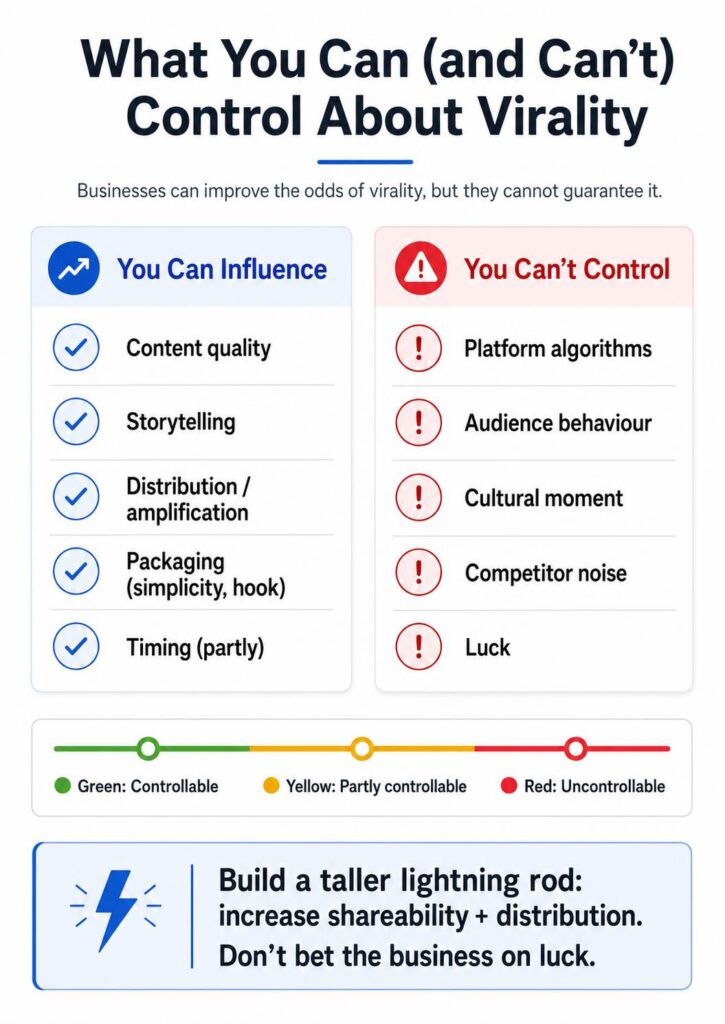
This is why virality is often compared to lightning: nobody can force lightning to strike a location, but it’s possible to build taller lightning rods that increase the chances of lightning strikes.
Rather than trying to manufacture viral success, the best marketers focus on creating content that is highly shareable and strategically distributed.
The Morbius Lesson: When Virality Does Not Translate Into Success
One of the most fascinating examples of misleading virality came from the 2022 superhero film Morbius.
The movie became a massive internet meme. Social media was flooded with jokes, parody quotes, and references to the film. One of the most famous memes was “It’s Morbin’ Time”, a catchphrase that spread online even though it does not appear in the film.
The online conversation became so widespread that Sony decided to re-release the film in cinemas. The assumption was understandable:
Millions of people appeared to be talking about the movie, so surely that interest would translate into ticket sales.
Re-release and Failure
It did not. The re-release weekend grossed only about US$280,000 despite the enormous online attention.
The reason is simple.
People were participating in the joke, not expressing genuine purchase intent. In fact, many people were joking about intentionally misleading Sony into losing money.
For businesses, this provides an important lesson:
Visibility and demand are not the same thing.
A campaign can dominate social conversations while producing little commercial value.
Hate-Watching And The Visibility Trap
Modern platforms have introduced another complication: people increasingly engage with content they dislike.
This phenomenon is often called hate-watching, which is consuming content mainly to criticise or mock it, even as it drives views, comments, and shares.
Examples include:
- Watching a controversial video specifically to criticise it
- Sharing content to mock it
- Commenting to argue against it
The challenge is that many recommendation systems optimize for engagement signals, so even negative interactions can sometimes increase distribution.
From a platform’s perspective, engagement is engagement, but from a business perspective, the picture is much more complicated.
A piece of content may generate:
- Views
- Comments
- Shares
- Discussions
Yet still fail to build trust or generate customers.
This is why businesses should be careful when interpreting engagement metrics. High visibility does not automatically mean positive business outcomes.
The New Risk: Cringe Virality
Not all failed viral campaigns are controversial; some fail because they feel forced.
Many younger audiences have spent years immersed in internet culture. As a result, they are often highly sensitive to content that feels manufactured or inauthentic.
Common examples include:
- Forced meme usage: Brands using outdated trends
- Corporate slang: Attempting to sound relatable in unnatural ways
- Trend chasing: Jumping into conversations without relevance
- Copycat content: Replicating viral formats without understanding why they worked
This creates a form of negative attention that differs from controversy.
Instead of being offended, audiences simply perceive the brand as out of touch. The result is often mockery rather than admiration.
Ironically, the content may still generate engagement. However, the attention comes from people laughing at the brand rather than connecting with it.
For professional service firms, B2B companies, and established brands, this type of visibility rarely produces meaningful value.
Focus On Shareability, Not Virality
Rather than asking: “How can we go viral?”
Businesses may benefit more from asking: “Why would someone want to share this?”
One useful framework is:
| Letter | Meaning |
|---|---|
| V | Value |
| I | Interest |
| R | Relevance |
| A | Amplification |
| L | Luck |
Value
Does the content help, educate, or inform?
Interest
Does it spark curiosity or emotion?
Relevance
Does it connect with the audience’s current concerns?
Amplification
Is there a strategy to distribute the content?
Luck
Are external conditions working in your favour?
The first four can be influenced. The last one cannot.
What Malaysian Businesses Should Focus On Instead
The most successful businesses are not usually the ones chasing viral moments every week.
They are the ones consistently creating content that builds trust, authority, and visibility over time.
Examples include:
- Industry thought leadership
- Original research
- Expert commentary
- Newsworthy company developments
- Customer success stories
- Educational resources
These may not generate millions of views.
However, they often generate something more valuable:
- Qualified leads
- Media coverage
- Industry recognition
- Brand credibility
- Long-term search visibility
For most businesses, those outcomes matter far more than a temporary viral spike.
Don’t Chase Viral Content
Virality remains one of the most misunderstood concepts in marketing and public relations.
While emotional storytelling, relevance, timing, and strong distribution can increase the likelihood of content spreading, no business can reliably force virality on demand.
The better goal is not to chase viral moments but to create content that deserves to be shared.
At PRESS PR Agency, Malaysia’s trusted PR agency, we help businesses develop PR strategies, media outreach campaigns, and thought leadership initiatives that build lasting visibility, credibility, and brand authority long after the latest viral trend has faded.
Sources
- Jonah Berger & Katherine Milkman — research on what drives sharing and virality (“What Makes Online Content Viral?”)
- Jonah Berger — research on arousal and social transmission (“Arousal Increases Social Transmission of Information,” Psychological Science, 2011)
- Domo — “Data Never Sleeps” annual reporting on internet/platform activity volume
- Merriam-Webster Dictionary — definition of “hate-watch”
- Morbius (2022) — reporting and box office summaries around the 2022 re-release performance and the “Morbin’ Time” meme context
Frequently Asked Questions About Going Viral in Malaysia
Can Businesses Guarantee Viral Content?
No. Businesses can improve the likelihood of virality through quality content and strategic distribution, but factors such as timing, audience behaviour, platform algorithms, and luck remain outside their control.
What Is The Difference Between Viral Content And Good PR?
Viral content focuses on rapid attention and sharing, while good PR focuses on reputation, trust, credibility, and long-term visibility.
Why Do People Share Content Online?
People typically share content because it creates an emotional response, provides practical value, tells an interesting story, or reflects something about their identity.
Is Negative Virality Ever Good For A Business?
In some cases, controversy may increase visibility. However, most businesses benefit more from positive attention that strengthens trust and brand reputation.
What Is Hate-Watching?
Hate-watching refers to consuming content mainly to criticise or mock something. While it may increase views and engagement, it does not necessarily create positive business outcomes.
Should Malaysian Businesses Try To Follow Every Trend?
No. Businesses should participate only in trends that align naturally with their audience, messaging, and overall brand strategy.