

Getting media coverage sounds simple until you actually try it.
Write a press release, send it to a few journalists and hope someone finds it worth publishing. More often than not, nothing happens and maybe your email ends up on spam.
It is not necessarily because your business or story is boring, but most companies are pitching the same things: a new product, an event, a milestone.
Original research changes the conversation. Instead of asking a journalist to write about your business, you give them fresh evidence they can use to tell a wider story (and really that’s the gist)
When packaged properly, it can turn an ordinary business commentary into a useful media source. Because there’s one thing journalists carved above all else in their stories, originality.
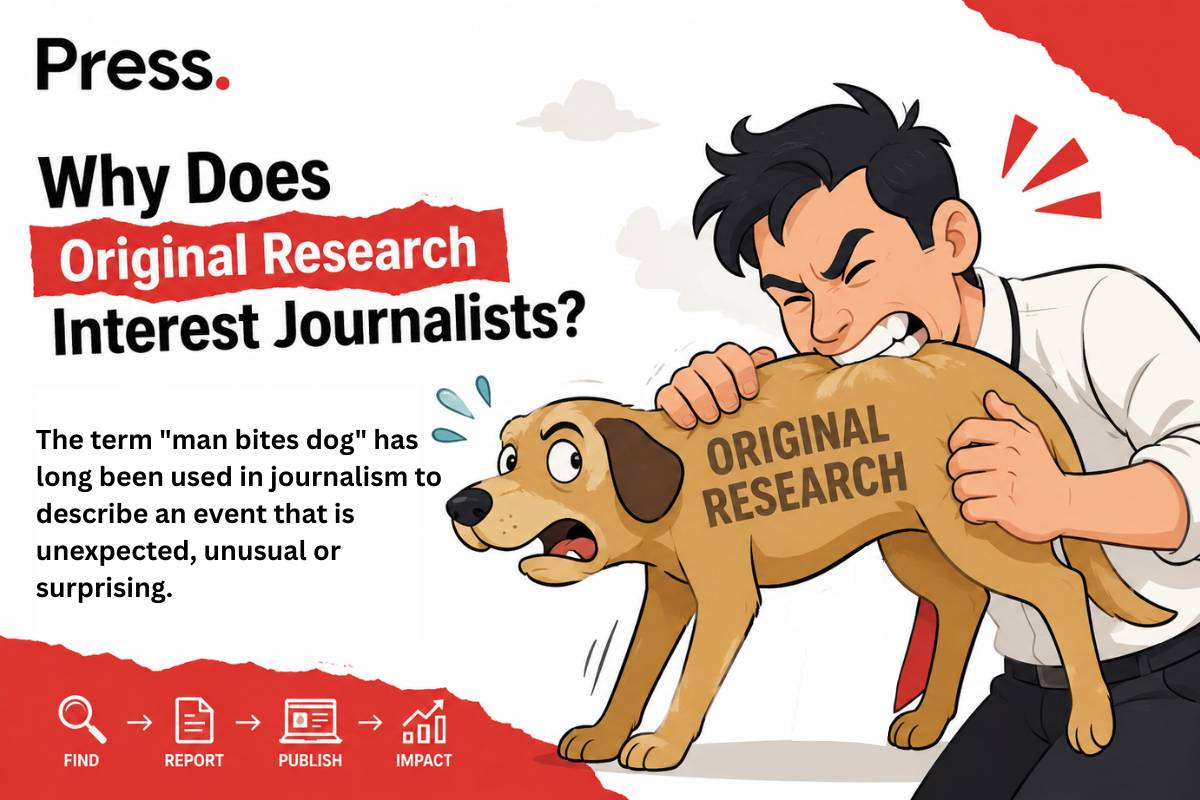
Why Does Original Research Interest Journalists?
Journalists need something new to report, it’s their lifeline and quite literally, their job.
They are trained and honed to sniff out stories that get people clicking and reading, they want a “man bites dog” story.
So when a company says “Malaysian consumers care about price”, that is not newsworthy because duh?
But a study showing that “68% of shoppers switched brands after a price increase” gives the journalist something more useful, it becomes a broader story about inflation, survival and how the average man copes with soaring prices.
The opening is statistics, but what comes next is always the story.
Original research can help answer:
- What Changed?
- Who Is Affected?
- How Large Is the Change?
- Why Does It Matter Now?
- What Happens Next?
Good research reduces the work needed to turn an idea into a story. The journalist already has a statistic, an angle and a source to quote.
Your company becomes part of the coverage because it produced the evidence, not because the article directly promotes its products.
Is the Media Coverage Really Free?
The placement may be earned rather than purchased, but that does not mean the campaign is cost-free.
There are usually three types of investment.
1. Research Costs
Perhaps one of the most time-consuming aspects. You may need survey respondents, software, analysts or an external research panel.
Even internal business data must be cleaned, organised and checked.
2. Production Costs
The findings must be turned into usable materials, such as:
- A Research Report
- Charts and Infographics
- A Media Release
- Expert Commentary
- A Landing Page
3. Distribution Costs
Someone must identify relevant journalists, personalise the pitch, answer questions and follow up.
“Free media coverage” is therefore better understood as unpaid editorial coverage earned through useful research.
What Type of Research Can a Business Use?
You do not always need a major nationwide survey, or even go out of your way to become a statistician.
Businesses already have useful information in their system, the main challenge is identifying what could interest people outside the company.
Customer Surveys
Surveys are useful for understanding opinions, intentions and frustrations.
- A Malaysian property company might survey renters about housing priorities.
- A recruitment firm might ask employees why they leave jobs other than pay.
- A retailer could study how living costs affect spending.
The biggest weakness is likely what people say they will do, may differ from what they actually do.
“Everyone wants to give “good” answers or is embarrassed to put answers that make them look bad.”
Internal Business Data
Internal data reveals market behaviour.
Examples include:
- Changes in Customer Enquiries
- Popular Product Categories
- Delivery Failure Rates
- Payment Preferences
- Seasonal Spending Patterns
- Common Complaints
A recruitment company might identify which jobs take the longest to fill in Johor Bahru. A delivery platform could study how weather affects order patterns during Monsoon season.
This data can be valuable, but it reflects your own users rather than the whole Malaysian population. That limitation should be stated clearly from the start.
Public Data Analysis
Businesses can also analyse information from the Department of Statistics Malaysia, Bank Negara Malaysia or MCMC.
The data may be public, but your interpretation can still be original.
For example, you could compare national inflation figures with changes in customer demand and link it to your own business.
It makes you look smart and you can say how your business helps with average joe cope with the price!
What Makes Research Finding Newsworthy?
Before starting a research project, ask if the finding passes three tests.
1. Is It New?
The research should reveal something that has not already been repeated everywhere.
“Malaysians use smartphones” is weak, in fact you probably use one before sleeping.
Data on how Malaysians use their smartphones for banking, shopping or work per week is far more interesting.
2. Is It Specific?
General claims are difficult to report, give numbers and data.
Compare: “Malaysians dislike slow customer service.” to “Three in five Malaysian online shoppers abandon a purchase when a business takes more than five minutes to reply.”
The second gives the journalist a clearer headline and consequence.
3. Is It Timely?
A finding becomes stronger when it connects to something happening now.
Research on festive spending may work before Hari Raya or Chinese New Year. Hiring data may be relevant around graduation periods, while Budget announcements or industry changes.
Timing is everything, so try to have something ready when the stars align and your pitch is ready for serving.
How Much Data Do You Really Need?
There is no perfect sample size for every campaign.
A survey of 1,000 Malaysian adults may support broader consumer conclusions.
A study of 100 customers may still provide useful insight into your audience, but it should not be described as representing all Malaysians.
For example, a killer headline might claim that Malaysians are abandoning cash, even though the survey covered only 80 users of one payment platform in Sabah.
The finding may still be interesting though! The wording just needs to match the evidence.
How Do You Turn Data Into a Media Story?
Research becomes useful for PR when it connects the findings to a clear human or business consequence.
You just need to answer “how is the data relevant to [person you’re targeting]”
Suppose a Malaysian HR company studies why employers struggle to attract qualified applicants.
The research finds that many candidates abandon applications taking more than 20 minutes to complete.
The wider story is not only about form length, It could be about complicated hiring processes costing companies suitable candidates or how going multiple rounds of interviews hurts talent acquisition rates.
That finding could be pitched differently depending on the framing:
- Business Media: How Slow Hiring Affects Growth
- HR Media: Why Application Processes Lose Candidates
- Technology Media: Whether Recruitment Systems Create Friction
- Consumer Media: What Jobseekers Dislike About Applications
One dataset can produce several stories when each pitch suits the publication, so take your pick.
What Should a Research Media Pack Include?
Journalists should not have to search through a 70-page report for the main point, no one would bother to do it (or they get AI to do a TLDR version of it for them).
A media pack should include:
- A Short Summary of the Main Findings
- A Clear Methodology
- The Sample Size and Research Period
- Simple Charts
- A Spokesperson Quote
- Supporting Context
- A Link to the Full Report
Make the materials easy to scan. A journalist on a deadline may have only a few minutes to decide whether the story is worth pursuing.
What Research Mistakes Can Hurt Credibility?
Research-led PR can build authority, but weak research can do the opposite.
Writing Questions to Produce a Preferred Answer
Some businesses decide on the headline first and design the survey around it.
Leading questions and selective reporting may produce dramatic results, but journalists can often spot the problem.
Confusing Correlation With Causation
Two things happening together does not mean one caused the other.
Use language such as “associated with,” “coincided with” or “may suggest” when the data cannot prove cause and effect.
Hiding Inconvenient Findings
The most interesting result may not be the one management expected.
Unexpected findings can create a stronger and more credible story than a perfectly convenient result.
If it is a contradiction to the norms, that’s even better.
Overselling the Results
Avoid claims such as “the first study of its kind” unless you can verify them.
Be careful with words such as “proves,” “all,” “most” and “nationwide.”
A modest claim supported by strong evidence is better than a bold one that falls apart under scrutiny. Remember, if your story is chosen, the whole world (or Malaysia) gets to see it.
Conclusion On Original Research
Original research earns attention when it gives journalists something credible, timely and easy to use. It does not need to be a huge national study, but it does need a clear question, honest methodology and a finding that matters beyond your company.
At PRESS PR Agency, we help businesses turn internal knowledge, survey findings and industry data into stories for real media audiences.
Our PR agency can support the process from developing the research angle to packaging and pitching the final story, without pretending that editorial coverage can be guaranteed.
Frequently Asked Questions About Original Research
What Is Original Research in PR?
Original research in PR is new data collected or analysed by an organisation to create a media story. It may come from surveys, customer records, platform activity, interviews or public datasets.
Why Do Journalists Use Original Research?
Journalists use original research because it provides fresh evidence, statistics and angles that support a timely story. It also gives them a credible source to quote.
How Many Survey Respondents Are Needed for Media Coverage?
The right number depends on the audience and the claims being made. A small industry survey can still be useful, but it should not be presented as representative of all Malaysians.
Can Internal Company Data Be Used for PR?
Yes. Anonymised sales trends, customer enquiries and operational data can produce strong stories. The business should protect personal information and state that the findings come from its own audience.
Is Earned Media Really Free?
The publication does not charge for genuine editorial coverage, but research, media materials and outreach still require resources. It is more accurate to describe it as unpaid coverage.
Can a PR Agency Guarantee Media Coverage?
No reputable PR agency can guarantee independent editorial coverage. An agency can improve the research angle, materials, timing and outreach, but the final decision remains with the publication.