
The first hour of a viral event is the most dangerous because silence acts as an accelerant for public anger.
When a brand goes viral for the wrong reason, Malaysian netizens expect immediate accountability. A complaint on TikTok can hit 1 million views and be covered by SAYS before your PR team has even finished their morning coffee.
Hence, our PR agency has created a guide that outlines the strategic “War Room” approach for Malaysian businesses to contain negative publicity and pivot toward brand recovery.
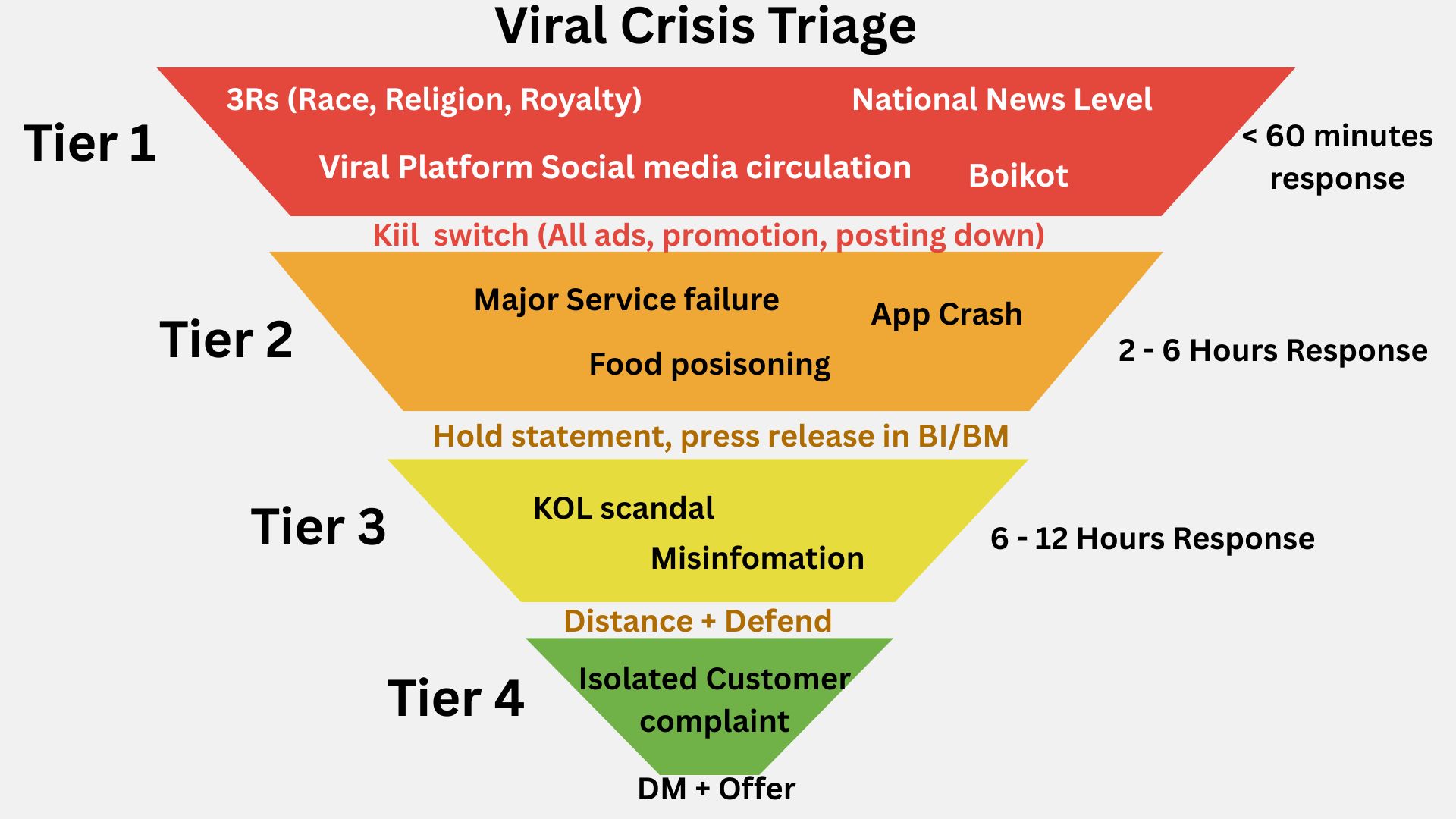
Crisis Response Matrix: Speed vs. Substance
Phase | Response Time | Format | Goal | Priority Platform |
The Triage | < 60 Minutes | Text Graphic / Status Update | Acknowledge & Pause Ads | X (Twitter) / TikTok |
The Investigation | 2–6 Hours | Internal Memo / Briefing | Fact-finding & Role Assignment | Internal / WhatsApp |
The Resolution | 6–12 Hours | CEO Video / Bilingual Post | Ownership & Action Plan | TikTok / Facebook |
The Recovery | 24 Hours+ | “Receipts” (Proof of Fix) | Rebuilding Brand Trust | Instagram / Threads |
How Do You Identify a Genuine Crisis From “Online Noise”?
Not every negative comment deserves a boardroom panic or a CEO statement. The first discipline in crisis response is knowing whether you are dealing with a loud distraction or a real reputational threat.
The thing about crises is that they rarely start big. They scale when the issue collides with cultural landmines and spreads through trusted community channels.
Start by separating noise from signal:
- Is it isolated or systemic?
A handful of angry comments, even if emotional, often signal individual dissatisfaction or trolling. A pattern of similar complaints, especially across different platforms, points to a deeper issue. - What is being triggered culturally?
Issues touching religion, race, language, festive practices, or perceived disrespect to local norms escalate faster than product or pricing complaints. - Are people sharing, not just reacting?
Likes and comments indicate attention. Shares indicate belief and endorsement. High share velocity is a far stronger warning sign than engagement volume.
Watch where the conversation is moving:
- When criticism stays on open platforms like Instagram or X, it is often manageable.
- When it jumps into WhatsApp groups, neighbourhood chats, alumni groups, or community Facebook pages, the dynamics change.
- These “interconnected digital kampungs” are trust-based networks. Once your brand narrative enters them, control drops sharply.
A rule of thumb in Malaysia:
If the conversation reaches the point where parents, relatives, or community elders are forwarding screenshots and voice notes, the issue has already crossed from online chatter into reputational risk.
“In Malaysia, virality is community-driven. If the ‘Aunties and Uncles’ are forwarding your brand’s mistake on WhatsApp, you are no longer dealing with a social media glitch, you are dealing with a reputation emergency.”
At that stage, speed, cultural awareness, and message discipline matter more than clever copy or social media replies.
Why is the “Holding Statement” your most important asset?
A holding statement buys you the one thing you don’t have: time.
Many Malaysian brands fail because they wait 12 hours to “get all the facts” before saying anything. By then, the narrative is already written by the commenters or worse, the media.
Your 60-minute response should be a bilingual (BM/English) acknowledgement that:
- You are aware
- You are investigating
- You care
It doesn’t need to be a solution, it just needs to be a presence. A “no comment” means your competitors and commenters can say whatever, and people would believe them because no one is telling them otherwise.
How should the tone change across different social platforms?
One size does not fit all in a multi-platform environment and it definitely does not fit in a multilingual and cultural society.
Your response on Facebook should not be a copy-paste of your TikTok response. The “Personality Playbook” is essential.
- TikTok: Needs a human face. A video of a manager or spokesperson speaking directly to the camera (unscripted, raw) feels more authentic to Malaysians.
- Threads/X: Requires a faster, punchier, and sometimes “witty” tone to de-escalate tension.
- Facebook: Remains the hub for community-focused, detailed explanations where older demographics seek clarity and “sincerity.”
What are the “Receipts” of a successful recovery?
Apologies are cheap but proof of change is expensive.
After the initial 24 hours, the public will move from “Why did this happen?” to “What are you doing about it?”
This is where you provide “The Receipts.”
- If the viral event was about a service failure, show photos of the staff undergoing new training.
- If it was a technical bug in your app, provide a transparent timeline of the fix.
Show you are doing something to rectify the mistake and the measures to make sure it doesn’t happen again.
How to Build a Resilient Response Structure
Every Malaysian business needs a pre-assigned “Crisis War Room” to bypass corporate red tape during a meltdown.
The last you want is bureaucracy and “approvals” to impede your response.
1. The 60-Minute Triage Checklist
Stop the bleeding by pausing all outgoing communication.
Immediately deactivate all scheduled posts and Meta/Google ads. There is nothing worse than a “Happy Friday!” automated post appearing right next to a viral video of a customer complaint.
Assign one person to be the “Listener”, someone who monitors the sentiment specifically in the comments of the viral post to identify the core “pain point”.
- Is it about the new price for an existing product?
- Rude attitude of our workers caught on camera?
- Cultural insensitivity during a holy month?
2. The Bilingual Advantage
Speak the language of the community to de-escalate.
A “Legal English” response can feel cold and evasive to the general public. Using Bahasa Melayu for your primary apology shows a level of local respect and sincerity that “Corporate English” lacks.
Ensure your translation isn’t just a Google Translate job or a ChatGPT one, it should use local nuances that reflect local values.
3. Implementing the “Social Listening” Shield
Catch the spark before it hits the forest.
WHile easier said than done, there are AI-driven social listening tools to set up alerts for your brand name + “bad,” “teruk,” “scam” or “boikot.”
By the time an executive sees a viral post, it’s often too late for a “low-key” fix.
Early detection allows you to reach out to the original complainant privately (Direct Message) within minutes, often resolving the issue before they hit the “Post” button on a public rant.
“Under the Online Safety Act (ONSA) 2025, self-reporting and rapid removal of “priority harms” can qualify your brand for “Safe Harbor” protections, avoiding MCMC fines of up to RM500,000.”
Conclusion: Turning Digital Crisis into a Strategic Comeback
A viral crisis is not just a PR headache, it is a defining moment for your brand’s future. The difference between a company that collapses under the weight of a TikTok scandal and one that emerges stronger lies in operationalized agility.
However, surviving the initial storm is only half the battle. True recovery happens in the weeks that follow, when you transition from defensive “firefighting” to proactive storytelling.
At PRESS (press.com.my), we specialize in helping Malaysian corporates and high-growth brands reclaim their narrative.
We don’t just “fix” reputations, we dominate the digital space to ensure your positive story is the one that stays.
Our Digital PR services are designed to:
- Rebuild Digital Visibility: We leverage high-authority media distribution to push negative search results off the news.
- AI Search Optimization (AEO): We ensure that AI-powered discovery tools like Gemini and Search Generative Experience (SGE) cite your brand’s corrective actions and official statements as the primary source of truth.
- Regain Public Favor: Through keyword-optimized storytelling and strategic “receipt” publishing, we help you win back customer trust by making your improvements visible and searchable.
- Long-term Reputation Shielding: Our hybrid PR x SEO approach builds a “moat” around your brand, creating a resilient digital footprint that protects you against future viral incidents.
Don’t let a 24-hour viral event define your legacy. Let Malaysia’s leading Digital PR agency help you flip the script and turn negative publicity into a catalyst for growth.
Disclaimer: The information in this article is provided for general information and educational purposes only and does not constitute legal, financial, or professional advice.