

Malaysia’s AI narrative has become impossible to ignore as of late.
- LinkedIn feeds are flooded with discussions about AI transformation (often made with AI)
- Companies are racing to integrate automation tools
- Universities are rapidly introducing AI-related programmes
The country too has seen growth. Data centres are expanding, foreign technology investments are increasing, and policymakers frequently position Malaysia as THE future-ready digital hub in Southeast Asia.
All very glib.
But behind the optimism lies a more uncomfortable question: Are fresh graduates actually benefiting from this AI boom in the way people assume?
Does AI only benefit corporations and companies while the everyday man is left out? Are the promised “high value chain jobs” really that many, or are our entry level jobs increasingly being replaced by AI?
We believe the readers already have a preconceived answer in their hearts, so let’s talk about it.
Did Malaysia’s AI Boom Actually Create Jobs?
To be fair, Malaysia’s AI and digital infrastructure boom has created jobs.
A lot of jobs, actually.
Microsoft previously estimated that its Malaysia cloud and AI investments alone could generate more than 37,000 jobs and US$10.9 billion in revenue over four years.
Google’s ongoing data centre and cloud expansion projects in Malaysia were also projected to support around 26,500 jobs by 2030.
At the same time, Malaysia’s data centre sector has exploded in activity:
- Equinix continues expanding in Kuala Lumpur
- Microsoft launched its Malaysia West cloud region
- Alibaba Cloud expanded its Malaysian footprint
- Johor and Klang Valley have become regional data centre hotspots
- Schneider Electric recently announced a Southeast Asia training hub in Malaysia tied directly to AI infrastructure demand
Even on job portals today, there are already:
- More than 700 AI-related job listings nationwide
- Hundreds of data centre-related openings in Kuala Lumpur alone
So the AI boom itself is not fake, so why does this article exist?
The Bigger Question Is: What Kind Of Jobs Are Being Created?
Not all AI-related jobs are automatically accessible to fresh graduates.
Many of the roles emerging from Malaysia’s AI boom are tied to:
- Cloud infrastructure
- Semiconductor engineering
- Cybersecurity
- Data centre operations
- Enterprise software
- Network engineering
- AI systems deployment
These are often highly specialised or technical positions, even many “junior” openings increasingly expect:
- Internships
- Portfolio projects
- Automation familiarity
- Cloud exposure
- AI workflow understanding
- Deployment experience
That creates a disconnect where the economic activity is booming, room for accessible entry-level pathways into that economy does not.
And perhaps that is why the anxiety among young Malaysians still feels so real despite all the optimistic headlines surrounding AI growth.
The AI Boom May Be Creating More Pressure Than Opportunity For Some Grads
This is where the discussion becomes more controversial, and we don’t shy away from it.
As you know, AI is also making many repetitive and high output jobs obsolete. Tasks once commonly assigned to junior employees now face automation pressure. These commonly include:
- Basic copywriting
- Administrative documentation
- Entry-level research
- Simple customer support
- Repetitive reporting
- Basic coding assistance
In many workplaces, AI tools are becoming productivity multipliers for senior employees. One experienced worker using AI can sometimes produce work that previously required several junior staff members, it’s the story Sam Altman and many other AI CEOs have sold to us.
That does not necessarily mean jobs are disappearing entirely. But it does mean less demand for junior roles that AI can easily replace.
Malaysian Employers Increasingly Want “AI-Ready” Graduates, But What Does That Mean?
A few years ago before the Great Covid-19 Pandemic changed our society as a whole, being digitally skilled in Malaysia mostly meant knowing how to use spreadsheets, presentation tools, or basic workplace software.
Today, many employers casually mention “AI familiarity” in job descriptions as though it is already a standard expectation.
But for fresh graduates, the phrase itself can feel incredibly vague.
Does AI-ready mean:
- Knowing how to use ChatGPT?
- Understanding prompting?
- Being able to automate workflows?
- Building machine learning models?
- Analysing data?
- Using AI tools productively at work?
Companies increasingly want graduates who can work faster using AI tools and integrate AI into day-to-day workflows.
The issue is that many graduates are still trying to figure this out themselves.
“Universities expect industry to provide course-appropriate jobs for fresh grads, yet the industry expects universities to churn-out job ready graduates.”
Students from stronger urban universities, tech-focused environments, or self-learning communities may naturally gain more AI exposure outside the classroom.
Others may graduate with solid academic results but little understanding of how businesses actually use AI tools operationally.
That creates a new type of employability gap, further creating the digital divide Malaysia already faces.
And while we don’t all live on top of trees, the truth is that many rural parts of Malaysia don’t even have internet access, this article won’t reach them either.
And in a slower economy where companies are pressured to improve efficiency, cut cost and restructure, businesses naturally prioritise candidates who can contribute immediately at the lowest price.
Universities Are Racing To Catch Up
Higher education institutions across Malaysia are increasingly promoting AI-focused programmes, certifications, and technology partnerships.
On one hand, this is necessary. Graduates entering the workforce without digital adaptability may struggle in future labour markets.
On the other hand, we feel it’s more of a gimmick marketing AI than in fully preparing students for workplace realities.
Learning about AI conceptually is very different from:
- Applying automation in workflows
- Solving business problems
- Managing AI tools productively
- Working in hybrid digital environments
Some graduates may leave university believing they are “AI-ready,” only to discover employers expect far more practical experience.
“Anyone can ask AI to spin out a prompt, but the why and know-how is always important.”
Malaysia’s AI Ambition Is Real, But So Is Graduate Anxiety
Malaysia genuinely is experiencing a major AI and digital transformation phase. The investments, infrastructure expansion, and business interest are all very real.
But fresh graduate anxiety is real too.
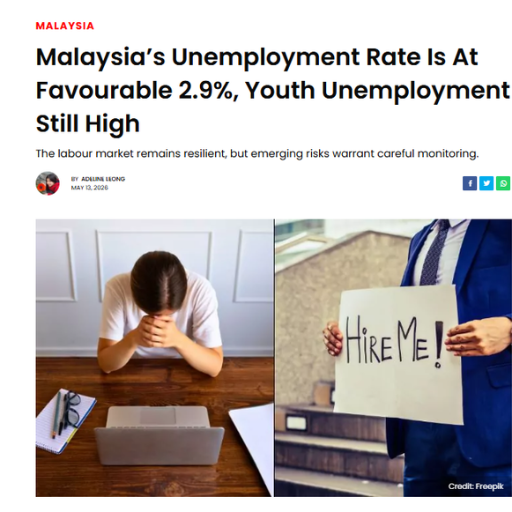
DOSM’s latest figures show Malaysia’s labour market is relatively stable overall, for example, the national unemployment rate was 2.9% in Q1 2026.
But youth unemployment remains much higher, and it depends on which “youth” age bracket you’re talking about. Recent DOSM-reported figures cited in March 2026 reporting show 15–24 at 10.2%, while the 15–30 bracket was 6.2%.
Either way, young Malaysians still face steeper barriers entering the workforce, even as the broader market looks “fine” on paper.
And increasingly, AI is becoming part of that pressure. Many are asking:
- What skills are actually enough anymore?
- Which jobs are still safe?
- How much experience is expected before getting hired?
- Is a university degree alone still enough?
- How do you gain experience if companies increasingly want “AI-ready” hires immediately?
This is the tension that often gets lost beneath the optimistic headlines about Malaysia’s AI growth.
The country may be advancing technologically, but many graduates still feel like they are struggling to find a place within that transformation.
The AI Bubble That Can’t Be Denied
Whether people want to admit it or not, the world is currently experiencing an AI gold rush unlike anything seen in the modern tech era.
Trillions of dollars are flowing into:
- AI infrastructure
- Data centres
- Semiconductor manufacturing
- Cloud computing
- GPU production
- AI software ecosystems
And of course the energy infrastructure needed to power all of it
The scale is honestly difficult to comprehend. In many ways, the ecosystem has started feeding itself. An ouroboros of AI capital so to speak.
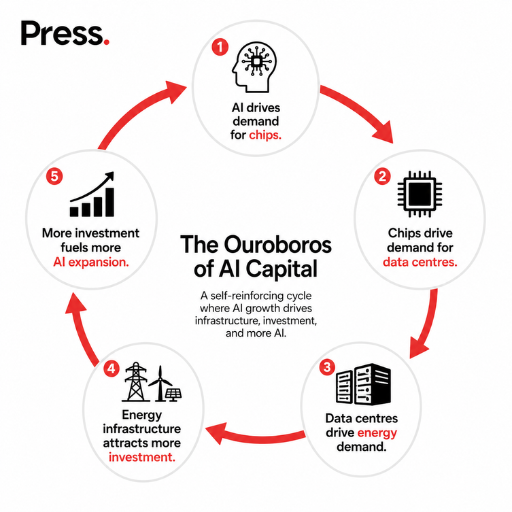
And the cycle continues accelerating. Governments and businesses are behaving as though AI will define the next economic era.
And Malaysia is no exception.
Like many countries across Asia, we are now trying to secure its position before the market fully matures. The country has aggressively promoted itself as a regional hub for:
- Data centres
- Digital infrastructure
- Cloud investments
- Semiconductor activity
- AI-driven economic growth
Countries that successfully position themselves early could benefit enormously from future technology ecosystems, talent inflows, and foreign investments.
But this race to stay ahead also creates immense pressure on all sides.
| Stakeholder | Growing Pressure From The AI Race |
|---|---|
| Businesses | Companies suddenly feel compelled to adopt AI quickly or risk appearing outdated and uncompetitive. |
| Universities | Higher education institutions are under pressure to produce “AI-ready” graduates for a rapidly changing market. |
| Workers | Employees increasingly worry about automation, redundancy, and whether their skills will remain relevant. |
| Fresh Graduates | Many young Malaysians fear they are already falling behind before their careers have even properly started. |
| Governments | Countries are racing to secure AI investments, digital infrastructure, and long-term technological relevance. |
Conclusion: How do we prepare The Next Generation for the Future
Every generation experiences a technological revolution that reshapes society.
In the early 1900s, it was electricity.
In the 2000s, it was the internet.
Today, it is AI.
And historically, there is always one generation that ends up living through the most uncomfortable part of the transition. The generation caught between the old system and the new one.
In many ways, Malaysian Gen Zs and perhaps even early Gen Alphas, may become that generation.
But for fresh graduates, the future may not simply depend on learning AI itself. It may depend on learning how to work alongside it and adapt with it. As the saying goes.
“Those who do not keep up with the times, will be left behind by it”.
And right now, we live in very interesting times.
This piece was brought to you by PRESS and their writers. The opinions expressed here are based on market observation and national policy.