

In Malaysian workplaces, when someone stops showing up and goes silent, people often say they’ve “gone AWOL” or are “MIA.” For managers and HR, it creates operational stress. For employees, it can quickly become a disciplinary issue.
But not every AWOL situation is simple job abandonment. Some involve emergencies, burnout, mental health struggles, miscommunication, unclear leave procedures, or administrative errors.
This guide breaks down what AWOL means in Malaysia, what HR typically does, what labour law basics actually say (without heavy legalese), and how both employers and employees can handle the situation more fairly.
What AWOL Means in Malaysian Workplaces
AWOL is workplace shorthand for being absent without approved or authorised leave. In HR documentation, you’ll often see clearer terms like:
- Unauthorised absence
- Absence without leave
- Absent without permission
An employee may be treated as AWOL when they:
- Fail to report to work without approval
- Do not follow reporting procedures (for example, who to contact and when)
- Stop responding to reasonable contact attempts
- Remain absent without explanation or evidence
- Do not provide required documents (such as medical certificates) under company policy
AWOL vs MIA: Is There a Difference?
“MIA” (“Missing In Action”) is usually casual slang. “AWOL” sounds more formal and is commonly used in HR and disciplinary conversations.
If you’re writing policies, letters, or records, “unauthorised absence” is usually the safest and least emotional wording.
What Malaysian Labour Law Says About Unauthorised Absence
“AWOL” isn’t defined as a legal term in Malaysian statutes. What the law deals with is absence, leave, contract obligations, and fair process.
One key point many articles miss: the governing law depends on where the job is based.
Peninsular Malaysia and Labuan: Employment Act framework
For many workplaces in Peninsular Malaysia and Labuan, a commonly referenced rule links prolonged unauthorised absence to a serious contract issue.
In plain English, the idea is:
- Continuous absence for more than two consecutive working days without prior leave may be treated as a breach of contract
- Unless the employee has a reasonable excuse and has informed (or tried to inform) the employer prior to or at the earliest opportunity during the absence
This is why “two straight working days with no prior leave and no contact” often triggers urgent HR action.
Sabah and Sarawak: Labour Ordinances framework
If the job is based in Sabah or Sarawak, the legal framework is different. Sabah and Sarawak have their own Labour Ordinances with similar “more than two consecutive working days” concepts, but the governing statutes and details are not identical to Peninsular Malaysia’s framework.
Why this does not mean “instant dismissal”
Even where the law recognises prolonged unauthorised absence as serious, employers are generally safest treating AWOL as a verification and fair-process issue, not a snap decision.
In practice, disputes often hinge less on “was the person absent” (sometimes obvious) and more on:
- Whether the employer verified facts before accusing the employee
- Whether the employee had a reasonable excuse
- Whether the employer attempted contact reasonably
- Whether the employee had a chance to explain
- Whether the employer applied policy consistently and proportionately
Common AWOL Scenarios in Office Life
AWOL can look the same on a timesheet, but the story behind it can be very different.
Intentional job abandonment
This usually involves patterns like:
- The employee stops coming in
- The employee ignores calls/messages
- There is no attempt to explain or return
- The employee does not resign properly
Emergency absence
This can include:
- Hospitalisation or accidents
- Family emergencies
- Bereavement
- Mental health crises
- Sudden caregiving responsibilities
Even if there was no intention to abandon the job, communication can break down.
Burnout or emotional shutdown
Some employees go silent because they’re overwhelmed by:
- Severe stress or anxiety
- Panic attacks
- Emotional exhaustion
- Fear of confrontation
- Toxic or unsafe workplace conditions
This doesn’t excuse prolonged silence, but it’s a reason employers should investigate before assuming bad faith.
Miscommunication or administrative failure
These situations can happen when approvals and reporting are unclear. For example:
- A manager gives a verbal “okay” but it’s not recorded
- A roster changes last-minute and expectations aren’t communicated
- HR or scheduling isn’t updated properly
This is why clear confirmations and consistent record-keeping matter.
Attendance system or record errors
Disputes can also happen due to practical issues, such as:
- Biometric scanner failures
- App check-in issues
- Roster mismatches
- Payroll/attendance syncing problems
- Manual entry mistakes
Before escalating, HR should verify records against rosters, system logs, and manager confirmations.
Why Not Every AWOL Case Is Misconduct
Absenteeism affects operations, workload, and payroll compliance, so employers can’t ignore it. But fair handling requires context.
Common reasons people end up AWOL include:
- Medical issues
- Personal emergencies
- Mental health struggles
- Severe burnout
- Fear of disciplinary action
- Workplace bullying
- Poor communication or unclear procedures
- Administrative mistakes
A fair process helps distinguish between genuine emergencies, carelessness, and intentional abandonment.
How HR Typically Handles an AWOL Case
A good HR response is calm, structured, and documented.
Step 1: Verify and attempt contact
Most employers try to reach the employee through:
- Phone calls
- Messaging (for example, workplace chat or WhatsApp where appropriate)
- Immediate supervisor
- Emergency contact (used carefully and only where appropriate)
At the same time, HR should verify:
- Attendance records
- Rosters and schedules
- Leave applications
- Prior communications
- Any medical or supporting documents already submitted
Step 2: Request an explanation formally
If the employee remains absent or the explanation is unclear, HR may issue a show cause letter asking the employee to explain the absence and provide evidence within a stated timeframe.
Step 3: Decide proportionately, with documentation
If the situation is serious (especially if termination is being considered), employers typically document the review process clearly and ensure the employee had a reasonable chance to respond.
Medical Certificates, Emergencies, And Privacy: Handling Evidence Without Overstepping
Many AWOL cases involve health or family emergencies, which creates a tension: employers need enough information to manage attendance fairly, but employees also deserve privacy and dignity.
A practical approach is to focus on function, not personal details:
- Ask what you need, not everything: For example, “Are you unfit for work and for how long?” is usually more appropriate than probing for medical specifics.
- Be clear about acceptable proof: If your policy requires a medical certificate, say so early. If the employee can’t obtain one immediately (hospitalisation, overseas emergency, etc.), allow them to provide supporting evidence later where reasonable.
- Apply standards consistently: If one employee is given flexibility for late documentation, similar cases should be treated similarly.
- Limit access to sensitive information: Keep documents with HR (or a designated officer) rather than circulating them in group chats or wide email chains.
- Separate support from discipline: Where mental health or crisis is involved, consider a welfare check-in and practical reintegration plan (return-to-work meeting, temporary adjustments) before jumping straight into punishment, while still documenting the absence properly.
Handled well, this reduces conflict on both sides: employees are less likely to shut down out of fear, and employers still get the evidence needed to make a fair decision.
A Simple AWOL Timeline HR Can Follow
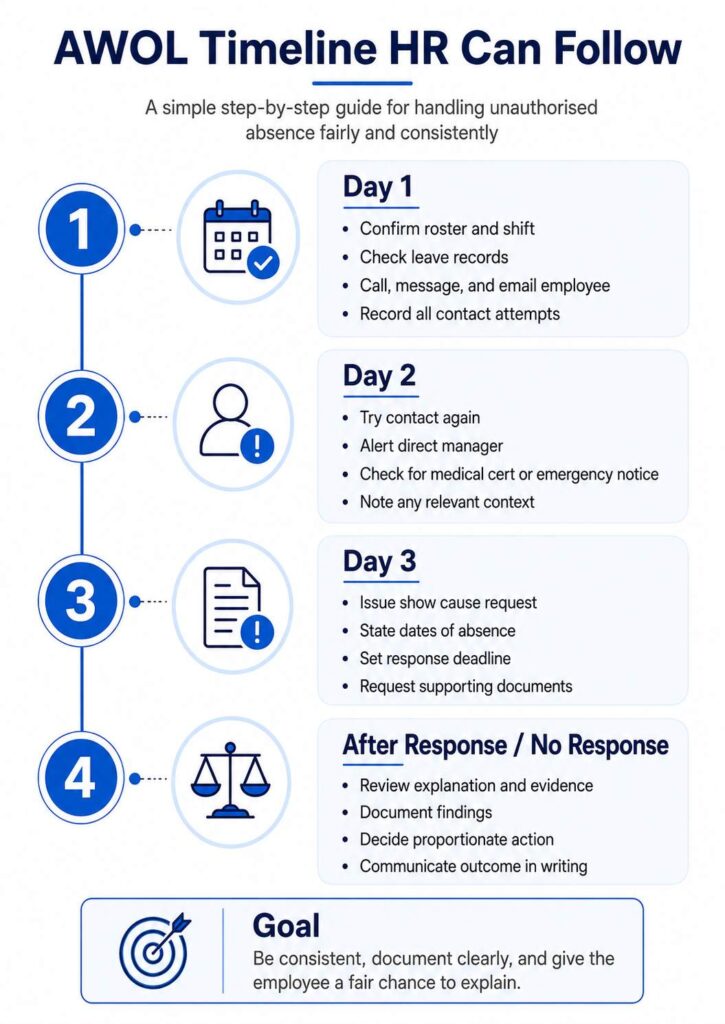
When AWOL happens, confusion usually comes from inconsistent timing: some managers panic on day one, others wait too long, and documentation becomes messy. A simple internal timeline helps HR act consistently and reduces disputes.
Day 1 (same day absence is noticed)
- Check roster/shift times and confirm the employee was expected to work.
- Review leave records and any prior messages.
- Attempt contact using the usual channels (call + message + email where appropriate).
- Record the time and method of each contact attempt.
Day 2 (continued absence)
- Try contact again at reasonable intervals.
- If there’s no response, alert the direct manager and check whether the employee recently reported stress, workload issues, or family emergencies.
- Confirm whether any medical certificate or emergency notice was submitted to a supervisor but not yet forwarded to HR.
Day 3 (risk point for prolonged absence)
- If there is still no response, issue a written request for explanation (often framed as a show-cause request).
- Clearly state: the dates of absence, the expected reporting procedure, the response deadline, and what documents can support the explanation (e.g., medical certificate, police report, hospital letter).
After response / no response
- If the employee replies, assess reasonableness and decide proportionate action.
- If there is no reply, HR should document the absence, the contact attempts, and the opportunities given to explain before taking serious action.
This kind of timeline doesn’t replace judgement. It makes judgement consistent, which is what protects both employer and employee.
What Outcomes Can Happen if AWOL Is Proven
Outcomes depend on the facts, policy, and how the process is handled. Common outcomes include:
- Counselling or a corrective discussion
- Verbal or written warning
- Final warning
- Loss of pay for days not worked (where applicable)
- Suspension pending investigation (where policy/contract allows)
- A more formal inquiry process for serious cases
- Termination in serious or repeated cases
A first-time incident caused by miscommunication may end with counselling or a warning. A multi-day disappearance with no response and no credible reason can lead to termination.
What a Fair Dismissal Process Usually Looks Like
Employers should generally avoid impulsive termination decisions. A fair process often includes:
- Confirming the absence with reliable records
- Checking whether any emergency notifications or leave requests exist
- Attempting reasonable contact and recording attempts
- Requesting an explanation (often via a show cause letter)
- Reviewing the response and evidence
- Taking proportionate, consistent action
- Communicating the decision in writing
Even where policy is strict, fairness and consistency are what reduce disputes.
Why Documentation and Leave Policies Matter
Clear documentation protects both sides.
For employees
Records can help show that you:
- Requested leave
- Informed someone early
- Tried to communicate during the absence
- Provided evidence (where possible)
For employers
Records can help show that you:
- Verified facts before accusing
- Tried to contact the employee reasonably
- Applied policy consistently
- Gave an opportunity to explain
- Made a proportionate decision
Good policies should clearly state:
- Who to contact if you can’t attend work
- Deadlines for reporting
- What evidence is needed (for example, medical certificates where applicable)
- How leave approvals are confirmed
- What happens if someone goes uncontactable
- How discipline is handled, step by step
What Employees Should Do if They Already Went AWOL
If you’ve already gone AWOL, continuing to disappear usually makes things worse.
Practical steps that help:
- Contact HR or your manager as soon as possible
- Explain what happened simply and honestly
- Apologise for the communication gap
- Provide documents if you have them
- Ask what the next step is (return date, meeting, show cause response)
Depending on the situation, outcomes may include returning to work, warnings, resignation discussions, or a mutual resolution.
How Employers Can Handle AWOL More Fairly
Employers don’t need to ignore misconduct to be compassionate. They need a process that is firm and fair.
Managers should avoid:
- Public humiliation
- Angry group chat messages
- Gossip
- Emotional threats
- Public accusations
Instead, HR should focus on:
- Checking whether there was an emergency
- Confirming record accuracy
- Applying policy consistently
- Keeping communication respectful
- Choosing proportionate outcomes
If AWOL is frequent across the organisation, it may signal deeper issues like burnout, weak scheduling, poor communication, bullying, or excessive overtime.
AWOL Isn’t Always Clear-Cut
AWOL in Malaysia is serious, but it’s rarely black and white. Some cases are misconduct; others involve emergencies, burnout, miscommunication, or system errors.
Employees should communicate early whenever possible. Employers should verify facts, document steps, and follow a fair process before making major decisions. Clear policies and consistent handling reduce disputes and protect everyone involved.
At PRESS PR Agency, Malaysia’s number one PR agency, we help businesses strengthen brand trust, reputation management, and organisational communication through strategic PR services for modern Malaysian companies.
Disclaimer: This article is general information, not legal advice. If a case involves dismissal, a dispute, or formal proceedings, professional advice may be appropriate.
Sources
Primary legal references:
- Employment Act 1955 (Act 265)
- Industrial Relations Act 1967 (Act 177)
- Industrial Relations Department guidance on dismissal representations
- Sabah Labour Ordinance (Cap. 67)
- Sarawak Labour Ordinance (Cap. 76)
Further reading (commentary):
- MahWengKwai & Associates — absenteeism and dismissal practice
Frequently Asked Questions About Being AWOL and How it Should be Handled
Can An Employee Be Fired Immediately For AWOL?
Not always. Even where prolonged unauthorised absence is treated as serious, employers are generally safer following a fair process (verifying records, attempting contact, requesting an explanation, and documenting each step) before deciding on dismissal.
What Counts As AWOL At Work In Malaysia?
AWOL usually refers to being absent without approved leave and without following reporting procedures. In practice, it often involves an employee not showing up and becoming uncontactable, with no clear explanation.
What Does The “Two Consecutive Working Days” Rule Mean?
Many workplaces treat continuous absence for more than two consecutive working days without prior leave as a serious contract issue. The exact legal framework depends on where the job is based (Peninsular Malaysia/Labuan vs Sabah vs Sarawak), and employers should still handle the case fairly and consistently.
Is AWOL Always Misconduct?
No. Some cases involve job abandonment, but others involve emergencies, burnout, mental health crises, or miscommunication. Employers should investigate before assuming bad faith.
What Should Employees Do If They Already Went AWOL?
Contact HR or your manager as soon as possible, explain what happened honestly, apologise for the communication gap, provide documents if you have them, and ask what the next steps are (return date, meeting, show cause response).
Can HR Or Attendance Systems Cause False AWOL Records?
Yes. Roster mismatches, check-in failures, syncing issues, or manual entry errors can cause disputes. HR should verify records against schedules and system logs before escalating.