

Malaysia’s ageing population could reshape everything from healthcare demand and labour supply to housing, consumer spending, and future government policy. As fertility rates decline and more Malaysians enter retirement age, businesses and policymakers may need to adapt faster than expected.
Recently, the government said it is studying a proposal to introduce a parental care law. The discussion sparked nationwide debate around caregiving, financial pressure, family responsibility, and a bigger question:
Is Malaysia prepared for the realities of an ageing society?
The discussion naturally sparked nationwide debate around caregiving, financial pressure, family responsibility, and the biggest question of all.
Is Malaysia prepared for the realities of an ageing society?
When many think of aging societies, they think of the East Asian countries like China, Japan or South Korea. Yet governments around the world had already sounded the alarm regarding falling fertility rates and the concerns of social security strains
The effects are already beginning to appear:
- Rising healthcare pressure
- Workforce shortages
- Growing retirement concerns
- Changing buyer priorities.
But an ageing population does not simply mean “more elderly people” and today, our PR agency would like to dive deeper into how an aging Malaysia will affect the country and what it means for businesses.
Malaysia’s Demographic Shift Is Happening Faster Than Expected
Malaysia’s fertility rate has continued declining in recent years, while the proportion of older Malaysians steadily increases.
According to the Department of Statistics Malaysia (DOSM), Malaysia’s total fertility rate (TFR) has been below the replacement level (2.1) since 2013, and the national TFR fell to 1.6 in 2022.
Here are the facts:
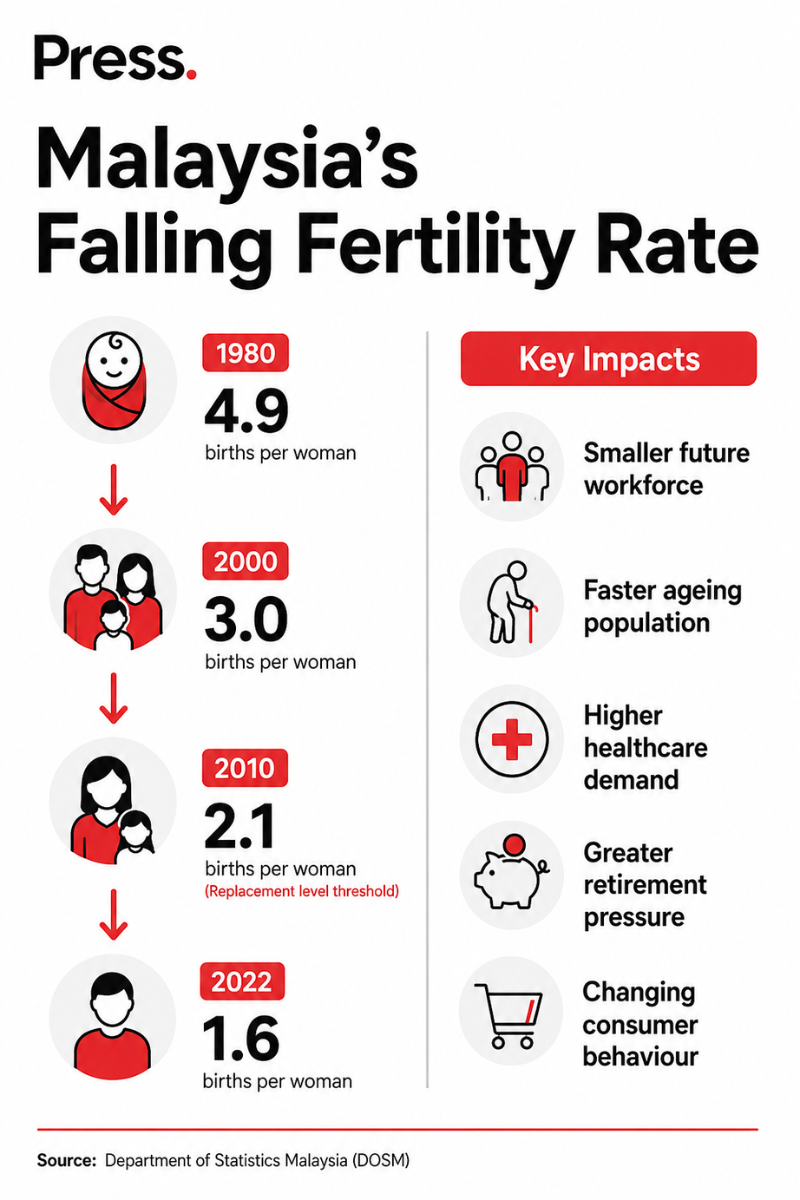
Eventually, these would lead to a domino effect where:
- Fewer young workers entering the labour force
- Higher dependency ratios
- Greater healthcare demand
- Slower household formation
- Increased retirement-related financial pressure
Unlike previous generations where housing was more affordable and land was cheaper, younger Malaysians today also face higher living costs, delayed marriage and lower home ownership rates.
For the youth of the Malaysia he sequence increasingly looks like:
“No financial stability → No house → Delayed marriage → Fewer children”
And according to DOSM, the Malaysia Chinese community recorded the lowest Total Fertility Rate (TFR) among major ethnic groups in Malaysia at approximately 0.8 children per woman in 2022, far below the replacement threshold of 2.1.
In comparison, Malays recorded around 2.1 children per woman during the same period.
DOSM’s population projections show the citizens’ population share of Malaysians identifying as Chinese is projected to decline from 21.1% (2030) to 14.8% (2060) if current demographic trends continue.
Total Fertility Rate (Approximate, 2022)
| Ethnicity | Fertility Rate |
|---|---|
| Malay | 2.1 |
| Indian | 1.1 |
| Chinese | 0.8 |
Why Businesses Should Pay Attention to an Ageing Malaysia
Businesses still view demographic shifts as purely government concern but a demographic decline will absolutely affect every industry.
Let’s take childhood education as an example.
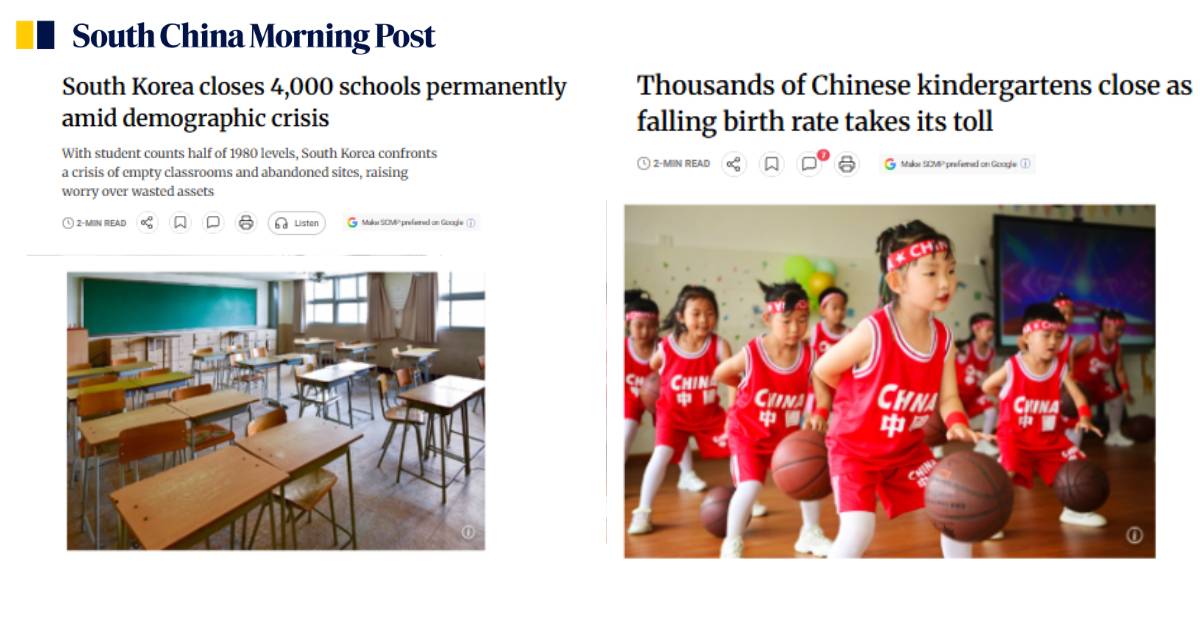
If fewer children are being born, demand for kindergartens, childcare centres, and primary schools naturally declines over time. Eventually, some schools may struggle to sustain enrollment numbers.
But the impact does not stop there.
Entire surrounding ecosystems may also feel the effects:
- Stationery shops
- School bus operators
- Tuition centres
- Children’s apparel brands
- Book publishers
- Canteen operators
- Enrichment programmes
This effect is already seen in other countries:
At the same time, other sectors will see exponential growth. Consumer priorities gradually shift toward:
- Healthcare and wellness spending
- Retirement planning
- Insurance and financial security
- Caregiving-related services
- Slower-paced travel and leisure preferences
Hence, why businesses that continue focusing only on younger consumers may eventually misread where future purchasing power is heading.
“Many older middle-income consumers already own homes, possess accumulated savings, and prioritise healthcare, comfort, stability, and long-term security.”
Over time, the question may no longer be: “How do we market to young consumers?”
But rather: “Are our products, services, and business models prepared for an older Malaysia?”
The Four Areas Most Likely to Be Affected
Labour and Workforce Pressure
One of the least discussed risks is workforce compression. As birth rates fall and older workers retire, businesses will eventually face:
- Hiring difficulties (especially in 3D sectors, Dirty, Difficult and Dangerous)
- Rising wage pressure
- Productivity strain
- Heavier reliance on automation
- Skills shortages
Malaysia already relies heavily on migrant labour across multiple industries like construction and plantation. An ageing population will intensify this dependence unless productivity and workforce participation improve.
Employers may also need to rethink:
- Retirement flexibility
- Older worker retention
- Workplace accessibility
- Reskilling programmes
Healthcare and Elderly Care Demand
Healthcare is often the first issue associated with ageing populations. Malaysia runs one of the best healthcare systems in the world, yet it is not without is snags
Public healthcare: Affordable, effective but requires long waiting time
Private healthcare: Fast but expensive, out of reach for many.
Older populations will see increased demand for:
- chronic disease management
- rehabilitation services
- long-term care
- specialist healthcare
- home caregiving
- mental health support
The data already shows why this matters. The Ministry of Health’s NHMS 2025 reports among older persons:
- Diabetes 39.1%
- Hypertension 73.1%
- Hypercholesterolaemia 76.2%.
More importantly, 68% have at least two of these non-communicable diseases, while 30% have all three.
| Health indicator among older Malaysians | NHMS 2025 finding |
|---|---|
| Diabetes | 39% |
| Hypertension | 73% |
| High cholesterol | 76% |
| At least two NCDs | 68% |
| All three NCDs | 30% |
The caregiving burden is already visible. NHMS 2025 reported that 1 in 3 caregivers of dependent older persons experience burden, including physical, emotional, social, or financial strain
Consumer Spending and the Silver Economy
So far we’ve been pretty negative on the effect of an aging population but an aging population does not automatically mean weaker economic activity.
This is where the “silver economy” becomes important and one where YOU as a business owner, should pay very close attention to.
Many companies still design digital experiences primarily around younger audiences, despite older users increasingly becoming digitally active.
“DOSM states internet usage among Malaysians aged 60 and above increased to 92.3% in 2024, reflecting how digital adoption among seniors has accelerated significantly.”
The shift became especially noticeable after the pandemic, when many older Malaysians began relying more heavily on:
- Online banking
- eWallets like TnG
- Telemedicine services
- Food delivery apps
- WhatsApp and video calls
- eCommerce platforms
Housing and Urban Planning
An ageing population may also reshape housing demand. Future trends could include:
- Smaller household sizes due
- Elderly-friendly housing
- Assisted living growth
- stronger demand for healthcare-accessible locations
That said, urban planning may eventually require more walkable infrastructure and age-friendly public spaces.
Property developers ignoring demographic realities may eventually misjudge long-term demand trends.
Retirement Pressure Is Becoming Harder to Ignore
One major challenge behind Malaysia’s ageing population is that many Malaysians are simply not saving enough for retirement.
According to recent EPF and Ministry of Finance data, a large proportion of EPF contributors still do not meet the minimum retirement savings benchmark required for basic long-term financial security.
As of end-2025:
- Parliamentary reporting said 3.1 million (41.2%) of active EPF members in the formal sector (Malaysian citizens aged 18–55) had reached the Basic Savings level-by-age
- Approximately 4.42 million (58.8%) had still had not reached the targeted minimum savings level for retirement
Even more concerning, broader parliamentary disclosures showed that when inactive contributors are included, only around 23.9% of EPF members aged 18 to 55 met the basic retirement savings benchmark as of August 2025.
Under EPF’s newer Retirement Income Adequacy (RIA) framework:
- Basic savings target: RM390,000
- Adequate savings target: RM650,000
- Enhanced savings target: RM1.3 million
EPF estimates that a single elderly Malaysian in the Klang Valley now requires approximately RM2,690 monthly for a reasonable retirement standard of living.
EPF Retirement Adequacy Snapshot
| Retirement Indicator | Latest Data |
|---|---|
| EPF members meeting minimum savings target | 41.2% |
| EPF members below minimum savings target | 58.8% |
| Basic retirement savings benchmark | RM390,000 |
| Adequate retirement savings benchmark | RM650,000 |
| Estimated monthly retirement needs | RM2,690 |
Malaysia Is Already Preparing for an Ageing Population
While Malaysia may not yet be an “aged nation,” policy discussions surrounding aging are already accelerating.
Several government initiatives, reforms, and proposals have either been introduced or are currently under review as policymakers prepare for long-term demographic pressure.
Existing and Proposed Ageing-Related Policies in Malaysia
| Policy / Initiative | Status | Why It Matters |
|---|---|---|
| National Policy for Older Persons (DWEN) | Existing | Supports active ageing, elderly well-being, and community support |
| Elderly Healthcare Services Action Plan 2023–2030 | Existing | Expands elderly healthcare planning and geriatric care |
| Proposed Parents Care Act / Filial Piety Law | Proposed | Would potentially require adult children to support elderly parents |
| EPF Retirement Income Adequacy (RIA) Framework | Implementing 2026 | Introduces stricter retirement savings benchmarks |
| Retirement Age Review under 13MP | Under study | Government reviewing retirement age and re-employment laws |
| Elderly Assistance (BWE) | Existing | Monthly aid for low-income senior citizens |
| National Dementia Action Plan | Existing / expanding | Addresses rising dementia and elderly cognitive care |
At the same time, the government is also reviewing Malaysia’s retirement-age framework under the 13th Malaysia Plan (13MP), including possible re-employment reforms for older workers.
Healthcare planning is evolving too. Malaysia’s Elderly Healthcare Services Action Plan 2023–2030 and National Dementia Action Plan reflect growing concern over:
- Frailty
- Chronic disease management
- Long-term care
- Geriatric workforce shortages
- Dementia support systems
Even broader social conversations are changing. The proposed Parents Care Act sparked debate because it touches directly on one uncomfortable reality:
“Malaysia’s traditional family support system may no longer be sufficient on its own as the population ages.”
Aging Population and Changing Wings
Throughout the article, we’ve explained and brought out some pretty grim data and trends ,yet that is the reality and demographic declines cannot be easily reversed.
For businesses, we think you understand how all of this will absolutely affect:
- Consumer behaviour
- Hiring
- Long-term demand
- Product design
- Market growth potential
Hence, the bigger question is no longer if Malaysia will age, we do so every year.
But rather, if business, institutions and society can adapt quickly enough before these demographic pressures become much harder to reverse, and too much for our current systems to handle.
This opinion piece is by PRESS and their writers.
Source:
- Department of Statistics Malaysia (DOSM) — Vital Statistics, Malaysia, 2023 (released 17 Oct 2023) — national TFR + ethnic-group highlights (e.g., Malay 2.1; Chinese 0.8; below replacement
- Department of Statistics Malaysia (DOSM) — Population Projections, Malaysia, 2020–2060 (released 11 Jul 2025) — projections like Chinese citizens’ share 21.1% (2030) → 14.8% (2060); ageing milestones.
- Department of Statistics Malaysia (DOSM) — ICT Use and Access by Individuals and Households Survey Report 2024 (published 2024) — internet usage by age group (used to validate the 60+ 92.3% claim).
- Ministry of Health Malaysia (MOH) / Institute for Public Health (IKU) — National Health and Morbidity Survey (NHMS) 2025: Older Persons Health Factsheet (published 2025) — diabetes/hypertension/cholesterol stats + caregiver burden.
- Employees Provident Fund (EPF/KWSP) — EPF release covering Belanjawanku 2024/2025 + Retirement Income Adequacy (RIA) Framework (published 2024/2025) — RM2,690/month estimate; RIA tiers RM390k / RM650k / RM1.3m.
- Employees Provident Fund (EPF/KWSP) — EPF policy/product enhancements announcement for 2026 (effective 1 Jan 2026) — RIA implementation timing.
- Bernama — Govt studying parental care (“filial responsibility”) law proposal (published 7 May 2026).
- Ministry of Finance Malaysia (MOF) — press citation/article on ageing milestone + aged society projections (published 26 Aug 2025) — “ageing” threshold framing used in Malaysia’s comms.
- World Bank — Migration, Automation, and the Malaysian Labor Market (published Nov 2024) — migrant labour share and sector concentration (used to quantify “relies heavily on migrant labour”).
- New Straits Times (secondary; cites DOSM / parliamentary statements) — used only where the original content needed context not directly in the DOSM headline release (e.g., Indian TFR trend; EPF benchmark reporting).
Frequently Asked Questions About Aging Malaysia
What Is an Ageing Nation?
An ageing society is commonly discussed using international thresholds such as 7% of the population aged 65+. In Malaysia’s policy context (DWEN), an additional milestone is often cited: an “ageing nation” when 15% of the population is aged 60+.
Why Is Malaysia’s Fertility Rate Declining?
Several factors contribute, including rising living costs, delayed marriage, urbanisation, career priorities, and changing lifestyle expectations among younger generations.
What Is the Silver Economy?
The silver economy refers to economic activity linked to older populations, including healthcare, retirement services, accessibility products, financial planning, and elderly-focused services.
How Could Ageing Affect Malaysian Businesses?
Businesses may face changing consumer demand, labour shortages, rising healthcare-related costs, and shifting spending behaviour among older consumers.
Which Industries May Benefit From an Ageing Population?
Healthcare, insurance, wellness, retirement planning, home care, pharmaceuticals, and elderly-friendly property sectors may see stronger long-term demand.
Why Does Demographic Change Matter for Policy Planning?
Ageing populations may increase pressure on pensions, healthcare systems, taxation, workforce participation, and social protection frameworks over time.