If you’ve ever been left waiting at a mamak while your friend suddenly goes quiet, chances are you’ve heard this before: “Eh, don’t FFK me.”
It’s one of those Malaysian slang terms that sounds casual, but can sting a bit depending on the situation. In simple terms, FFK means someone cancelled last minute or didn’t show up after saying they would.
But like most Malaysian slang, there’s more going on beneath the surface. It comes from Cantonese, has a literal image that doesn’t immediately “click,” and somehow became one of the most relatable everyday expressions here.
And honestly, Malaysia is the perfect place for a word like this to go mainstream. We’re a country where languages mix naturally; Malay, English, Mandarin, Chinese dialects, Tamil, plus many more. The 2020 census recorded a population of 32.4 million, and everyday speech often reflects the different communities, schools, and social circles we move through. No surprise slang travels fast, gets shortened, and eventually becomes… just normal.
Let’s break it down properly, from what it literally means to how people actually use it.
What Does FFK Mean in Malaysian Slang?
FFK means to back out of plans, cancel last minute, or leave someone hanging after agreeing.
You’ll usually hear it when:
- Someone confirms plans, then disappears
- Someone cancels too late
- Someone just doesn’t show up
Compared to a simple “cancel,” FFK carries more feeling. It suggests the plan was already set, and now someone’s been inconvenienced.
So when someone says “you FFK me,” they’re not just stating a fact, they’re reacting to it. And if it happens repeatedly, it can quietly become a comment on reliability too.
What Does “Fong Fei Kei” Mean Literally?
To really understand FFK, it helps to look at the original Cantonese phrase:
- Fong (放) = let go / release
- Fei (飛) = fly
- Gei (機) = machine
- And 飛機 together is “airplane”
So word-for-word, it’s like: “let the plane fly / set the plane free.”
Still sounds unrelated to cancelling plans, right? That’s where slang gets interesting.
A lot of Cantonese expressions rely on imagery. They don’t always describe an action directly. Instead they paint a picture that feels like the situation.
Why Does “Airplane” Mean Cancelling Plans?
There isn’t one single “confirmed” origin story everyone agrees on, but a few explanations make sense.
The simple metaphor
Think of the plan as something that’s supposed to happen. When someone FFKs:
- The plan is suddenly dropped
- The commitment disappears
- It’s like it just “flies away”
The appointment meaning
In Cantonese usage, 放飛機 is an idiom meaning someone fails to show for an agreed appointment. Basically, standing someone up. So it’s not about flights literally; it’s about the situation: someone disappears when they were expected.
Why Malaysians shortened it to “FFK”
Once it landed in local speech, it got compressed the Malaysian way: fast, practical, and easy to type. Over time, “fong fei kei/gei” became FFK, and the meaning stayed:
- Breaking a promise
- Not showing up
- Letting someone down
Origin of FFK: From Cantonese to Malaysian Slang
FFK comes from Cantonese 放飛機 (simplified: 放飞机; Jyutping: fong3 fei1 gei1), and it’s been used in Cantonese-speaking communities for a long time.
In Malaysia, it caught on because language mixing isn’t a special occasion, but is used in daily life. The national language is Bahasa Melayu, but English is widely used too, and many Malaysians grow up hearing multiple languages at home, in school, and with friends. Depending on how you count dialects and indigenous languages, Malaysia is often described as having well over 100 living languages in active use.
So the path makes sense:
- Cantonese speakers used it casually
- It spread through urban slang and friend groups
- Manglish absorbed it into everyday conversations
- Over time, it lost its “dialect-only” feel and became fully localised
Today, even if you don’t speak Cantonese, you probably understand FFK immediately, and that’s exactly what Malaysian slang tends to do: cross communities and become shared.
How Malaysians Actually Use FFK
One reason FFK stuck is because it’s super easy to use. It works like a plug-and-play verb.
Basic usage
- “He FFK me yesterday.”
- “Don’t FFK, okay?”
- “She said coming, then FFK.”
With Manglish particles
- “Don’t FFK me lah.”
- “You FFK again lor.”
- “Why you FFK one?”
No tense changes, no grammar stress. You just drop it into the sentence.
And FFK can also imply habit:
- “He always FFK” suggests a pattern, not just a one-offThat’s where it starts to carry more social weight.
Read More: Fourth or Forth: The Easy Grammar Rule You Need
Real-Life Examples (Tone Matters)
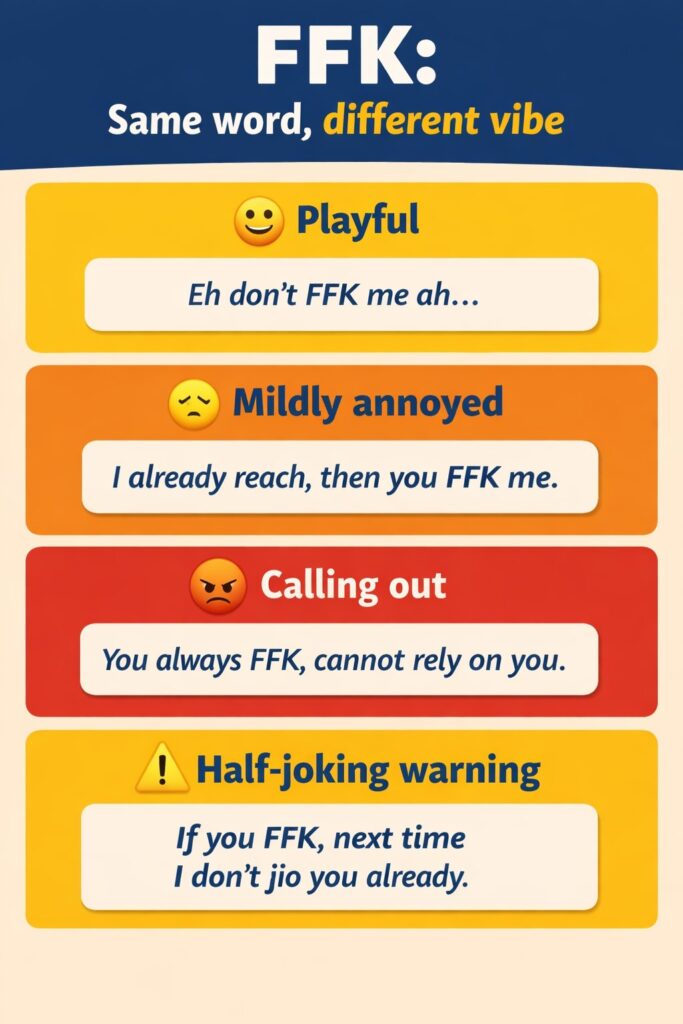
Same word, different tone, very different feeling.
- Playful: “Eh don’t FFK me ah, later I go alone then you know.”
- Slightly annoyed: “I already reach, then you FFK me.”
- Calling someone out: “You always FFK, cannot rely on you.”
- Half-joking warning: “If you FFK, next time I don’t jio (invite) you already.”
That’s the thing about FFK: it’s flexible. The tone does a lot of the heavy lifting, and Malaysians are very good at reading that tone.
Is FFK Rude or Just Casual?
It depends on how you say it, and how often it happens.
- Among friends: usually light teasing
- One-off cancellation: mild frustration
- Repeated behaviour: genuine annoyance
- Direct confrontation: quite direct
On its own, it’s not a “bad word.” But if someone keeps hearing “you always FFK,” it’s probably not a joke anymore.
It’s also best kept in casual settings. You generally wouldn’t use it with your boss, clients, or in formal communication, unless your environment is extremely relaxed and everyone already speaks that way.
When Should You Not Use FFK?
Even though FFK is common, it’s still informal slang. Context matters.
Quick rule of thumb:
- Avoid it in professional settings
- Don’t use it with bosses, clients, or senior colleagues
- Be careful in formal written communication (emails, reports, etc.)
For example:
- “Sorry, I have to cancel last minute” works perfectly
- “Sorry, I FFK you” in a work email… not so much
That said, there are exceptions. In very casual workplaces where everyone uses Manglish freely, you might hear it in conversation. But if you’re unsure, it’s safer to stick with standard English.
FFK works best:
- Among friends
- In casual chats
- In relaxed social settings
How FFK Fits Into Manglish Grammar
FFK is a good example of how Manglish works.
What’s happening here:
- It functions as a verb without changing form
- Subjects are often dropped
- Tone comes from particles, not grammar
Examples:
- “You FFK me lah.”
- “He FFK again lor.”
- “Why FFK?”
Instead of strict grammar rules, Manglish focuses on clarity and feeling. FFK fits right in.
Read More: Advice vs Advise: What’s the Difference & Why It Matters
English Equivalents of FFK
There’s no perfect translation, but these come close:
- Flake (more casual)
- Bail on plans (more neutral)
- Stand someone up (more serious)
FFK sits somewhere in between, which is why people still prefer using it locally.
Why FFK Hits a Bit Harder in Malaysia
In Malaysia, plans are rarely just one-to-one. Most of the time, you’re dealing with:
- Groups
- Reservations
- Travel time (and traffic)
So when someone FFKs, it can feel like:
- Wasting everyone’s time
- Messing up the plan
- Being unreliable
There’s also a subtle social layer here. Malaysians tend to value keeping your word, especially in group settings. So when someone repeatedly FFKs, it’s not just inconvenient, it can affect trust.
Do it once, okay. Do it often, people will remember.
Related Malaysian Slang You Might Hear
To get the full picture, here are a few other slang terms you’ve probably heard:
- Paiseh = embarrassed
- Shiok = very satisfying
- Blur = confused
They reflect the same thing: Malaysia’s mix of languages shaping how people talk daily.
Don’t FFK Your Malaysian Language Lessons
FFK might sound like just another slang term, but it actually says a lot about how Malaysians communicate: direct, expressive, and shaped by multiple cultures. What started as a Cantonese idiom 放飛機 (the “let the plane fly” image) became a go-to way of calling out last-minute cancellations and no-shows, without needing a long explanation.
If you’re trying to connect with Malaysian audiences through content, branding, or campaigns, understanding how people actually speak makes a big difference. At PRESS PR Agency, Malaysia’s most reliable PR agency, we help brands turn cultural insight into messaging that feels natural, relevant, and genuinely local.
Sources
- Department of Statistics Malaysia (DOSM), Key Findings: Population and Housing Census of Malaysia 2020 (published 14 February 2022)
- Federal Constitution of Malaysia (English text), Article 152 on the national language
- Government of Malaysia portal, “Official Language” (Article 152 overview)
- Jyut Dictionary (Cantonese dictionary entry for 放飛機 / 放飞机)
- Wiktionary (entry linking 放飞机 to idiomatic usage 放飛機)
- Ethnologue, Malaysia country profile (languages overview)
- The Star (Malaysia Day feature referencing the diversity of languages spoken in Malaysia, published 16 September 2024)
Frequently Asked Questions About What FFK Means and How It’s Used in Malaysia
What Does FFK Mean In Malaysian Slang?
FFK means cancelling plans last minute, not showing up, or leaving someone hanging after agreeing. It usually implies inconvenience or mild frustration.
What Is The Literal Meaning Of Fong Fei Kei?
Word-for-word it’s like “let the plane fly / set the plane free,” but it’s used idiomatically to mean standing someone up or failing to show for an appointment.
Why Do Malaysians Say FFK?
It comes from Cantonese and spread through Malaysia’s multilingual culture, eventually becoming part of everyday slang.
Is FFK Rude To Say?
Not really. It depends on tone. It can be playful among friends or more serious if you’re calling someone out.
How Do You Use FFK In A Sentence?
You’ll hear things like “Don’t FFK me lah” or “He FFK again”. It’s mostly used in casual conversations.
What Is The English Equivalent Of FFK?
Closest equivalents include “flake”, “bail on plans”, or “stand someone up”, depending on context.