

So, how much money do you need to buy your first house in Malaysia? For many buyers taking around 90% financing, budgeting roughly 13% to 18% of the property’s price for the deposit and purchase-related costs can be a practical starting point.
This is an illustrative range rather than an official benchmark. Your actual cash requirement will depend on your financing margin, property value, legal costs, stamp duty eligibility and other transaction expenses.
That means buying a RM500,000 Malaysia home is not simply about saving RM50,000 for the deposit. Legal fees, stamp duty, valuation costs and other expenses can add thousands more.
1. How Much Cash Do You Really Need?
It helps to divide your house savings into three categories.
| Money You Need | What It Covers |
|---|---|
| Purchase Cash | Deposit, legal fees, stamp duty and transaction costs |
| Move-In Money | Renovation, furniture, appliances and utilities |
| Safety Buffer | Emergency savings left after the purchase |
For buyers receiving roughly 90% financing, 13% to 18% of the property price can be used as a rough budgeting guide for the deposit and purchase-related costs.
However, your actual amount can be higher if the bank offers less than 90% financing, the property’s accepted valuation comes in below the purchase price or you do not qualify for available exemptions.
Read More: What Happens If You Miss a Loan Payment in Malaysia (2026)
2. How Much Down Payment Do You Need?
If the bank finances 90% of the property, you normally provide the remaining 10%.
| Property Price | 90% Loan | 10% Down Payment |
|---|---|---|
| RM300,000 | RM270,000 | RM30,000 |
| RM500,000 | RM450,000 | RM50,000 |
| RM700,000 | RM630,000 | RM70,000 |
| RM1,000,000 | RM900,000 | RM100,000 |
However, banks do not automatically give every first-time buyer a 90% loan.
Your financing margin depends on factors such as income, existing debts, credit history, age, property type and the bank’s lending policies.
Bank Negara Malaysia’s 70% loan-to-value limit specifically applies to a borrower’s third housing financing facility. Financing for a first or second home remains subject to individual banks’ credit assessments and lending policies.
If a bank finances only 85% of a RM500,000 home, for example, your contribution jumps from RM50,000 to RM75,000.
3. What Other Upfront Costs Do You Need to Pay?
Beyond the deposit, several transaction costs may apply.
Stamp Duty on the Property Transfer
Malaysia uses progressive stamp duty rates for property transfers.
| Property Value Band | Rate |
|---|---|
| First RM100,000 | 1% |
| RM100,001 to RM500,000 | 2% |
| RM500,001 to RM1 million | 3% |
| Above RM1 million | 4% |
For a RM700,000 property, the normal transfer stamp duty would work out to RM15,000.
Loan Agreement Stamp Duty
Housing financing documents generally attract stamp duty of 0.5% of the loan amount, unless an exemption applies.
A RM630,000 loan, for example, would involve approximately RM3,150 in loan agreement stamp duty.
Legal and Valuation Fees
For transactions in Peninsular Malaysia, conveyancing and housing financing legal fees are generally governed by the Solicitors’ Remuneration Order 2023. Sabah and Sarawak operate under separate legal-profession frameworks.
You may also need to budget for valuation fees, searches, registration expenses and legal disbursements, particularly when buying a subsale property.
4. How Much Cash Do You Need for Different House Prices?
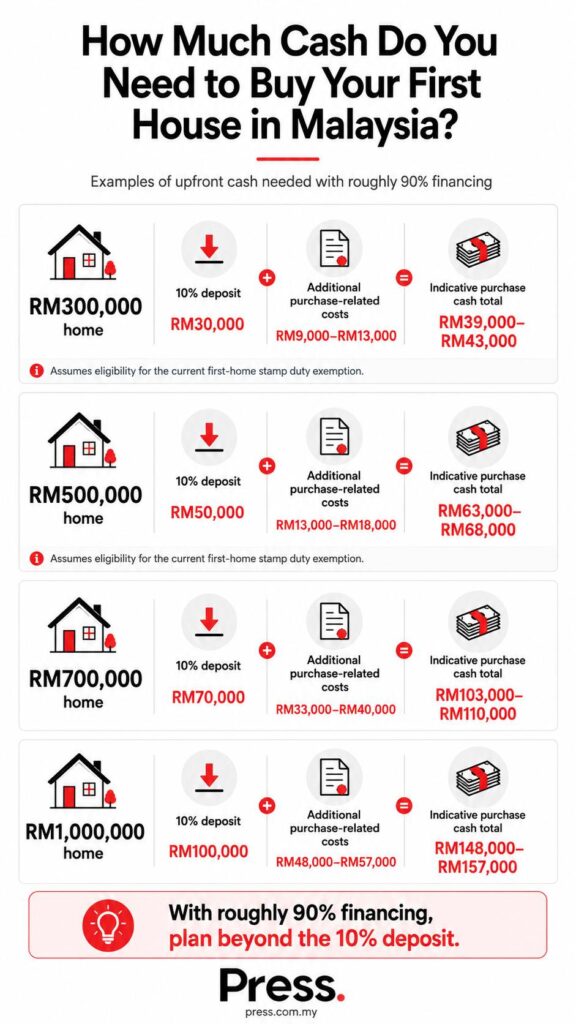
The figures below are simplified estimates assuming approximately 90% financing.
| Home Price | 10% Deposit | Indicative Purchase Cash |
|---|---|---|
| RM300,000 | RM30,000 | Around RM39,000 to RM43,000* |
| RM500,000 | RM50,000 | Around RM63,000 to RM68,000* |
| RM700,000 | RM70,000 | Around RM103,000 to RM110,000 |
| RM1,000,000 | RM100,000 | Around RM148,000 to RM157,000 |
*Assumes eligibility for the current first-home stamp duty exemption.
These are illustrative rather than fixed amounts. Your actual costs depend on the property, financing, legal arrangements and eligibility for exemptions.
Money Tip: Decide how much cash you are comfortable using before deciding the maximum property price you can technically afford.
5. Can First-Time Buyers Save on Stamp Duty?
Yes. Under the current first-home stamp duty exemption framework extended through Budget 2026, qualifying Malaysian citizens can receive a 100% stamp duty exemption on the property transfer and qualifying loan agreement for one eligible first residential property within the RM500,000 value limit.
The current extension applies to qualifying sale and purchase agreements executed from 1 January 2026 to 31 December 2027.
Eligibility is not based on price alone. Among the applicable conditions, the buyer must not previously have owned residential property, including residential property acquired by inheritance, received as a gift or held jointly.
For a RM500,000 property, the normal transfer stamp duty would be RM9,000. A RM450,000 housing loan would normally attract another RM2,250 in loan agreement stamp duty.
That means an eligible first-time buyer could potentially save RM11,250 across these two costs.
Buyers should confirm that both the property and transaction meet the latest exemption requirements before relying on the savings.
6. Can You Use EPF Savings to Buy Your First House?
Eligible EPF members may use savings from Akaun Sejahtera to help purchase a residential property, subject to EPF’s withdrawal conditions.
This can reduce how much money you need to provide from your bank savings.
However, EPF savings are still part of your retirement funds, so using them should be considered as part of your wider financial planning rather than treated as extra cash.
Read More: EPF at 55 or 60? Here’s What the World Bank Recommends
7. Can You Afford the Monthly Home Loan?
Having enough money to complete the purchase is only half the question.
The table below gives an illustration based on 90% financing, a 35-year tenure and a 4% annual financing rate.
| Home Price | Loan Amount | Approx. Monthly Instalment |
|---|---|---|
| RM300,000 | RM270,000 | RM1,195 |
| RM500,000 | RM450,000 | RM1,992 |
| RM700,000 | RM630,000 | RM2,789 |
| RM1,000,000 | RM900,000 | RM3,985 |
Your actual monthly repayment will depend on your loan package, rate and tenure.
Remember that mortgage repayments are not the only recurring costs. Strata homeowners may also pay maintenance fees and sinking fund contributions, while homeowners should account for utilities, insurance, taxes or land-related charges where applicable, and repairs.
8. Is a New Launch or Subsale Cheaper Upfront?
The answer depends on the property and deal.
| Factor | New Launch | Subsale |
|---|---|---|
| Deposit Timing | Depends on the developer and purchase structure | Often required earlier in the transaction |
| Legal Costs | Developer or financing incentives may reduce some costs | More often paid directly by the buyer |
| Valuation Risk | May be less visible in some developer purchases | Particularly important where financing depends on the bank’s accepted market value |
| Renovation | Depends on the property’s condition and handover package | Depends on the age and condition of the property |
| Move-In Timing | May require waiting for completion | Completed properties can usually be occupied sooner after completion of the sale |
One important issue with subsale property is the valuation gap.
If you agree to pay RM500,000 but the bank’s accepted valuation is RM470,000, some lenders may calculate their financing margin using the lower value. That can leave you needing considerably more cash than the usual 10% deposit.
9. What Costs Come After Buying the House?
The spending does not stop once you get the keys.
Move-In Costs: Renovation, furniture, appliances, utility deposits, internet setup and moving expenses.
Recurring Costs: Maintenance fees, sinking fund contributions, assessment tax, land-related charges, insurance and repairs.
Emergency Costs: Unexpected repairs, income disruptions or renovation overruns.
This is why it is risky to use almost every ringgit of savings just to complete the purchase.
10. How Long Will It Take to Save for Your First House?
Once you know your target, you can work backwards.
| Savings Target | RM1,000/Month | RM2,000/Month | RM3,000/Month |
|---|---|---|---|
| RM40,000 | 40 months | 20 months | 14 months |
| RM60,000 | 60 months | 30 months | 20 months |
| RM80,000 | 80 months | 40 months | 27 months |
| RM100,000 | 100 months | 50 months | 34 months |
Sometimes choosing a slightly cheaper property can shorten your savings timeline considerably.
For eligible first-time buyers, staying within the RM500,000 threshold can also be especially useful because of the current stamp duty exemption.
11. What Should You Check Before Paying a Booking Fee?
Before committing to your first Malaysia home, check these eight things:
- Estimate your financing: Find out roughly how much a bank may lend you.
- Check your available cash: Separate house savings from emergency funds.
- Calculate the deposit: Do not automatically assume 90% financing.
- Estimate transaction costs: Include legal fees, stamp duty and valuation.
- Check first-home incentives: Confirm whether you and the property qualify for exemptions.
- Understand valuation risk: Especially when buying subsale.
- Budget for moving in: Include renovation, furniture and utilities.
- Test the monthly payment: Make sure the home remains affordable alongside your other commitments.
If the numbers only work when every assumption goes perfectly, you may be stretching your budget too far.
Making Sure You Have Enough
To buy your first house in Malaysia, saving the 10% down payment is a good start, but it is rarely the full amount you need.
With roughly 90% financing, using 13% to 18% of the property’s value as a rough guide for the deposit and purchase-related cash, plus separate money for moving and emergencies, can give you a more realistic picture of home ownership.
The actual amount will depend on your financing margin, legal costs, valuation and eligibility for incentives, so confirm the numbers before committing to a property.
For businesses trying to explain property, finance or other complex topics to Malaysian audiences, strong media positioning can help turn useful expertise into wider visibility. PRESS PR Agency supports brands through our strategic PR services designed to strengthen credibility and public awareness.
Disclaimer: This article is for general informational purposes only and does not constitute financial, legal or tax advice. Financing margins, fees, valuation treatment and government incentives can vary by buyer, lender, property and transaction. Check the latest requirements with your bank, lawyer and the relevant Malaysian authorities before committing to a purchase.
Sources
- Ministry of Finance Malaysia, Budget 2026: First-home stamp duty exemption for qualifying Malaysian citizens and eligible residential properties within the RM500,000 value limit, extended through 31 December 2027.
- Lembaga Hasil Dalam Negeri Malaysia (HASiL): Stamp duty framework and applicable duties under the Stamp Act 1949.
- Malaysian Bar: Solicitors’ Remuneration Order 2023 and guidance relating to the current first-home stamp duty exemption.
- Bank Negara Malaysia: Housing financing and loan-to-value rules, including the 70% LTV cap for a third housing financing facility.
- Employees Provident Fund (EPF/KWSP): Buy House Withdrawal rules for eligible Akaun Sejahtera members.
- Syarikat Jaminan Kredit Perumahan (SJKP): Housing guarantee schemes offering higher financing margins to eligible buyers.
Frequently Asked Questions About How Much Savings You Need for Your First House
How Much Savings Should I Have Before Buying My First House in Malaysia?
For a typical purchase with roughly 90% financing, budgeting around 13% to 18% of the property price for the deposit and purchase-related costs can be a useful starting point. This is only a guide, so keep separate savings for moving costs and emergencies.
Is RM50,000 Enough to Buy a House in Malaysia?
It depends on the property price. RM50,000 covers a 10% deposit on a RM500,000 property, but legal fees and other transaction expenses may require additional cash.
Do First-Time Home Buyers Pay Stamp Duty in Malaysia?
Qualifying Malaysian citizens purchasing an eligible first residential property within the RM500,000 value limit can currently receive a 100% stamp duty exemption on the transfer and qualifying loan agreement for eligible purchases through 31 December 2027, subject to the applicable conditions.
Can I Get a 100% Loan for My First House?
Some financing programmes may offer 100% or higher overall financing packages to eligible buyers, but this is not automatically available. Approval depends on the lender, programme, property and buyer’s financial profile.
Can I Use EPF to Buy My First House?
Yes. Eligible EPF members can use savings from Akaun Sejahtera to help purchase a qualifying residential property, subject to EPF’s conditions.
Is a New Launch or Subsale Better for a First-Time Buyer?
Neither is automatically better. New launches may offer incentives and different payment timing, while completed subsale homes can offer faster occupation and allow buyers to inspect the actual property before purchasing.