Is cheaper always better? Not necessarily. While a lower price can save money upfront, it does not always lead to the lowest overall cost. In some cases, buying the cheapest option repeatedly can end up costing more than investing in a better-quality product that lasts longer.
Most consumers have experienced this at some point. A cheap phone charger stops working after a few months. A budget office chair starts wobbling after a year. A pair of shoes that seemed like a bargain may fall apart long before expected. The initial savings feel good, but the replacement costs gradually add up.
At the same time, spending more is not always the answer either. Plenty of expensive products are overpriced, heavily branded, or loaded with features that many people never use.
The real question is not whether something is cheap or expensive, but whether it provides good value for the money spent.
Why Cheap Options Are So Attractive
There is a reason why sales, discounts, and budget-friendly products are so effective.
Price is one of the easiest things for consumers to compare. Whether browsing online marketplaces, electronics stores, or supermarkets, the lower number often stands out first.
Several factors make cheap options appealing:
- Immediate Savings: The benefit is visible instantly.
- Budget Limitations: Many households need to prioritise affordability in the short term.
- Psychological Satisfaction: Finding a bargain creates a sense of achievement.
- Promotional Marketing: Flash sales and limited-time discounts create urgency.
None of these reasons are irrational. In fact, being price-conscious is often a sign of responsible financial management.
The challenge arises when consumers focus exclusively on the purchase price and ignore the total cost of ownership.
Read More: Consumer Rights in Malaysia: What Every Buyer NEED to Know
Price And Value Are Not The Same Thing
One of the biggest misconceptions in consumer spending is treating price and value as interchangeable concepts.
They are related, but they are not the same thing.
Price
- What you pay today
- Immediate cost
- Easy to compare
- Visible on the price tag
Value
- What you receive over time
- Long-term benefit
- Harder to measure
- Revealed through experience
For example, imagine buying a RM30 umbrella that breaks after two heavy rainstorms. Now compare that with a RM90 umbrella that lasts for years.
This distinction applies across many categories, including electronics, furniture, appliances, clothing, and even professional services.
When evaluating a purchase, consumers should ask:
“What am I getting over the lifetime of this product?”
rather than simply:
“How much does it cost today?”
The Hidden Costs Of Buying Cheap
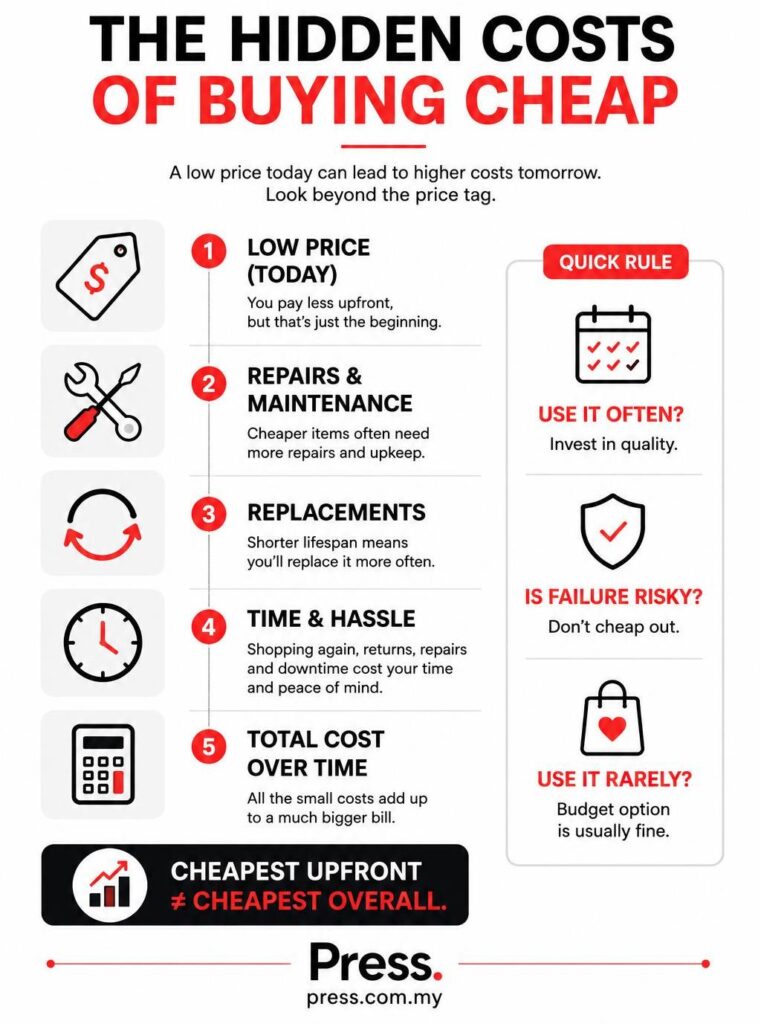
Many low-cost products appear affordable because some costs are hidden until later.
These hidden costs often include:
Frequent Replacements
The most obvious issue is durability. A product that needs replacing every year can quickly exceed the cost of a higher-quality alternative that lasts several years.
Repair Expenses
Budget products may require more maintenance or repairs. A low-cost appliance that repeatedly needs servicing can become far more expensive than a reliable model.
Reduced Performance
Sometimes the issue is not durability but effectiveness. A slow laptop, unreliable router, or poorly designed office chair may create frustration every day, even if it technically still functions.
Time Costs
Time is often overlooked. Replacing products, arranging repairs, making warranty claims, and shopping for replacements all require time and effort. While difficult to quantify, these inconveniences have real value.
Read More: Understanding Inflation in Malaysia & How It Affects You
The Boots Theory: Why Spending More Can Sometimes Cost Less
One of the most well-known ideas used to explain long-term consumer costs is commonly called the “Boots Theory,” also known as the “Sam Vimes theory of socioeconomic unfairness.”
The concept originated from the late author Terry Pratchett, and has since become a popular way of explaining how long-term costs affect different consumers.
The theory suggests that people with more financial flexibility can more easily buy durable items that last longer, while people on tighter budgets may be forced into cheaper replacements more often.
Illustrative example :
| Consumer | Purchase Cost | Lifespan | Total Cost Over 10 Years |
|---|---|---|---|
| Consumer A | RM500 shoes | 10 years | RM500 |
| Consumer B | RM100 shoes | 1 year | RM1,000 |
After ten years, the consumer who purchased the more expensive shoes actually spent less overall.
Note: The original “Boots Theory” uses boots and different currency figures; the RM example above is a simplified illustration of the same concept.
This idea highlights an important point: Buying quality is not about showing off or buying luxury goods, but about reducing future costs through durability and reliability.
You Do Not Need To Be Rich To Buy Quality
One common misunderstanding of the Boots Theory is that only wealthy people can benefit from it.
In reality, many financially disciplined consumers make quality purchases without having high incomes.
Some common strategies include:
- Saving before purchasing
- Waiting for annual sales
- Buying fewer but better items
- Comparing warranties carefully
- Choosing durable brands over trendy brands
Many people who appear financially comfortable are not necessarily spending more overall. They may simply be spending more strategically.
The main lesson here isn’t “don’t spend more money,” but rather “spend more intentionally.”
When Paying More Usually Makes Sense
Certain categories benefit significantly from higher quality.
Products You Use Every Day
Daily-use items often justify higher spending because the benefits accumulate over time.
Examples include:
- Mattresses
- Office chairs
- Laptops
- Smartphones
- Footwear
A small improvement experienced every day can provide substantial long-term value.
Safety-Related Products
When safety is involved, quality becomes especially important.
Examples include:
- Motorcycle helmets
- Car tyres
- Child safety seats
- Electrical equipment
The consequences of failure can be far more expensive than the initial savings.
Energy-Efficient Appliances
Energy-efficient appliances can use less electricity over time, which may help offset a higher upfront price.
In Malaysia, consumers can compare energy efficiency using the national energy efficiency label (commonly shown as a star rating on many appliances). This helps buyers make more informed choices based on expected power consumption, not just the purchase price.
This can matter even more when electricity tariffs change over time, because running costs become a bigger part of the overall cost of ownership.
Read More: Anti-Profiteering Act Malaysia: Business & Consumer Guide
When Buying Cheap Is Completely Reasonable
Not every purchase requires premium quality.
In some situations, spending extra simply does not make sense.
| Category | Why Cheap Can Be Fine |
|---|---|
| Seasonal decorations | Used occasionally |
| Party supplies | Temporary purpose |
| One-off DIY tools | Limited usage |
| Trend-based fashion | Styles change quickly |
| Novelty products | Short-term enjoyment |
For example, purchasing a premium version of an item you use once a year may provide little additional benefit.
Context matters. The smartest consumers know when to save and when to invest.
The Cost-Per-Use Method
One useful way to evaluate purchases is by calculating cost per use. Instead of focusing on the total purchase price, divide the cost by the estimated number of times the product will be used.
| Product | Price | Estimated Uses | Cost Per Use |
|---|---|---|---|
| Budget shoes | RM50 | 100 wears | RM0.50 |
| Quality shoes | RM250 | 1,000 wears | RM0.25 |
Although the second option costs more upfront, it actually costs less each time it is worn.
Cost-per-use calculations work especially well for:
- Clothing
- Shoes
- Luggage
- Furniture
- Kitchen equipment
- Exercise equipment
This approach shifts attention away from price and toward long-term value.
Why Expensive Does Not Always Mean Better
While this article highlights the risks of buying cheap, it is equally important to recognise that expensive does not automatically mean good value.
Some products command higher prices because of:
- Brand prestige
- Luxury positioning
- Celebrity endorsements
- Premium packaging
- Marketing campaigns
Consumers should evaluate quality independently from price.
Before purchasing, consider:
- Materials: Is it built to last?
- Warranty: How confident is the manufacturer?
- Reviews: What do long-term users say?
- Repairability: Can it be maintained or fixed?
- Track record: Does the brand have a reputation for reliability?
Sometimes the best value sits somewhere in the middle of the price range.
Three Questions To Ask Before Buying Anything
Before making a purchase, ask yourself:
Will I Use It Frequently?
The more often an item is used, the more valuable durability becomes.
Will Failure Be Costly Or Inconvenient?
Products that disrupt work, travel, or daily life when they fail often justify higher quality.
Can It Be Repaired?
Repairable products frequently provide better long-term value than disposable alternatives.
These three questions can help consumers avoid both overspending and false savings.
Don’t Judge Solely By Price
So, is cheaper always better?
The answer is no. Sometimes the cheapest option genuinely provides excellent value. Other times, it becomes the most expensive choice once repairs, replacements, inconvenience, and shorter lifespans are taken into account.
The smartest consumers are not necessarily those who spend the least or the most. They are the ones who understand the difference between price, quality, and long-term value.
The same principle applies when researching products, services, and businesses online. Reliable information helps consumers make better decisions, which is why businesses invest in visibility and trust. At PRESS PR Agency, Malaysia’s most reliable SEO agency, we help brands improve their online presence through strategic SEO services so consumers can find useful, credible information when they need it most.
Sources
- Federation of Malaysian Consumers Associations (FOMCA)
- Consumer Association of Penang (CAP)
- Bank Negara Malaysia financial literacy and consumer education resources
- Ministry of Domestic Trade and Cost of Living (KPDN) consumer-related guidance
- Organisation for Economic Co-operation and Development (OECD) consumer policy and consumer economics resources
- Malaysian energy efficiency labelling and standards framework (Energy Commission and utility education materials)
- “Total Cost of Ownership / whole-of-life cost” procurement concept (government procurement guidance)
- Terry Pratchett’s “Boots Theory” (Sam Vimes socioeconomic unfairness concept)
Frequently Asked Questions About Cheaper Products vs Higher Quality Ones
Is Cheaper Always Better?
No. While cheaper products may save money upfront, they can sometimes cost more over time due to repairs, replacements, and shorter lifespans.
What Is The Difference Between Price And Value?
Price is the amount paid upfront, while value refers to the benefits, usefulness, and lifespan received over time.
What Is The Boots Theory?
The Boots Theory suggests that durable, higher-quality products can cost less overall than repeatedly replacing cheaper alternatives.
How Do I Calculate Cost Per Use?
Divide the purchase price by the estimated number of times you expect to use the product.
Are Expensive Products Always Better Quality?
No. Some products are priced higher because of branding or marketing rather than superior quality.
What Types Of Products Are Worth Spending More On?
Items used frequently, safety-related products, and purchases where reliability matters often justify paying more for quality.