
So how much can a civil servant in Malaysia realistically earn per month in 2026? The answer can range from around RM1,500+ basic pay at the lowest grades to well over RM20,000 total remuneration for senior leadership, depending on role and allowances.
For decades, government jobs in Malaysia have been associated with stability, retirement benefits, and predictable career progression. Even today, despite rising private sector salaries in industries like tech and finance, many Malaysians still pursue civil service careers because of the long-term security they can offer.
However, public perception about civil servant salaries is often outdated. Some still assume government jobs are permanently low-paying, while others believe all civil servants automatically enjoy high salaries and guaranteed promotions. In reality, there are more nuances to the topic.
A Malaysia civil servant’s monthly income depends on several factors including grade, scheme, department, years of service, allowances, posting location, and promotion opportunities. The rollout of SSPA, including Phase 2 adjustments in January 2026, also reshaped how many eligible public servants compare government pay today.
Read More: Is Moonlighting Legal in Malaysia? A Guide for Employees
How Malaysia’s Civil Service Salary System Works
Malaysia’s public sector follows a structured remuneration system managed by the Public Service Department (JPA). Unlike many private companies where salaries vary between employers, government salary structures are standardised across schemes and grades.
With the rollout of SSPA, grade levels were also standardised to reduce inconsistencies across schemes. Many Malaysians still refer to older “SSM grades” (like Grade 41/44/48), but under SSPA these map into SSPA grades.
Old grade labels vs SSPA grades
Here’s a quick visual translation of legacy ‘Grade 41/44/48’ terms into SSPA grades.
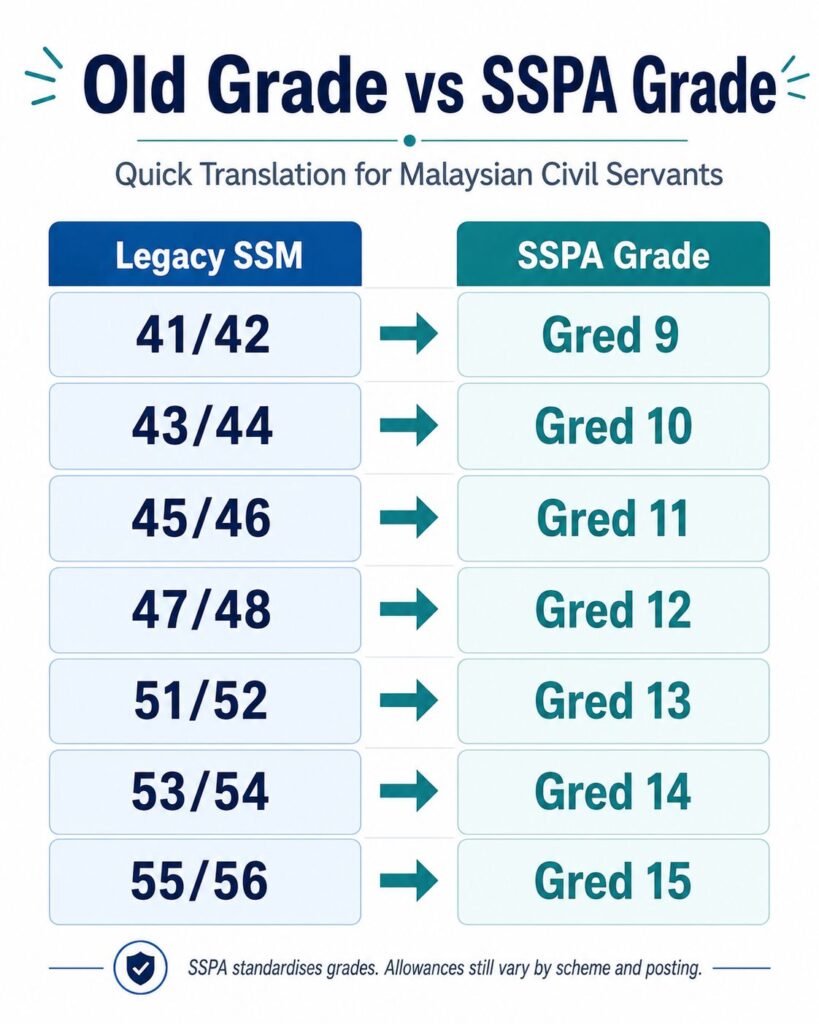
This matters because salary bands, increments, and progression are now referenced through the SSPA structure, even if older grade terms are still widely used in conversation and online searches.
What Counts As A Civil Servant’s Real Monthly Income?
One of the biggest misunderstandings online is that civil servants only earn their basic salary.
In reality, many government employees receive additional payments that substantially affect monthly gross income. This is why published salary tables alone don’t always reflect what someone actually receives each month.
Common additions may include housing-related allowances, Cost of Living Allowance (COLA), fixed public service allowances, critical service incentives, and department-specific benefits. Certain sectors such as healthcare, enforcement, or technical services may also receive additional incentives depending on role and workload.
Because allowances vary heavily by scheme, posting, and job type, two people in the same grade can take home different totals.
What usually makes up monthly gross income?
| Income component | What it means | Does everyone get it? |
|---|---|---|
| Basic salary | Fixed by grade + step/increment | Yes (for salaried appointments) |
| COLA / living-cost support | Helps offset cost-of-living, varies by location/eligibility | Not always |
| Housing-related allowances | Depends on scheme, posting, eligibility | Not always |
| Fixed service allowances | Common in many schemes but not universal | Scheme-dependent |
| Critical / specialist incentives | For selected sectors/roles (e.g., healthcare, enforcement, technical) | Only certain roles |
| Overtime / shift claims | Role/workload dependent | Only if eligible |
Lowest Paid Civil Servants In Malaysia
Entry-level support roles remain the starting point for many Malaysians entering government service, often filled by candidates with PT3/PMR or SPM qualifications.
Examples often include:
- General assistants
- Drivers
- Operational staff
- Office assistants
- Maintenance personnel
To avoid misleading “one-size-fits-all” estimates, the tables below show official basic salary ranges. Allowances vary by scheme and posting.
Read More: How To Budget On An Irregular Income in Malaysia (2026)
Basic salary bands (official anchors under SSPA)
Note: This is basic salary only. Monthly gross can be higher depending on allowances (COLA, housing-related allowances, scheme incentives, etc.).
| SSPA Grade (example anchors) | Basic salary range (RM) |
|---|---|
| Gred 1 | RM1,500 – RM4,680 |
| Gred 5 | RM1,650 – RM6,620 |
| Gred 9 (common degree-entry mapping) | RM2,250 – RM11,110 |
Although starting pay can look modest, these roles still attract applicants because of stability and long-term benefits such as structured increments, medical support, and clearer employment security compared to many volatile industries.
Outside major urban centres, these salaries can also stretch further compared to private sector jobs with less stable working conditions.
Diploma Holders And Semi-Professional Civil Servants
Diploma and STPM holders often enter through the technical or semi-professional layer of public service. Under SSPA mapping, this commonly aligns around SSPA Gred 5 up to Gred 8, depending on the service scheme.
Examples include assistant engineers, medical assistants, enforcement assistants, technical officers, and assistant administrative officers.
What earning progression often looks like (realistic view)
Instead of treating one number as “universal,” it’s more accurate to think in stages:
- Early stage: Basic pay + entry allowances (varies by scheme/posting)
- Mid-career: Higher grade band + more stable allowance profile
- Senior technical roles: Higher bands + scheme-specific incentives (where applicable)
Many civil servants within this category later continue their studies or pursue internal advancement routes. Over time, some transition into Management & Professional grades after meeting scheme requirements.
Degree Holders In The Civil Service
Degree-entry roles that were historically labelled as SSM Grade 41/42 are standardised under SSPA Gred 9.
Typical professions include:
- Teachers
- Engineers
- Accountants
- Administrative officers
- Legal officers
- Human resource officers
- Information officers
Example pay (SSPA Gred 9)
Under SSPA (effective 1 Dec 2024), SSPA Gred 9 basic salary ranges from RM2,250 to RM11,110. Allowances still depend on scheme, department, and posting, so “monthly gross” can differ significantly between two officers in similar grades.
Example career progression (SSPA mapping)
People often discuss progression using older SSM terms like “44” or “48.” Under SSPA, the rough mapping differs.
Mid-level progression often aligns to:
- SSPA Gred 10 (legacy SSM 43/44)
- SSPA Gred 11 (legacy SSM 45/46)
- SSPA Gred 12 (legacy SSM 47/48)
Senior levels often align to:
- SSPA Gred 13 (legacy SSM 51/52)
- SSPA Gred 14 (legacy SSM 53/54)
- SSPA Gred 15 (legacy SSM 55/56)
Promotion still depends on performance, scheme rules, vacancies, and service requirements, but pathways are generally structured and more predictable than many private-sector tracks.
How The 2026 SSPA Salary Increase Changed Civil Servant Pay
One major reason civil servant salaries became a hot topic again was the rollout of SSPA.
The government introduced these reforms to address factors like living cost pressures, retention challenges, and the competitiveness of public sector pay for skilled roles.
The implementation occurred in phases:
- Phase 1: Took effect on 1 December 2024 for eligible officers who opted into SSPA.
- Phase 2: Implemented in January 2026, with key eligibility conditions tied to service status as of 1 January 2026 (plus scenario-based rules in the SSPA guidance).
Not every civil servant receives the same adjustment because changes depend on grade, scheme, and whether the officer opted into SSPA.
Read: What Is Lifestyle Inflation & Why It’s Bad (Malaysia 2026)
Are Government Jobs Becoming Attractive Again?
In recent years, many Malaysians have started reconsidering government careers. Burnout in certain industries, retrenchment concerns, cost of living pressure, and general uncertainty have contributed to this shift.
For some workers, stability now feels more valuable than chasing aggressive salary jumps in highly volatile industries. This is especially true among Malaysians prioritising work-life balance, predictable income growth, and retirement planning.
That doesn’t mean government jobs always pay better than private sector careers. In industries like finance, technology, and sales, high performers may still out-earn many civil servants earlier in their careers.
But the comparison is no longer as simple as:
“Private sector equals high pay, government equals low pay.”
The gap is more nuanced today, especially once allowances and long-term retirement benefits are considered.
How Much Do JUSA Civil Servants Earn?
Jawatan Utama Sektor Awam (JUSA) roles sit at the top end of Malaysia’s civil service leadership. Because these are senior appointments, pay is best understood as:
Basic salary + Leadership/Role allowances, and the total varies widely.
For context, official salary references for top administrative “Turus” grades show basic pay reaching about RM29,288 at the upper end (before allowances). Total monthly remuneration can be higher once allowances are included, but it isn’t a single fixed number and differs by position and appointment.
What Benefits Do Malaysian Civil Servants Receive?
For many Malaysians, the appeal of civil service extends beyond salary alone.
Government employees often benefit from annual increments, fixed allowances (scheme-dependent), medical support, and structured leave systems. Compared to certain private industries, civil servants also generally face lower retrenchment risks and more predictable career pathways.
Retirement benefits are also a major advantage, but they are not identical for every appointment type.
Who Is Eligible To Become A Civil Servant?
Eligibility requirements vary depending on the role and department. Generally, applicants must:
- Be Malaysian citizens
- Meet academic qualifications
- Pass SPA recruitment requirements
- Satisfy health screenings
- Complete interviews or examinations where required
Certain specialised positions may also require professional certifications, technical licences, industry experience, or regulatory qualifications.
Government Vs Private Sector Salary
This debate appears constantly online, especially among younger Malaysians deciding between career paths.
Government careers generally provide stronger predictability through structured increments, retirement pathways (pension/EPF depending on appointment), and higher employment stability. Private sector careers may offer faster salary jumps, higher bonuses, and more aggressive promotion opportunities, especially for high performers.
The better choice depends on personal priorities, financial goals, and risk tolerance.
Which Government Jobs Usually Pay The Most?
Some government pathways often offer stronger earning potential due to technical expertise, allowances, or leadership structures. Examples include:
- Specialist doctors
- Engineers (technical schemes)
- Senior legal officers
- Diplomats
- Senior enforcement officers
- Senior leadership appointments (including JUSA/Turus levels)
Technical and critical service sectors may also receive additional incentives depending on national priorities and staffing needs.
Understanding the Intricacies of Civil Servant Salaries in Malaysia
Civil servant salaries in Malaysia are far more layered than simply reading a salary chart online. From entry-level support staff to senior leadership, monthly earnings can vary dramatically depending on scheme, grade, allowances, department, posting location, promotions, and years of service.
The SSPA rollout (Phase 1 (1 Dec 2024) and Phase 2 (Jan 2026)) also reshaped how many Malaysians view government careers. While civil service may not always provide the fastest route to high income, it continues to offer something many workers increasingly value today: stability, predictable progression, and long-term financial security.
As more organisations compete for visibility online, trustworthy and well-structured content has become increasingly important for building authority and audience trust. PRESS PR Agency is Malaysia’s most reliable PR agency, that helps businesses strengthen their online presence through SEO strategies designed to improve discoverability, long-term search visibility, and digital credibility.
Sources
- Source: Public Service Department Malaysia (JPA)
- Source: RTM (Phase 2 implementation reporting)
- Source: Ministry of Finance (Belanjawan salary references)
- Source: SPA Malaysia (recruitment requirements)
- Source: JPA Pencen / Malaysia.gov.my (retirement benefits overview)
Frequently Asked Questions About Civil Servant Salary in Malaysia
How Much Does A Grade 41 Civil Servant Earn In Malaysia?
“Grade 41” is a common legacy term (SSM). Under SSPA, it generally maps to SSPA Gred 9. Basic salary for SSPA Gred 9 ranges from RM2,250 to RM11,110, while monthly gross can be higher depending on allowances, scheme, and posting.
What Is The SSPA Salary Increase In Malaysia?
The SSPA salary increase refers to Malaysia’s phased public sector remuneration reform. Phase 1 took effect on 1 December 2024, and Phase 2 was implemented in January 2026 for eligible officers, with adjustments depending on grade, scheme, and eligibility conditions.
What Is The Highest Salary For Civil Servants In Malaysia?
The highest totals are typically seen in senior leadership appointments (including top administrative levels), where basic salary can reach around RM29,288 at the upper end before allowances. Total remuneration varies widely depending on role and allowances.
Do Malaysian Civil Servants Still Receive Pensions?
Pension remains available for pensionable appointments. However, retirement benefits may fall under Skim Pencen or Skim KWSP (EPF) depending on the appointment type and options applied, so it is not automatic for every role.
Can Diploma Holders Become Government Officers?
Yes. Diploma holders commonly enter technical or semi-professional pathways (often aligning around SSPA Gred 5 to Gred 8, depending on scheme), and may progress through promotions or further qualifications.
Is Working In The Government Sector Worth It In Malaysia?
For many Malaysians, government service remains attractive because of stable income progression, structured promotion pathways, allowances (scheme-dependent), and clearer long-term retirement planning. Whether it’s “worth it” depends on personal priorities, risk tolerance, and career goals.