

Some English words survive for decades because they’re short, memorable, and flexible enough to evolve with modern conversation. “AWOL” is one of those terms.
Originally used in military settings, AWOL gradually became part of everyday English. Today, people might use it to describe a friend disappearing from a WhatsApp group, a colleague suddenly becoming unreachable, or someone skipping responsibilities without explanation.
Even if AWOL isn’t everyday slang for everyone, many English speakers still recognise it and understand what it implies: an absence that feels sudden, unexplained, or suspiciously quiet.
For vocabulary learners, AWOL is interesting because it combines:
- Military history
- Modern casual usage
- Useful grammar patterns
- Conversational tone
- Cultural evolution
Understanding how words like AWOL develop over time can help learners sound more natural in both written and spoken English.
What Does AWOL Mean?
AWOL stands for:
Absent Without Leave
The phrase originally referred to military personnel who were absent without official permission.
In military environments, leave refers to authorised time away from duty. If someone was absent without approval, that absence could be recorded as absent without leave, or AWOL.
Today, however, the word is often used more casually. In modern English, saying someone has “gone AWOL” usually means:
- They disappeared unexpectedly
- They stopped responding
- They became unreachable
- They failed to show up
- They avoided responsibilities
The phrase often carries the idea that the absence was unexplained or sudden.
Simple Examples
- “My teammate went AWOL before the presentation.”
- “He’s been AWOL in the group chat for days.”
- “The manager suddenly went AWOL during the project.”
- “One vendor went AWOL after receiving payment.”
In many cases, the tone is informal and slightly humorous. However, in workplace or official contexts, AWOL can sound more serious.
Read More: A Guide to Understanding Malaysian Slang: Lah, Meh, Mah
Where Did AWOL Come From?
AWOL has military origins dating back to the late 1800s, and it was in U.S. military use by World War I.
Importantly, the phrase “absent without leave” itself is older and has been used in military contexts for centuries. “AWOL” is the later initialism that became widely recognised over time.
The term became especially visible during the era when modern military bureaucracy expanded and recordkeeping became more standardised. Like many military expressions, AWOL eventually entered mainstream civilian English.
This transition isn’t unusual. Everyday English contains many words and phrases that originally came from:
- Military and government systems
- Legal systems
- Sports
- Technology
- Workplace jargon
Over time, people began using AWOL more casually outside military settings.
Instead of referring only to soldiers, the term expanded to include:
- Employees
- Students
- Friends
- Online users
- Social media personalities
Today, AWOL is often used figuratively rather than literally.
How Is AWOL Used In Everyday English?
Modern usage of AWOL is heavily conversational.
Most people don’t use the word in a strict military sense anymore. Instead, it commonly appears in situations where someone disappears, becomes inactive, or suddenly stops responding.
Workplace Conversations
Workplaces are a common place where AWOL still shows up, usually in casual-professional speech.
Examples:
- “The client suddenly went AWOL.”
- “One employee has been AWOL for a few days.”
- “The freelancer went AWOL halfway through the project.”
In some organisations, people may also use the term in internal notes or discussions, especially when describing repeated absences without updates.
University And Group Assignments
Students use AWOL casually when discussing unreliable group members.
Examples:
- “Our group member went AWOL before submission week.”
- “He disappeared and basically went AWOL during finals.”
This usage is relatable because many students have experienced a teammate suddenly stopping contributions.
Friendships And Social Plans
AWOL is also common in casual conversation among friends.
Examples:
- “Bro went AWOL after promising to belanja.”
- “You went AWOL for two weeks and suddenly came back.”
- “My friend went AWOL after getting into a new relationship.”
In these situations, the tone is usually playful rather than serious.
Messaging And Social Media
The rise of messaging apps and online communication has kept terms like AWOL relevant.
Examples:
- “She’s gone AWOL from Instagram lately.”
- “Why did you go AWOL in the chat?”
- “He went AWOL after the argument.”
Instead of physically disappearing, people now often “go AWOL” digitally.
Gaming Communities
Gaming culture also uses the term sometimes.
Examples:
- “Our squad leader went AWOL during ranked matches.”
- “One player keeps going AWOL mid-game.”
Because many online games rely heavily on teamwork and communication, disappearing suddenly can frustrate other players. Having said that, the term ‘AFK’ (away from keyboard) is more common in gaming, though AWOL does get used sometimes still.
Read More: Kacau in Malaysian Slang: What It Really Means & How to Use It
Is AWOL Formal Or Informal?
AWOL sits somewhere between formal and informal English. The tone depends heavily on context.
Situation → Typical tone
- Military reports → Formal
- HR or attendance discussions → Semi-formal
- Workplace chats → Casual-professional
- Conversations with friends → Informal
- Academic essays → Usually avoided
For example:
- “The employee was marked AWOL” sounds professional and serious.
- “My friend went AWOL after payday” sounds casual and humorous.
Understanding tone is important because vocabulary isn’t just about meaning, but also social context.
How To Use AWOL Correctly In Grammar
One reason AWOL is useful for learners is that it works smoothly in a few common structures.
AWOL is commonly used as an adjective, and it can also be used in set phrases like “go AWOL.”
Common Sentence Structures
Be + AWOL
- “He is AWOL.”
- “The player has been AWOL all week.”
- “Several students were AWOL yesterday.”
Go/Went + AWOL
- “She went AWOL after lunch.”
- “My classmate suddenly went AWOL.”
- “The seller went AWOL after the deal.”
Remain + AWOL
- “The suspect remains AWOL.”
- “The missing employee is still AWOL.”
In everyday speech, “go AWOL” and “be AWOL” are both common, depending on what you want to emphasise.
Common Grammar Mistakes
Some learners misuse AWOL because they treat it like a verb.
Incorrect: “He AWOL yesterday.”
Correct: “He went AWOL yesterday.”
Another common issue is awkward sentence construction.
Less natural: “My friend very AWOL recently.” More natural:
- “My friend has been AWOL recently.”
- “My friend keeps going AWOL lately.”
These small changes make sentences sound more fluent.
Why “Go AWOL” Sounds Natural In English
English often uses go together with states or conditions.
Examples:
- Go missing
- Go silent
- Go crazy
- Go viral
- Go dark
“Go AWOL” follows the same pattern. That’s why native speakers usually say:
- “He went AWOL.”
Instead of:
- “He AWOL.”
AWOL Vs Ghosting Vs MIA Vs FFK
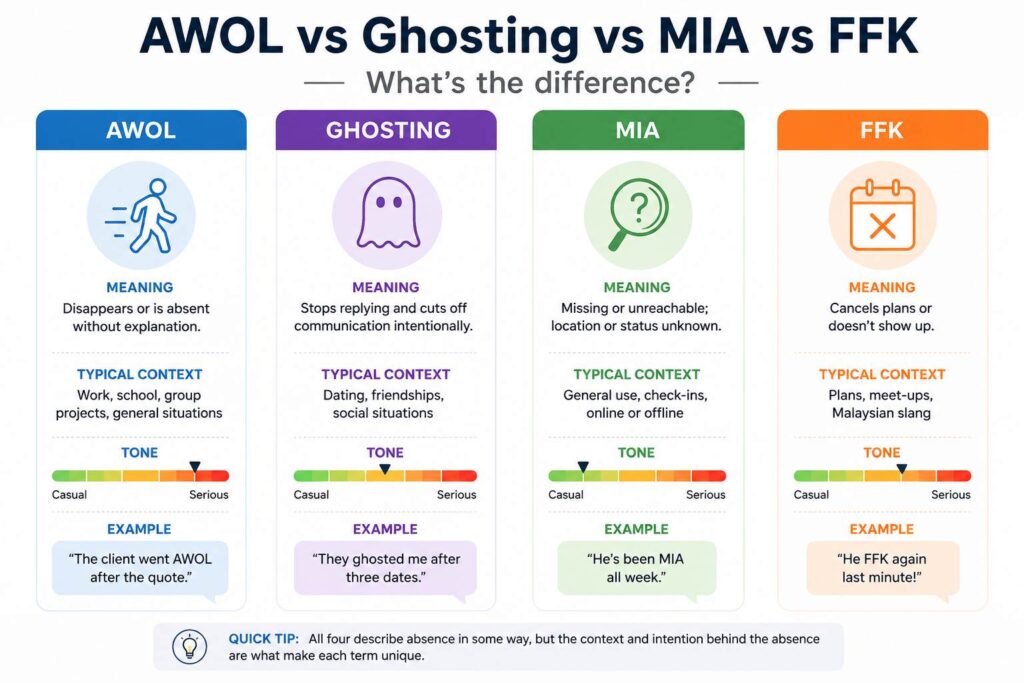
Several modern terms overlap with AWOL, but they aren’t exactly the same.
Term → Meaning → Tone
- AWOL → Disappearing unexpectedly / absent without explanation → Slightly serious
- Ghosting → Cutting off communication and ignoring messages (often dating/social) → Internet slang
- MIA → Missing/unreachable (often figurative now) → Casual
- FFK → Cancelling plans / not showing up (common Malaysian slang) → Casual
For example:
- Someone who ignores messages after dating may be “ghosting.”
- Someone who skips a meeting without explanation may be “AWOL.”
- Someone who cancels plans last minute may be “FFK.”
- Someone temporarily unreachable may be described as “MIA.”
These differences are subtle, but they help learners understand conversational nuance.
Is AWOL Commonly Used In Malaysia?
In Malaysia, some English speakers recognise and occasionally use AWOL, often in workplace or group-chat contexts, though many people also use alternatives like MIA or ghosting.
The choice often depends on:
- Age group
- Workplace culture
- Language preference
- Tone of conversation
For example:
- “Employee went AWOL” sounds serious.
- “He went AWOL from the group chat” sounds playful.
This flexibility helps explain why the word still appears in modern conversation.
Why Words Like AWOL Stay Popular
Some vocabulary disappears quickly. Others survive for generations.
AWOL stays relevant because it is:
- Short
- Expressive
- Adaptable
- Easy to understand
- Emotionally descriptive
Instead of saying: “He unexpectedly became absent without explanation,” people simply say: “He went AWOL.”
That efficiency makes the term memorable.
It also shows how language evolves: a military initialism from long ago can become part of casual online speech and workplace conversation.
Other Military Or Operational Terms Used In Everyday English
AWOL isn’t the only term that travelled from official systems into daily speech.
Some everyday phrases have links to military, government, or operational contexts. For example, “on the radar” connects to radar technology and later became a metaphor for noticing or monitoring something.
Other phrases people assume are “military” actually have different roots. For example, “deadline” in its time-limit meaning comes from journalism (and may have been influenced by an earlier Civil War-era “do-not-cross” line).
This is one reason vocabulary is interesting: familiar words often carry hidden historical layers.
Why Vocabulary Context Matters
Learning vocabulary isn’t just memorising definitions.
Strong language learners also understand:
- Tone
- Context
- Formality
- Cultural usage
- Grammar patterns
- Emotional nuance
For example, saying:
- “My friend went AWOL” feels different from saying:
- “My friend disappeared.”
The first sounds more conversational and expressive. Those small differences help learners sound more natural.
Using AWOL the Right Way
AWOL is more than just a military initialism. It has evolved into a flexible modern English term used to describe unexpected absence, disappearing acts, and sudden unresponsiveness across work, school, friendships, and online communication.
For vocabulary learners, understanding words like AWOL helps build stronger conversational English, improve tone awareness, and deepen understanding of how language changes over time.
At PRESS PR Agency, your trusted Malaysian PR partner, we help brands communicate more clearly through strategic PR, content development, and language-driven storytelling that connects naturally with modern audiences.
Sources
- Merriam-Webster Dictionary
- Cambridge Dictionary
- Collins Dictionary
- Oxford English Dictionary (OED)
- Etymonline
- Encyclopaedia Britannica
- British Council Learning English
Frequently Asked Questions About AWOL Meaning and Usage
What Does AWOL Mean?
AWOL stands for “Absent Without Leave.” It originally referred to military personnel who were absent without permission, but today it’s also used casually to describe someone disappearing or becoming unexpectedly unavailable.
Is AWOL Still Used Today?
Yes. AWOL still appears in workplaces, conversations, online chats, and social situations, although it’s usually more informal outside military contexts.
Is “Gone AWOL” Grammatically Correct?
Yes. “Gone AWOL” and “went AWOL” are both common and grammatically correct expressions in English.
Is AWOL Formal Or Informal?
AWOL can be both. In military or HR contexts, it may sound formal or serious. In casual conversation, it’s often informal and sometimes humorous.
What Is The Difference Between AWOL And Ghosting?
AWOL usually refers to someone unexpectedly disappearing or becoming absent. Ghosting specifically refers to cutting off communication and ignoring messages, especially in social or dating situations.
Is AWOL Commonly Used In Malaysia?
Some Malaysians recognise and occasionally use AWOL, particularly in English-speaking environments, though many people also use alternatives like ghosting, MIA, or FFK.