
Malaysia’s EV market has grown quickly, especially as more affordable electric vehicle models entered the country. For many buyers, EV ownership finally started to feel realistic instead of reserved for early adopters or luxury car shoppers.
That is why the RM200,000 minimum rule for imported EVs has sparked concern. Some Malaysians are worried about price increases, delayed launches, and whether popular fully imported models will still remain accessible.
The good news is that this does not mean every EV buyer is suddenly affected overnight. The real impact depends on whether the car is fully imported, already registered, currently booked, in transit, part of existing stock, or locally assembled.
This guide breaks down what has changed, who may be affected, and what Malaysian EV buyers can do now without panic buying.
What Is The New EV Rule In Malaysia?
Malaysia is tightening the conditions for fully imported CBU (Completely Built-Up) electric vehicles.
Starting 1 July 2026, imported CBU EVs (under the franchise AP framework) will be subject to two main conditions:
- Minimum CIF value of RM200,000
- Minimum motor power of 180 kW and above (revised from 200 kW)
This comes after the special exemption period ended on 31 December 2025. MITI also indicates that companies may continue selling remaining stock (including existing stock, port stock and in-transit units) under earlier exemption conditions until that stock is exhausted.
For everyday consumers, the most important takeaway is simple: many imported EVs may become significantly more expensive once the new framework fully bites.
The broader policy objective appears to focus on:
- Encouraging more local EV assembly
- Developing Malaysia’s EV supply chain ecosystem
- Supporting local automotive industry participation
- Moving Malaysia higher up the EV manufacturing value chain
This means Malaysia may increasingly prioritise CKD locally assembled EVs over cheaper fully imported CBU models.
Read More: How Malaysia’s Lemon Law Protects Your New Car Purchase
What Does CIF Actually Mean?
One of the biggest misunderstandings surrounding this policy is the RM200,000 figure itself.
Many consumers assume this means imported EVs will still retail around RM200,000. That is not how CIF works.
CIF refers to:
- Cost
- Insurance
- Freight
This represents the vehicle’s landed value before local taxes, duties, dealer margins, registration fees, and other costs are added.
A common misunderstanding is thinking “RM200,000” means the EV will retail near RM200,000. It won’t—because RM200,000 refers to CIF, not the final on-the-road price.
Once you factor in things like import duty (which can vary depending on the EV’s country of origin and trade agreement used), plus excise duty and sales tax, the final showroom price can climb quickly.
That’s why some reports and analysts suggest the policy could push many imported CBU EVs into higher retail price bands, and potentially reduce mass-market imported EV choices.
Why Is Malaysia Tightening Imported EV Rules?
Many online discussions focus only on rising prices or frustration from buyers. However, the policy direction is also tied to industrial planning and long-term economic goals.
Malaysia does not only want to become a buyer of EVs. It also wants to become part of the regional EV production ecosystem.
That includes areas such as:
- Local assembly
- Battery-related industries
- EV parts suppliers
- Engineering jobs
- Charging infrastructure growth
- Automotive technology investment
Countries like Thailand have already moved aggressively in this direction, and Malaysia likely does not want to fall behind.
Why CKD EVs May Become More Important
CKD, or Completely Knocked Down assembly, refers to vehicles assembled locally rather than imported fully built.
This allows Malaysia to potentially:
- Create more jobs
- Support local vendors
- Develop manufacturing capability
- Reduce long-term dependence on imports
Over time, this could result in more locally assembled EV options entering the market.
For buyers, this matters because the future of affordable EV choices in Malaysia may depend less on imported CBU models and more on how quickly brands localise assembly.
Why There Is A National Automotive Angle
Malaysia’s automotive policies have often carried some degree of local industry protection.
With local players becoming more active in the EV space, many observers believe the government wants to avoid a situation where local participation is overwhelmed by aggressively priced imported EVs.
Whether consumers agree with this strategy or not, it is an important part of understanding the policy direction.
The policy may feel frustrating in the short term, but from the government’s perspective, the goal is likely to build a stronger local EV industry instead of relying mainly on imported vehicles.
Read More: Top 10 Affordable Cars for a Fresh Graduate in Malaysia (2026)
Which EV Buyers Could Be Most Affected?
Not all EV owners or buyers will experience the impact equally.
The biggest impact will likely be felt by consumers shopping for imported EVs below the RM200,000 CIF threshold.
This may include buyers considering models such as:
- BYD Dolphin
- BYD Atto 3
- MG4
- Ora Good Cat
- Other entry-to-mid-range imported EVs
Some future models could become more expensive, delayed, or shifted toward CKD assembly plans.
Buyers waiting for upcoming EV launches may also be affected because some brands may now rethink their Malaysia strategy. This could lead to delayed launches, reduced model variety, premium-only positioning, or slower expansion plans.
What About Existing EV Owners?
Current EV owners are not suddenly being retroactively taxed under the new conditions.
The new requirements apply to imported CBU EVs from 1 July 2026 onward, rather than already-registered vehicles. That said, existing owners may still worry about:
- Future resale value
- Spare parts support
- Long-term warranty continuity
- Software updates
- Brand commitment to Malaysia
These are valid concerns, especially for brands still building long-term trust locally.
For example, if a certain model becomes harder to import or is discontinued in Malaysia, some owners may wonder whether parts and aftersales support will remain smooth. That does not mean support will disappear, but it does make brand commitment more important.
Does This Affect Buyers Who Already Booked An EV?
This is probably the biggest concern among Malaysian consumers right now.
The answer depends heavily on the status of the booked vehicle.
Some units may already be:
- In Malaysian inventory
- At local ports
- In transit before implementation
- Allocated to buyers
In addition, MITI has indicated that remaining stock (including port and in-transit units) may still be sold under earlier exemption conditions until exhausted.
However, buyers should not rely purely on verbal promises from sales advisers.
What Buyers Should Ask Their Dealer Right Now
Instead of panicking, buyers should focus on getting clarity.
Important questions include:
- Is my unit already allocated?
- Is the vehicle already in Malaysia, at port, or in transit?
- Is the quoted price locked in?
- Could taxes or pricing change later?
- What happens if delivery gets delayed?
- What are the refund or cancellation terms?
- Can the dealer provide written confirmation?
This documentation could become very important if disputes arise later.
A simple WhatsApp message is better than nothing, but a formal written confirmation, updated quotation, or booking document is much stronger.
Could Imported EV Prices Rise Sharply?
Potentially yes, especially for imported CBU models.
However, the situation is still evolving.
Several factors may soften the impact:
- Some brands could move toward CKD assembly
- Promotions may continue temporarily
- Competition between EV brands remains intense
- Future government incentives could evolve further
Still, many expect the era of aggressively affordable imported EVs to become harder to sustain if more models must clear the new CIF and power thresholds.
Rough Cost Example: How A RM200,000 Imported EV Can Become RM300,000+
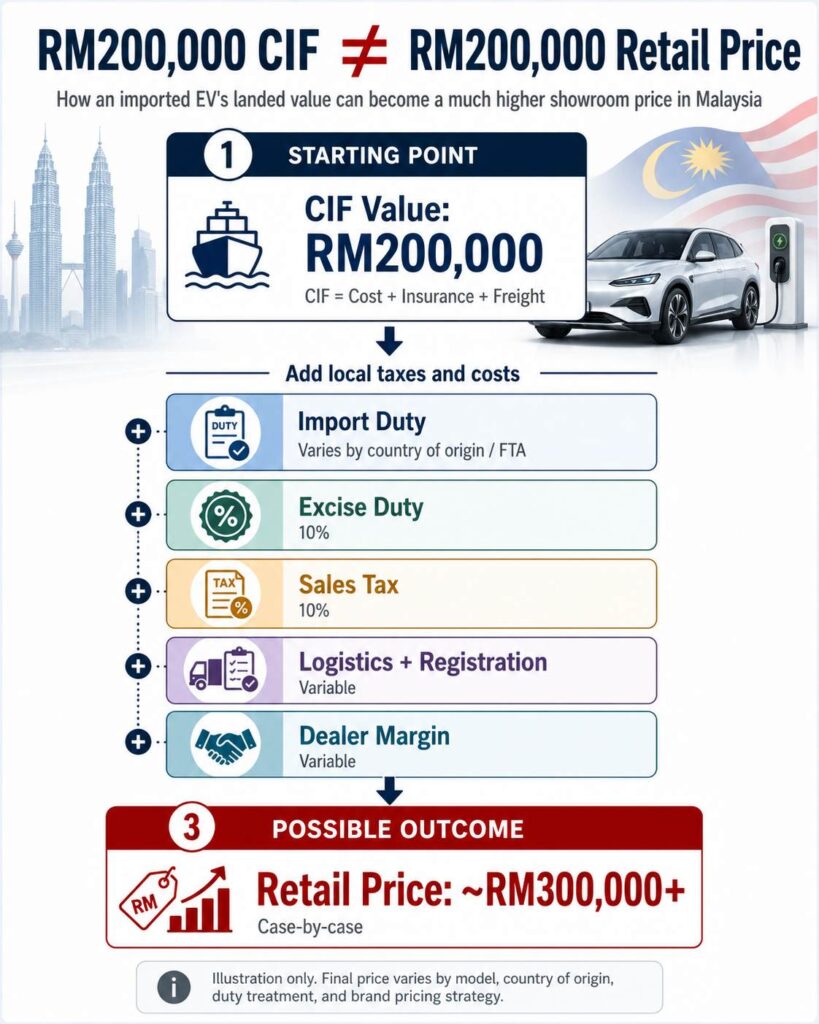 The RM200,000 figure can be misleading because it refers to CIF value, not the final customer price.
Here is a simplified table (numbers vary by brand, origin country, trade agreement, and pricing strategy):
| Cost Component | Rough Illustration (if CIF is RM200,000) |
| CIF value | RM200,000 |
| Import duty | ~5% to 30% (≈RM10,000 to RM60,000) |
| Excise duty | 10% (≈RM20,000) |
| Sales tax (part of SST) | 10% (≈RM20,000) |
| Logistics, registration and handling | Variable |
| Dealer margin | Variable |
| Possible retail price | Could reach ~RM300,000+ (case-by-case) |
The exact outcome depends on the model, the country of origin, the duty treatment used, and how the brand prices the car locally.
Buyers should also remember that the actual “drive away” cost may include:
- Road tax
- Insurance
- Number plate
- Loan interest
- Charger installation
- Accessories
- Tinting or coating
- Tyre replacement over time
For many households, the more important question is not just “Can I buy the EV?” but “Can I comfortably own it for the next five to seven years?”
Read More: Consumer Rights in Malaysia: What Every Buyer NEED to Know
Should Malaysians Still Buy An EV In 2026?
For many people, the answer is still yes.
EVs continue to offer several practical benefits:
- Lower fuel costs
- Lower maintenance requirements
- Smoother driving experience
- Convenient home charging
- Reduced exposure to petrol price fluctuations
For urban Malaysians with stable charging access, EV ownership can still make financial sense over the long term.
However, there is also nothing wrong with waiting.
Some consumers may prefer more clarity regarding:
- Future pricing
- CKD expansion
- Charging infrastructure
- Resale market stability
- Financing packages
Buying a car is a major financial commitment. Waiting for more certainty is completely reasonable.
Note: This is general information, not financial advice—always compare total ownership costs and financing terms based on your own situation.
Practical Tips For EV Buyers Right Now
The best response to policy uncertainty is not panic. It is preparation.
Avoid Panic Buying
Social media tends to amplify fear.
Do not rush into buying an EV simply because headlines suggest prices will suddenly skyrocket overnight.
A rushed car purchase can lead to regrets if the model does not fit your driving needs, charging access, budget, or long-term ownership plans.
Calculate Total Ownership Cost
The showroom price is only one part of EV ownership.
Buyers should also estimate:
- Insurance
- Road tax
- Charging setup costs
- Financing interest
- Tyre replacement
- Battery warranty coverage
A cheaper EV is not always cheaper long term.
Check Charging Accessibility
Condominium and apartment owners should verify charging access before committing.
This remains one of the biggest real-world ownership issues in Malaysia.
If your building has no EV charger, ask the management office whether installation is allowed, whether there are approved charging vendors, and how billing is handled.
Prioritise Stable Brands
Consumers may increasingly value:
- Service network strength
- Spare parts support
- Warranty reputation
- Financial stability of distributors
Brand reliability may become even more important if the market becomes more uncertain.
Keep All Booking Documentation
Buyers with active bookings should keep:
- Receipts
- Booking forms
- Price quotations
- Dealer confirmations
Having clear written records is always safer than relying on verbal discussions.
What Could Happen Next In Malaysia’s EV Market?
Malaysia’s EV market is still evolving rapidly.
Over the next few years, we may see:
- More CKD EV assembly
- Higher localisation efforts
- Premiumisation of imported EVs
- Stronger Chinese EV manufacturing partnerships
- Faster charging infrastructure growth
- Greater battery ecosystem investment
The market may become more mature, but also more competitive.
For consumers, this transition period may feel frustrating at times. However, it could also shape a stronger long-term EV ecosystem if managed properly.
What This Means For The Average Malaysian Buyer
For the average buyer, the main takeaway is not that EVs are suddenly “bad” or “too expensive.”
The real takeaway is that EV buying decisions now require more homework.
Before placing a booking, Malaysian consumers should understand:
- Whether the model is CBU or CKD
- Whether the price is likely to change
- Whether the dealer can honour the quoted price
- Whether the aftersales network is strong
- Whether charging fits their daily routine
- Whether the EV still makes sense compared with hybrid or petrol alternatives
For some buyers, an EV will still be the right choice. For others, a hybrid or efficient petrol car may feel more practical until pricing and infrastructure become clearer.
Both decisions can be valid.
Understanding the New EV Policy Without Panicking
Malaysia’s RM200,000 imported EV policy has understandably created uncertainty, especially among buyers who were finally preparing to switch to electric vehicles. While the changes may affect pricing and model availability, consumers who stay informed, ask the right questions, and focus on long-term ownership value can still make smart EV decisions without rushing into panic purchases.
At PRESS PR Agency, Malaysia’s trusted PR partner, we help brands communicate clearly during major industry shifts through strategic PR, reputation management, and media storytelling. As Malaysia’s EV market continues evolving, strong public communication and consumer trust will become more important than ever.
Sources
- Ministry of Investment, Trade and Industry (MITI)
- JPJ Malaysia
- Ministry of Transport Malaysia
- Malaysian Green Technology and Climate Change Corporation (MGTC)
- The Edge Malaysia
- New Straits Times
- Paul Tan Automotive News
Frequently Asked Questions About the Upcoming EV Policy Changes in Malaysia
Will Existing EV Owners Be Taxed Again?
No. The new conditions mainly apply to imported CBU EVs from 1 July 2026 onward, rather than EVs already registered.
However, existing owners may still feel indirect effects if resale values, parts supply, or future model availability change.
Will My EV Booking Price Change?
It depends on whether your booked unit is already allocated, in transit, or part of existing inventory.
Buyers should request written confirmation from dealers instead of relying only on verbal promises.
Are CKD EVs Affected By The RM200,000 Rule?
The policy mainly targets fully imported CBU EVs rather than locally assembled CKD models.
This is why CKD EVs may become more important in Malaysia’s future electric vehicle market.
Could Imported EV Prices Exceed RM300,000?
Yes, it is possible in some cases. A RM200,000 CIF threshold is not the final retail price, and taxes plus other costs can push the final figure higher.
The final price depends on the model, country of origin, duty treatment, and brand pricing strategy.
Should I Cancel My EV Booking?
Not necessarily. First, clarify your unit status, pricing guarantee, delivery timeline, and cancellation terms.
If the dealer can provide written confirmation and the car still fits your budget, cancelling may not be necessary.
Is It Better To Wait Before Buying An EV?
For some consumers, waiting may provide more clarity on pricing, CKD options, future incentives, and resale values. Others may still benefit from current promotions and available stock, especially if the unit is already in Malaysia or covered under earlier conditions.