

In Malaysian slang (especially Manglish), “kacau” describes unwanted or playful interaction, not just “disturbing” someone.
If you check a dictionary, you’ll see meanings around disruption, like creating disorder, disturbing peace, or (in verb form) stirring/mixing. That’s technically correct, but it doesn’t fully reflect how Malaysians use it day to day.
In real conversations, “kacau” can mean:
- bothering someone while they’re busy
- teasing a friend
- interrupting someone’s work
- interfering in a situation
- getting someone’s attention in a playful way
The exact meaning depends less on the word itself and more on tone and context.
What Is the Basic Definition of “Kacau”?
At its simplest, “kacau” carries the idea of disruption: physically, socially, or emotionally.
In standard Bahasa Melayu, the most literal “stir/mix” meaning is tied to mengacau (the verb), like stirring coffee. The same root also extends into “disrupting” or “throwing something into disorder.”
Meanwhile, kacau on its own is often used to describe something that’s messy, mixed up, or chaotic, and it also appears in phrases like “kacau daun”, which means disturbing or bothering someone’s comfort or personal affairs.
In Manglish (informal Malaysian English), people commonly use “kacau” as a verb anyway, and that’s why you’ll hear lines like:
- “Don’t kacau me” (stop bothering/disturbing me)
- “Why you kacau my work?” (stop interfering)
Same core idea: you’re disrupting something, but the exact meaning depends on context.
Where Did “Kacau” Come From and How Did It Evolve?
A simple way to understand “kacau” in Malaysian slang is through a metaphor: stirring/mixing → disrupting or “stirring up” a situation.
This isn’t a single documented origin story with a neat timeline, it’s just a practical explanation of why the word can stretch from physical actions (like stirring) to social situations (like bothering or interfering).
In Malaysia’s multilingual environment, informal Malaysian English (Manglish) naturally borrows and adapts words. Grammar gets simplified, and meaning becomes more flexible, which is exactly why “kacau” can cover several situations depending on delivery.
Why Malaysians Prefer “Kacau” Over English Words
In casual Manglish, “kacau” often feels less formal than English equivalents like “disturb” or “interfere.”
Consider these two sentences:
- “Don’t disturb me.”
- “Don’t kacau me.”
The first sounds more formal and firm. The second feels more casual and conversational.
That’s why “kacau” shows up so often in everyday speech, it’s short, flexible, and most people can read the intent from tone and context.
How Is “Kacau” Used in Real Life?
The best way to understand “kacau” is to see it in real situations.
When You Want to Be Left Alone
- “Don’t kacau me, I got deadline.”
- Meaning: You’re busy and don’t want to be disturbed.
When Friends Are Teasing You
- “Eh don’t kacau la, paiseh already.”
- Meaning: Friendly teasing, but you want them to stop.
When Someone Interferes
- “Why you kacau my work?”
- Meaning: They’re interrupting or interfering.
When It’s Slightly Flirty
- “He always kacau her one.”
- Meaning: He keeps bothering her in a playful, attention-seeking way (sometimes light flirting).
When It Becomes Annoying
- “That guy keep kacau me whole day.”
- Meaning: Repeated, unwanted disturbance.
Across all examples, the core idea stays the same: someone is creating an interaction that disrupts your flow, but tone decides whether it feels playful or irritating.
The “Kacau Spectrum”: One Word, Many Meanings
“Kacau” works across a range of meanings, rather than having a single fixed definition.
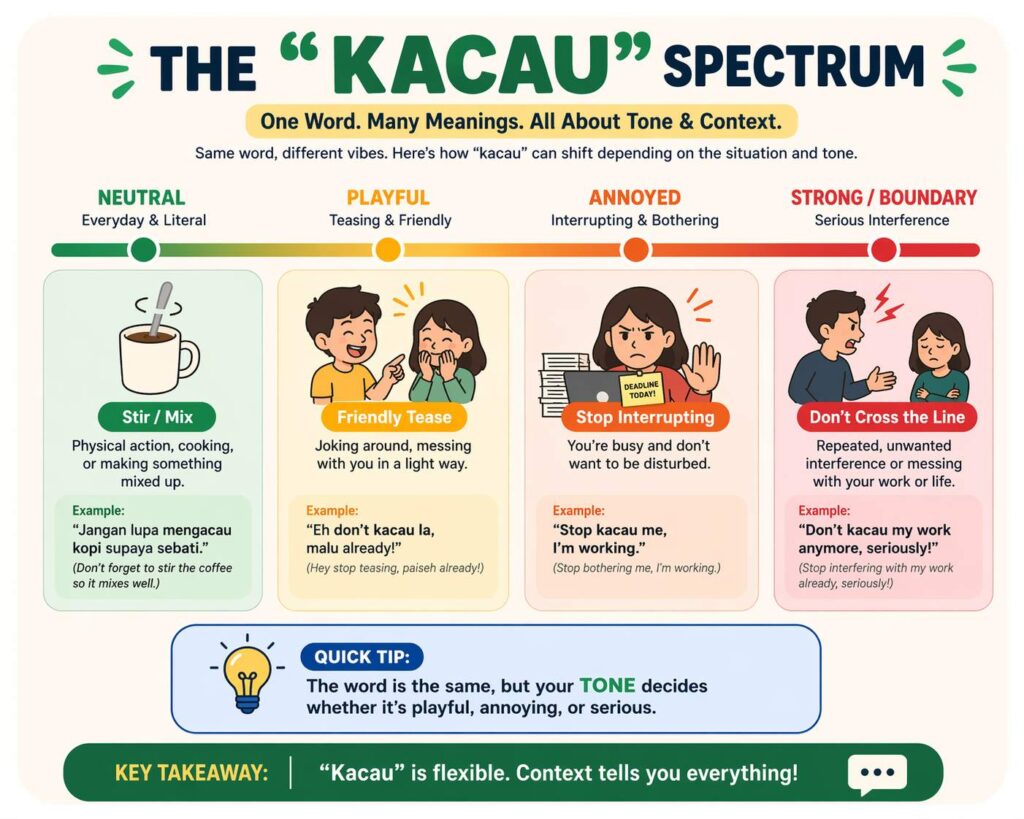
This flexibility is what makes it so widely used. Instead of switching vocabulary, Malaysians rely on tone and context to convey the meaning.
Read More: FFK in Malaysian Slang: What Does “Fong Fei Kei” Really Mean?
How Tone Changes Everything
With “kacau,” tone plays a bigger role than the word itself.
Take the same sentence:
- “Don’t kacau me” said with a smile sounds playful
- “Don’t kacau me” said seriously sounds irritated
In Malaysian conversations, tone, facial expression, and context often carry more meaning than strict grammar, especially in Manglish, where sentences are usually shorter and less structured.
So understanding “kacau” is less about memorising definitions and more about recognising social cues.
When Should You Avoid Using “Kacau”?
Despite how common it is, “kacau” is still informal and not suitable for every situation.
Avoid using it in:
- Professional emails
- Formal presentations
- Customer-facing communication
- Serious complaints or disputes
In those contexts, it’s better to use:
- disturb
- interrupt
- interfere
Using “kacau” in formal settings can make your message sound too casual or unprofessional.
“Kacau” vs Other Words: Why It’s Hard to Translate
No single English word fully captures what “kacau” means in everyday Malaysian speech.
| Word | Limitation |
|---|---|
| Disturb | Can sound formal and narrow |
| Annoy | Can feel too strong and negative |
| Tease | Too playful and doesn’t cover “interfere” |
| Interrupt | Doesn’t always cover playful “bother” |
“Kacau” sits somewhere in between all these meanings, and that’s why people often stick with it instead of switching between multiple English words.
Why “Kacau” Reflects Malaysian Slang So Well
“Kacau” is a good example of how Malaysian slang works: flexible, context-driven, and shaped by a multilingual culture.
It reflects a few common features:
- language mixing (Malay + English + local influences)
- practicality over strict grammar
- meaning carried by tone, not just words
Rather than being precise like formal writing, Malaysian slang prioritises being expressive and efficient.
Quick Practice: Would You Use “Kacau” Here?
Try applying the concept to everyday scenarios.
- A friend joking about your crush
- A colleague interrupting your task
- A stranger offering helpful advice
- Your sibling annoying you repeatedly
In most of these cases, “kacau” fits when there’s unwanted or playful disruption. If the interaction is neutral or genuinely helpful, “kacau” usually doesn’t apply.
Interesting Things You Might Not Know About “Kacau”
- It’s common in casual Malaysian speech and often shows up in Manglish (informal Malaysian English).
- It’s often paired with “la/lah” (e.g., “don’t kacau la”), and the vibe depends on delivery.
- It can sound friendly, playful, or rude; tone does a lot of the work.
- It’s a flexible word that can cover “bother,” “interrupt,” or “interfere,” depending on context.
“Kacau” in Social Dynamics (And Why It Hits Different)
“Kacau” is one of those words Malaysians lean on because it doesn’t only describe an action,it also signals the relationship between speakers.
In English, “stop bothering me” can sound cold or confrontational even when you don’t mean it that way. In Manglish, “don’t kacau” can carry a softer “eh, not now” vibe, especially when it’s paired with little tone markers like la/lah, or said with a smile. You’re still asking someone to stop, but the social message is often: I’m irritated, but we’re still okay.
Read More: What Does Gostan Mean: Malaysian Slang Origins and Usage
It also works as a playful boundary word. Friends use it to tease without escalating:
- “Eh, don’t kacau la.”
- This can mean: Stop exposing me, stop clowning me, stop pushing that topic.
In relationships, “kacau” often hints at attention-seeking rather than serious disruption. When someone says, “He always kacau her one,” it may suggest he’s deliberately looking for reactions (joking, poking, messaging a lot), and whether that’s cute or annoying depends on the tone and the two people involved.
Interference
Another reason “kacau” feels so Malaysian is that it can describe interference without sounding too “official.” Saying “Don’t interfere” can sound like a serious accusation. Saying “Why you kacau?” might still show annoyance, but it’s more everyday, like you’re describing someone messing with your flow rather than making a formal complaint.
A useful way to think about it is this:
- Mild kacau = playful nudging, casual teasing, light attention
- Medium kacau = distracting you when you’re busy, interrupting, being a bit much
- Heavy kacau = messing with your work, stirring drama, crossing boundaries
That’s also why tone matters so much. The same word can be a joke, a warning, or a scolding, and locals can usually tell which one it is within a second.
If you’re learning Manglish, “kacau” is worth knowing not just for the literal meaning, but because it teaches you something bigger: Malaysians often communicate intent through delivery (tone, facial expression, context), not just the dictionary definition.
It’s Not Just About “Disturbing”
“Kacau” might look like a simple word, but it captures something very Malaysian: communication that balances tone, intent, and context.
If you’re building narratives that need to resonate with local audiences, understanding these nuances matters. At PRESS PR Agency, Malaysia’s top PR agency, we help brands translate cultural language and everyday communication into PR strategies that feel authentic, relevant, and impactful. Don’t miss this chance to partner with PRESS and improve your brand narrative!
Sources
- Dewan Bahasa dan Pustaka (DBP), PRPM / Kamus Dewan entries: kacau, mengacau
- Oxford English Dictionary (OED): “Introduction to Malaysian English”
- Peer-reviewed research on informal Malaysian English features shaped by language contact
- Read.com.my, Manglish usage references
Frequently Asked Questions About the Word “Kacau”
What Does “Kacau” Mean in Malaysian Slang?
It usually means to bother, disturb, tease, or interfere in a casual Manglish context. The exact meaning depends on tone and situation.
Is “Kacau” Always Negative?
No. It can be playful, neutral, or annoyed/negative depending on delivery and context.
Can Foreigners Use “Kacau”?
Yes. It’s fine in casual conversation. Avoid it in formal or professional settings, where it may sound too informal.
What Is the Difference Between “Kacau” and “Disturb”?
“Disturb” is generally more formal and direct. “Kacau” is more flexible and often sounds more casual, but it can still come off rude with the wrong tone.
Why Is “Kacau” So Common in Malaysia?
Because it’s short and versatile in casual speech, and can cover multiple meanings (bother/interrupt/interfere/tease) depending on context.
Does “Kacau” Also Mean “Stir” in Malay?
In standard Malay, the clearest verb for “stir/mix” is mengacau (like stirring a drink). In Manglish, people often say “kacau” as a verb too, but the standard dictionary form is typically mengacau.