
Disease outbreaks can quickly shift investor attention toward healthcare stocks. Even when public health risks are considered manageable, markets often rotate into companies linked to hospitals, medicine, diagnostics, healthcare infrastructure, PPE, and pharmaceutical supply chains.
Malaysia saw this clearly during COVID-19, when glove stocks became some of Bursa Malaysia’s most heavily traded counters. More recently, hantavirus-related headlines revived interest in healthcare counters. In May 2026, Malaysia’s Health Ministry said the current risk of hantavirus infection in Malaysia is low, while advising precautions and stepping up surveillance.
Still, healthcare investing today is no longer just about gloves. Investors now also monitor hospital groups, pharmaceutical firms, diagnostics companies, healthcare distributors, and medical infrastructure providers whenever healthcare demand or pandemic preparedness becomes a major market theme.
Read More: Foreign Portfolio Investment (FPI)? – In Simple Terms
Comparison Table
| Company | Segment | Outbreak Angle | Key Data Point |
|---|---|---|---|
| Top Glove Corporation Bhd | Gloves/PPE | Global glove demand | FY2025 revenue: RM3.49 billion |
| Hartalega Holdings Bhd | Gloves/PPE | Nitrile glove demand | FY2025 revenue: RM2.59 billion |
| IHH Healthcare Bhd | Hospitals | Regional healthcare demand | FY2025 revenue: RM25.75 billion |
| KPJ Healthcare Bhd | Hospitals | Domestic healthcare growth | FY2025 revenue: RM4.26 billion |
| Duopharma Biotech Bhd | Pharmaceuticals | Essential medicine demand | FY2025 revenue: RM931.69 million |
| Pharmaniaga Bhd | Pharmaceutical Distribution | Vaccine and healthcare supply chain | FY2025 revenue: RM3.93 billion |
| Sunway Healthcare Holdings | Hospitals/Infrastructure | Hospital expansion | IPO valuation: RM16.7 billion |
| LKL International Bhd | Medical Equipment | Hospital bed and equipment demand | Healthcare equipment manufacturing exposure |
| Malaysian Genomics Resource Centre (MGRC) | Diagnostics/Genomics | Diagnostic and testing demand | Genomics and precision medicine exposure |
| Adventa Bhd | Healthcare Supplies | Medical disposable products | Healthcare consumables exposure |
How We Selected These Healthcare Stocks
The list focuses on healthcare companies that may attract investor attention during disease outbreaks, healthcare demand spikes, or broader healthcare resilience discussions.
Selection criteria include:
- Exposure to healthcare demand: Hospitals, pharmaceuticals, diagnostics, medical supplies, PPE, or healthcare infrastructure.
- Malaysia relevance: Listed in Malaysia or strongly connected to Malaysia’s healthcare ecosystem.
- Operational scale: Companies with meaningful healthcare operations, distribution reach, manufacturing capacity, or hospital infrastructure.
- Investor relevance: Stocks that historically attracted attention during COVID-19, SARS-related healthcare scares, or recent outbreak headlines.
- Available financial data: Revenue, patient volume, profit growth, or operational indicators.
1. Top Glove Corporation Bhd
Why investors watch it during outbreaks
Top Glove remains Malaysia’s best-known outbreak-sensitive healthcare stock. During COVID-19, global PPE shortages pushed glove demand sharply higher. The stock often reacts quickly when investors anticipate rising glove demand.
Hard data to note
- FY2025 revenue: RM3.49 billion
- FY2025 revenue grew 39% year-on-year
- Sales volume increased 55% year-on-year
- Profit after tax (group): RM123 million
- Profit attributable to shareholders (PATAMI): ~RM105 million
What investors should monitor
- Average selling prices (ASP): Rising ASPs usually signal improving glove demand and stronger pricing power across the industry.
- Factory utilisation rates: Higher utilisation can improve operational efficiency and profit margins after the post-pandemic slowdown.
- US and Europe demand recovery: These remain key export markets for Malaysian glove manufacturers.
- Latex and nitrile raw material costs: Input cost increases can pressure earnings even when revenue improves.
- Global PPE inventory levels: Excess distributor inventory may slow future glove orders.
2. Hartalega Holdings Bhd
Why investors watch it during outbreaks
Hartalega is strongly linked to nitrile glove demand in healthcare settings. The company is often viewed as a premium glove manufacturer with strong automation capabilities. Investors frequently monitor Hartalega during healthcare demand surges.
Hard data to note
- FY2025 revenue: RM2.59 billion
- FY2025 net profit: ~RM74.5 million
- Earnings per share: 2.18 sen
What investors should monitor
- Nitrile glove pricing trends: Hartalega’s earnings are closely tied to premium nitrile glove demand and pricing recovery.
- Automation efficiency: Stronger automation may help the company defend margins during weaker industry cycles.
- Healthcare export orders: Export growth can indicate improving hospital and healthcare demand globally.
- Capacity expansion discipline: Investors may watch whether the company expands too aggressively during uncertain demand conditions.
- Institutional fund activity: Hartalega is widely followed by institutional investors and healthcare-focused funds.
3. IHH Healthcare Bhd
Why investors watch it during outbreaks
IHH Healthcare is one of Asia’s largest private healthcare groups. During outbreaks, hospital groups may benefit from diagnostics, inpatient treatment, specialist care, and emergency response demand. Investors often view hospital operators as more defensive healthcare investments.
Hard data to note
- FY2025 revenue: RM25.75 billion
- Revenue grew 6% year-on-year
- Network spans 89 hospitals across 10 countries (within a broader footprint of healthcare facilities)
- Expanded its Malaysia footprint through the Island Hospital acquisition
What investors should monitor
- Hospital occupancy rates: Higher occupancy generally supports stronger recurring healthcare revenue.
- Medical tourism recovery: International patient flows remain important for premium private hospitals in Malaysia and Singapore.
- Revenue per inpatient: Rising revenue per patient may indicate stronger specialist and complex-care demand.
- Expansion and acquisitions: New hospitals and acquisitions can strengthen long-term regional market share.
- Healthcare staffing costs: Labour shortages and specialist doctor costs may pressure margins.
Read More: Top 10 Accounting Software in Malaysia for SMEs
4. KPJ Healthcare Bhd
Why investors watch it during outbreaks
KPJ is one of Malaysia’s largest private hospital operators. It gives investors stronger exposure to Malaysia’s domestic healthcare demand. Outbreaks may increase demand for diagnostics, outpatient services, and specialist healthcare.
Hard data to note
- FY2025 revenue: RM4.26 billion
- Inpatient admissions rose 3% year-on-year
- Outpatient visits increased 6% year-on-year to 773,799
- Surgical cases increased 11% year-on-year to 30,784
- Bed occupancy rate for Q4 FY2025 was 67%
What investors should monitor
- Patient volume growth: Rising inpatient and outpatient numbers may reflect strengthening healthcare demand.
- Bed occupancy rates: Higher occupancy can improve hospital operating leverage and recurring revenue.
- Revenue per patient: Investors often track whether KPJ is treating more complex and higher-value medical cases.
- Hospital expansion plans: Additional hospital capacity may support long-term growth but also increase capital expenditure.
- Labour and operating costs: Rising staffing and medical supply costs can affect margins.
5. Duopharma Biotech Bhd
Why investors watch it during outbreaks
Duopharma gives investors pharmaceutical exposure instead of pure PPE exposure. Medicine demand and healthcare procurement often rise during healthcare crises. Pharmaceutical companies may provide steadier healthcare exposure than cyclical glove stocks.
Hard data to note
- FY2025 revenue: RM931.69 million
- Revenue grew 14.5% year-on-year
- Profit before tax: RM114.91 million
- Profit after tax: RM87.46 million
What investors should monitor
- Government healthcare procurement: Public-sector medicine contracts remain an important revenue driver.
- Essential medicine demand: Demand for chronic care and hospital medicines may remain stable even during economic slowdowns.
- Product approvals and launches: New product registrations can support future revenue growth.
- Vaccine and healthcare partnerships: Strategic healthcare collaborations may improve long-term positioning.
- Profit margin stability: Investors often watch whether cost increases are affecting profitability.
6. Pharmaniaga Bhd
Why investors watch it during outbreaks
Pharmaniaga is closely tied to Malaysia’s pharmaceutical distribution and healthcare supply chain. The company became highly visible during COVID-19 because of vaccine logistics and healthcare procurement. Future outbreaks may again increase focus on medicine distribution and healthcare preparedness.
Hard data to note
- FY2025 revenue: RM3.93 billion (+4.5% year-on-year)
- Profit after tax: RM50.7 million
- Manufacturing EBITDA: RM88.0 million (+64.8%)
- Recorded eight consecutive profitable quarters by Q4 FY2025
What investors should monitor
- Government healthcare contracts: Public-sector procurement remains a major earnings contributor.
- Medicine distribution demand: Higher healthcare utilisation may strengthen pharmaceutical logistics activity.
- PN17 restructuring progress: Investors continue monitoring the company’s balance sheet recovery.
- Inventory and supply-chain efficiency: Effective medicine distribution is important for cash flow and profitability.
- Healthcare policy changes: Procurement and healthcare spending decisions may materially affect future earnings.
7. Sunway Healthcare Holdings
Why investors watch it during outbreaks
Sunway Healthcare gives investors exposure to hospital infrastructure and healthcare expansion. Its IPO became one of Malaysia’s largest healthcare listings in recent years. Hospital groups may benefit from rising diagnostics and treatment demand during outbreaks.
Hard data to note
- IPO valuation: RM16.7 billion
- IPO proceeds targeted: RM2.86 billion
- Licensed beds as of January 2026: 1,805
- 2024 revenue: RM1.85 billion
- 2024 net profit: RM257.5 million
What investors should monitor
- Hospital expansion projects: New facilities and additional beds may support long-term revenue growth.
- Occupancy and utilisation rates: Higher patient utilisation usually strengthens healthcare earnings visibility.
- Medical tourism demand: International patients remain an important growth segment for premium hospitals.
- Capital expenditure requirements: Rapid expansion may improve scale but also increase financial pressure.
- Healthcare service diversification: Expansion into specialist care may improve long-term margins.
8. LKL International Bhd
Why investors watch it during outbreaks
LKL International manufactures hospital beds, medical furniture, and healthcare equipment. During healthcare crises, hospitals may increase spending on beds, equipment, and treatment infrastructure. This gives investors exposure to healthcare infrastructure instead of pure glove manufacturing.
Hard data to note
- Core businesses include medical beds, ward furniture, dialysis chairs, and healthcare facility equipment
- Exports healthcare equipment to multiple markets
- During COVID-19, many health systems expanded capacity and increased focus on beds and critical equipment—supporting demand themes for hospital infrastructure suppliers
What investors should monitor
- Hospital equipment orders: Rising healthcare infrastructure spending may improve demand visibility.
- Government and hospital projects: Public healthcare expansion may support future orders.
- Export market demand: Overseas healthcare infrastructure demand can diversify revenue.
- Manufacturing margins: Material and production costs may affect profitability.
- Healthcare facility upgrades: Long-term hospital modernisation trends could support recurring demand.
Read More: What Is Passive Income? A Malaysia Guide (2026)
9. Malaysian Genomics Resource Centre (MGRC)
Why investors watch it during outbreaks
MGRC gives investors exposure to diagnostics, genomics, and precision medicine. Diagnostic and testing demand often becomes highly relevant during disease outbreaks. Investors increasingly monitor healthcare technology and genomics during healthcare crises.
Hard data to note
- Operates within genomics, DNA sequencing, precision medicine, and healthcare testing
- Precision medicine and genomic diagnostics became more widely discussed after COVID-19 accelerated healthcare technology adoption
- Has partnerships linked to genomic and biotechnology initiatives
What investors should monitor
- Demand for diagnostic and genomic testing: Healthcare crises often increase attention on early detection and personalised medicine.
- Commercial scalability: Investors may look for recurring healthcare revenue instead of purely research-driven income.
- Healthcare and biotech partnerships: Collaborations can strengthen credibility and long-term growth potential.
- Regulatory developments: Precision medicine businesses remain sensitive to healthcare regulation and approvals.
- Healthcare technology adoption: Wider use of genomic healthcare services may improve future demand.
10. Adventa Bhd
Why investors watch it during outbreaks
Adventa is linked to healthcare supplies and medical disposable products. During outbreaks, healthcare systems often increase demand for medical consumables and healthcare supplies. The stock provides broader healthcare consumables exposure beyond gloves alone.
Hard data to note
- Has exposure to healthcare disposable products and medical supply distribution
- COVID-19 increased attention on medical consumables and supply chains, especially during peak outbreak periods
- Investors often watch whether healthcare supply businesses can sustain demand beyond one-off outbreak cycles
What investors should monitor
- Healthcare consumables demand: Higher hospital and clinic activity may improve recurring supply orders.
- Distribution efficiency: Inventory management and logistics performance can affect profitability.
- Operational restructuring progress: Investors may monitor whether healthcare operations are improving sustainably.
- Product diversification: Wider healthcare product offerings may reduce dependence on a single segment.
- Margin recovery: Cost management remains important in healthcare consumables distribution.
Why Healthcare Stocks Still Matter During Disease Outbreaks
Healthcare stocks remain highly relevant during outbreaks because disease scares often increase attention on:
- Hospital capacity
- Medical preparedness
- Healthcare infrastructure
- Medicine supply chains
- Diagnostics and testing
- PPE and medical consumables
COVID-19 also showed that healthcare investing is broader than gloves alone. Hospitals, diagnostics, pharmaceutical logistics, and healthcare technology now play increasingly important roles in outbreak-related investing.
What Investors Should Watch Before Buying Healthcare Stocks
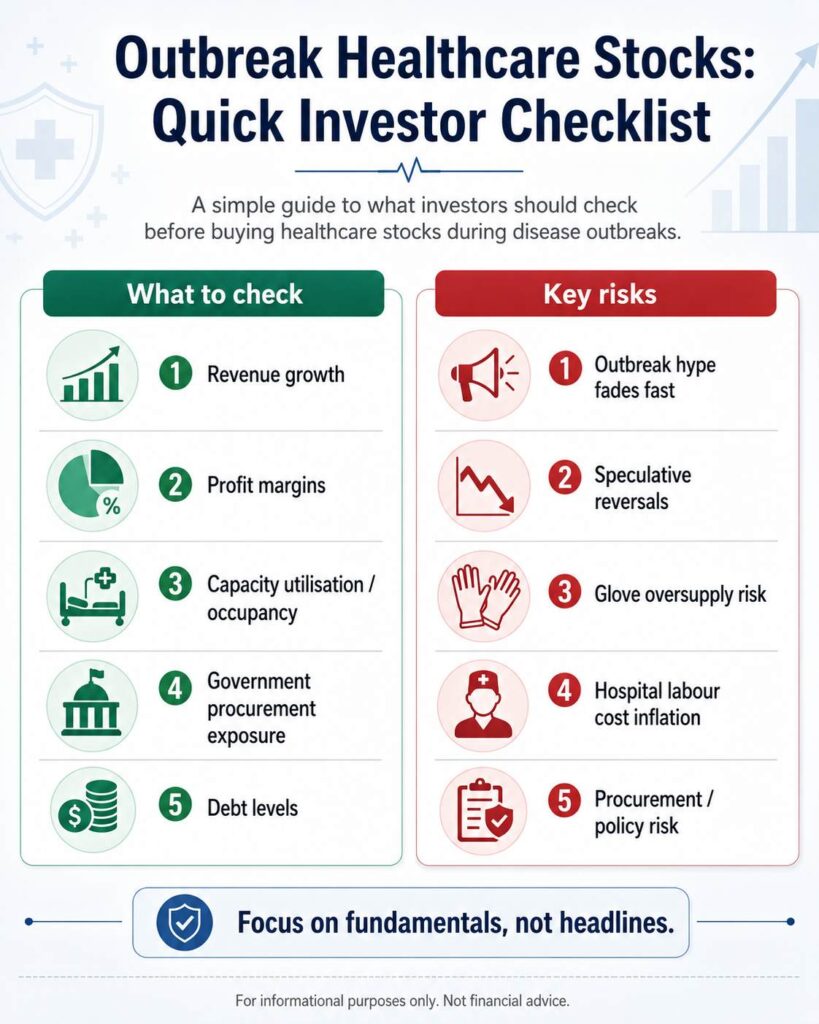
Before buying healthcare stocks during an outbreak, investors should check:
- Revenue growth
- Profit margins
- Capacity utilisation
- Hospital occupancy
- Government procurement
- Debt levels
- Trading volume
- Operational scalability
Outbreak-related rallies can become speculative very quickly, especially in smaller healthcare counters.
Key Risks To Understand
Healthcare stocks still carry important risks:
- Outbreak fears may fade quickly
- Speculative rallies can reverse sharply
- Glove oversupply may pressure margins
- Hospital operators face labour cost inflation
- Pharmaceutical firms face procurement risks
- Smaller healthcare counters may have weaker liquidity
Why You Should Invest in Healthcare Stocks
Healthcare stocks in Malaysia continue to attract investor attention whenever disease outbreaks, healthcare scares, or pandemic preparedness become major market themes. While glove stocks still matter, modern healthcare investing now extends into hospitals, pharmaceutical distribution, diagnostics, medical technology, and healthcare infrastructure.
For healthcare companies, visibility and public trust become even more important during uncertain market cycles. At PRESS PR Agency, Malaysia’s most trusted PR agency,we help healthcare and business brands strengthen media exposure, authority positioning, and public visibility through strategic PR campaigns tailored for Malaysia’s evolving business and healthcare landscape.
Disclaimer: This article is not financial advice. Investors should always evaluate fundamentals, valuations, and risks before investing.
Sources
- The Edge Malaysia
- FSMOne Malaysia
- Bursa Malaysia
- Reuters
- World Health Organization (WHO)
- US Centers for Disease Control and Prevention (CDC)
- Malaysia Ministry of Health (MOH) – Media Statement on Hantavirus Risk (May 2026)
- Top Glove Integrated Annual Report 2025
- Hartalega FY2025 results / company announcements
- IHH Healthcare Annual Report 2025
- IHH – Island Hospital acquisition information
- KPJ Healthcare 4Q FY2025 Analyst Briefing / performance highlights
- Duopharma Biotech FY2025 Financial Results
- Pharmaniaga Q4FY2025 Press Release / FY2025 Financial Information
- Sunway Healthcare IPO Prospectus
- Malaysian Investment Development Authority (MIDA)
- LKL International Annual Report
- MGRC Corporate Information / Annual Report materials
- Adventa Corporate Information
Frequently Asked Questions About Malaysian Healthcare Stocks
What Are Healthcare Stocks?
Healthcare stocks are shares of companies involved in hospitals, pharmaceuticals, diagnostics, healthcare equipment, medical supplies, healthcare infrastructure, and healthcare distribution.
Why Do Healthcare Stocks Rise During Disease Outbreaks?
Healthcare stocks may rise during outbreaks because investors expect higher demand for hospitals, diagnostics, medicine, PPE, vaccines, and healthcare infrastructure.
Are Glove Stocks Still Important During Disease Outbreaks?
Yes. Glove stocks remain one of Malaysia’s most outbreak-sensitive healthcare sectors because they are directly linked to PPE demand.
Are Hospital Stocks Safer Than Glove Stocks?
Hospital operators may be less volatile than glove stocks, but they still face labour costs, occupancy risks, expansion costs, and healthcare inflation pressures.
Why Are Diagnostics And Genomics Companies Relevant During Outbreaks?
Disease outbreaks often increase demand for testing, diagnostics, healthcare technology, and genomic analysis.
Should Investors Buy Healthcare Stocks During Every Outbreak?
Not necessarily. Some outbreaks create only short-term market reactions. Investors should compare outbreak sentiment with company fundamentals, valuation, and long-term healthcare demand.