

Many Malaysians are exploring ways to earn beyond a traditional monthly salary. Rising living costs, financial independence goals, and easier access to online platforms have encouraged people to diversify income.
One concept that frequently appears in personal finance discussions is passive income. You may hear people talking about dividends, rental property, or online businesses that generate revenue even when they are not actively working.
While the idea sounds appealing, passive income is often misunderstood. In reality, most passive income streams require initial effort, capital, or strategic planning before they begin producing consistent returns.
This guide explains what passive income means, how it works in Malaysia, common examples, and practical steps to start in 2026.
What Is Passive Income?
Passive income refers to income that continues to generate revenue with relatively minimal ongoing effort after the initial setup, investment, or creation phase.
Unlike active income, which depends on continuous work (for example, salary or freelancing), passive income usually comes from assets or systems that can produce recurring returns.
Common examples of passive income
- Rental income from property
- Dividend income from shares
- Distributions from REITs
- Royalties from intellectual property
- Income from digital products (e-books, templates, software, courses)
- Advertising or affiliate income from a website or channel
The core idea
Create or acquire an asset → The asset generates income over time.
Important: passive income rarely means “hands-off.” Most streams still require some combination of monitoring, management, compliance, updates, and reinvestment. (Sources: LHDN guidance on rental and digital business income; Securities Commission Malaysia and Bank Negara Malaysia consumer alerts)
Why Passive Income Is Becoming Important In Malaysia
Interest in passive income has grown as Malaysians look for added stability and flexibility beyond a single salary. Rising living costs, job uncertainty, and more online earning options have made income diversification more appealing. Passive income can support goals like retirement planning, wealth accumulation, and greater financial resilience. (Source: DOSM; MDEC)
Passive Income Vs Active Income
Income Type | Description | Examples |
Active Income | Earned directly from working time | Salary, freelancing, consulting |
Passive Income | Earned from assets/systems that can generate returns over time | Dividends, rental income, royalties, digital product sales |
Active Income Characteristics
Active income typically involves:
- Trading time for money
- Continuous work to maintain earnings
- Income stopping when work stops
Examples include salaries, hourly work, or project-based freelancing.
Passive Income Characteristics
Passive income usually involves:
- Initial effort and/or capital
- Assets generating recurring returns
- Potential to grow over time with reinvestment
Even so, “passive” income may still require monitoring and occasional maintenance.
How Passive Income Works
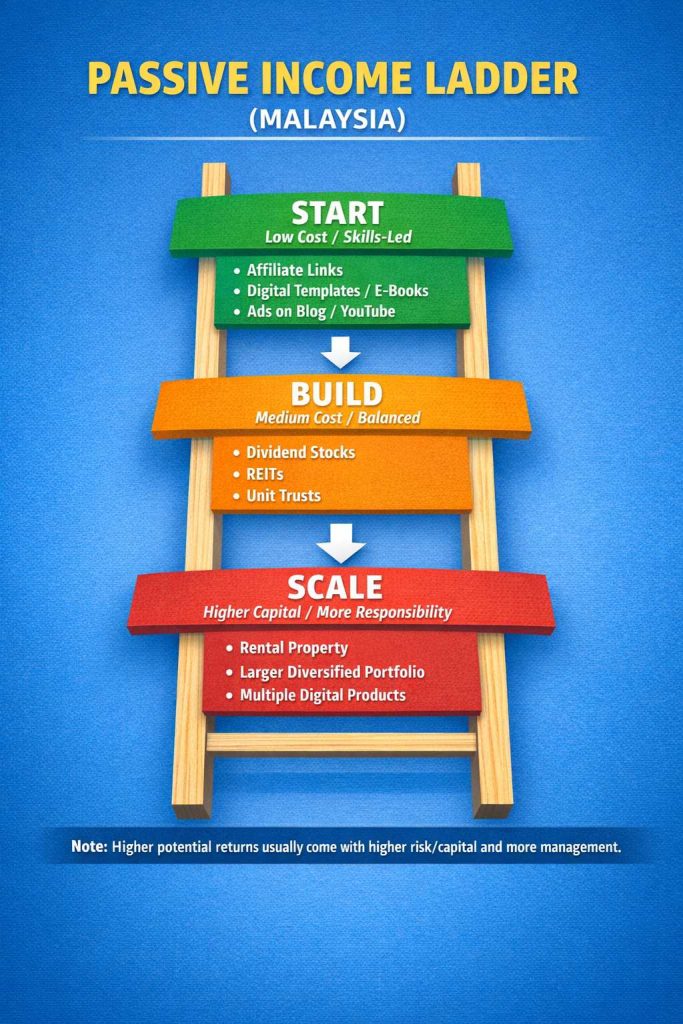
Most passive income strategies follow a similar structure:
- Build or buy an asset: This could be shares, a property, a course, a website, or a product.
- Monetise the asset. Examples:
- Dividend-paying shares can provide dividend payouts (subject to company performance and distribution decisions)
- Property can generate rental income
- A course can continue selling after launch
- A website can earn advertising or affiliate income
- Maintain and improve: Over time, these assets may generate income with limited upkeep, but most still need occasional monitoring and improvement.
Common Types Of Passive Income In Malaysia
1) Investment-Based Passive Income
Investment income is one of the most common passive income paths.
Common examples include:
- Dividend-paying shares listed on Bursa Malaysia
- Real Estate Investment Trusts (REITs)
- Unit trust funds
- Bonds and other fixed income instruments
These investments may generate recurring returns through dividends or interest payments. Some may also deliver capital gains if the asset price rises and you sell, but capital gains are not a recurring income stream and are not guaranteed. (Sources: Bursa Malaysia; Securities Commission Malaysia)
Practical note: fees, taxes, and risk levels vary. Always understand what you’re buying, how it earns returns, and what could cause losses.
2) Rental Property Income
Property investment remains popular in Malaysia.
Rental income can come from:
- Residential rentals
- Commercial leases
- Short-term accommodation rentals
Although rental income can be stable, property owners are still responsible for maintenance, tenant management, documentation, and compliance.
3) Digital Passive Income
Digital platforms have opened new opportunities for Malaysians to build income streams that are less tied to daily working hours.
Common examples include:
- Blogging and advertising revenue
- Affiliate commissions
- Selling digital templates, e-books, or design assets
- Online courses and educational content
Digital income can be scalable, but it often requires significant upfront effort: creating quality products, building trust and traffic, testing monetisation, and keeping content updated.
Realistic Expectations About Passive Income
One of the biggest misconceptions is that passive income requires little or no effort.
In reality, most passive income strategies involve upfront investment, time, and risk before they become meaningful.
Common realities include:
- Digital businesses may take months or years before earning consistently
- Property investment requires capital (or financing), plus ongoing maintenance
- Investment returns fluctuate with market conditions and company performance
- Some income streams decline without upkeep (for example, outdated content or neglected properties)
A healthier mindset is: passive income becomes “more automated” over time, but rarely becomes “zero effort.”
Tax Considerations For Passive Income In Malaysia
Income generated through passive sources may still be subject to taxation depending on the type of income and how it is classified.
Key considerations include:
- Rental income is generally taxable under Malaysian income tax rules. (Source: LHDN guidance on letting/rental income)
- Income from digital products, affiliate marketing, and online sales may be treated as business income depending on circumstances. (Source: LHDN guidance on digital business and e-commerce)
- Malaysia uses a single-tier dividend system, meaning company profits are generally taxed at the corporate level before dividends are paid.
- However, from Year of Assessment 2025 onward, individuals with annual dividend income above RM100,000 may be subject to an additional 2% tax on chargeable dividend income based on prescribed rules. (Source: LHDN announcements and explanatory notes)
Because tax treatment can vary depending on personal circumstances, it’s wise to refer to the latest official guidance from LHDN or consult a qualified tax professional. (Source: Inland Revenue Board of Malaysia)
Legal And Regulatory Considerations
When building passive income streams, Malaysians should also consider relevant regulations and compliance expectations.
Common examples include:
- Licensing or compliance requirements for certain online business activities (depending on model and industry)
- Rules and policies affecting short-term rentals (local authority and building management)
- Compliance requirements for financial investments and marketing of investment products
Authorities have also warned the public about fraudulent investment schemes that promise unusually high returns. Common warning signs include:
- Guaranteed high returns with “no risk”
- Pressure tactics and limited-time offers
- Lack of transparency, unclear ownership, or no regulatory approval
- Complicated structures that can’t be explained clearly
Before investing, verify products and entities with the appropriate regulators where possible. (Sources: Securities Commission Malaysia; Bank Negara Malaysia)
Risks And Mistakes To Avoid
Passive income can provide real benefits, but it comes with risks.
Common mistakes include:
- Believing passive income requires no effort
- Investing without understanding risks, fees, and downside scenarios
- Concentrating income in a single source (for example, one property or one platform)
- Over-leveraging (taking on too much debt too soon)
- Falling for unrealistic investment promises
To reduce risk, focus on:
- Diversifying income streams
- Conducting proper research and reading official guidance
- Starting with manageable amounts
- Reviewing performance and expanding gradually
How Malaysians Can Start Building Passive Income (Practical Steps)
Step 1: Assess your starting point
- Monthly budget and surplus cash flow
- Emergency savings
- Debt obligations and interest rates
- Risk tolerance and time availability
A stable foundation makes it easier to invest without panic-selling or overextending.
Step 2: Choose one stream to start
Pick one approach based on your strengths:
- If you prefer structured options: start with regulated investment products (diversified where possible)
- If you prefer tangible assets: explore rental property carefully (including financing and vacancy risks)
- If you prefer skills-based growth: build a digital product or content platform
Step 3: Build systems, not just income
For example:
- Investment: automate contributions (where possible) and track fees/returns
- Property: use clear tenant screening, documentation, and maintenance planning
- Digital: set a schedule for content/product updates and performance tracking
Step 4: Reinvest and scale
Many passive income streams grow faster when you reinvest:
- Reinvest dividends or distributions
- Upgrade property to reduce vacancy risk
- Improve products and marketing to increase conversion
Step 5: Add a second stream only when the first is stable
A common mistake is starting too many streams at once. Build one stable stream, then expand.
Read More: 10 Best Gigs and Hustles for Side Income in Malaysia
Improving Your Income Stream
Passive income has become an increasingly important concept for Malaysians who want to diversify earnings and build long-term financial stability. By creating assets and systems that can generate recurring returns, individuals can reduce reliance on a single salary and work toward greater financial flexibility.
That said, passive income works best when built on realistic expectations, proper risk management, and clear compliance with Malaysia’s tax and regulatory environment.
For businesses discussing financial topics, entrepreneurship, or digital income opportunities, strong media visibility can significantly improve credibility and reach. PRESS PR Agency helps brands amplify their message through strategic public relations campaigns that build authority and connect businesses with wider audiences. Get in touch with PRESS, Malaysia’s number one PR agency, in order to make sure the right audience hears your message.
Disclaimer: This article is for general informational and educational purposes only and should not be treated as financial, investment, legal, or tax advice. For guidance specific to your situation, refer to the latest official guidance from the relevant Malaysian authorities and/or consult a licensed professional.