

If you are planning to enter a Malaysian university, MUET is not something you can ignore. For many programmes, it is a formal entry requirement. For others, it still matters because it reflects how well you can handle academic English once you step into lectures, tutorials, and assignments.
Whether you are coming from STPM, matriculation, or a diploma programme, your MUET band can affect what courses you qualify for, how confident you feel in class, and how well you perform in coursework that involves reading and writing.
But here is the reality:
Most students understand what MUET is, yet struggle with what to actually do about it. They take the test, get Band 3, feel stuck, and retake it without a clear plan.
This guide is designed to fix that. Instead of only explaining MUET, we will walk you through how it works, what band you might need based on your pathway, and how to improve strategically based on your situation.
What Is MUET (And Why It Exists)
MUET (Malaysian University English Test) is a national English proficiency exam designed to assess whether students can function in an academic English environment. It is administered by the Malaysian Examinations Council and aligned with the Common European Framework of Reference for Languages (CEFR), allowing it to be benchmarked against international standards.
MUET evaluates four core skills:
- Listening
- Speaking
- Reading
- Writing
Each skill reflects real-world academic tasks such as understanding lectures, participating in discussions, and producing structured written arguments.
Unlike SPM English, which focuses more on general language ability, MUET is specifically designed for higher education readiness.
Why MUET Matters More Than You Think
MUET is not just an entry requirement. It is also a signal of whether you can cope and perform in university. Here is where MUET typically plays a role:
- Admission into public universities and selected programmes
- Eligibility for competitive programmes such as law, medicine, and education (requirements vary by faculty)
- Graduation requirements in some institutions
- Internship and job readiness, especially in roles that require clear English communication
Many universities set a minimum MUET band, but that minimum is often just a baseline. A band that gets you accepted does not automatically mean you will feel comfortable reading academic journals, writing assignments, or contributing in discussions.
In other words, MUET is not just about getting in. It is about surviving and succeeding once you are there.
How MUET Works (What Actually Happens in the Exam)
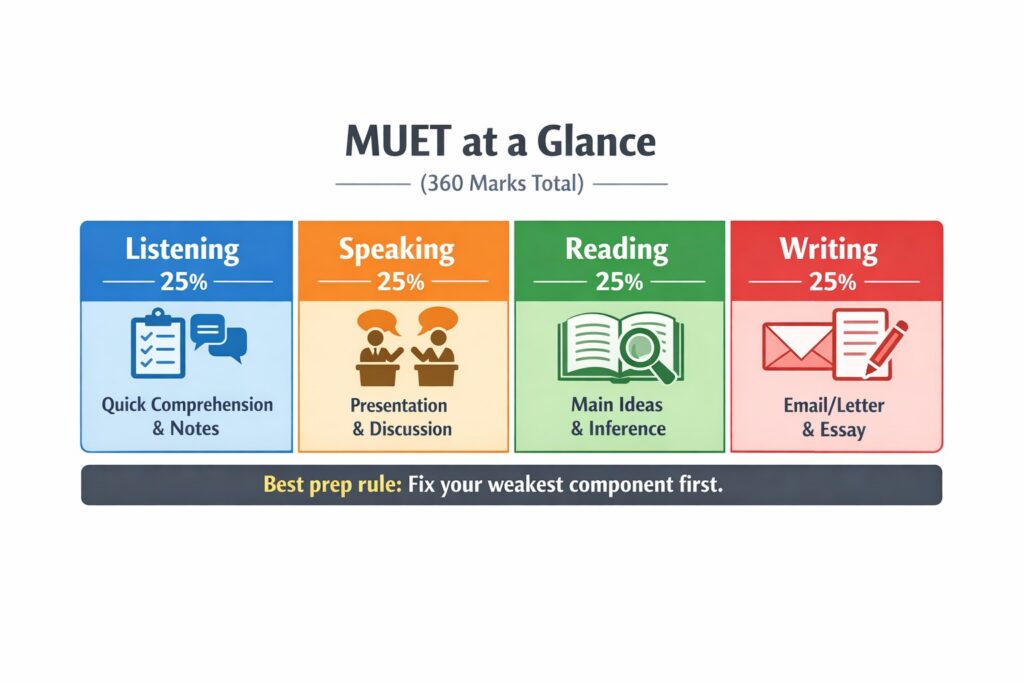
Understanding the structure of MUET is the first step to improving your score.
MUET consists of four components (Listening, Speaking, Reading, Writing). Each component is weighted at 25% of the overall score. Marks are aggregated up to a total score of 360.
This matters because a higher overall band is rarely about one “magic” skill. It is usually about improving your weakest component while keeping the others stable.
Here is what each paper looks like:
Listening
- Audio-based questions
- Includes conversations, interviews, and lecture-style listening
- Requires fast comprehension and note-taking under time pressure
Speaking
- Part 1: Individual presentation (with preparation time)
- Part 2: Group discussion (discussion length varies by group size)
- Assesses fluency, clarity, organisation of ideas, and interaction
Reading
- Multiple comprehension passages
- Tests your ability to identify main ideas, infer meaning, and analyse academic-style texts
- Rewards speed, accuracy, and vocabulary range
Writing
- Task 1: Guided writing (reply to a letter/email)
- Task 2: Extended writing essay (discursive, argumentative, or problem-solution)
- Assesses clarity, organisation, development of ideas, and language accuracy
Each section tests a different skill, so being generally “okay” at English is not enough. You need targeted preparation for the skills MUET actually rewards.
MUET Bands Explained (And What They Really Mean)
Your MUET band reflects your ability to function in an academic English environment.
Band | Level | What It Means |
Band 1–2 | Basic | Limited communication ability, struggles with academic tasks |
Band 3 | Intermediate | Can understand and respond, but lacks fluency and consistent structure |
Band 4 | Upper Intermediate | Functional academic user, clearer organisation and more confident delivery |
Band 5+ | Advanced | Strong academic proficiency, clearer reasoning and more mature language control |
MUET bands are mapped to CEFR levels, ranging from A2 up to C1+ (Band 5+). This is why bands are not just “test results”. They represent real academic readiness, especially for writing and speaking performance.
What MUET Band Do You Actually Need (Malaysian Context)
The band you need depends on your goals, not just general expectations.
Instead of relying on a one-size-fits-all answer, treat band targets as pathway-based:
- If you are applying for many mainstream undergraduate programmes, a Band 3–4 range is often treated as a practical baseline.
- If you are targeting competitive programmes, you may need a higher band depending on faculty requirements. For example, some faculties publish specific MUET minimums (such as Band 4.0 for certain programmes).
- If you are applying for postgraduate study, English requirements can differ by programme and may be stated alongside other English tests.
The key point is simple: band requirements vary by university and programme. Always check your target faculty’s latest published entry requirements.
Meeting the minimum requirement also does not mean you are fully prepared. If your course involves heavy reading, writing, or presentations, aiming higher will make university life significantly easier.
Examples: Real Student Scenarios in Malaysia
Understanding MUET becomes clearer when you look at realistic situations.
Scenario 1: STPM Student Targeting Competitive Programmes
- Target: Band 4 or higher (depending on faculty requirements)
- Main risk: Strong grammar but weak speaking delivery and essay reasoning
- Best move: Prioritise speaking structure and argument development in writing
Scenario 2: Diploma Student Entering Degree Programme
- Target: Band 3 may be accepted for some pathways
- Main risk: Struggling with assignments, reports, and presentation tasks
- Best move: Build academic vocabulary and practise writing clarity early
Scenario 3: Student Retaking MUET
- Current: Band 3
- Main risk: Repeating the same practice method and getting the same result
- Best move: Diagnose the weakest component and build a focused plan, not more repetition
These scenarios show that MUET is not just about passing. It is about being ready.
Why Most Students Get Stuck at Band 3
Band 3 is a common sticking point many students report. It usually happens because Band 3 represents “functional but inconsistent” English.
Common reasons include:
- Weak speaking confidence and unclear delivery
- Limited academic vocabulary (especially for reasoning and argumentation)
- Poor essay structure and weak paragraph development
- Lack of consistent English exposure outside exam practice
Band 3 is not a failure. It indicates that your fundamentals exist, but your structure, fluency, and control are not refined yet.
What You Should Do About MUET (Action Plan)
Improving your MUET score requires targeted effort and a clear plan.
Step 1: Diagnose Your Weakest Component
Identify which paper is pulling your band down. Many students assume the problem is “overall English”, but MUET is component-based.
Step 2: Focus on High-Impact Areas
- Speaking: practise daily with timed delivery and clear point structure (intro, point, example, link back)
- Writing: master structure first (task fulfilment, paragraph flow, clarity) before chasing “big vocabulary”
- Reading: build speed through timed practice and learn to skim for main ideas
- Listening: train note-taking and learn to catch signal words (however, therefore, in contrast, for example)
Step 3: Simulate Exam Conditions
Practice under timed conditions. MUET performance drops when students only practise casually, then face real pressure on test day.
Step 4: Avoid Common Mistakes
- Do not rely on memorisation alone
- Do not neglect speaking practice (it is easier to avoid, but costly)
- Do not depend only on past year papers without feedback and reflection
MUET vs IELTS: Should You Consider Alternatives?
MUET is typically sufficient for Malaysian university pathways, but IELTS may be required for international routes.
Factor | MUET | IELTS |
Cost | Lower | Higher |
Recognition | Local | Global |
Difficulty (typical student experience) | Moderate | Often more demanding |
If you plan to study abroad, IELTS is commonly required. If you are staying in Malaysia, MUET is typically the relevant exam to focus on.
When Should You Retake MUET
Retaking MUET should be strategic, not automatic.
Consider retaking if:
- Your band is below your target requirement
- You are applying for programmes with higher English thresholds
- You have improved your English skills and can prove it through better timed performance
Avoid retaking if:
- You are repeating the same preparation method without change
- You do not know which component is dragging your score down
- You are not practising under timed conditions
Common Mistakes Students Make About MUET
- Treating MUET like a memorisation-based exam
- Underestimating the speaking component
- Ignoring real-world English usage (reading, listening, and speaking outside practice sets)
- Over-relying on past year papers without improving structure and feedback loops
These mistakes often explain why students remain stuck at the same band.
Conclusion
MUET is not just a requirement. It is a reflection of how prepared you are for university and beyond. Understanding how MUET works, what your pathway requires, and how to improve the right skills can make a significant difference in your academic journey.
If you are an education brand or institution looking to communicate clearly with Malaysian students, we at PRESS PR Agency help shape narratives that build trust, visibility, and authority at scale. Our PR strategies ensure your message reaches the right audience with clarity and impact.
Sources
- Malaysian Examinations Council (MPM) – MUET Test Specification & Regulations. 2019.
- Malaysian Examinations Council (MPM) – MUET Entry Requirements and Validity Period. 1 March 2022.
- Malaysian Examinations Council (MPM) – MUET Band Description (CEFR Mapping). (Publication date as stated in document).
- Universiti Malaya – Faculty of Law: Entry Requirements (Open Channel / relevant intake document). (Publication date as stated in document).
- Universiti Malaya – Application for Postgraduate (General Entry Requirements). (Publication date as stated in document).
- Council of Europe – Common European Framework of Reference for Languages (CEFR). (Relevant framework publication/version used by institutions).