
Most Malaysian businesses approach competitor analysis with the wrong mindset. They either copy what competitors are doing, or they collect large amounts of data without translating it into actionable decisions.
Regardless of whether your company is newly established, rebranding, or expanding your target market, expanding into a new business niche is risky. Entering a market without understanding how competitors operate often leads to poor positioning, pricing mistakes, and wasted marketing spend.
In reality, competitor analysis is not about studying competitors for the sake of it. It is about identifying where you can win in your target market, and more importantly, where others are underperforming.
In this guide, you will learn how to analyse competitors in a way that is structured, localised to Malaysia, and aligned with how businesses actually compete in 2026 across Google, Shopee, TikTok, and physical markets.
What Is Competitor Analysis in a Business Niche
Competitor analysis is the process of evaluating businesses within your target market to understand their strengths, weaknesses, positioning, and opportunities for differentiation.
This goes beyond surface-level research like browsing websites or checking prices. A proper analysis includes:
- Product and offer structure
- Pricing strategy and perceived value
- Target audience alignment
- Marketing channels and messaging
- Customer feedback and sentiment
The goal is not to replicate competitors, but to uncover gaps you can leverage to position your business more effectively.
Why Competitor Analysis Matters in Malaysia (2026 Context)
Malaysia’s multi-channel digital ecosystem makes competitor analysis both more complex and more important.
Unlike traditional markets where competition is easier to spot, Malaysian businesses compete across multiple layers at the same time:
- Google Search (including AI-powered experiences such as AI Mode, where available)
- Marketplaces like Shopee and Lazada
- Social commerce platforms such as TikTok Shop
- Local discovery via Google Maps and WhatsApp
This creates a situation where your competitors are not just websites, but also:
- Shopee sellers competing on price and reviews
- TikTok creators driving demand through content
- Local businesses dominating location-based searches
Key Insight: In multi-platform markets, it’s easy to overlook platform-based competitors (marketplace sellers, creators, and local listings) if you only benchmark “business websites”.
Who Are Your Real Competitors (And Who to Ignore)
Not every competitor is worth analysing. Filtering is one of the most important steps.
Types of Competitors
- Direct competitors: same product and target audience
- Indirect competitors: different product, but the same customer need
- Substitute competitors: alternative ways to solve the same problem
Malaysia-Specific Competitor Layers
- Search competitors: websites ranking on Google
- Platform competitors: Shopee, Lazada, TikTok Shop sellers and listings
- Local competitors: Google Maps listings and physical stores
Competitor Relevance Filter
Only analyse competitors who:
- Target your exact target audience
- Operate within your price range
- Compete in your primary acquisition channel
This keeps your analysis focused and actionable instead of diluted.
When Should You Do Competitor Analysis
Competitor analysis is not a one-time task. It should be done at key moments:
- Before entering a new business niche
- Before launching a new product or service
- When expanding into a new target market
- When growth slows or conversions decline
In fast-moving platforms like TikTok Shop and Shopee, monitoring matters because listings, prices, content trends, and reviews can shift quickly.
Where to Find Competitor Data (Malaysia Context)
Your data sources should reflect where your competitors actually operate.
Search-Based Sources
- Google search results
- Google Maps listings
- SEO tools (if needed)
Platform-Based Sources
- Shopee and Lazada product listings
- TikTok Shop listings and creator content performance
- Instagram and Facebook business pages
Customer-Based Sources
- Reviews and ratings
- Forums and discussion platforms
- Survey responses
Internal Sources
- Customer feedback
- Sales objections
- Lost leads
These sources provide both quantitative data and qualitative insights.
Step-by-Step: How to Analyse Competitors in Your Target Market
Step 1: Identify and List Competitors
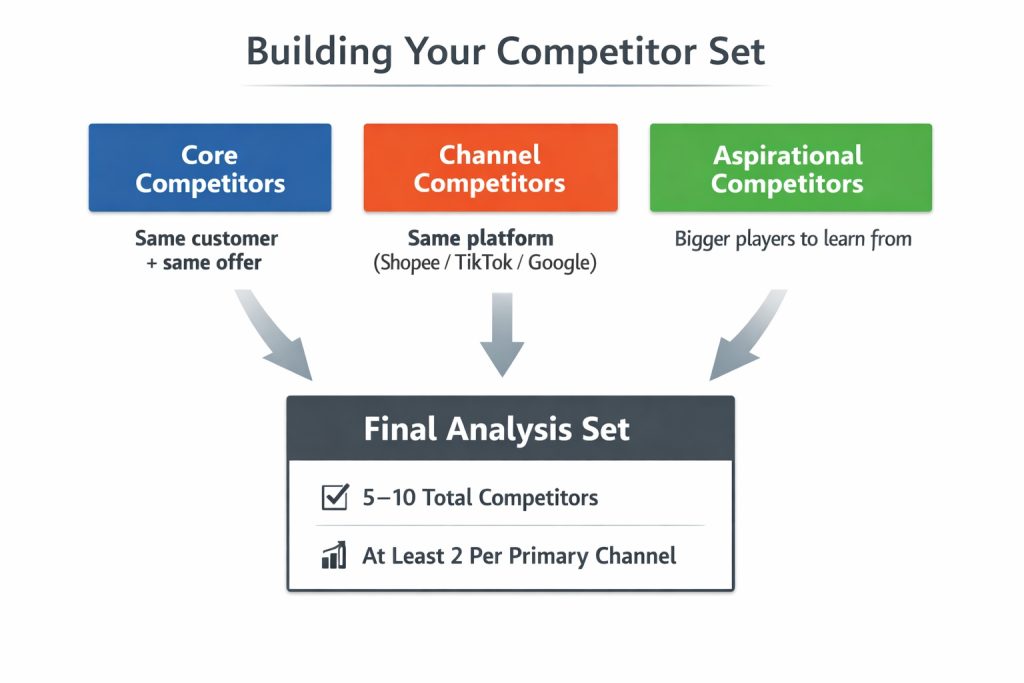
Start by listing 5 to 10 competitors across different channels:
- Google search results
- Marketplaces
- Social platforms
- Local listings (where relevant)
Include a mix of:
- Market leaders
- Mid-tier competitors
- Emerging players
Upgrade Your Authority: Build a “Competitor Set” (Not Just a List)
To keep your analysis structured, split your competitors into three buckets:
- Core competitors: same customer + same offer
- Channel competitors: you compete for attention on the same platform (Shopee/TikTok/Google Maps/Google Search), even if the product differs
- Aspirational competitors: bigger players you learn from (systems, messaging, offer design), but don’t blindly copy
Then, create your final analysis set:
- Keep it to 5–10 competitors max
- Include at least 2 competitors per primary channel you’re betting on
This makes your findings more reliable and prevents “random competitor research” that doesn’t translate into decisions.
Step 2: Analyse Product and Offer Structure
Focus on what competitors are actually offering:
- Product variations
- Bundles and packages
- Add-ons and upsells
Ask:
- What are they really selling beyond the core product?
- What do they bundle to increase order value?
- What’s the “default” offer they push most?
Pro tip: Look for “offer engineering” signals:
- Guarantees and return policies
- Delivery promises
- Free gifts, add-ons, or membership perks
These often matter more to buyers than the product description itself.
Step 3: Analyse Pricing Strategy
Pricing reveals positioning more clearly than branding.
Compare:
- Price ranges
- Discounts and promotions
- Value perception (what they claim you get for the price)
Example table:
- Brand A: RM50–RM80 → Premium positioning
- Brand B: RM20–RM40 → Volume sales
Don’t just look at the sticker price. Look at:
- Shipping fees
- Minimum order values
- Bundle pricing
- “Free gifts” and upsells
If you’re selling on platforms, also note:
- Always-on vouchers vs campaign-only discounts
- Whether the “best deal” is locked behind bundles or minimum spend
Step 4: Analyse Positioning and Messaging
Look at:
- Target audience
- Pain points addressed
- Unique selling propositions
Pay attention to:
- Repeated keywords
- Emotional triggers
- Content themes and promises
Tip: Screenshot headlines, hero sections, product titles, and top-performing ads. Patterns show up faster when you can compare them side-by-side.
Step 5: Analyse Marketing Channels
Break down where competitors are getting attention:
- SEO and content marketing
- TikTok and short-form content
- Marketplace optimisation (titles, images, keywords, voucher strategy)
This reveals their growth strategy:
- Are they building long-term search visibility?
- Are they relying on content virality?
- Are they dominating platforms with deals and reviews?
Step 6: Analyse Customer Reviews and Sentiment
Customer reviews are one of the most valuable insight sources.
Look for:
- Common complaints
- Frequently praised features
- Unmet expectations
- “I wish it had…” comments
👉 Reviews often reveal what customers actually care about, which is not always what brands emphasise.
Review Mining Cheat Sheet (Fast + Repeatable)
To turn reviews into real insights, tag each review into one of these buckets:
- Price (value, “worth it”, expensive/cheap comparisons)
- Quality (durability, performance, defects, consistency)
- Delivery (speed, packaging, damage, missing items)
- Support (response time, friendliness, refunds, after-sales)
- Expectation gap (“not as described”, sizing mismatch, misleading photos)
Then track:
- Top 3 complaints
- Top 3 praised outcomes (not features, but outcomes like “saves time” or “skin cleared”)
Finally, look for “switch triggers” customers reveal naturally:
- “Switched from X because…”
- “Won’t buy again…”
- “Better than…”
Those phrases tell you exactly what makes customers change brands.
Step 7: Evaluate Customer Experience
Test their journey like a customer:
- Website navigation and clarity
- Checkout process
- Response time (WhatsApp, DMs, chat)
- Delivery expectations and policies
Customer experience gaps can be a high-leverage area to target. Small fixes in navigation, forms, and checkout friction can meaningfully improve conversions.
Step 8: Use a Malaysia Competitor Scorecard
Turn insights into a structured evaluation.
Example scorecard (1–5):
- Demand / popularity
- Visibility (SEO / Shopee ranking signals / TikTok reach)
- Pricing power
- Brand trust
- Differentiation
Malaysia-Specific Metrics That Improve the Scorecard
If you want more accuracy (and better decision-making), add a few channel-specific checks:
- Shopee/Lazada: voucher strategy patterns, rating volume, response rate, shipping promise, and the “default bundle” that drives conversions
- TikTok Shop: content format patterns (UGC vs creator vs brand), live frequency, hook style, and how the offer is framed in the first 3 seconds
- Google/Maps: review velocity (how often new reviews appear), category fit, photo freshness, Q&A completeness, and whether they match “near me” intent keywords
These metrics make your scorecard feel grounded in how Malaysia discovery actually works.
Step 9: Map Market Positioning
Plot competitors based on:
- Price vs quality
- Mass vs niche
This helps you identify underserved segments and positioning gaps.
Example questions:
- Who’s premium but generic?
- Who’s cheap but trusted?
- Where is nobody clearly owning a specific niche?
Step 10: Turn Insights Into Strategy
Your final step is decision-making.
Identify:
- What to adopt (proven patterns that match your brand)
- What to avoid (common weaknesses and customer frustrations)
- What to differentiate (gaps competitors can’t easily fix)
Decision Rules That Prevent “Analysis Paralysis”
Use these rules to convert research into action:
- If 2+ competitors win on the same angle, it’s likely table stakes; don’t try to differentiate there
- If customers complain about the same issue across 3+ competitors, that’s your fastest wedge to build a better offer
- If a competitor is strong in one channel but weak elsewhere, attack the weak channel first (e.g., they dominate Shopee but ignore Google Maps)
A simple way to execute:
- Pick 1 positioning advantage (why you)
- Pick 1 channel focus (where you win first)
- Pick 1 offer improvement (what makes the purchase easier)
Common Challenges Malaysian Businesses Face
Even with a framework, many businesses struggle due to:
- Analysing too many irrelevant competitors
- Ignoring platform-based competition
- Over-focusing on price instead of value
- Copying competitors instead of differentiating
- Overlooking customer sentiment
Recognising these mistakes early improves your chances of success.
Costs and Tools for Competitor Analysis
Free Tools
- Google search and Google Maps
- Shopee and TikTok platforms
- Customer reviews
Paid Tools (Optional)
- SEO platforms like Ahrefs or Semrush
- Analytics tools
- Market research software
For many SMEs, free tools are enough for an initial pass: shortlisting competitors, spotting positioning patterns, and extracting review themes. Paid tools become useful when you need scale, tracking, or deeper SEO data.
How Competitor Analysis Shapes Your Target Market Strategy
Competitor analysis is not an isolated task. It directly influences:
- How you define your target audience
- How you position your business niche
- How you structure your offers
It helps shift your thinking from:
“What are competitors doing?”
to
“Where can we win?”
Turning Insight Into Advantage
Competitor analysis, when done properly, reduces uncertainty and improves your ability to enter and compete in a new business niche with confidence. It gives you clarity on your target market, highlights hidden opportunities, and helps you position your business more effectively.
If you are looking to strengthen your visibility and outperform competitors in your niche, we help businesses translate these insights into structured SEO strategies that drive sustainable growth. Through our work at PRESS PR Agency, we focus on building search presence that aligns with how modern platforms and AI-powered search experiences select, evaluate, and surface content. Don’t miss this chance to work with Malaysia’s number one PR agency and improve your business growth!
Disclaimer: This guide is for general informational purposes only and does not constitute business, legal, or financial advice. Results vary by niche, platform changes, budget, and execution, so validate insights with your own data before making major decisions.