

If the past few years have taught investors anything, it is that the global economy can shift direction quickly.
Geopolitical tensions, supply chain shifts, inflation cycles, and regional conflicts have all increased uncertainty for global investors in recent years. As a result, many investors are reassessing where they deploy capital and looking for markets that offer a balance of resilience, growth potential, and strategic relevance. (Source: DOSM, 2025)
Malaysia is increasingly becoming one of those destinations.
Foreign direct investment into Malaysia rose to RM51.5 billion in net inflows in 2024, up from RM38.6 billion in 2023, while total approved investments reached a record RM378.5 billion. That combination of stronger inflows, large project approvals, and sustained business expansion is helping Malaysia stand out more clearly on investors’ radar. (Source: DOSM, 2025; MIDA, 2025)
For Malaysian business owners, understanding why investors are turning to Malaysia during global uncertainty can help uncover new opportunities for partnerships, expansion, and growth.
Why Global Uncertainty Is Redirecting Investment Flows
Periods of global uncertainty often reshape global investment strategies.
When geopolitical tensions rise and economic forecasts become less predictable, investors usually diversify risk and look for markets that offer relative stability with room for long-term growth. Several global developments are helping drive this shift:
- Geopolitical conflicts affecting trade and logistics
- Slower growth in parts of the developed world
- Continued supply chain diversification after the pandemic
- Rapid investment in AI, cloud, and digital infrastructure
These conditions are encouraging investors to look more closely at economies that are resilient, well connected, and capable of supporting global supply chains. Malaysia has increasingly stood out in this environment as a diversified Southeast Asian market with strong manufacturing depth and improving investment momentum. (Source: DOSM, 2025; MIDA, 2025)
Malaysia’s Strong Economic Fundamentals
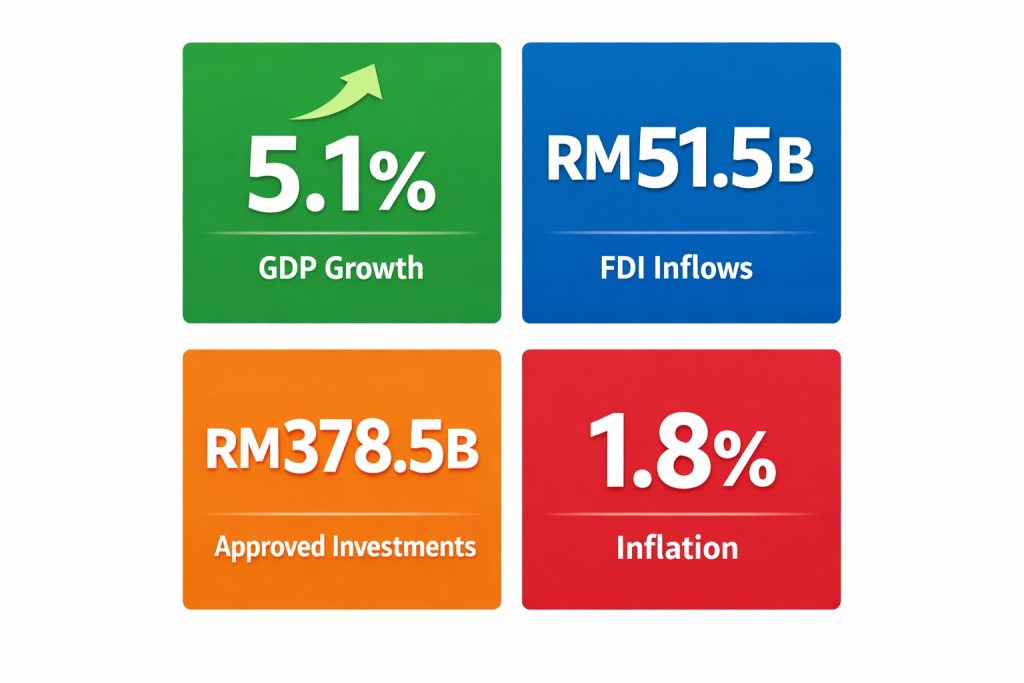
Malaysia’s economic fundamentals play a major role in attracting investors during uncertain times.
Malaysia’s economy grew 5.1% in 2024, up from 3.5% in 2023, supported by services, manufacturing, domestic demand, exports, and investment activity. Private consumption remained steady, while gross fixed capital formation recorded double-digit growth. (Source: DOSM, 2025)
Key indicators that support investor confidence include:
- GDP growth of 5.1% in 2024
- Moderate inflation
- A well-capitalised banking system
- Ongoing efforts to improve fiscal sustainability
Inflation also remained relatively contained. Malaysia’s headline inflation averaged 1.8% in 2024, which compared favourably with many economies still dealing with more persistent price pressures. (Source: DOSM, 2025)
Another important strength is Malaysia’s diversified economy. Instead of relying heavily on one industry, the country has built capacity across:
- Manufacturing
- Electronics and semiconductors
- Financial services
- Commodities
- Tourism and services
That diversification gives Malaysia more resilience when external conditions change.
The Semiconductor And Technology Investment Boom
Malaysia’s role in the global technology supply chain is another major reason investors are paying closer attention.
The country has long been an important player in semiconductors, especially in assembly, packaging, testing, and electronics manufacturing. Malaysia is also widely recognised as one of the world’s leading exporters of semiconductor and E&E products, which reinforces its role in the broader electronics ecosystem. (Source: MATRADE, 2024; MIDA, 2025)
As demand grows for AI chips, cloud infrastructure, and high-performance computing, Malaysia is benefiting from renewed interest in technology-related investments. Several trends are helping drive that momentum:
- Rising demand for AI and computing hardware
- Expansion of semiconductor supply chains across Asia
- Growth in hyperscale data centres and cloud infrastructure
Large technology firms have also announced major investments in Malaysia. Johor and Selangor, in particular, have seen strong momentum in digital infrastructure and data-centre related projects. (Source: Reuters, 2024; Reuters, 2025; MIDA, 2025)
For investors, this signals long-term growth potential in Malaysia’s technology ecosystem.
Malaysia’s Expanding Capital Market
Malaysia’s financial ecosystem is also evolving rapidly.
The country’s capital market has expanded substantially, and the launch of the Capital Market Masterplan 2026–2030 provides a new framework for the next phase of growth. The plan is designed to make Malaysia’s capital market more vibrant, inclusive, sustainable, and regionally connected. (Source: Securities Commission Malaysia, 2026)
Its priorities include:
- Strengthening fundraising channels
- Supporting sustainable finance
- Expanding private-market development
- Reinforcing Islamic capital market leadership
- Enhancing data-driven supervision and market readiness
For investors, a more developed capital market creates practical advantages such as better market depth, stronger oversight, improved transparency, and a wider range of investment opportunities.
Supply Chain Diversification And The China+1 Strategy
Another major trend shaping investment flows is supply chain diversification.
Many multinational companies are reducing overdependence on a single manufacturing base. This strategy, often referred to as China+1, involves expanding production capacity into other Asian markets.
Malaysia is well positioned to benefit from this shift because it offers:
- An established electronics manufacturing ecosystem
- A skilled engineering and technical workforce
- Strategic access to Southeast Asian markets
- Strong trade connectivity and export capability
As more companies diversify production networks, Malaysia continues to attract investment in advanced electronics, industrial components, automation, and related manufacturing activities. (Source: MIDA, 2025; DOSM, 2025)
Malaysia’s Unique Strength: Islamic Finance
Another advantage that often receives less attention internationally is Malaysia’s leadership in Islamic finance.
Malaysia remains a global leader in sukuk and Shariah-compliant capital-market products. The Securities Commission’s new masterplan highlights the country’s continued strength in Islamic capital markets as one of its strategic advantages. (Source: Securities Commission Malaysia, 2026)
This ecosystem helps attract capital from:
- Middle Eastern sovereign and institutional investors
- Investors seeking Shariah-compliant instruments
- Global funds exploring alternative funding structures
Islamic finance also overlaps with wider responsible-investment themes, which adds to Malaysia’s appeal in a global environment where investors are increasingly focused on long-term sustainability and governance.
Government Policy Roadmaps Supporting Investment
Government policy direction also plays an important role in shaping investor confidence.
Malaysia has introduced several national frameworks aimed at strengthening competitiveness and supporting long-term investment. These include:
- Capital Market Masterplan 2026–2030
- National Energy Transition Roadmap (NETR)
- New Industrial Master Plan 2030 (NIMP 2030)
Together, these frameworks support growth in areas such as:
- Renewable energy
- Advanced manufacturing
- Semiconductor and digital infrastructure
- Technology and industrial upgrading
Clear long-term planning helps reduce uncertainty for investors and gives businesses a stronger sense of where future opportunities may emerge. (Source: Securities Commission Malaysia, 2026; MITI)
Which Malaysian States Are Attracting The Most Investment
Investment trends are also becoming increasingly regional within Malaysia.
Based on MIDA’s 2024 data on approved investments, the leading locations were Selangor, W.P. Kuala Lumpur, Johor, Kedah, and Pulau Pinang. Each offers different strengths depending on sector and business needs. (Source: MIDA, 2025)
Johor
Johor has become a major destination for digital infrastructure and cross-border investment, helped by its proximity to Singapore and strong momentum in data-centre development.
Penang
Penang continues to strengthen its reputation as a semiconductor and advanced-electronics hub, with deep ties to multinational manufacturing supply chains.
Selangor
Selangor remains a key centre for logistics, services, manufacturing, and corporate operations thanks to its infrastructure and access to the Klang Valley.
Kedah
Kedah is becoming increasingly important for industrial and manufacturing investment, particularly within northern corridor growth areas.
W.P. Kuala Lumpur
Kuala Lumpur continues to attract major projects in services, headquarters functions, and regional business activity.
For investors, these state-level ecosystems create specialised opportunities depending on industry focus and investment strategy.
What Global Investors Are Still Watching
Despite the positive outlook, investors are still monitoring a number of risks.
These include:
- Geopolitical tensions affecting trade and shipping
- Currency fluctuations
- Dependence on global technology demand cycles
- The pace of domestic policy implementation
Even so, Malaysia’s recent economic performance, investment approvals, and policy direction suggest that many investors still view the country as a credible and increasingly attractive destination. (Source: DOSM, 2025; MIDA, 2025)
How Malaysian Businesses Can Take Advantage Of This Investment Wave
For Malaysian companies and entrepreneurs, rising investor interest in Malaysia creates several practical opportunities.
Businesses that position themselves strategically can benefit from new capital flows, partnerships, and market expansion.
Some of the most effective ways to do that include:
- Strengthen industry positioning: Companies that show clear strengths in sectors attracting investment, such as technology, manufacturing, renewable energy, or logistics, are more likely to gain attention.
- Improve digital visibility: Investors often research suppliers, partners, and local operators online before making decisions. A strong digital presence and digital PR services make a business easier to discover and assess.
- Develop strategic partnerships: Foreign investors entering Malaysia often look for local partners who understand the market, regulations, and operating environment.
- Align with national growth sectors: Businesses in industries supported by national roadmaps may be better placed to attract investor interest.
- Demonstrate operational transparency: Clear governance, professional communication, and reliable financial records build trust.
- Show long-term scalability: Companies that can expand, innovate, or serve regional markets tend to be more attractive to investors.
By aligning with these trends, Malaysian businesses can put themselves in a stronger position to benefit from the next wave of investment entering the country.
Grabbing the Malaysian Opportunity
Although global uncertainty continues to shape the economic landscape, Malaysia is increasingly emerging as a stable and attractive destination for international investors.
Strong economic growth, rising FDI inflows, record approved investments, technology-sector momentum, and clear policy direction are all helping position the country as an important investment hub in Southeast Asia. (Source: DOSM, 2025; MIDA, 2025; Securities Commission Malaysia, 2026)
For Malaysian businesses, this shift represents a real opportunity to strengthen credibility, attract partnerships, and grow alongside the country’s rising investment profile.
At PRESS PR Agency, Malaysia’s most reliable PR agency, we help businesses build authority and visibility through strategic SEO and PR services so your brand can be discovered by global investors and partners searching for opportunities in Malaysia.
Grab this prime opportunity ASAP; contact PRESS today to learn more!