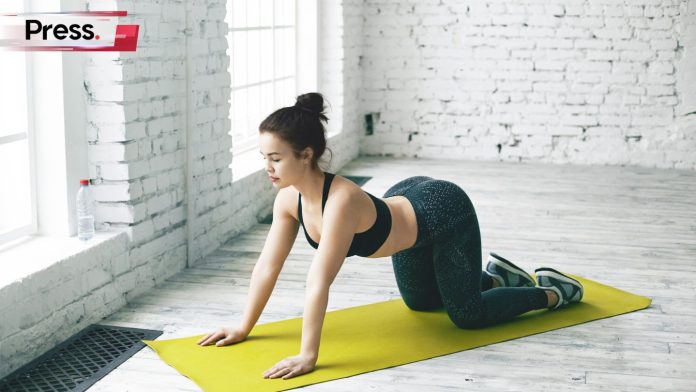
Gentle Pilates is a low-impact, slower-paced form of mat Pilates focused on breathing, control, and joint-friendly movement—ideal for beginners, recovery days, or easing back into exercise.
What Is Gentle Pilates, Exactly?
Gentle Pilates keeps the principles of Pilates—but reduces intensity, range, and speed.
Instead of pushing endurance or complexity, it emphasises:
- Slower transitions
- Smaller ranges of motion
- Shorter lever positions (bent knees instead of straight legs)
- Controlled breathing with core engagement
Most gentle sessions are done as mat Pilates, because mat work is easy to modify and accessible at home.
The difference isn’t the exercise list. It’s how the exercises are performed.
Gentle Pilates vs Regular Mat Pilates: What’s The Real Difference?
Both use the same Pilates principles—but the difference lies in intensity, range, and challenge level.
They share the same foundation:
- Controlled breathing
- Core stability
- Alignment awareness
- Precision over momentum
The difference is not the exercise list. It’s how those exercises are executed.
1. Intensity And Effort Level
Gentle Pilates stays around 4–5/10 effort.
You should feel capable of repeating the session tomorrow.
Regular mat Pilates often reaches 6–8/10, adding:
- Longer sets
- Faster transitions
- More sustained core tension
2. Range Of Motion
Gentle Pilates uses smaller, joint-friendly ranges.
For example:
- Dead bug → heel taps instead of full leg extensions
- Bridge → smaller lift
- Roll-down → partial articulation
Regular mat Pilates:
- Uses longer lever positions
- Involves deeper spinal flexion/extension
- Adds dynamic transitions
Smaller range improves control and reduces joint irritation—especially for beginners.
3. Tempo And Stability
Gentle Pilates prioritizes stability over complexity.
Movements are often:
- Supine (on your back)
- Side-lying
- Supported against a wall
Regular mat Pilates may include:
- Teaser variations
- Plank progressions
- Single-leg balance sequences
Gentle sessions remove unnecessary instability so your nervous system can learn control first.
“Gentle movement done consistently builds more long-term strength than intense movement done inconsistently.”
Who Should Do Gentle Pilates?
Gentle Pilates suits anyone prioritising safe consistency over intensity.
You’ll benefit if you:
- Are a beginner or restarting
- Feel stiff from prolonged sitting
- Prefer low-impact movement
- Want a recovery-day workout
- Have limited space at home
If you cannot tolerate floor work comfortably, consider switching to a floor-free chair Pilates routine for beginners.
Choosing The Right Level: Understanding The Trade-Off
Not all “low-impact” workouts stress your body the same way. The difference isn’t just about calories—it’s about how much load your joints and spine handle during the session.
Many beginners quit within the first few weeks not because they lack discipline, but because they choose movements that exceed their current tolerance. If your joints, connective tissue, or core stability aren’t ready for higher loads, even “normal” exercises can feel overwhelming.
If you’re carrying an extra 10–15 kilograms, upright movements like squats, lunges, or prolonged standing flows naturally increase compressive force through your knees and lower back. That doesn’t mean you should avoid them forever. It means your starting point matters.
The table below clarifies how common low-impact options differ so you can choose what fits your current capacity—not your future goals.
Low-Impact Decision Matrix
Exercise Method | Lumbar Spine Load | Primary Focus | Calorie Burn (Approx/Hour) | Best Suited For |
Gentle Mat Pilates | Low (mostly supine positions) | Core stability & alignment | 150–250 kcal | Beginners, desk workers, recovery days |
Standard Mat Pilates | Moderate (includes flexion & longer levers) | Strength endurance | 250–350 kcal | General fitness, pain-free movers |
Restorative Yoga | Very Low (static, supported holds) | Flexibility & relaxation | 100–150 kcal | Stress relief, very limited tolerance |
Bodyweight Strength Training | High (upright loading) | Muscle & conditioning | 300–450 kcal | Healthy joints, established baseline |
What this means in practice:
- Gentle mat Pilates reduces spinal compression by keeping you supported on the floor.
- Standard mat Pilates increases challenge through longer levers and endurance.
- Bodyweight strength adds upright loading that multiplies joint forces.
If you’re managing osteoarthritis or persistent lower-back stiffness, starting with supported, neutral-spine work can significantly reduce irritation compared to upright squats or repeated sit-ups.
You may burn fewer calories per session—but you gain something more important at the beginning: consistency without flare-ups.
And consistency is what builds long-term strength.
Why Desk Workers Benefit Most
If you sit for long hours, your body doesn’t need intensity first—it needs re-alignment.
A long commute followed by hours at a desk keeps your spine in sustained forward flexion. Over time:
- Hip flexors tighten
- Chest muscles shorten
- Glutes become underactive
- Deep core stabilisers switch “offline”
Jumping straight into high-intensity training from this position often leads to flare-ups—not because you’re weak, but because your alignment isn’t restored yet.
“Adults should limit the amount of time spent being sedentary. Replacing sedentary time with physical activity of any intensity (including light intensity) provides health benefits.” — WHO Guidelines on Physical Activity and Sedentary Behaviour 2020
Gentle Pilates acts as your transition phase. It restores neutral alignment and reactivates stabilising muscles before you add load or speed.
You don’t need two hours. You need the right 15 minutes—and a way to measure whether it’s working.
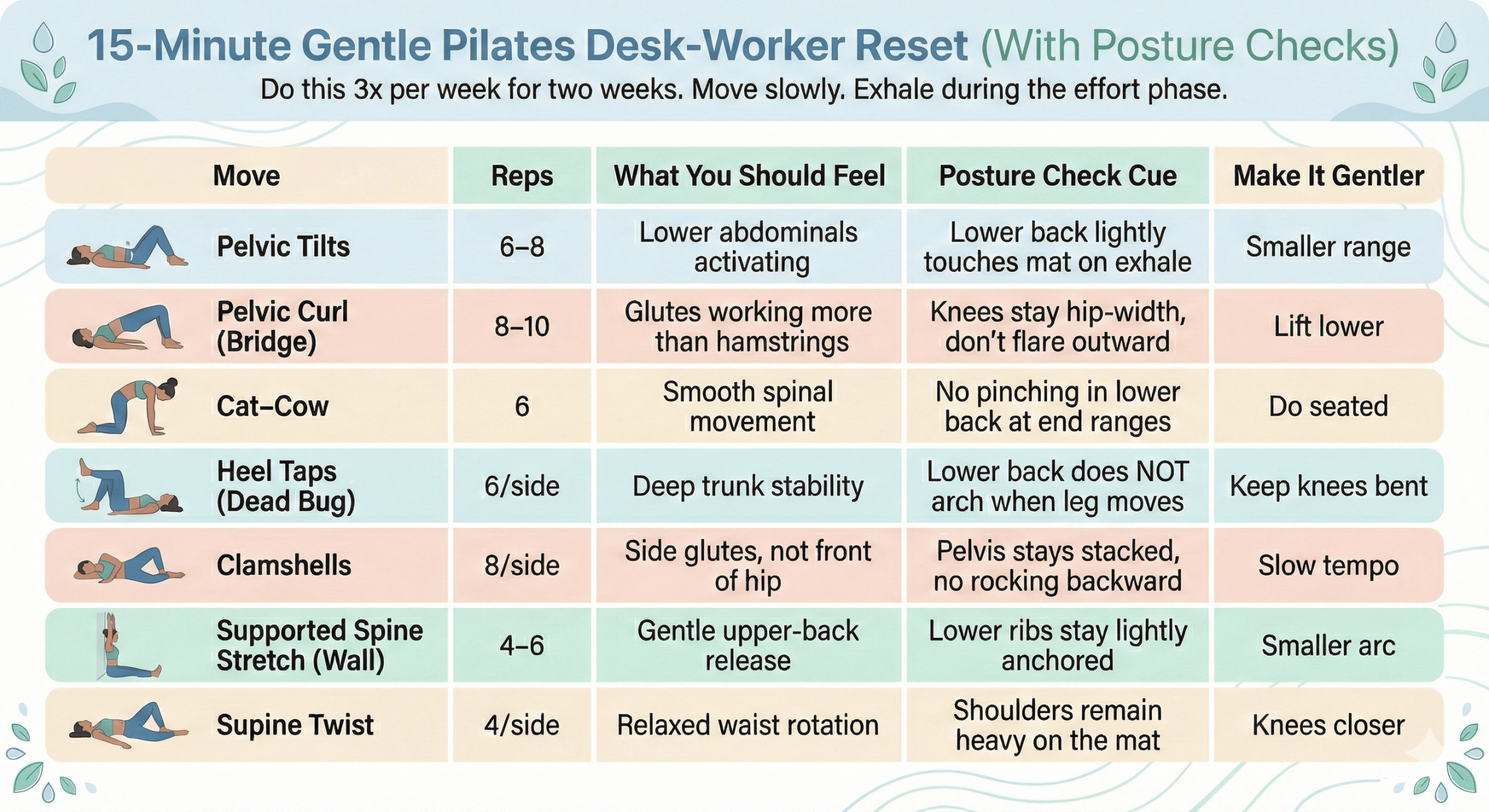
15-Minute Gentle Pilates Reset For Desk Workers
Do this 3 times per week for two weeks. Move slowly. Exhale during the effort phase.
Long hours at a desk create predictable imbalances. Tight hip flexors. Underactive glutes. Stiff mid-back. Reduced deep core engagement.
Each movement below directly addresses one of those patterns.
1. The Lower Back Reset
Sitting compresses the lumbar spine and reduces deep core activation. These two movements restore neutral alignment.
Pelvic Tilts (6–8 reps)
Small, controlled rocking of the pelvis while lying on your back.
- On your exhale, gently flatten the lower back into the mat.
- Movement should feel subtle, not forceful.
- Neck and shoulders stay relaxed.
If it feels intense, reduce the range. This is a precision movement, not a stretch.
Pelvic Curl / Bridge (8–10 reps)
Slowly roll your hips upward, one segment at a time.
- Press through your heels.
- Glutes should do more work than hamstrings.
- Stop lifting when ribs begin to flare.
Posture check: Knees stay hip-width apart. If they drift outward, reduce the lift height.
2. The Core & Hip Rebalance
Sitting shortens the front of the hips and weakens the stabilising muscles around the pelvis. These movements restore balance.
Heel Taps / Dead Bug (6 per side)
Lower one heel toward the floor while keeping your torso steady.
- Lower back should not arch as the leg moves.
- Core stays gently engaged.
If the lower back lifts, shorten the leg path or keep the knee bent.
Clamshells (8 per side)
Open the top knee while lying on your side.
- Target the outer hip, not the front of the thigh.
- Movement should feel controlled, not wide.
Posture check: Pelvis stays stacked. No rocking backward. If you feel momentum, slow down.
3. The Mid-Back & Shoulder Release
Computer work encourages rounded shoulders and a rigid thoracic spine. These movements restore spinal mobility safely.
Cat–Cow (6 slow cycles)
Move gradually between rounding and extending the spine.
- Motion should feel evenly distributed.
- Avoid collapsing into the lower back.
If wrists are uncomfortable, perform seated.
Supported Spine Stretch (4–6 reps)
Sit or stand supported against a wall and gently round forward.
- Focus on mid-back release.
- Lower ribs stay softly drawn inward.
Keep the range small and controlled.
Supine Twist (4 per side)
Let knees drift gently to one side.
- Shoulders remain grounded.
- Rotation should feel relaxed, not forced.
The goal is not depth. The goal is tension release without losing upper-body stability.
Execution Reminder
- Move slower than you think necessary.
- Stop one repetition before fatigue changes your form.
- You should finish feeling more organised—not exhausted.
If sharp, worsening, or radiating pain occurs, stop and seek professional advice before continuing.
Before-And-After Posture Self-Test (2 Minutes)
Test before you start. Test again after the routine.
1️. Wall Alignment Check (30 seconds)
Stand with your:
- Heels 5–8 cm from the wall
- Glutes touching the wall
- Upper back touching
- Back of head gently touching
Measure this:
Can you slide one hand (not two) between your lower back and the wall?
- Two hands easily = excessive arch
- No space at all = over-tucked pelvis
- One hand snug = neutral alignment
After the routine, your lower back should feel less rigid and closer to neutral without forcing it.
2️. Shoulder Drop Test
Stand tall and shrug your shoulders up. Then fully relax.
Measure this:
Do your shoulders settle naturally lower after the routine? If yes, chest tightness has reduced and upper traps are less dominant.
3. Single-Leg Balance Check (10 seconds per side)
Stand on one leg.
Measure this:
Can you hold steady without gripping your toes or hiking your hip? Improved balance suggests better deep core and glute activation.
The Three “Gentle” Rules That Keep You Safe
Gentle works when you control breathing, tempo, and range.
Rule 1: Calm Effort
You should finish feeling better—not exhausted.
Rule 2: Joint-Friendly Range
Stop before:
- Lower back compression
- Hip pinching
- Shoulder strain
Rule 3: Core Bracing Through Breath
Exhale → ribs soften → pelvis stays neutral → move limbs slowly.
Where Should You Practice Gentle Pilates In Malaysia?
Your practice environment affects safety, consistency, and cost — not just convenience.
Before choosing where to train, ask one simple question:
Are you dealing with general stiffness, or unexplained pain?
If you have symptoms like:
- Pain shooting down your leg
- Numbness or tingling
- Persistent worsening discomfort
You need professional assessment first, not a random online video.
But if your issue is everyday stiffness from long sitting, low activity, or posture fatigue, gentle Pilates can be done safely at home or in a studio.
Another practical factor: Malaysia’s weather.
During the monsoon season, outdoor walking or jogging routines can easily get disrupted. Gentle Pilates gives you a stable indoor option that keeps your activity consistent — rain or shine.
Consistency protects progress.
Practice Environment And Cost Comparison
Use this breakdown to match your needs with the right setup.
Practice Environment | Average Cost (RM) | Instructor Feedback | Equipment Needed | Best For |
Home (Apps / YouTube) | 0 – 80/month | None | Mat only | General stiffness, budget beginners |
Group Mat Class | 50 – 80/class | Moderate (verbal cues) | Provided | Beginners who want structure |
Group Reformer Class | 80 – 130/class | Moderate–High | Provided | Intermediate level, added resistance |
Clinical Pilates (1-on-1) | 150 – 250/session | High (hands-on correction) | Clinical equipment | Injury recovery, medical conditions |
How To Decide
- On a budget + mild stiffness? Start at home.
- Need accountability? Join a group mat class.
- Recovering from diagnosed injury? Choose clinical 1-on-1 guidance.
Remember: more expensive doesn’t always mean better — it means more supervision and equipment.
Equipment Matters More Than You Think
If you’re practicing at home, upgrade your mat before upgrading your intensity.
Most standard 3mm yoga mats are designed for standing flows — not spinal articulation.
On typical Malaysian tiled floors, thin mats can:
- Increase tailbone pressure
- Irritate the lower back
- Make rolling movements uncomfortable
For gentle Pilates, a 10mm–15mm thick exercise mat provides better cushioning and joint protection.
It’s a small investment that makes consistency easier.
Common Discomforts And Fixes
Issue | Likely Cause | Fix |
Neck strain | Over-lifting head | Keep head down |
Lower back tension | Over-arching | Bend knees |
Wrist pain | Excess pressure | Do seated version |
Hip flexor fatigue | Legs too low | Shorten lever |
Stop if pain becomes sharp, worsening, or radiating.
How Often Should You Do Gentle Pilates?
Start with:
- 3 sessions/week
- 10–15 minutes
After 2 weeks:
- Increase to 15–20 minutes
- Add one extra session
This can contribute toward the WHO recommendation of 150–300 minutes of moderate weekly activity when combined with walking or other movement.
4-Week Gentle Pilates Progression
- Week 1: Learn control
- Week 2: Improve consistency
- Week 3: Add brief pauses
- Week 4: Slightly increase reps or time
Progress one variable at a time.
The Upgrade Rule (When To Progress)
You’re ready to increase intensity when:
- Wall alignment feels neutral without effort
- Heel taps stay stable without lower-back arching
- You complete 15 minutes without next-day stiffness
At that point, you can:
- Increase reps slightly
- Add a light resistance band to clamshells
- Extend sessions to 20 minutes
Gentle Pilates becomes powerful when you can measure improvement, not just feel it.
Do’s And Don’ts
DO
- Breathe before moving
- Keep effort moderate
- Stop if pain increases
DON’T
- Chase burn
- Force deep stretches
- Hold your breath
Common Myths
Myth | Truth |
Gentle Pilates is ineffective | It builds foundational stability |
Pain means progress | Pain signals overload |
Bigger range is better | Control matters more |
Summary
Gentle Pilates is a low-impact, slower-paced form of mat Pilates that builds core stability, posture control, and mobility without overloading your joints. It’s ideal for beginners, desk workers, and recovery days.
A simple 15-minute routine done three times per week can reduce stiffness and improve alignment. Focus on controlled breathing, small ranges of motion, and gradual progression before increasing intensity.
For more info, follow PR agency Malaysia.
Disclaimer: All of the content was thoroughly fact-checked and verified by our editorial team to ensure accuracy, clarity, and reliability.
Legal Disclaimer: All brand names, trademarks, and logos displayed on this website are the intellectual property of their respective owners. Their use herein is solely for identification purposes without written consent or direct affiliation from the respective owner.