When a company appears in a negative news story, the internal reaction can be immediate.
Management wants answers, legal wants to assess exposure to prevent unhappy shareholders from dialing in. And of course, PR/marketing would quickly come up with a post or statement for the issue just to quell down the panic from the public.
And somewhere in that discussion, someone (presumably a management level senior) might ask: Should we sue the publication?
False reporting can damage customer trust, investor confidence and a company’s reputation. We think that much is clear for many companies.
But threatening the media is a PR decision, not a legal one. Legally you can do it, but that doesn’t mean you should. Once a company sends a letter of demand, the story can shift from what the media published to how the company responded to the media.
And by goodness, you better not become a villain in the eyes of the media.
When the Legal Threat Becomes the Story
In 2024, Human Resource Development Corporation issued a letter of demand against The Edge Communications and one of its writers over reports linked to findings by Parliament’s Public Accounts Committee and the Auditor-General.
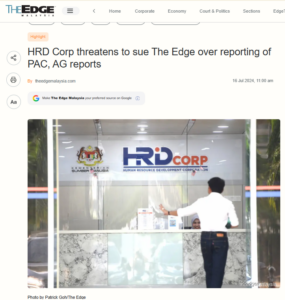
HRD Corp alleged that the reporting had misquoted, sensationalised and misinterpreted parts of those findings, so akin to defamation. The organisation reportedly sought the removal of articles, an apology and damages.
However, the dispute did not remain between HRD Corp and The Edge.
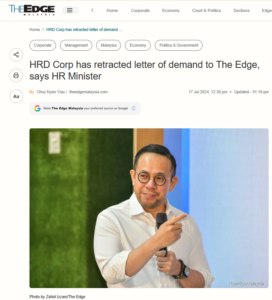
The Public Accounts Committee (PAC) criticised the legal move, and Human Resources Minister Steven Sim later personally instructed HRD Corp to withdraw the letter of demand.
At that point, the company was no longer dealing with only one reputational issue.
It was dealing with:
- The original reporting
- The public reaction to its legal response
- Questions about whether the legal threat itself was appropriate
- Is the government censoring freedom of speech?
For Malaysian businesses like public listed companies, take note. Whatever you do will be broadcast, recorded and reported to the public.
So the risk is clear, don’t piss off the media, but what should you do if your company genuinely thinks there is incorrect reporting?
1) First, Is the Article Actually Wrong?
This sounds obvious, but it is probably the most important question.
Negative reporting is not automatically defamatory reporting.
A company may strongly dislike an article because it questions management, criticises governance, highlights complaints or presents information in an unfavourable way.
That does not necessarily mean the publication has made a false factual claim.
There is a major difference between “Company X misappropriated RM5 million.”
And: “Company X’s handling of the issue raises concerns about governance.”
The first is a factual allegation while the second could be analysis, criticism or opinion. From a PR perspective, both may feel damaging, but the response should not automatically be the same.
Before discussing legal action, identify the problem properly
Ask:
- Which exact statement is inaccurate?
- Is it a factual claim or opinion?
- What evidence do we have to prove it is wrong?
- Is the headline inaccurate, or do we simply dislike the framing?
- Has important context been omitted?
- Is there a reasonable interpretation that differs from ours?
Once you ask these questions and you can respond to them (yourself), you can do the next step.
Correction, Clarification or Legal Action?
Let’s be blunt here, not every inaccurate article needs to become a court case.
Sometimes the most effective reputation strategy is still the simplest one: correct the record.
| Situation | Possible Response |
|---|---|
| Minor factual error | Request a correction |
| Missing context | Request clarification or update |
| Company was not given a chance to respond | Request right of reply |
| Headline is misleading but article is accurate | Raise the headline issue with the editor |
| Serious false allegation | Seek legal advice |
| Publication refuses to correct a damaging falsehood | Consider escalation |
| Story has little reach and no meaningful impact | Monitor before reacting |
For Malaysian PR teams, relationships with journalists and editors still matter.
If a journalist has made a genuine factual mistake, presenting the documentary evidence and requesting a correction can often resolve the issue without turning it into a confrontation.
A clear email saying:
“The figure stated in paragraph six is incorrect. Attached is the audited record showing the correct figure.”
may do more for your reputation than immediately demanding that the entire article be removed.
Legal action remains an option, it just does not always need to be option number one.
What Happens If You Sue and Lose?
PDZ Holdings sued The Edge Communications and two journalists over three articles it claimed were defamatory and malicious.
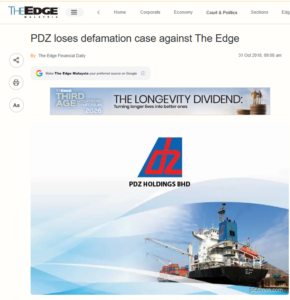
The High Court dismissed the claim and ordered PDZ to pay RM50,000 in costs.
From a legal standpoint, that is a court outcome. From a PR standpoint, it creates something additional like a crisis.
Before litigation, there is a searchable record of the original reporting.
After an unsuccessful case, there is now also a searchable record (probably by the same media corp) saying: X company sued X publication and lost.
Then that news gets reported by other news outlet and now you have a bigger problem of being known as “the company who see this media group and lost.
PR should ask this before litigation begins
If we win, what does that achieve? Do we prove we are correct? We protected reputation and improved investor confidence?
And just as importantly: If we lose, what does that do to the reputation we were trying to protect?
Litigation Can Keep the Story Alive
KomarkCorp provides another great example.
The company sued The Edge (it’s always them huh) over reporting concerning penny stocks. The High Court dismissed the claim, the matter went to the Court of Appeal, and the dispute later reached the Federal Court.
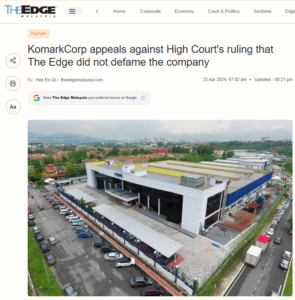
Each stage created another opportunity for the original issue to return to the public record and the publication can just keep the story alive by making it front-page news.
For businesses, this is an important trade-off.
Court action may provide vindication, but it may also keep an issue alive much longer than it would have survived naturally.
A controversy that might have disappeared from public attention within weeks can continue resurfacing through:
- Court hearings
- Appeals
- Written judgments
- Statements from both parties
- Follow-up reporting
- Social media discussion
If the original objective was simply: “We need this story to stop spreading.”
litigation may not always achieve that, just bunker down and wait for the storm to pass, that’s a genuine PR strategy.
The Streisand Effect Matters in Malaysia Too
The Streisand effect happens when an attempt to suppress information accidentally gives it more attention.
In PR terms, it can look like this:
Stage 1: A publication runs an article.
Stage 2: The company threatens legal action.
Stage 3: Other publications report on the legal threat.
Stage 4: Industry groups, politicians or commentators respond.
Stage 5: People who never saw the original article suddenly search for it.
The company has now helped increase the visibility of the information it wanted removed.
This does not happen every time a company takes legal action, but the possibility should always be assessed.
Before escalating, measure the actual reputation impact and ask:
- Is the story being widely shared? If its reaches whatsapp group level, that’s a code red.
- Are other Malaysian media outlets following it?
- Is it appearing prominently on Google?
- Are customers asking questions?
- Are investors or partners concerned?
- Is the issue spreading on LinkedIn, Facebook, TikTok or Reddit?
- Is there evidence of actual business damage?
A story with very limited reach may not justify a response that gives it national attention.
Sometimes Legal Action Is Absolutely Necessary
This article should not be read as an argument against suing the media, they are not infallible.
There are situations where litigation may be the correct response such as The Raub Australian Gold Mine case involving Malaysiakini is an important example.
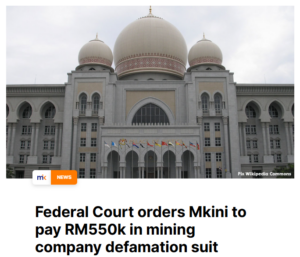
Raub Australian Gold Mine sued Malaysiakini over reporting related to residents’ concerns about its mining operations. The company initially lost at the High Court but later succeeded at the Court of Appeal, and the Federal Court ultimately upheld the outcome in its favour.
The case is important because it reinforces something businesses should not forget:
Corporate reputation has real value.
For Malaysian companies operating in heavily regulated or reputation-sensitive industries such as finance, healthcare, or listed markets, these consequences can be substantial.
Doing nothing can therefore be just as risky as overreacting.
PR and Legal Are Solving Different Problems
Legal teams are responsible for protecting the organisation’s legal position.
PR teams are responsible for understanding how the organisation’s actions will be interpreted by customers, journalists, employees, investors and the wider public.
Those responsibilities overlap, but they are not identical.
A lawyer may correctly advise: “The company has grounds to sue.”
PR still needs to ask: “Will suing improve the company’s reputation?”
- Sometimes the answer is yes.
- Sometimes a correction, clarification or right of reply may be more effective.
- Sometimes a strong public statement is necessary.
- And sometimes the best decision is to allow a weak story to lose momentum rather than extending its lifespan through litigation.
At PRESS, we are a PR Agency, and we believe Malaysian companies should treat media disputes as both legal and reputation-management issues.
In the end, we believe companies should only care about how customers/investors see your brands, not whether you are right in a high and mighty sense.
Because goodwill is a currency and can be traded in times of hardship.
Frequently Asked Questions About Legal Action Against the Media
Can a company sue a newspaper for defamation in Malaysia?
Yes. Malaysian companies may pursue defamation claims where published material allegedly causes reputational harm. Corporate reputation can have legal value, particularly where false allegations affect business interests.
Should a company immediately send a letter of demand over inaccurate reporting?
Not always. If the issue is a factual error, the company may first request a correction, clarification or amendment. More serious allegations may justify immediate legal advice.
Can threatening the media make a PR crisis worse?
Yes. A legal threat can itself become news and may attract additional coverage from other publications, industry groups, public figures or social media users.
What is the Streisand effect?
The Streisand effect happens when an attempt to suppress information unintentionally draws more attention to it. In media disputes, aggressive action can sometimes increase interest in the original article.
When should Malaysian companies consider legal action against the media?
Legal action may be appropriate when an allegation is serious, false, supported by evidence, causing genuine harm and cannot be resolved through a reasonable correction or clarification process.
Should PR or legal decide whether to sue?
Legal counsel should assess the legal merits. PR should assess the reputational consequences. Management should consider the commercial impact. The strongest decision usually involves all three.