

If you’re being sued for defamation in Malaysia, stop discussing the disputed statement publicly, preserve all relevant evidence and speak to a litigation lawyer as soon as possible. Being sued does not mean you have already lost, but ignoring the claim or missing a deadline can make matters much worse.
Defamation claims can arise from social media posts, WhatsApp messages, online reviews, workplace emails, interviews and even comedy performances. However, merely upsetting, insulting or embarrassing someone is not always enough.
The court will consider what was communicated, whether the claimant was identifiable, who received it and how an ordinary reasonable person would understand the words.
Civil defamation in Malaysia is mainly governed by the Defamation Act 1957 and common law principles. Criminal defamation is separately covered under Sections 499 and 500 of the Penal Code.
What Counts as Defamation in Malaysia?
A claimant will generally need to prove three main elements.
| Legal element | What it generally means |
|---|---|
| Defamatory meaning | The statement could lower the claimant’s reputation among reasonable members of society |
| Identification | The words, images or context reasonably referred to the claimant |
| Publication | The statement was communicated to at least one other person |
The claimant does not have to be named directly. A photograph, job title, workplace, family relationship or surrounding details may still make the person identifiable.
Publication is also broader than appearing in a newspaper. It can include a TikTok video, Facebook post, forwarded email, online review or message sent to a WhatsApp group.
Is Insulting Someone Automatically Defamation?
No. Defamation concerns damage to reputation, not simply hurt feelings.
Calling someone annoying or unpleasant may be rude, but it may not amount to a serious allegation about their conduct. The risk is particularly high where the statement alleges dishonesty, corruption, criminal activity, professional incompetence or serious wrongdoing.
Other statements that expose a person to hatred, ridicule or contempt may also be defamatory, depending on their meaning and context.
| Type | Example |
|---|---|
| Insult | “I find this business owner irritating.” |
| Opinion | “In my experience, the service was slow and disorganised.” |
| Allegation | “The owner steals customers’ payment information.” |
The final statement alleges criminal conduct and would usually require credible evidence or another valid legal defence.
Jokes are not automatically protected either. A court may consider the tone, setting, visuals and whether the audience would understand the words as obvious exaggeration, comment or a factual allegation.
What Does the Rosmah and Harith Iskander Case Show?
On 9 June 2026, Datin Seri Rosmah Mansor filed a defamation suit against comedian Harith Iskander over a routine performed during The Outspoken Comedy Tour in Melaka.
According to Rosmah’s statement of claim, Harith allegedly displayed imagery associated with supernatural creatures in Malaysian folklore, before showing her photograph. She claims the performance portrayed her as frightening, exposed her to ridicule and amounted to body shaming. Reports described the routine as including references to a pocong and pontianak.
In his statement of defence dated 9 July 2026, Harith denied that the performance carried the defamatory meanings alleged. He maintains that the routine must be considered in its full context and that recordings circulated online did not show the complete performance.
The court has not determined whether the routine was defamatory. The proceedings therefore do not yet establish a legal precedent.
The case illustrates why context matters. Satire, ridicule and comedy may be offensive without necessarily being defamatory, but humour does not provide automatic immunity where an audience could understand the performance as conveying a damaging factual imputation.
Read More: Consumer Rights in Malaysia: What Every Buyer NEEDS to Know
What Should You Do After Receiving a Defamation Claim?
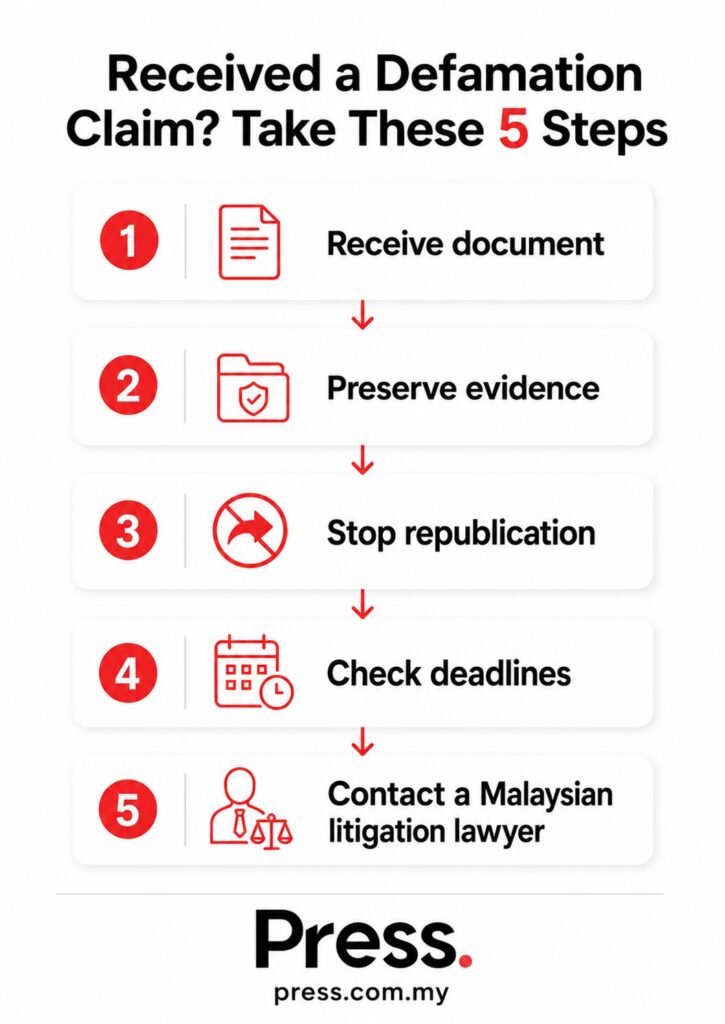
Check What You Have Received
A letter of demand is not a court judgment. It may ask you to remove the content, stop repeating it, publish an apology or correction, give an undertaking or pay compensation.
A sealed writ of summons ordinarily means court proceedings have been commenced.
A defendant served with a writ will generally have 14 days to enter an appearance, although the applicable deadline may be affected by the manner and place of service, an extension or a court order. Other documents may carry different deadlines.
Do not assume the matter will disappear. Give every document to a Malaysian litigation lawyer promptly.
Preserve the Evidence
Save the complete context before deleting or editing anything.
Useful evidence may include:
- The original post, message, video or recording.
- Drafts and earlier versions.
- Research notes and supporting documents.
- Emails or messages from your sources.
- Screenshots showing dates, captions and comments.
- Corrections or clarifications published afterwards.
Do not alter screenshots or hide unfavourable material. Your lawyer needs the genuine record to assess both the strengths and weaknesses of the case.
Stop Repeating the Statement
Repeating an allegation may create a fresh publication.
Even reposting it to explain what happened can increase its reach. A neutral response is usually safer:
“We are aware of the matter and are obtaining legal advice. As proceedings are ongoing, we will not comment on the merits of the dispute.”
Businesses should also notify management, their communications team and any relevant insurer.
What Defences May Be Available?
Can Truth Be a Defence?
Yes. The defence commonly called justification may apply where the substance of the defamatory allegation is true.
However, claiming something is “common knowledge” is not enough. You may need reliable documents, witnesses, official records, photographs or other admissible evidence.
A screenshot of another person repeating the same accusation generally proves only that the allegation was repeated, not that it was true.
Half-truths can also be risky. A statement may be technically accurate but still defamatory if important context is omitted and the overall impression becomes misleading.
Can Fair Comment Protect Criticism?
The Malaysian defence of fair comment may protect comments or opinions on matters of public interest when the relevant legal requirements are met.
The words must be recognisable as comment rather than a hidden allegation of fact. The comment should also have a sufficient factual basis and be one that a fair-minded person could honestly make on the facts proved.
Factual allegation: “The director stole RM500,000.”
Comment based on disclosed facts: “Based on the unexplained expenses identified in the published report, I believe the project was poorly managed.”
Adding “in my opinion,” “allegedly” or a question mark does not automatically provide protection. The court will examine the meaning conveyed to the audience and the factual basis for the comment.
What Is Qualified Privilege?
Qualified privilege may apply where a person has a legal, social or moral duty or interest in communicating information to someone who has a corresponding duty or interest in receiving it.
Examples may include:
Workplace report: An employee reports suspected misconduct to authorised management.
Professional reference: A former employer provides relevant information to a potential employer through an appropriate channel.
Complaint to an authority: A person reports suspected wrongdoing to an appropriate regulator or disciplinary body.
Statements made in a police report are generally treated separately and may be protected by absolute privilege. However, publicly repeating or posting the contents of the police report does not necessarily receive the same protection.
The audience and purpose matter. A private report to a person responsible for investigating an issue is different from publishing the allegation widely online.
Qualified privilege may be defeated where publication was motivated by malice or an improper purpose.
Where Is the Line Between Criticism and Defamation?
People are generally allowed to criticise public figures, businesses, policies, services and public conduct. Problems arise when criticism becomes an unsupported factual allegation.
This distinction can be especially blurry when discussing politics, race, religion, gender, corruption or criminal proceedings.
A safer approach is to describe what you can prove and separate it from your interpretation.
| Higher-risk wording | More careful wording |
|---|---|
| “He stole public funds.” | “The report identifies unexplained spending, and he should clarify how it was used.” |
| “This company is a scam.” | “I paid for the item but did not receive it, and my three emails were unanswered.” |
| “She supports illegal activity.” | “I believe her remarks could be interpreted as normalising that conduct.” |
| “Everyone knows he is corrupt.” | “Allegations have been reported, but they have not been proven in court.” |
The word “allegedly” is not a magic shield. Avoid making claims that you cannot properly support, for example “The seller scammed me out of my money!”
Can Companies Sue for Defamation?
Yes. A company may generally sue when they believe a statement damages their business or trading reputation, creating negative PR.
A company can have a reputation for honesty, safety, competence and financial reliability. Allegations that it sells counterfeit goods, cheats customers or operates illegally may therefore support a claim, as they allegations can cause financial losses. Restoring good PR will also take time and further effort.
However, a negative review is not automatically defamatory. A factual account of a genuine customer experience may be defensible, especially where the reviewer avoids exaggeration and unsupported accusations.
Should You Delete the Post or Apologise?
Do not make either decision purely out of panic.
Removing the material may reduce further circulation, but it does not erase the earlier publication. Preserve an accurate copy before restricting or deleting access.
Section 10 of the Defamation Act 1957 permits an apology to be relied on in mitigation of damages where the statutory requirements are satisfied. These requirements include appropriate notice and the timing of the apology or offer to apologise.
An apology, correction or clarification may help resolve the dispute or reduce damages. However, a poorly worded apology may admit more than intended.
Possible responses include:
- Removing the content without admitting liability.
- Correcting a factual error.
- Clarifying what was intended.
- Agreeing not to repeat specific words.
- Negotiating an agreed public statement.
Any response should be reviewed by a lawyer first.
What Can Happen If You Lose?
A successful claimant may seek several remedies.
Damages: Compensation for injury to reputation, with the amount affected by factors such as the seriousness, reach and persistence of the publication.
Aggravated damages: Additional damages where the defendant’s conduct increased the injury, including conduct after publication or during the proceedings.
Injunction: A court order preventing or restricting further publication.
Legal costs: The unsuccessful party may be ordered to pay part of the successful party’s legal costs.
Defamation disputes may also be resolved through negotiation, mediation, correction, retraction, undertakings or compensation. The appropriate outcome depends on the parties and the circumstances, and a settlement does not always require an admission of liability.
Taking the Right Action When You Get Sued for Defamation
Being sued for defamation in Malaysia is serious, but it doesn’t mean the claimant has already proven the case, or that you’re automatically guilty.
Preserve the full evidence, stop repeating the statement, comply with every deadline and obtain advice on whether justification, fair comment, qualified privilege or another defence may apply.
Defamation disputes can also become public reputation crises when they spread across news websites, social media and search results. PRESS PR Agency can help organisations prepare controlled public statements, handle media enquiries and protect stakeholder confidence through strategic PR while their lawyers manage the legal proceedings.
Disclaimer: This article provides general information only and does not constitute legal advice. Defamation claims are highly fact-specific, and court deadlines, available defences and procedural requirements may depend on the documents received, the manner of service and the circumstances of the publication.
Anyone facing a defamation claim should obtain advice from a qualified Malaysian advocate and solicitor.
Sources
- Defamation Act 1957.
- Penal Code, Sections 499 and 500.
- Rules of Court 2012, including Order 12 and Order 78.
- National Feedlot Corporation Sdn Bhd v Mohd Rafizi Ramli.
- Nor Aziz Mat Isa v Sun Teoh Tia & Ors.
- Lee Yoke Yam v Chin Keat Seng.
- Seema Elizabeth Isoy v Tan Sri David Chiu Tat-Cheong.
- Lim Lip Eng v Ong Ka Chuan.
- Malaysian Judiciary Civil Trials Guidebook.
- The Star, 14 July 2026, reporting on Rosmah Mansor’s defamation suit against Harith Iskander.
- The Edge Malaysia, 14 July 2026, reporting on Harith Iskander’s statement of defence.
- The Vibes, 14 July 2026, reporting on the allegations concerning the disputed comedy routine.
Frequently Asked Questions About Getting Sued For Defamation in Malaysia
Can I Be Sued Over a WhatsApp Message?
Yes. A WhatsApp message may amount to publication if it is sent to at least one person other than the person being discussed.
Can I Be Sued Without Naming the Person?
Yes. The claimant may still be identifiable through a photograph, title, workplace or surrounding details.
Can I Be Sued for Sharing Someone Else’s Post?
Yes. Reposting or forwarding another person’s allegation may be treated as a fresh publication.
Does Saying “In My Opinion” Prevent Defamation?
No. The court looks at the real meaning of the statement, not merely the words placed before it.
Can a Negative Review Be Defamatory?
A genuine and accurate review may be defensible. Risk increases when the reviewer exaggerates or alleges fraud, dishonesty or criminal conduct without evidence.
How Quickly Should I Respond to a Lawsuit?
Immediately. A defendant served with a writ will generally have 14 days to enter an appearance, but the actual deadline may depend on the document, the manner and place of service, an extension or a court order.
Give all documents to a Malaysian litigation lawyer as soon as possible.