

Kiasu is a Hokkien term that literally means being afraid to lose or lose out (kia = afraid of/fear, su = lose), especially when that fear makes someone extra competitive, overly prepared or very determined to secure an advantage.
You may hear someone say:
“You bought the tickets three months early? So kiasu!”
They probably do not mean the person is literally afraid of losing. They are teasing them for taking extra precautions so they do not miss out. That is what makes kiasu difficult to translate perfectly into English.
Sometimes it means competitive. Sometimes it means overly cautious. In other situations, it simply describes someone doing more than everyone else because they do not want to be disadvantaged.
For example, someone who turns up ridiculously early, compares ten different deals or buys something the moment it becomes available might be called kiasu.
What Is the Definition of Kiasu?
A simple definition of kiasu is:
A fear of losing out that makes someone especially competitive, cautious or eager to gain an advantage.
The Oxford English Dictionary includes an entry for kiasu, while research from Singapore Management University describes it as the “fear of losing out” and examines it as both a mindset and behavioural tendency.
| Situation | What “Kiasu” Implies |
|---|---|
| Arriving extremely early | Afraid of being late or missing out |
| Buying several units during a sale | Afraid the item will sell out |
| Comparing every possible deal | Determined to get maximum value |
| Studying far ahead of an exam | Very competitive or prepared |
| Rushing to be first in a queue | Afraid someone else will get ahead |
| Taking more than necessary | Can imply selfishness or greed |
The meaning depends heavily on context and tone.
Calling a friend kiasu because they arrived at the airport four hours early can be affectionate teasing. Calling someone kiasu because they grabbed all the free samples is much more critical.
That flexibility is part of why the word is so useful in casual conversation.
Where Does the Word Kiasu Come From?
Kiasu comes from Hokkien, a Southern Min Chinese language spoken in Singapore, Malaysia and elsewhere in the region.
The term is commonly explained as combining the ideas of being afraid and losing, giving it the literal sense of being “afraid to lose” or “afraid of losing out.” Over time, the meaning became broader.
Kiasu can describe the mentality of wanting to avoid being disadvantaged in almost any situation, from buying concert tickets to applying for a job or arriving early for a buffet.
Cross-Border Usage
The word is particularly associated with Singaporean English, or Singlish, where it has been used for decades. Researchers have also studied kiasu as a cultural and psychological concept because of its close association with competitive behaviour and Singaporean identity.
The term is also used and understood in Malaysia, especially among people familiar with Hokkien-influenced colloquial speech.
That cross-border familiarity makes sense. Malaysia and Singapore share many linguistic influences, including English, Malay and several Chinese languages. Slang naturally moves between communities, especially in places with long-standing cultural and family ties.
Still, the strongest documented cultural association of kiasu remains in Singapore.
How Is Kiasu Commonly Used in Malaysia?
In Malaysian conversations, kiasu is usually used to describe someone’s behaviour or attitude.
You often hear it when somebody seems to be trying unusually hard to avoid losing an opportunity.
Shopping: “There’s a sale tomorrow and she already reached the mall before opening. Damn kiasu.”
Travel: “Our flight is at 8 p.m. but he wants to reach KLIA at 3 p.m. Very kiasu.”
School: “The exam is next month and you already finished revising everything? So kiasu lah.”
Food: “He saw the buffet running low and immediately took three plates. A bit kiasu.”
Work: “She sent in the application the moment it opened because she didn’t want the positions to fill up.”
The behaviour does not have to involve an actual competition. Nobody “wins” by arriving at the airport excessively early. The kiasu part is the desire to remove any chance of missing out.
The same applies when someone checks every voucher before buying something or books a popular restaurant weeks in advance. The person is trying to eliminate uncertainty before someone else gets the better option.
Read More: How to Use Walao Naturally In Malaysian Slang
What Are Some Everyday Examples of Kiasu Behaviour?
Imagine a bakery announces it will sell only 100 boxes of a limited-edition pastry.
One person arrives at opening time.
Another arrives 20 minutes early.
Then your kiasu friend shows up two hours early with a portable chair.
That is the spirit of the word.
Other examples include:
- Booking Early: Reserving flights, hotels or restaurant tables months ahead so the best options do not disappear.
- Queueing Early: Arriving long before a shop opens because a promotion is limited to the first 50 customers.
- Taking Extra: Picking up several free samples because you worry there will be none left later.
- Overpreparing: Bringing several power banks, two umbrellas and printed copies of every reservation for a simple day trip.
- Comparing Every Deal: Checking multiple apps, vouchers and credit-card promotions before making a small purchase.
Some of these behaviours are perfectly sensible.
Others may make your friends look at you and say, “Eh, no need so kiasu lah.”
That difference matters because the word is not automatically negative. It becomes more critical when the behaviour feels excessive, inconsiderate or driven too strongly by the need to come out ahead.
How Do You Use Kiasu in a Sentence?
Kiasu fits naturally into informal Malaysian and Singaporean English.
Describing Someone
“You’re very kiasu.”
This means someone is being overly competitive, careful or determined not to lose out.
Describing Behaviour
“That’s quite kiasu.”
Here, the speaker is commenting on an action rather than the person’s whole personality.
Asking Why Someone Is Acting That Way
“Why you so kiasu?”
In casual speech, this usually means something like:
“Why are you being so competitive or cautious about this?”
Using It Playfully
“Wah, you bought yours already? Kiasu ah?”
Here, kiasu is teasing rather than insulting.
The tone matters more than strict grammar. Among friends, the word can sound affectionate or funny. In a disagreement, the exact same word can sound accusatory.
Read More: AWOL Meaning Explained: Origins, Grammar & Everyday Usage
Is Kiasu the Same as FOMO?
Kiasu and FOMO are related, but they are not the same.
FOMO means fear of missing out. It usually refers to anxiety about missing experiences, opportunities or social activities.
Kiasu is often more competitive and more focused on avoiding disadvantage.
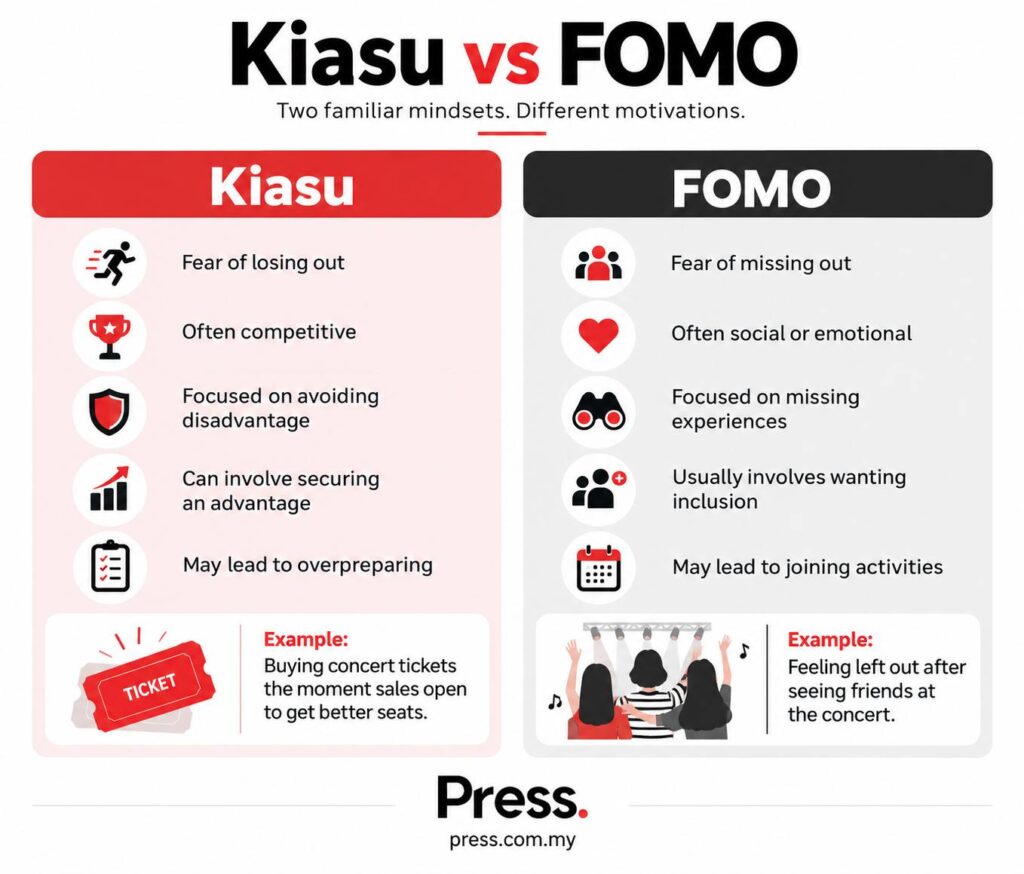
Seeing your friends at a concert and wishing you had gone could be FOMO.
Buying tickets the moment sales open because you are determined to get better seats before everyone else could be described as kiasu.
There is overlap between the two ideas, but kiasu tends to carry a stronger sense of competition, preparation or securing an advantage.
Is Being Kiasu Always a Bad Thing?
No. Kiasu behaviour can be positive, negative or somewhere in between.
Some forms of kiasu behaviour look like preparation or determination.
You might arrive early, compare several options or work harder because you do not want to lose an opportunity.
Research on kiasu also treats the concept as more complicated than simply calling it good or bad.
The positive side might look like this:
Prepared: You arrive early enough that traffic will not make you miss your flight.
Competitive: You work hard because you want to perform well.
Careful: You compare several options before making an expensive purchase.
It becomes more negative when the desire not to lose out starts inconveniencing other people.
Taking all the promotional items, refusing to share limited resources or pushing ahead simply to be first can make kiasu sound much more critical.
In other words, there is a difference between being prepared because you do not want to miss out and behaving as though nobody else should get a chance.
Is Kiasu a Malaysian or Singaporean Word?
Kiasu is strongly associated with Singapore, but it is also used in Malaysia.
Its strongest cultural association comes from its long-standing place in Singlish and Singaporean popular culture. Academic research also describes kiasu as closely connected with Singaporean identity.
That does not mean the word is exclusive to Singapore.
Hokkien and other Chinese languages have also influenced colloquial speech in Malaysia, so the term can be heard and understood in Malaysian settings too.
For Malaysian readers, it is safest to think of kiasu as a Hokkien-derived colloquial term that is especially associated with Singapore and is also used in Malaysia.
That framing avoids turning a shared regional expression into a question of who “owns” the word.
What Is the Difference Between Kiasu and Kiasi?
Kiasu and kiasi sound similar but refer to different fears.
Kiasu: Afraid to lose.
Kiasi: Afraid to die.
In everyday slang, kiasi does not necessarily mean someone literally fears death. It can describe someone who is extremely cautious, risk-averse or unwilling to do something they think is dangerous.
Imagine two people looking at a scary roller coaster.
One refuses to get on because it looks too dangerous. Their friends might jokingly call them kiasi.
Another rushes ahead because they want to be first in line. That is much closer to kiasu.
Remembering lose = kiasu and die = kiasi is an easy way to keep the two apart.
When Should You Avoid Calling Someone Kiasu?
Kiasu is often used jokingly, but it can also sound critical.
Calling a close friend kiasu because they booked a table six weeks early may be harmless teasing. Calling a colleague kiasu during a serious disagreement could sound like you are accusing them of being selfish or excessively competitive.
The safest rule is to consider relationship, situation and tone.
Among friends, the word can be playful.
In professional communication, formal writing or with people you do not know well, standard English is usually the better choice.
Getting Kiasu Right
Kiasu essentially means being afraid to lose out, but its everyday meaning can range from being highly prepared and competitive to being excessively concerned about gaining an advantage.
The word is especially associated with Singapore and Singlish, while also being used and understood in Malaysia.
Learning words like kiasu can reveal a lot about how language, culture and everyday behaviour overlap across Malaysia and Singapore. For brands trying to communicate with Malaysian audiences just as naturally, PRESS PR Agency can help turn local understanding into stronger stories through strategic PR and media communications.
Sources
- Oxford English Dictionary: Entry for kiasu, covering its meaning and etymology.
- Singapore Management University: Cheng and Wee’s 2023 research on kiasu as the “fear of losing out” and its role as a psychological construct.
- South China Morning Post: Background on the Hokkien origins of kiasu and its spread into Singapore English.
- Los Angeles Times: Discussion of kiasu culture and how it differs from simple FOMO.
- NUS PPE Club: Discussion of kiasu and its colloquial use in Singapore.
Frequently Asked Questions About Kiasu, Its Meaning, and Its Usage
What Does Kiasu Mean in English?
Kiasu roughly means “afraid to lose” or “afraid to lose out.” It describes someone who becomes especially competitive, cautious or eager to secure an advantage.
Is Kiasu a Malaysian Slang Word?
Kiasu is used and understood in Malaysia, but it is more strongly associated with Singapore, Singlish and Singaporean culture.
Is Kiasu a Hokkien Word?
Yes. Kiasu originates from Hokkien and is commonly translated as “afraid to lose” or “afraid of losing out.”
Is Calling Someone Kiasu an Insult?
Not necessarily. Friends often use it jokingly, but in a serious context it can suggest that someone is selfish or excessively competitive.
What Is an Example of Being Kiasu?
Arriving several hours before a shop opens because only the first 50 customers receive a promotion would be a classic example. The person is taking extra measures because they do not want to lose out.
What Is the Difference Between Kiasu and FOMO?
FOMO is the fear of missing out, usually on experiences or social activities. Kiasu is closer to the fear of losing out and often carries a stronger competitive element.