

There is no single official starting salary for Malaysian Technical and Vocational Education and Training (TVET) graduates in 2026. As a broad guide, some entry-level technical roles may advertise salaries from around RM2,000 upward, but actual offers vary depending on the course, qualification level, occupation, employer, location and technical skills involved.
A graduate working in a small automotive workshop, for example, may receive a different offer from a semiconductor equipment technician working shifts in Penang.
One useful market indicator comes from MYFutureJobs. According to figures reported by the Human Resources Ministry, the platform carried 343,836 TVET-related job opportunities from 1 January to 30 June 2026. The average advertised salary across those vacancies was RM3,658 per month.
However, students should not treat RM3,658 as the standard starting salary for every fresh TVET graduate. The vacancies may include entry-level workers, experienced technicians, specialists and supervisors.
What Is a Realistic Starting Salary for TVET Graduates?
No current public dataset establishes one nationwide 2026 starting-salary range for all Malaysian TVET graduates.
An indicative range of roughly RM2,000 to RM3,500 may appear in some entry-level technical occupations, but it is not an official salary band or guaranteed outcome.
Some workers may begin closer to Malaysia’s minimum wage of RM1,700 per month. Others may receive higher offers when their qualifications match urgent industry needs, include substantial industrial training or lead to a recognised competency certificate.
In September 2024, the National TVET Council announced selected arrangements between TVET institutions and participating employers offering premium starting salaries of RM2,500 to RM4,000.
These arrangements do not apply to every graduate. RM4,000 represents the upper end of selected offers rather than a standard national starting salary.
Read More: How Much Can a Civil Servant in Malaysia Earn Per Month?
Indicative TVET Salary Factors by Field
Reliable national starting-salary bands are not publicly available for every TVET occupation. Students should compare current vacancies in their chosen field rather than treating fixed figures as guaranteed.
| TVET Field | Factors That May Support Higher Pay |
|---|---|
| Automotive servicing | Diagnostics, EV systems and manufacturer training |
| Electrical installation | Competency certificates and industrial systems experience |
| Electronics and semiconductors | Equipment knowledge, clean-room work and rotating shifts |
| Welding and fabrication | Recognised qualifications and specialist processes |
| Industrial maintenance | Automation, troubleshooting and PLC skills |
| HVAC and refrigeration | Commercial systems and field experience |
| ICT and technical support | Networking, cloud and cybersecurity credentials |
| Machining and CNC | CAD, CAM and precision manufacturing |
| Mechatronics and automation | Robotics, sensors and machine-control systems |
Actual take-home pay may also include overtime, shift allowances, site payments, incentives, transport, meals or accommodation.
Students should confirm whether an advertised amount refers to basic salary or total compensation.
Why Does the RM3,658 Average Need Context?
The average advertised salary of RM3,658 is encouraging, but it is not the average salary received by every new TVET graduate.
TVET-related listings can include junior technicians, experienced workers, specialists, supervisors and candidates with competency certificates.
Some roles may also advertise higher total packages because they involve shifts, overtime, hazardous environments or remote sites.
Common additions may include:
- shift allowances;
- overtime payments;
- site allowances;
- productivity incentives;
- transport, meals or accommodation.
A RM2,800 role with structured training, overtime and recognised certification may offer better long-term value than a RM3,100 position with limited benefits and no clear progression.
Which TVET Fields May Offer Stronger Earning Potential in 2026?
TVET roles may offer stronger salaries when they require scarce technical skills, recognised certification, complex equipment knowledge or difficult working conditions.
Semiconductor and Advanced Manufacturing
Malaysia’s semiconductor and electronics sector requires technicians for equipment maintenance, production support, quality control, process operations and automation.
Offers may be more competitive in major industrial areas, especially when roles involve rotating shifts, clean-room work or sophisticated machinery.
Relevant programmes include mechatronics, industrial electronics, precision manufacturing, instrumentation and equipment maintenance.
Electrical and Industrial Maintenance
Factories, commercial buildings, data centres and infrastructure projects require workers who can install, inspect and repair electrical and mechanical systems.
Graduates with recognised competency certificates may qualify for more specialised responsibilities. Troubleshooting skills are also valuable because employers need technicians who can diagnose faults and minimise downtime safely.
Automation and Mechatronics
Factories increasingly use automated machinery, robotics, sensors and computer-controlled systems.
Graduates with practical skills in programmable logic controllers, robotics, pneumatics and industrial sensors may qualify for more specialised roles than those with only general mechanical training.
ICT and Cybersecurity
TVET also includes computer systems, networking, technical support, cloud infrastructure and cybersecurity.
Practical experience, industry-recognised certification and a strong portfolio may improve a graduate’s employment prospects.
Specialist Welding and Fabrication
Basic welding roles may offer ordinary entry-level salaries, while specialist welding can provide stronger earning potential.
Pay may increase when graduates obtain recognised qualifications for particular materials, welding processes or industrial environments. Large projects may also include overtime and site allowances.
Are TVET Graduates in Demand in Malaysia?
Malaysia recorded 343,836 TVET-related job opportunities on MYFutureJobs from 1 January to 30 June 2026.
The vacancies covered sectors including manufacturing, automation, engineering, maintenance, electrical and electronics, ICT, construction, automotive, semiconductors and machine operations.
The figure indicates substantial advertised demand for technical and vocational skills.
However, it does not show how many vacancies were specifically intended for fresh graduates, how many were unique listings or how many were eventually filled.
Demand also varies by occupation, location and employer. Students should investigate whether a programme is linked to active employers and current industry needs.
Read More: Is A Higher Salary Always Worth It? Evaluating Malaysian Jobs
What Determines a TVET Graduate’s Salary?
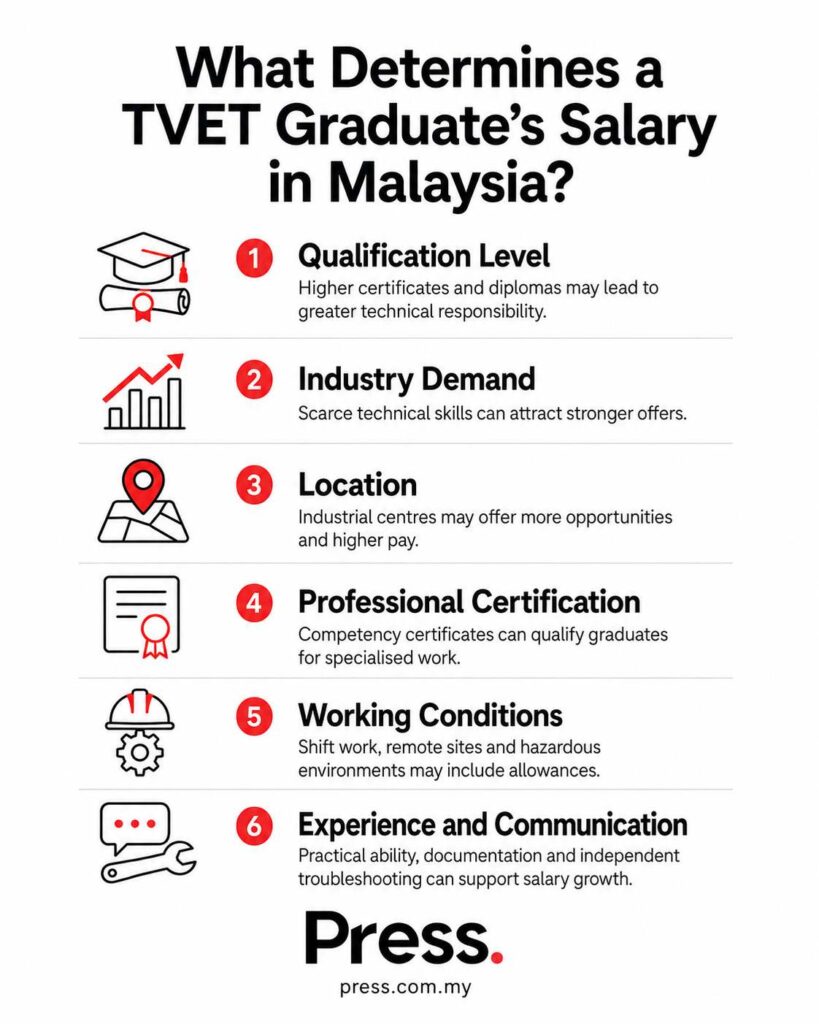
Several factors can cause two graduates from similar programmes to receive different offers.
Qualification Level
Higher-level certificates and diplomas may qualify graduates for roles involving greater technical responsibility.
Industry Demand
Pay may improve when employers are competing for workers with specific technical skills.
Location
Industrial centres such as the Klang Valley, Penang and Johor may offer more technical opportunities, although living costs may also be higher.
Professional and Competency Certification
Licences, competency certificates and industry credentials can show that a graduate is trained or authorised to perform specialised work.
Working Conditions
Shift work, remote sites, hazardous environments and physically demanding roles may include additional allowances.
Communication and Experience
Employers value technicians who can explain faults clearly, complete documentation and work independently. Industrial training and practical project experience can also strengthen a graduate’s position.
Can TVET Graduates Earn More Than Degree Graduates?
Some TVET graduates can earn more than some degree holders, particularly in scarce, highly technical or allowance-heavy occupations.
However, neither qualification automatically guarantees a higher salary.
A specialised technician may earn more than a degree graduate in a crowded field, while certain professional degrees may provide higher long-term earnings than many general technical roles.
Students should compare specific career paths rather than treating TVET and university as opposing choices.
Useful questions include:
- What occupation does the qualification lead to?
- What do current entry-level vacancies offer?
- Are additional licences required?
- How quickly can workers progress?
- Is the qualification recognised by employers?
TVET may allow students to enter employment earlier and gain practical experience sooner. University may still be required for careers involving academic, professional or regulatory accreditation.
How Quickly Can TVET Salaries Increase?
There is no reliable national salary ladder for every TVET occupation.
Earnings may rise when a worker gains experience, works independently, obtains an in-demand certificate, accepts shift or site work or moves into a specialist or supervisory position.
Possible progression routes include junior technician, senior technician, specialist, supervisor, trainer, technical salesperson, contractor or business owner.
Self-employment may increase the income ceiling in automotive repair, electrical services, air-conditioning maintenance, fabrication and construction. It also involves risks such as equipment costs, customer acquisition and irregular cash flow.
How Should Students Choose a TVET Course?
Students should not select a programme based only on an attractive salary headline.
Before enrolling, check:
- what jobs recent graduates secured;
- whether employers provide placements or direct recruitment;
- whether the training uses current equipment and software;
- whether the programme supports recognised certification;
- whether industrial training is substantial;
- whether the qualification can lead to a diploma or degree.
A strong TVET programme should connect practical training with real employment opportunities.
If an institution cannot explain where its graduates work or how the programme connects to industry, students should treat that as a warning sign.
Is TVET a Good Choice in 2026?
TVET can be a strong option for Malaysian students who prefer practical learning and want a direct route into a skilled occupation.
It may suit students who enjoy repairing equipment, operating machinery, building products or troubleshooting physical and digital systems.
However, TVET should not be chosen simply because it appears easier than university. Technical careers may require mathematics, safety discipline, documentation, physical stamina and continuous learning.
The strongest outcomes usually come from choosing a field with active employer demand, substantial hands-on training, recognised certification and clear career progression.
Keeping Salary Expectations Realistic
Malaysian TVET graduates should not expect one standard starting salary in 2026. Pay varies according to occupation, qualification, employer, location, certification, experience and working conditions.
MYFutureJobs carried 343,836 TVET-related opportunities from 1 January to 30 June 2026, with an average advertised salary of RM3,658 per month.
This is a useful indicator of the wider technical job market, but it should not be presented as the average starting salary for every fresh graduate.
Selected employer partnerships have offered premium starting salaries of RM2,500 to RM4,000, while other graduates may begin on lower basic salaries and increase their earnings through experience, certification, overtime and allowances.
Students should compare specific occupations, current vacancies and complete compensation packages before choosing a course or accepting an offer.
As education providers and employers compete to attract skilled students and workers, credible communication matters. PRESS PR Agency helps organisations use strategic PR services to highlight industry partnerships, graduate outcomes and workforce initiatives to the audiences that need to hear about them.
Sources
- MalaysiaGazette: Human Resources Ministry figures on 343,836 TVET-related opportunities and an average advertised salary of RM3,658 from January to June 2026.
- Utusan Malaysia: Reporting on the same announcement and the industries covered.
- Bernama: National TVET Council announcement on selected premium salary arrangements of RM2,500 to RM4,000.
- Khazanah Research Institute: Research on TVET qualifications, earnings and self-employment.
- Department of Statistics Malaysia: Graduates Statistics 2024.
- Ministry of Human Resources: Official minimum-wage information.
- Malaysian Qualifications Agency: TVET qualification and progression pathways.
- Energy Commission: Electrical competency requirements.
Frequently Asked Questions About Average Salaries for TVET Graduates in Malaysia
What Is the Average Salary of a TVET Graduate in Malaysia?
There is no official nationwide 2026 figure covering only fresh TVET graduates.
MYFutureJobs reported an average advertised salary of RM3,658 across TVET-related vacancies from January to June 2026, but those listings were not limited to new graduates.
Can Fresh TVET Graduates Earn RM4,000?
Yes, some can. Selected employer programmes and specialised roles may offer starting salaries or packages of up to RM4,000.
However, RM4,000 is not the standard starting salary across all TVET occupations.
Which TVET Course Has the Highest Salary?
No single course is guaranteed to offer the highest salary.
Fields linked to semiconductors, automation, electrical systems, industrial maintenance, cybersecurity and specialist welding may provide stronger earning potential when demand is high.
Is TVET Better Than University for Getting a Job?
TVET may provide a faster and more practical route into specific skilled occupations.
University is still required for many professional and academically regulated careers. The better option depends on the student’s target occupation, preferred learning style and long-term plans.
Do TVET Graduates Receive Overtime and Allowances?
Some technical jobs provide overtime, shift allowances, site payments, incentives, transport, meals or accommodation.
Applicants should confirm whether an advertised figure refers to basic salary or total compensation.
Can TVET Graduates Continue to a Degree?
Yes. Malaysia’s TVET framework includes progression routes from certain skills qualifications to diploma and degree programmes, subject to institutional and admission requirements.