

Installing solar panels, switching to electric vehicles or reducing operational emissions can deliver genuine environmental and business benefits. But when customers, employees and investors do not hear about an initiative, understand its purpose or see evidence of its results, the project is less likely to influence how they perceive the company.
Solar may reduce the amount of electricity a company purchases from the grid. EVs may reduce fuel consumption, eliminate tailpipe emissions and support quieter deliveries on selected routes. However, operational value and reputational value are not the same.
A RM5 million solar installation hidden behind a factory roof may still reduce electricity use. However, it will probably create less public awareness than a project supported by regular, evidence-based updates explaining its output, savings and environmental impact.
The investment may create real operational value, but you need clear communication to help people recognise that value.
Why Do Sustainability Investments Often Go Unnoticed?
A common communications mistake is to treat sustainability as a single event.
The project launches, a press release is published, perhaps LinkedIn receives one update, and then communication stops.
Months later, stakeholders may struggle to remember what was announced or understand what happened afterwards.
The issue is not necessarily the investment itself. It is the lack of accessible information showing how the project developed and what results it produced.
| Investment | What Companies Say | What Audiences Want to Know |
|---|---|---|
| Solar installation | “We installed rooftop solar.” | How much electricity does it generate? |
| EV fleet | “We bought electric vehicles.” | How are they being used, and what impact have they had? |
| Energy efficiency | “We reduced electricity usage.” | By how much, and against what baseline? |
| Recycling programme | “We support sustainability.” | What measurable result has it produced? |
Outcome-focused updates are more informative than announcements with no evidence of progress.
What Is the Difference Between a Green Claim and a Credible Story?
A green claim states what the company has done.
A credible story explains why it matters, provides evidence of the impact and connects the initiative to customers, employees or communities.
A Generic Green Claim
“Our company is committed to sustainability through electric vehicles.”
It sounds positive, but it also sounds like thousands of other corporate statements.
A Credible Sustainability Story
A stronger version might say:
“To reduce emissions from selected last-mile routes, the company introduced electric delivery vehicles into its fleet. During the first year, the vehicles completed thousands of deliveries and reduced fuel use on the routes where they were deployed. Customers also experienced quieter neighbourhood deliveries. The company is now reviewing performance data before expanding the programme.”
The second version answers the questions people naturally ask:
- What changed?
- Why was it done?
- What happened afterwards?
- Who benefited?
- What comes next?
That is evidence-based storytelling rather than unsupported marketing copy.
Any figures used should include a reporting period, calculation method and explanation of what was measured.
Why Is Pos Malaysia’s EV Fleet a Useful Example?
Pos Malaysia treated its EV rollout as an ongoing story rather than limiting communication to a single announcement.
As the programme developed, the organisation published updates about fleet expansion, operational decarbonisation and its longer-term ambitions for greener first- and last-mile delivery.
This gave stakeholders several opportunities to follow the programme and understand what the investment was intended to achieve.
Public information does not prove how much attention resulted specifically from that communications approach. However, the example demonstrates an important principle.
A sustainability initiative is easier to understand when the organisation explains its goals, reports progress and connects the investment to operational outcomes.
How Should Businesses Tell Their Sustainability Story?
One announcement is rarely enough. Sustainability communication should be treated as a journey rather than a one-off campaign.
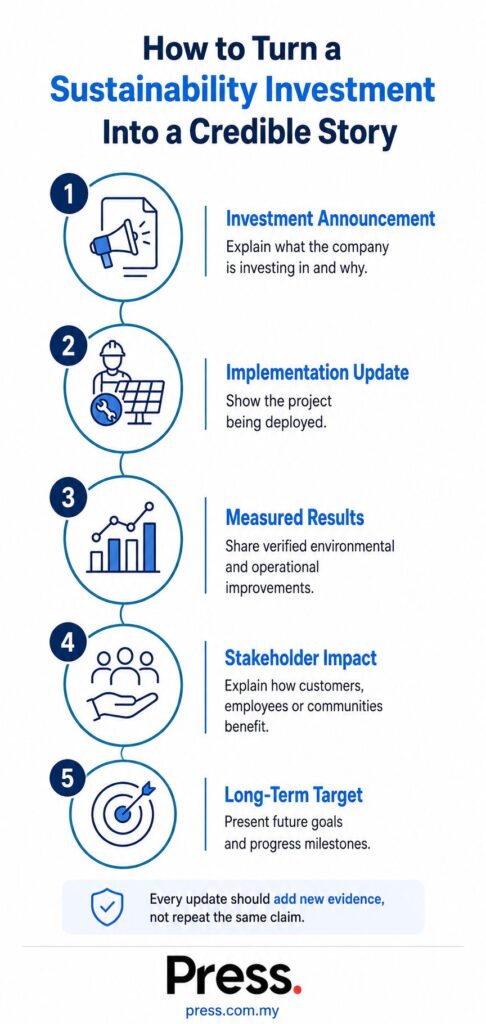
Not every milestone requires a press release.
Some updates may work better as:
- A sustainability report.
- A website article.
- A customer case study.
- An executive interview.
- A social media update.
- A media briefing.
The important point is consistency.
Every update should add useful information rather than repeat the same claim.
Why Should Sustainability Be Connected to Business Outcomes?
Sustainability is usually one consideration among price, quality, reliability, service and performance.
Companies should therefore explain both the environmental benefit and the practical result.
Examples include:
- Potentially Lower Operating Costs: On-site solar can reduce the amount of electricity purchased from the grid and may lower bills. Actual savings depend on system output, tariffs, financing, maintenance and consumption patterns.
- Operational Resilience: Renewable energy can reduce reliance on purchased electricity and may lessen exposure to some energy-price changes. It does not remove tariff, grid, weather or equipment risks.
- Better Customer Experience: Electric vehicles can support quieter deliveries, particularly at lower speeds, while demonstrating progress towards environmental goals.
- Stronger Employer Brand: Global research indicates that environmental and social issues influence the career decisions of many Gen Z and millennial workers. The strength of that preference varies by person, industry, role and market.
- Investor Confidence: Consistent sustainability reporting gives investors more useful information about material risks, opportunities and business resilience. It does not guarantee investment, but it can make the company easier to evaluate.
The environmental benefit remains important, while the business context helps stakeholders understand how the investment supports the organisation.
Read More: Solar ATAP Guidelines: Updated 2026 Guide for Malaysia
Why Is Evidence More Important Than Marketing Language?
Modern audiences are sceptical.
They have seen too many vague promises built around words such as:
- Sustainable.
- Eco-friendly.
- Green.
- Carbon conscious.
- Environmentally responsible.
Without supporting evidence, these phrases can sound like marketing and create greenwashing risks.
Businesses should publish information people can verify, such as:
- Installed solar capacity.
- Renewable electricity generated.
- Grid electricity avoided.
- Reduction in electricity use.
- Number and type of EVs deployed.
- EV utilisation rates.
- Fuel displaced.
- Emissions reduced.
- Delivery performance changes.
- Reporting period and baseline.
- Calculation methods and assumptions.
- Whether results were independently assured.
Companies should also use precise terminology.
For example, a battery-electric vehicle produces no tailpipe emissions while being driven. That does not mean it has no lifecycle emissions, because electricity generation, vehicle manufacturing and battery production still have environmental impacts.
Specific numbers build trust.
Generic adjectives rarely do.
What Does Sustainability Have to Do With Search and AI Visibility?
Sustainability content can contribute to online discoverability, but the relationship is not automatic.
Search-enabled AI products such as ChatGPT search, Google AI Overviews and AI Mode can retrieve, summarise or link to information from the web.
A single press release can still be indexed or cited. However, a clear, crawlable page supported by useful evidence gives search systems and human readers more information to evaluate.
Accurate coverage across corporate reports, reputable publications and industry websites can also provide additional references.
This may create several advantages:
- Greater Discoverability: Useful, well-structured content gives customers and search systems more opportunities to find the initiative.
- Independent References: Accurate third-party coverage can support claims made in corporate reports or on the company website.
- Potential AI Visibility: Reputable, crawlable pages may be surfaced by search-enabled AI products. However, no number of articles, mentions or backlinks can guarantee inclusion in an AI-generated answer.
- Longer-Lasting Visibility: Published coverage may remain discoverable after a campaign ends, although continued availability and ranking depend on the publisher and search platform.
Sustainability communication can therefore support public relations and search strategy.
It should not be presented as a guaranteed method of securing rankings or AI citations.
Why Should PR Be Part of a Sustainability Investment?
Businesses often focus on implementation and give less attention to explaining the results.
That can limit the initiative’s reputational impact, even when the operational results are strong.
PR can help turn technical information into accessible stories for customers, employees, investors, regulators and the wider public.
Effective PR services can help companies:
- Provide context: Explain why the initiative was introduced.
- Create continuity: Share milestones and measured results after launch.
- Support ESG communication: Turn formal reporting into content wider audiences can understand.
- Build independent references: Provide third-party context and corroboration.
- Strengthen discoverability: Create additional ways for customers and search systems to find the company.
- Differentiate the initiative: Explain results and stakeholder benefits instead of relying on generic environmental language.
Investment size alone does not determine public recognition.
Results, relevance, timing, evidence, audience interest and distribution all affect whether a sustainability story gains attention.
How Can Companies Avoid Greenwashing?
Greenwashing often occurs when environmental claims are vague, exaggerated or unsupported.
Companies can reduce this risk by:
- Using measurable claims.
- Stating the reporting period.
- Explaining the baseline.
- Disclosing the calculation method.
- Avoiding claims that make a pilot programme sound company-wide.
- Separating future targets from completed results.
- Explaining assumptions and limitations.
- Considering independent verification for material claims.
Terms such as “carbon neutral,” “zero emissions” or “100% green” should not be used unless the company can substantiate exactly what they mean.
Credibility comes from accuracy, not exaggeration.
What Should Companies Measure After Investing in Solar or EVs?
Useful solar metrics may include:
- Installed capacity.
- Electricity generated.
- Grid electricity avoided.
- Electricity-cost changes.
- System uptime.
- Estimated emissions avoided.
Useful EV metrics may include:
- Number and type of vehicles deployed.
- Routes covered.
- Distance travelled.
- Vehicle utilisation.
- Charging energy consumed.
- Fuel displaced.
- Maintenance-cost changes.
- Delivery performance.
- Tailpipe emissions avoided.
For every metric, companies should explain:
- The reporting period.
- The baseline.
- The calculation method.
- The assumptions used.
- Whether the figures were independently assured.
A number without context can still be misleading.
Getting the Process Right
Installing solar panels or transitioning to EVs is only one part of the process. These investments can create operational and environmental value even without publicity.
Clear, evidence-based communication helps customers, employees and investors understand that value and follow the organisation’s progress.
Accurate sustainability stories may also support search discoverability and provide useful sources for search-enabled AI products. Media attention, rankings and AI citations, however, cannot be guaranteed. The strongest sustainability communication does not simply say that a company is green. It shows what changed, how the result was measured, who benefited and what happens next.
PRESS PR Agency helps companies transform verified operational achievements into clear, credible stories designed to earn trusted media coverage, strengthen discoverability and build long-term brand authority through strategic PR.
Sources
- Securities Commission Malaysia: National Sustainability Reporting Framework and PACE resources.
- Bursa Malaysia: Sustainability-reporting requirements and guidance for listed issuers.
- Pos Malaysia Berhad: Sustainability statements and corporate announcements concerning its EV fleet.
- Ministry of Economy Malaysia: National Energy Transition Roadmap.
- Sustainable Energy Development Authority Malaysia: Rooftop solar and renewable-energy programme information.
- International Sustainability Standards Board: IFRS S1 and IFRS S2 sustainability-disclosure standards.
- International Energy Agency: Clean-energy, renewable-energy and electric-vehicle research.
- European Environment Agency: Evidence concerning electric-vehicle emissions and noise.
- Google Search Central and OpenAI: Official documentation on search-enabled AI products and web sources.
- United Nations: Guidance on greenwashing and environmental claims.
Frequently Asked Questions About Getting Customers to Notice Sustainability Investments
Why Don’t Customers Notice Our Sustainability Investments?
Customers may not understand an initiative when communication stops after launch. Regular updates with measured outcomes can help stakeholders follow its progress, although attention is never guaranteed.
Is Installing Solar Enough to Improve Brand Reputation?
No. Solar can create operational and environmental value, but its effect on reputation depends on how clearly the company explains its purpose, results and stakeholder benefits.
How Can Companies Avoid Greenwashing?
Use specific, verifiable data and explain the reporting period, baseline, methodology and limitations behind each claim.
Avoid broad terms such as “green,” “eco-friendly” or “carbon neutral” unless the company can substantiate exactly what they mean.
Why Does PR Matter for Sustainability Projects?
PR can make technical information easier for journalists, customers, employees and investors to understand.
Third-party coverage may also provide independent references, but it does not guarantee attention, rankings or AI citations.
How Does Sustainability Affect AI Search Visibility?
Search-enabled AI products can retrieve and link to indexed web content.
Clear, reliable and crawlable information may improve discoverability, but every platform selects sources differently and no company can guarantee inclusion.
What Should Companies Measure After Investing in Solar or EVs?
Useful metrics may include renewable electricity generated, grid electricity avoided, operating-cost changes, EV utilisation, fuel displaced, delivery performance and emissions.
Companies should also state the reporting period, baseline, calculation method and whether the results were independently assured.