

Yes, HR in Malaysia can ask for your payslips from the past three months during recruitment. However, asking for them is not the same as having a legal right to demand them.
There is generally no broad Malaysian law requiring a job applicant to disclose previous salary information or provide payroll records to a prospective employer. You may decline, ask why the documents are needed or offer another form of verification.
The practical situation is less straightforward. Some employers make payslip submission part of their internal recruitment process. If you refuse, HR may request alternative proof, delay the offer or stop the application.
Is It Legal for HR to Ask for Your Payslip?
Generally, yes.
A prospective employer does not automatically break Malaysian employment law by requesting one to three months of payslips. The important distinction is between an employer asking for a document and the law requiring you to provide it.
For Peninsular Malaysia and the Federal Territory of Labuan, the Employment Act 1955 regulates matters such as wages, working hours and employment conditions. It does not create a general requirement for applicants to disclose salary history or provide previous payslips.
Read More: 7 Types of Employment Contract in Malaysia You Need to Know
Sabah and Sarawak have separate labour legislation. In all cases, a company’s internal recruitment policy should not automatically be treated as a legal obligation.
| Situation | General Position |
|---|---|
| HR asks for your last three payslips | Generally permitted |
| You decline to provide them | Generally permitted |
| HR says submission is company policy | It may be required for its process, but not generally by law |
| HR ends the application after refusal | Possible, depending on the circumstances |
| HR mishandles the document | May raise privacy concerns |
A company may therefore make payslip submission a condition of progressing your application. That is an internal hiring requirement rather than a general statutory duty.
Why Do Employers Ask for Three Months of Payslips?
Employers may request several months of payslips to understand your normal remuneration rather than relying on a single pay cycle.
Three months can help HR distinguish between:
- Basic salary
- Fixed allowances
- Overtime
- Commission
- Bonuses
- Statutory deductions
The request may also form part of employment verification or an internal salary-approval process.
Some employers use previous pay when calculating an offer. For example, if your current salary is RM5,000 and the company offers a 15% increase, the offer would be RM5,750.
That may sound reasonable, but it could still be below the approved range or market value of the new position.
Does the PDPA Protect Your Payslip?
A payslip ordinarily contains personal data because it includes information relating to an identifiable employee.
It may show your name, employee number, employer, salary, allowances, bonuses, EPF or SOCSO deductions, tax deductions and payment details.
Where the Personal Data Protection Act 2010, or PDPA, applies, a prospective employer should have a lawful and relevant reason for collecting the document. The information requested should be necessary for that purpose and should not be excessive.
Read More: PDPA: What Malaysian SMEs Must Know About Data Protection
Before sharing a payslip, you can ask:
Purpose: Why is the document needed?
Access: Who will be able to view it?
Disclosure: Will it be shared with another department or an external background-check provider?
Retention: How long will it be kept if you are not hired?
Alternatives: Can you provide a redacted document or employment-confirmation letter instead?
The employer should also use a secure submission method and avoid retaining the document longer than necessary.
Salary information is personal data, but salary alone is not automatically classified as sensitive personal data under the PDPA’s specific definition. It should still be handled carefully because a payslip reveals detailed financial and employment information.
The PDPA does not apply to the Federal Government or state governments, so public-sector recruitment may require a different legal analysis.
Can Your Payslip Be Used to Lowball You?
Once HR knows your current salary, that figure may become the starting point for negotiation. Instead of focusing on what the new role is worth, the employer may focus on the smallest increase it believes you will accept.
Not every employer negotiates this way. Some companies use structured salary bands based on experience, responsibilities and internal equity.
However, your previous pay may not reflect your current market value. It could have been affected by:
- Past underpayment
- Several years without a meaningful raise
- A smaller employer with a limited budget
- Different responsibilities
- A career break
- Increased demand for your skills
A payslip shows what one employer paid you at a particular time. It does not prove what your experience is worth in a new position.
How Can You Avoid Being Lowballed?
Try to move the discussion from your previous salary to the value of the new role.
Ask for the approved salary range before disclosing your current pay:
“Could you share the approved salary range for this role? I would like to make sure our expectations are aligned before discussing my current remuneration.”
You can also explain that your existing salary relates to a different role:
“My current salary reflects a different scope and level of responsibility. I would prefer to discuss compensation based on the responsibilities and approved range for this position.”
Support your expected salary with relevant factors such as your experience, specialist skills, qualifications, responsibilities and market rates.
Where appropriate, give a realistic expected range rather than one fixed number.
Can You Refuse to Provide Your Payslips?
Yes, you may ordinarily decline.
Because there is generally no statutory requirement for job applicants to provide previous payslips, you can tell the recruiter that you prefer not to share them.
A professional response may be:
“I prefer to keep my previous employer’s payroll documents confidential. However, I’m happy to discuss my expected salary and provide alternative confirmation of my employment.”
You may also ask:
“Could you explain how the payslips will be used and whether an employment-confirmation letter would be sufficient?”
Refusing does not automatically make you uncooperative. However, it may have practical consequences.
Could Refusing Cost You the Job?
Realistically, yes. If payslip submission is part of the employer’s internal process, HR may delay the application, ask for another document or decide not to proceed.
Possible outcomes include:
- HR accepts your explanation and continues.
- A redacted payslip or employment letter is accepted.
- The offer is delayed while the recruiter seeks approval.
- Additional employment verification is requested.
- The application ends because the company insists on the documents.
Your bargaining power may affect the outcome. Candidates with rare skills, strong experience or competing offers may have more room to refuse than those applying for highly competitive roles.
The absence of a legal duty to provide payslips does not guarantee that refusing will have no practical effect.
Read More: Employer Guide to Severance Pay Malaysia
What Can You Provide Instead of a Full Payslip?
You do not always have to choose between complete disclosure and complete refusal. Depending on the company’s policies, you may be allowed to provide the following. Check with their HR first before
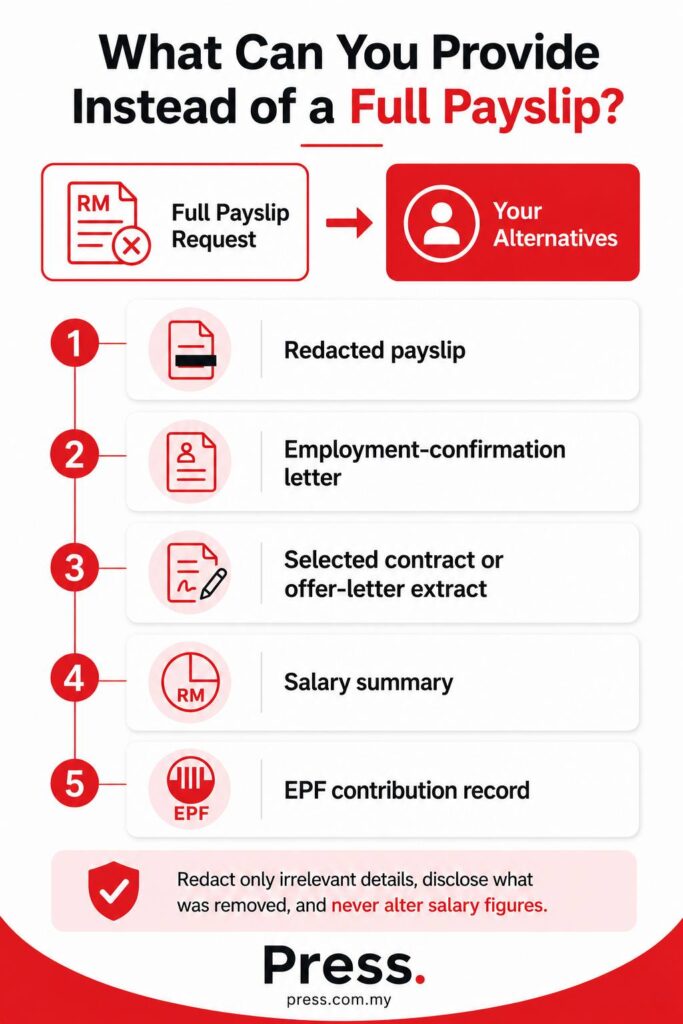
Redacted Payslip
You may conceal information that is not relevant to the employer’s stated purpose, such as:
- Bank or payment details
- Tax identifiers
- Employee numbers
- Personal deductions
- Internal payroll codes
Tell HR what has been redacted. Do not alter salary figures, employer details or other material information.
The employer does not have to accept the redacted version, but it may be a reasonable compromise.
Employment-Confirmation Letter
A current or previous employer may confirm your job title, employment period and employment status without revealing your full payroll history.
Employment Contract or Offer Letter
You may provide relevant extracts confirming your role or remuneration. Check for confidentiality clauses and remove unrelated terms before sharing the document.
Salary Summary
You can provide a written breakdown of your basic salary, fixed allowances, variable pay and expected salary without sharing the full payslip.
EPF Contribution Record
An EPF record may support employment history, but it should be used carefully because it may reveal salary-related information and details about other employers.
How Should You Respond to a Payslip Request?
A calm and cooperative response is usually better than an immediate refusal.
Start by asking why the document is required:
“Could you explain the purpose of the payslip request and whether another form of employment verification would be acceptable?”
If privacy is your concern, say:
“I’m happy to support the verification process, but I would prefer not to disclose unrelated payroll and deduction information. Would a redacted payslip or employment letter be sufficient?”
If salary negotiation is the main issue, say:
“My current remuneration reflects a different role and market situation. I would prefer to discuss the approved range and responsibilities for this position.”
You can also ask whether the document can be provided after a conditional offer. This may reduce the chance that your previous salary determines the initial offer.
Should You Lie About Your Previous Salary?
No.
Do not falsify a payslip, alter salary figures or deliberately give misleading information.
You may decline disclosure. That is different from providing false information.
If an employer discovers that a payslip was altered or that your salary was intentionally misrepresented, theymay withdraw the offer. If you have already started work, the issue may damage trust or lead to disciplinary consequences, depending on the circumstances.
A safer response is:
“I’m not comfortable sharing the exact figure, but I’m happy to discuss my expected salary and the value I would bring to the role.”
Honest non-disclosure is safer than inaccurate disclosure.
Is a Payslip Request a Red Flag?
Not automatically.
Some employers request payslips to verify remuneration, separate fixed and variable pay or obtain internal approval for an offer.
The more important issue is how the request is handled.
A responsible employer should explain why the document is needed, request only relevant information, use a secure submission method and limit access to authorised people.
Be more cautious when:
- HR refuses to explain why the document is required.
- The recruiter will not reveal the salary range.
- Three months of payslips are requested without explanation.
- Sensitive documents must be sent through an unsecured channel.
- HR cannot explain who will access the information.
- The employer appears more interested in your old salary than your skills.
A payslip request may be routine. Poor handling of the request is the more important warning sign.
Keeping Your Payslip Private
HR in Malaysia may ask for your last three months of payslips during recruitment, but job applicants are generally not legally required to provide them.
You may decline, ask why the documents are needed, offer a redacted version or provide alternative proof such as an employment-confirmation letter. However, the employer may decide not to continue with your application if payslip submission is part of its internal process.
Where the PDPA applies, the organisation should have a relevant purpose for collecting the document, explain how it will be used, protect it appropriately and avoid retaining it longer than necessary.
Clear communication around recruitment and employment policies also affects how organisations are perceived. PRESS PR Agency helps companies communicate workplace matters professionally through strategic PR services.
Disclaimer: This article provides general information only and is not a substitute for advice from a qualified Malaysian lawyer.
Sources
- Personal Data Protection Department Malaysia: Personal Data Protection Act 2010 and official data-protection guidance.
- Department of Labour Peninsular Malaysia: Employment Act 1955 and official employment guidance.
- Employment Regulations 1957: Rules covering wage statements provided by employers to employees.
- Sabah Labour Ordinance and Sarawak Labour Ordinance: Labour legislation applicable in Sabah and Sarawak.
Frequently Asked Questions About Employers Requesting Payslips
Can HR Legally Ask for My Payslip in Malaysia?
Generally, yes. A prospective employer may request a payslip, but there is generally no law requiring a job applicant to provide one.
Must I Give HR Three Months of Payslips?
Generally, no. Three months is usually an internal recruitment requirement rather than a statutory obligation. The employer may still decide not to progress your application if you decline.
Can a Company Reject Me for Refusing?
A private employer may decide not to continue an application when an applicant declines a requested hiring step. The exact legal position depends on the circumstances and the reason for the decision.
Can I Redact My Payslip?
You may offer a redacted payslip that conceals information not needed for the employer’s stated purpose. Tell HR what has been redacted and do not alter material details. The employer does not have to accept it.
Can I Provide an Employment Letter Instead?
You can offer an employment-confirmation letter, salary summary, reference or selected contract extracts. Whether the employer accepts the alternative depends on its process.
How Do I Decline a Payslip Request Politely?
You can say, “I prefer to keep my previous employer’s payroll documents confidential. However, I’m happy to discuss my expected salary and provide alternative confirmation of my employment.” This doesn’t guarantee the company will accept your refusal, of course, but it’s a good starting point.