

If you’re exploring public relations jobs in Malaysia, the short answer is that there are far more career paths available than simply becoming a PR executive who writes press releases. Today’s PR professionals work across corporate communications, digital reputation management, public affairs, employer branding, crisis communications, media relations, and stakeholder engagement.
This often surprises students and fresh graduates. Many people enter university believing PR services are mainly about organising events, handling media interviews, or getting brands featured in newspapers, but the role has expanded alongside social media, online news, influencer marketing, AI tools, and digital reputation management.
PR is also evolving faster than many people realize. In Muck Rack’s State of PR 2025 survey of 1,089 PR professionals (fielded June 5–July 16, 2025), 84% said media relations is their top job function, showing traditional PR remains central even as the field modernizes. The same findings show AI is now mainstream in communications: about three in four PR professionals reported incorporating AI into their work in 2025, up from 28% in 2023.
Before deciding whether PR is the right path for you, it’s worth understanding what the profession actually involves and the different directions it can take.
What Is Public Relations, Really?
Defining PR Beyond Just Press Releases
At its core, public relations is the practice of managing communication, relationships, and reputation between an organisation and its stakeholders.
Those stakeholders can include:
- Customers
- Employees
- Investors
- Journalists
- Government agencies
- Business partners
- Local communities
One of the biggest misconceptions about PR is that it only becomes important when a company wants media coverage.
In reality, PR influences nearly every aspect of how an organisation is perceived. When a company launches a new product, announces a major partnership, responds to a public controversy, introduces a sustainability initiative, or communicates with employees during organisational changes, PR is often involved.
A useful simplified way to compare PR and related disciplines is by their typical aim:
| Function | Primary Objective |
|---|---|
| Marketing | Generate demand and sales |
| Advertising | Promote products and services |
| Public Relations | Build trust and reputation |
| Customer Service | Support customers |
| Corporate Communications | Manage stakeholder communication |
Marketing may convince someone to buy from a company. PR helps convince them the company is trustworthy in the first place.
Why PR Appeals To So Many Career Starters
PR is one of the few professions where no two weeks are likely to look exactly the same.
A typical week could involve drafting a media release, preparing an executive interview, coordinating an event, responding to a journalist’s enquiry, monitoring social media conversations, and attending a stakeholder meeting.
For many graduates, this variety is part of the appeal.
People often enjoy PR because it combines several different skill sets:
- Communication: Writing, speaking, and storytelling.
- Relationship Building: Connecting with journalists, clients, stakeholders, and communities.
- Problem-Solving: Managing unexpected situations and finding communication solutions.
- Continuous Learning: Understanding new industries, business models, and social trends.
Another advantage is flexibility. PR professionals can work in healthcare, technology, finance, education, government, property, entertainment, consumer brands, and many other sectors.
In many cases, your communication skills can be transferred across industries throughout your career.
The Different Types Of Public Relations Jobs In Malaysia
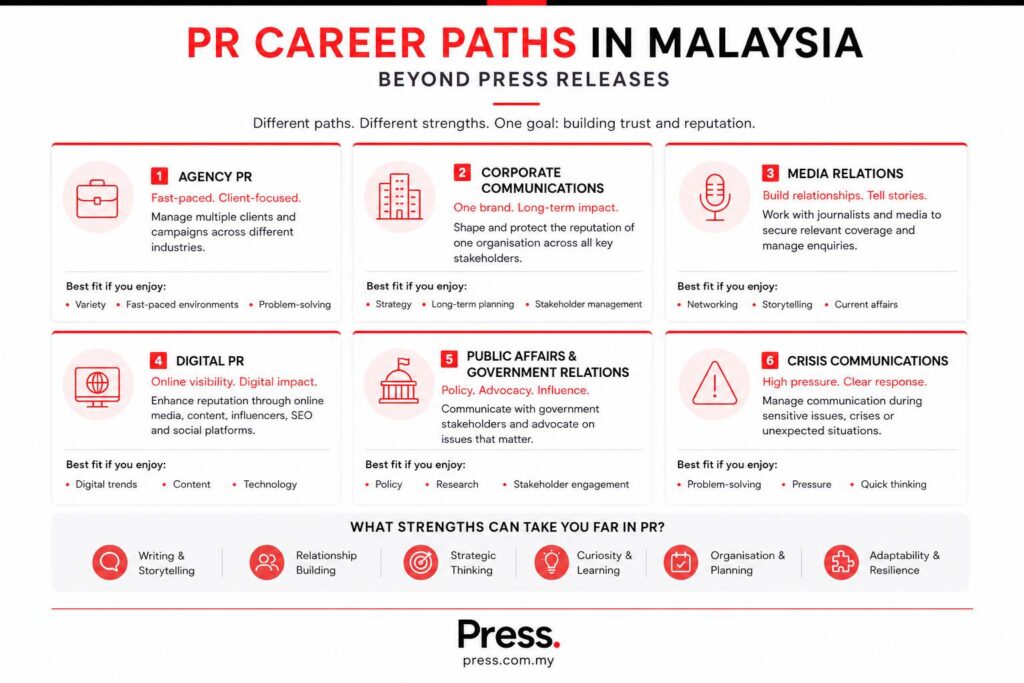
Agency PR: Fast-Paced And Client-Focused
Agency PR is often the most visible entry point into the profession.
PR agencies typically represent multiple clients simultaneously, allowing professionals to gain exposure to different industries and communication challenges.
A typical agency career progression may look like this:
| Entry-Level | Mid-Level | Senior-Level |
|---|---|---|
| PR Intern | Account Manager | Account Director |
| PR Executive | Senior Account Executive | PR Director |
Agency professionals may spend their time:
- Pitching stories to journalists
- Preparing media materials
- Attending client meetings
- Coordinating campaigns
- Managing event logistics
- Monitoring coverage and reporting results
One week you might be supporting a property launch. The next, you could be helping a technology startup announce a funding round.
For people who enjoy variety and fast-paced environments, agency life can provide valuable experience early in a career.
Corporate Communications: Managing One Organisation’s Reputation
Unlike agency professionals who work across multiple clients, corporate communications specialists focus on a single organisation.
Their responsibility is often broader than media relations alone. They help manage how employees, investors, customers, regulators, and business partners perceive the organisation.
Typical responsibilities include:
| Internal Focus | External Focus |
|---|---|
| Employee communications | Media engagement |
| Leadership messaging | Public announcements |
| Change management | Stakeholder relations |
| Internal campaigns | Reputation management |
This career path is particularly common within:
- Multinational corporations
- Banks
- Listed companies
- Government-linked companies
- Large private organisations
People who enjoy strategic thinking and long-term relationship management often gravitate towards corporate communications.
Media Relations: Building Relationships With Journalists
Media relations remains one of the foundations of public relations.
Professionals in this area focus on helping organisations communicate with news media and secure relevant coverage.
Their responsibilities typically include:
- Identifying newsworthy stories
- Pitching ideas to journalists
- Coordinating interviews
- Preparing media materials
- Managing media enquiries
Success in media relations requires understanding what journalists actually need rather than simply promoting a company.
Strong relationships, credibility, and good storytelling skills are often more valuable than aggressive pitching.
If you enjoy current affairs, networking, and understanding how newsrooms operate, media relations may be worth exploring.
Digital PR: Where Communications Meets Online Visibility
Modern PR increasingly extends beyond traditional media.
Today, brands build reputation not only through newspapers and television but also through online publications, podcasts, social media, search engines, and influencer networks.
Digital PR professionals may work on:
- Online reputation management
- Digital publications
- Thought leadership campaigns
- Influencer collaborations
- Content promotion
- Search visibility initiatives
The shift towards digital communications is not theoretical. Muck Rack’s 2025 findings show AI has become mainstream in PR: about three in four PR professionals reported incorporating AI into their work in 2025, up from 28% in 2023.
As a result, PR increasingly overlaps with content marketing, SEO, and digital communications.
For individuals interested in both communication and technology, digital PR offers one of the fastest-growing career paths within the industry.
Public Affairs And Government Relations
Not every PR professional works with brands and media.
Some focus primarily on communication between organisations and government stakeholders.
Public affairs and government relations professionals often work within highly regulated sectors such as:
- Healthcare
- Telecommunications
- Financial services
- Transportation
- Energy
Their work may involve:
Monitoring Regulatory Developments
Keeping organisations informed about policy changes and industry regulations.
Stakeholder Engagement
Building relationships with regulators, policymakers, and industry associations.
Advocacy
Representing organisational interests through appropriate communication channels.
Public Communication
Helping stakeholders understand complex policies and regulatory changes.
For individuals interested in governance, politics, and public policy, this can be a particularly rewarding area of PR.
Crisis Communications: Managing Difficult Situations
Some of the most important communication work happens when things go wrong.
Companies may face situations such as:
- Product recalls
- Data breaches
- Workplace incidents
- Regulatory investigations
- Public backlash on social media
During these moments, communication becomes critical.
A well-managed response can help maintain trust. A poorly managed one can significantly damage an organisation’s reputation.
| Challenge | Communication Goal |
|---|---|
| Public confusion | Provide clarity |
| Stakeholder concern | Maintain trust |
| Media scrutiny | Ensure consistency |
| Reputation risk | Protect credibility |
Contrary to popular belief, crisis communication is not about hiding bad news. It is about communicating accurately, responsibly, and transparently when stakeholders need information most.
Emerging PR Careers Malaysians Should Watch
The communications profession continues to evolve as technology, consumer behaviour, and stakeholder expectations change.
Several newer specialisations are becoming increasingly common.
ESG And Sustainability Communications
As organisations place greater emphasis on environmental and social responsibility, professionals are needed to communicate sustainability initiatives clearly and credibly.
Employer Branding
Companies compete for talent as much as they compete for customers. Employer branding specialists help shape how current and prospective employees perceive an organisation.
Influencer Relations
Managing relationships with content creators has become a specialised communications discipline that combines PR, social media, and partnership management.
Executive Thought Leadership
Many senior executives now maintain public profiles through interviews, articles, LinkedIn content, and industry speaking engagements. PR professionals often help develop and manage these initiatives.
Online Reputation Management
Search results, online reviews, social media discussions, and digital publications all influence public perception. Managing this ecosystem has become a specialised communications function in its own right.
Which PR Career Path Fits Your Personality?
Choosing a PR career becomes easier when you focus on your strengths rather than job titles.
| If You Enjoy… | Consider |
|---|---|
| Writing and storytelling | Digital PR, Content Communications |
| Networking and relationship building | Media Relations, Agency PR |
| Strategic planning | Corporate Communications |
| Politics and public policy | Public Affairs |
| Fast-paced environments | Agency PR |
| Problem-solving under pressure | Crisis Communications |
| Social media and online trends | Digital PR, Influencer Relations |
For example, someone who enjoys writing but prefers independent work may be drawn towards content communications or digital PR.
Meanwhile, individuals who enjoy meeting people, networking, and building relationships may thrive in media relations or agency environments.
There is no universally “best” PR career path. The right one depends on your interests, strengths, and preferred working style.
What Skills Do Employers Look For In PR Professionals?
Although technical knowledge can be developed through experience, several core skills consistently appear across successful PR professionals.
Essential Skills For PR Careers
Strong Writing Skills
The ability to communicate clearly and concisely remains fundamental across nearly every PR role.
Relationship Building
Many PR activities depend on trust and long-term stakeholder relationships.
Adaptability
Communication landscapes evolve quickly, requiring professionals to adjust to new situations and technologies.
Organisation
Managing multiple projects, stakeholders, and deadlines is part of everyday PR work.
Critical Thinking
PR professionals often need to evaluate situations carefully before recommending communication strategies.
Curiosity
Understanding industries, trends, audiences, and emerging issues helps communicators remain effective.
These skills can be developed through internships, student organisations, freelance projects, volunteering, and entry-level work experience.
PR is A Wide Field
Public relations is far broader than many students and graduates initially expect. Beyond press releases and media interviews, PR careers in Malaysia span agency consulting, corporate communications, public affairs, digital reputation management, crisis communications, employer branding, and many other specialisations.
As organisations place increasing importance on trust, reputation, and stakeholder engagement, the communications profession continues to evolve alongside them. If you’d like to see how PR campaigns are developed and executed in the real world, get in touch with PRESS PR Agency. As Malaysia’s trustworthy PR agency, we offer reliable PR services and case studies that frame PR in practical terms.
Understanding how experienced practitioners manage reputation, media relations, and strategic communications can provide valuable insight into the profession before you take your first step into the industry.
Sources
- PRSA – About Public Relations (accessed June 9, 2026)
- CIPR – What is PR? (accessed June 9, 2026)
- CIPR – About PR (accessed June 9, 2026)
- PRCA – A New Definition for Public Relations + PR Definition PDF (accessed June 9, 2026)
- Muck Rack – State of PR (State of PR 2025 report hub) (accessed June 9, 2026)
- Axios – “Communicators embrace tools like AI and LinkedIn…” (Aug 14, 2025)
- AMA – Definition of Marketing (definition approved 2017; accessed June 9, 2026)
Frequently Asked Questions About Public Relations Jobs in Malaysia
What Qualifications Do I Need For Public Relations Jobs In Malaysia?
Many employers hire graduates from communications, public relations, journalism, marketing, business, and related disciplines. Relevant internships and practical experience are often equally important.
Is Public Relations A Good Career In Malaysia?
Yes. PR remains an important profession across industries including technology, finance, healthcare, property, education, government, and professional services.
What Is The Difference Between PR And Marketing?
Marketing focuses on generating demand and sales, while PR focuses on building trust, reputation, and stakeholder relationships.
Can Introverts Work In Public Relations?
Absolutely. While some PR roles involve extensive networking, others focus more on writing, research, strategy, planning, and digital communications.
What Is The Highest-Paying PR Career Path?
Senior corporate communications, public affairs, investor relations, and communications leadership positions often command some of the highest salaries within the profession.
How Do I Start A Career In Public Relations?
Internships, student leadership roles, freelance writing, event experience, and entry-level communications positions are common pathways into the industry.