Will virtual influencers eventually replace human creators? The answer is more nuanced than many headlines suggest.
Virtual influencers are no longer a futuristic concept reserved for science fiction films or experimental marketing campaigns.
Today, AI-generated personalities such as Lil Miquela and imma have attracted massive followings, worked with major brands, and built communities that rival many human creators. As artificial intelligence improves, virtual influencers are becoming more realistic, more interactive, and more commercially viable.
This has sparked an ongoing debate across marketing. If AI can create content, hold conversations, appear in campaigns, and promote products, what happens to human creators?
For Malaysian businesses, this question is increasingly relevant. Brands want efficient ways to reach audiences, while creators are navigating a fast-changing digital landscape. The rise of virtual influencers raises important questions about authenticity, trust, creativity, and the future of influencer marketing in Malaysia.
What Are Virtual Influencers?
Virtual influencers are computer-generated personalities designed to function like social media influencers.
Unlike human creators, they do not physically exist. Their appearance, personality, opinions, and online activities are created and managed through a combination of technology and creative direction.
A virtual influencer may be powered by:
- Artificial intelligence
- CGI (Computer Generated Imagery)
- 3D modelling software
- Human content teams
- Social media managers
To audiences, they may appear to live normal lives, attend events, collaborate with brands, and interact with followers like traditional influencers.
Examples Of Popular Virtual Influencers
| Virtual Influencer | Origin / Creator | Known For |
|---|---|---|
| Lil Miquela | United States (project origin) | Fashion, music, luxury brand campaigns |
| imma | Japan (Aww Inc.) | Fashion and lifestyle collaborations |
| Shudu | Creator: Cameron-James Wilson (UK) | CGI fashion model / “digital supermodel” |
| Avina | Malaysia (local media example) | Early Malaysian virtual/robot influencer example |
Malaysia’s virtual influencer scene is still emerging compared with larger markets, but there have already been notable local experiments such as AirAsia’s virtual influencer Miss AVA, coverage of Avina, and more recent AI-generated personas like SPARK’s Liz and Adam.
As AI production becomes more accessible, more Malaysian brands are likely to test virtual personalities in campaigns.
Why Are Brands Interested In Virtual Influencers?
The appeal of virtual influencers becomes easier to understand when viewed from a business perspective.
Many of the challenges associated with traditional influencer marketing simply do not exist with AI-generated personalities.
Complete Brand Control
One of the biggest attractions is predictability.
Human influencers are individuals with personal lives, opinions, and behaviours. While authenticity is valuable, it can also create risks for brands.
A controversial statement, public dispute, or personal scandal can quickly become a reputational issue for sponsors.
Virtual influencers offer significantly more brand control. Brands can manage:
- Messaging
- Visual appearance
- Brand alignment
- Posting schedules
- Campaign narratives
This can be especially appealing for brands with strict reputation requirements.
Always Available
Unlike human creators, virtual influencers do not require:
- Holidays
- Travel arrangements
- Personal downtime
- Scheduling negotiations
They can theoretically appear in multiple campaigns across different markets at the same time, supporting scalability for multi-market campaigns.
Long-Term Asset Ownership
When businesses work with human influencers, they are essentially renting access to an audience.
Virtual influencers can become company-owned assets. Instead of paying creators repeatedly, brands may invest in building a digital personality that can be used across campaigns for years, potentially improving long-term ROI.
What Human Creators Still Do Better
Despite the advantages of AI, there are several areas where human creators remain difficult to replace.
Real Experiences Cannot Be Fully Recreated
The strongest creators are often successful because they share genuine experiences.
A food creator can visit a restaurant and describe the atmosphere. A travel creator can talk about what went wrong during a trip. A parenting creator can share lessons learned while raising children.
These experiences create credibility because audiences know they are real.
A virtual influencer may simulate these situations convincingly, but many consumers understand the difference between a generated scenario and an experience that actually happened.
Emotional Storytelling Creates Stronger Connections
Many successful creators are not famous because of perfect photography or polished videos.
They are successful because audiences connect with their stories.
Followers often support creators because they have witnessed:
- Personal growth
- Career milestones
- Family developments
- Business journeys
- Life challenges
These emotional connections are hard for AI-generated personas to replicate in a way that feels truly earned over time.
Community Building Requires Trust
Trust remains one of the most valuable assets in influencer marketing.
Many Malaysian creators have spent years building highly engaged communities. Their followers often view them as trusted sources of information rather than simply content producers.
This matters most in categories like:
- Healthcare
- Financial services
- Education
- Property
- Parenting
In these categories, trust often influences purchasing decisions more than production quality.
Which Malaysian Creators Are Most At Risk From AI?
Not all creators face the same level of disruption.
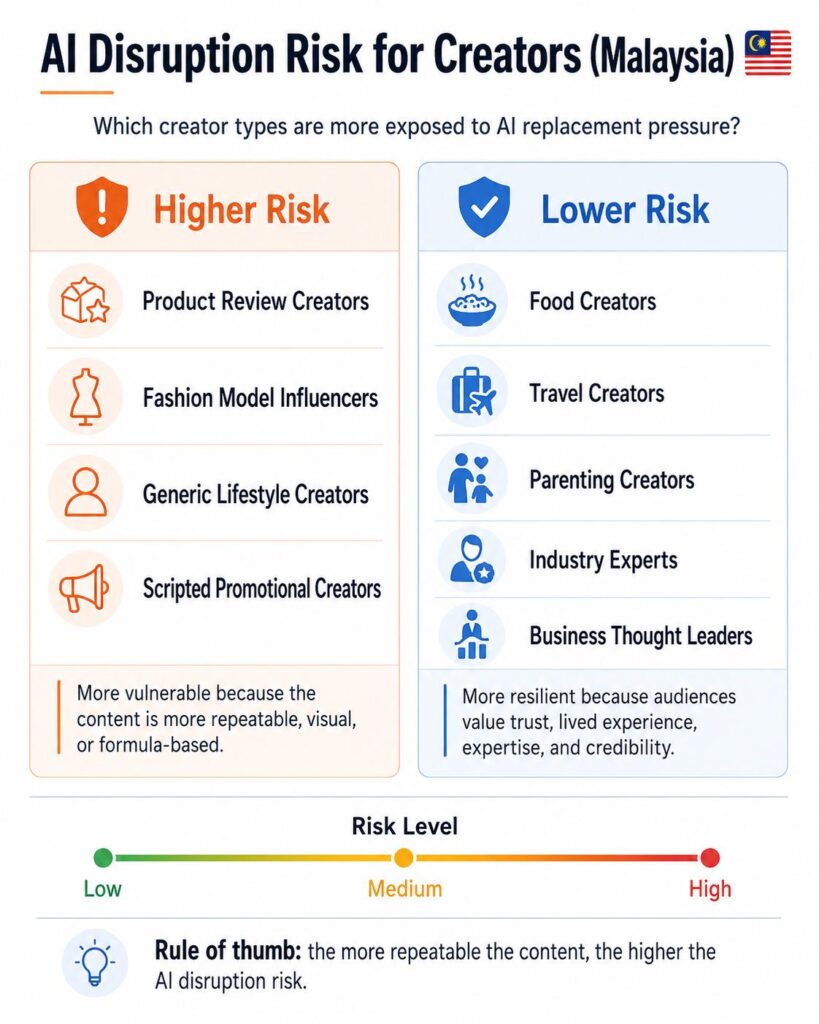
The likelihood of replacement depends largely on how much value comes from repeatable content versus genuine expertise or lived experience.
Higher Risk Categories
| Creator Category | Risk Level | Why |
|---|---|---|
| Product Review Creators | High | Many reviews follow similar formats |
| Fashion Model Influencers | High | Virtual models can replicate look-based content |
| Generic Lifestyle Creators | Medium-High | Visual content can be replicated easily |
| Promotional Brand Creators | Medium-High | AI can deliver scripted messaging consistently |
These categories often focus heavily on aesthetics, presentation, and consistency, areas where AI performs relatively well.
Lower Risk Categories
| Creator Category | Risk Level | Why |
|---|---|---|
| Food Creators | Low | Real experiences and credibility matter |
| Travel Creators | Low | Requires genuine exploration |
| Parenting Creators | Very Low | Trust and lived experience are critical |
| Industry Experts | Very Low | Expertise cannot be easily automated |
| Business Thought Leaders | Very Low | Reputation and credibility matter |
Creators who provide expertise, insight, personality, and real-world experiences are likely to remain valuable.
Will Malaysians Trust Virtual Influencers?
This may ultimately determine whether virtual influencers become mainstream.
Technology alone does not guarantee marketing success. Brand trust remains a critical factor.
The Trust Equation
Consider two different scenarios.
A virtual influencer recommends a mobile game. Most consumers may feel comfortable with that.
Now imagine a virtual influencer recommending:
- A financial investment
- A medical treatment
- A property purchase
- A childcare service
The level of trust required increases dramatically.
As purchase risk increases, audiences generally place greater value on human credibility, transparency, and lived experience.
Transparency Is Becoming More Important
Consumers are becoming more aware of AI-generated content.
Many people now want to know:
- Is this influencer real?
- Was the content AI-generated?
- Who controls the account?
- Is the endorsement genuine?
Regulators are also paying closer attention. In Malaysia, MCMC has been reported as considering requirements to label AI-generated social media content. Even before any formal rules are finalised, brands that prioritise clear disclosure are more likely to maintain trust.
The Real Future: Human + AI
The conversation is often framed as a battle: humans versus AI.
The reality is likely far more collaborative.
Human Creators Already Use AI
Many creators already rely on AI tools in daily workflows. Common uses include:
- Research: generating topic ideas and identifying trends
- Writing assistance: drafting captions and content outlines
- Video production: editing, generating subtitles, refining cuts
- Design support: thumbnails and simple graphics
- Translation: localising content for multiple audiences
In many cases, audiences consume AI-assisted content without realising it.
AI Can Improve Productivity
For creators, AI may function less as a replacement and more as a productivity multiplier.
A creator who previously produced two videos per week may now produce four. A small marketing team may now execute tasks that once required significantly larger budgets.
This creates opportunities for both businesses and creators if used responsibly.
How Malaysian Businesses Should Decide Between Human And Virtual Influencers
Rather than asking which option is superior, businesses should focus on campaign objectives.
When Virtual Influencers May Be A Good Fit
Virtual influencers may be suitable when:
- Brand consistency is essential
- Creative experimentation is desired
- Technology-focused branding is important
- Campaigns target digitally native audiences
When Human Creators May Be More Effective
Human creators may be preferable when:
- Authentic experiences matter
- Trust influences purchasing decisions
- Community engagement is important
- Local cultural relevance is required
Why Hybrid Campaigns May Become Common
Some brands may use both.
A virtual influencer could generate awareness through creative content, while human creators deliver reviews, testimonials, and community engagement.
This hybrid model combines efficiency with authenticity.
Will AI Replace Human Creators In Malaysia?
Probably not, but it will change the creator industry significantly.
AI is likely to automate certain forms of repetitive content creation and reduce demand for highly generic influencer content.
However, the qualities that make many creators successful remain difficult to replicate, including:
- Authenticity
- Expertise
- Personality
- Trust
- Real experiences
- Community relationships
As AI-generated content becomes more common, genuinely human content may become even more valuable.
Creators who adapt, use AI tools wisely, and continue delivering unique value are likely to remain highly competitive.
Virtual Influencers and the Future of Marketing
Virtual influencers are likely to become a permanent part of the marketing landscape, including in Malaysia. However, rather than replacing human creators entirely, they will more likely reshape how brands approach content creation, audience engagement, and influencer partnerships.
The businesses that gain the greatest advantage will not be those choosing between humans and AI, but those learning how to combine both effectively. If you’re looking to build stronger online visibility through SEO-driven content, digital PR, and strategic brand positioning, PRESS PR Agency is Malaysia’s trusted PR agency that can help create campaigns that connect with both search engines and real audiences.
Sources
Malaysia & regional coverage
- Channel News Asia (CNA) – Big Read: AI influencers and advertising
- Vulcan Post – Coverage of virtual/robot influencers in Malaysia (includes Avina)
- Marketing Interactive – AirAsia’s virtual influencer Miss AVA
- SAYS – SPARK’s AI-generated influencer personas (Liz and Adam)
- The Malaysian Reserve – MCMC considering labelling rules for AI-generated social media content
- New Straits Times – MCMC governance / deepfake and AI regulatory considerations
Global context
- Aww Inc. – imma (official creator/producer information)
- Wired – Coverage of CGI celebrities and virtual influencers
- Marketing Brew – Brand use of virtual influencers (incl. Lil Miquela)
- FTC – Endorsement/disclosure guidance (transparency in promotions)
- ASA (UK) – Disclosure expectations for AI in advertising
Guidelines / governance
- Malaysia National Guidelines on AI Governance & Ethics (MOSTI/MASTIC)
Frequently Asked Questions About Virtual Influencers in Malaysia
What Are Virtual Influencers?
Virtual influencers are computer-generated personalities that act like social media creators: posting content, interacting with audiences, and doing brand collaborations without physically existing.
Are Virtual Influencers Already Popular In Malaysia?
They’re still emerging, but Malaysia has seen increasing experimentation with virtual/AI personas as tools become more accessible and brands test new formats.
Can Virtual Influencers Be More Effective Than Human Influencers?
Yes for campaigns that need tight brand control, consistent output, or creative experimentation. For trust-heavy decisions, human creators usually perform better.
Which Malaysian Creators Are Most At Risk From AI?
Creators whose content is highly repeatable or mainly visual (like generic lifestyle, scripted promotional content, and some product review formats) face higher disruption risk.
Do Consumers Trust Virtual Influencers?
It depends on the stakes. Audiences may accept virtual influencers for entertainment and low-risk purchases, but prefer human credibility for health, finance, family, or major purchases.
What Is The Future Of Influencer Marketing In Malaysia?
Most likely a hybrid: AI and virtual influencers help with scale and creativity, while human creators remain central for trust, lived experience, and community connection.