

So, are mass communication courses in Malaysia worth it? Yes, but with one condition: students should treat the degree as a practical launchpad, not a guaranteed career ticket.
Mass communication is one of those degrees many people have heard of, but not everyone fully understands. Some think it is journalism. Some think it is TV, radio, film, or social media. Others assume it is just “posting online”, which is not exactly fair.
A mass communication course teaches students how messages are created, shaped, distributed, and understood by large audiences. This can include public relations, journalism, advertising, broadcasting, film production, media writing, digital content, corporate communication, and media studies.
Unlike engineering, medicine, law, or pharmacy, a mass communication degree is not always tied to one fixed professional pathway. Many communication careers depend less on the exact degree name and more on whether students can write, think, pitch, produce, analyse audiences, and show actual work.
What Exactly Is A Mass Communication Course?
A mass communication course teaches students how to communicate with large audiences through media, brands, platforms, stories, and public messages.
In simple terms, mass communication is about how information moves from one person, brand, organisation, or institution to a wider audience. This can happen through articles, press releases, videos, ads, public statements, social media campaigns, websites, and crisis responses.
A typical mass communication degree may cover:
- Media writing: Articles, scripts, captions, newsletters, and public messages.
- Journalism: Research, interviews, fact-checking, and responsible reporting.
- Public relations: Reputation, announcements, media relationships, and public trust.
- Advertising: Campaign planning, copywriting, and audience persuasion.
- Film and broadcasting: Video, audio, editing, scripting, and visual storytelling.
- Digital media: Social media, websites, online communities, and platform behaviour.
- Media studies: How media affects society, culture, public opinion, and consumer behaviour.
A good course should not only teach students how to create content. It should teach them how to understand audiences, choose the right message, communicate responsibly, and adapt ideas for different platforms.
Why Is Mass Communication Important In Malaysia’s Digital Landscape?
Mass communication matters because Malaysia’s media habits, businesses, and public conversations are now shaped by digital platforms.
People in Malaysia discover products, universities, restaurants, employers, public issues, entertainment, and brands through Google, TikTok, Instagram, YouTube, LinkedIn, WhatsApp, online reviews, news portals, and AI-powered search experiences.
A single campaign today may involve:
- A press release for media coverage
- A TikTok video for quick awareness
- An Instagram carousel for short-form education
- A blog article for search visibility
- A LinkedIn post for professional trust
- A crisis statement when something goes wrong
Some Statistics
Malaysia’s numbers support this. DataReportal’s Digital 2026: Malaysia report noted that Malaysia had 35.4 million internet users with 98.0% internet penetration, based on the latest available data at the end of 2025. It also reported 30.7 million social media user identities in October 2025, equal to 85.0% of the population.
The wider economy also shows why communication skills matter. DOSM reported that ICT and e-commerce contributed 23.4% (RM451.3 billion) to Malaysia’s economy in 2024. DOSM also reported that Malaysia’s cultural and creative industry generated RM130.7 billion in 2024 and contributed 6.8% to Malaysia’s GDP that year. PwC reported that Malaysia’s entertainment and media industry revenue grew to RM50.3 billion in 2023 and was projected to reach RM58.9 billion by 2028.
In short, Malaysia needs people who can communicate clearly. Brands need visibility. PR teams need reputation management. Media companies need stories. Employers need corporate communication. Even technical companies need people who can explain complex ideas simply.
Read More: Full-time vs Part-time Degree in Malaysia: Which is Best?
Is A Mass Communication Degree Actually Useful?
A mass communication degree is useful, but it works differently from specialised professional degrees.
Some degrees lead to highly specific regulated careers. Mass communication is different. It gives students a communication toolkit rather than one fixed job title.
That toolkit can support careers in public relations, journalism, digital marketing, social media, corporate communications, and advertising.
This flexibility is useful, but it also creates risk. A broad degree needs direction. A student who only completes assignments may graduate with a general qualification. A student who builds published work, videos, campaign samples, internship experience, media kits, and writing samples will have stronger proof of ability.
So, the better question is not “Is mass comm useless?”, but rather, “Can the student turn the degree into practical, visible, employable proof?”
What Careers Can A Mass Communication Course Lead To?
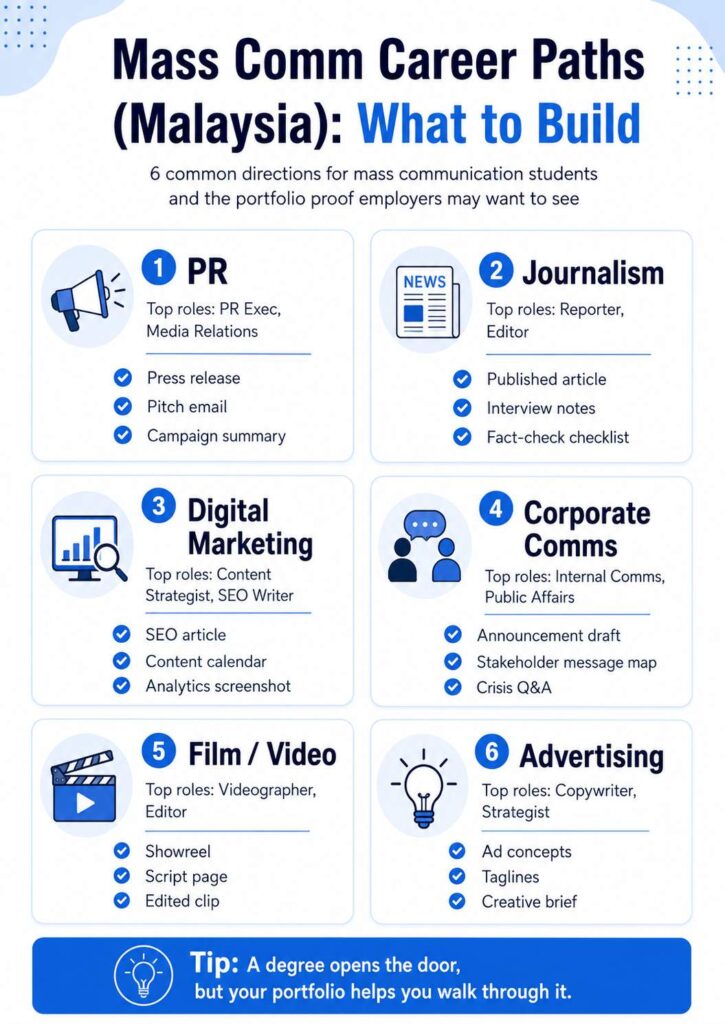
Mass comm can lead to many careers, but each career path needs different proof of skill.
| Career Direction | Possible Roles | What Employers May Want To See |
|---|---|---|
| Public Relations | PR executive, media relations executive | Press releases, media pitches, campaign samples |
| Journalism | Reporter, editor, content writer | Published articles, interviews, fact-checking |
| Digital Marketing | Content strategist, SEO writer, social media executive | Content samples, analytics, campaign work |
| Corporate Communications | Internal comms, brand comms, public affairs | Professional writing, stakeholder messaging |
| Film And Video | Videographer, editor, producer | Showreel, scripts, edited videos |
| Advertising | Copywriter, account executive, creative strategist | Campaign concepts, copy samples, creative briefs |
The degree can open the door, but the portfolio helps students walk through it. A PR student should show press releases and pitch angles. A social media student should show content calendars and short-form video samples. A journalism student should show published writing or reporting samples.
Examples Of Classes And Subjects That May Apply To Specific Careers
Mass communication subjects become more useful when students connect them to real career outcomes.
| Subject Or Class | Career It Can Support | How It Applies In Real Work |
|---|---|---|
| Media Writing | Journalism, PR, content marketing | Articles, press releases, blogs, captions, scripts |
| Public Relations | PR, corporate comms | Reputation, media relations, stakeholder messaging |
| Crisis Communication | PR, public affairs | Responses to complaints, backlash, or misinformation |
| Journalism | Editorial, publishing, content | Interviews, reporting, fact-checking, storytelling |
| Advertising | Marketing, agency work | Campaign ideas, copywriting, message positioning |
| Digital Media | Social media, digital marketing | Content planning, platform strategy, engagement |
| Film Production | Video, entertainment, content | Scripting, shooting, editing, production planning |
| Media Law And Ethics | Journalism, PR, content | Defamation, copyright, misinformation, responsible messaging |
Theory should not be dismissed too quickly. Employers care about practical skills, but theory helps students understand why messages work, why campaigns fail, and why audiences react differently.
When Is A Mass Communication Course Worth It?
A mass communication course is worth it when students use university as a training ground, not just a certificate route.
It is usually worth it when:
- The student builds a portfolio early: Articles, videos, campaign plans, PR samples, social media content, or event coverage can become proof of ability.
- The student treats internships seriously: Internships expose students to deadlines, clients, editors, managers, feedback, and real workplace expectations.
- The student chooses a direction: By Year Two, students should start leaning toward PR, journalism, content marketing, film, advertising, corporate comms, or social media.
- The student learns digital tools: This may include editing software, analytics tools, CMS platforms, social media tools, AI tools, and basic design tools.
- The student practises outside class: Clubs, campus media, volunteer campaigns, freelance work, and small brand projects can all help.
Students do not need to be perfect by graduation. They just need evidence that they have tried, improved, and produced real work.
Read More: When to Change University Courses: 2026 Malaysian Student Guide
When Might A Mass Communication Degree Not Be Worth It?
Mass comm can feel weak when students choose it without interest, direction, or practical effort.
It may not be the best choice if a student dislikes writing, presenting, teamwork, deadlines, feedback, editing, or fast-moving work. Communication careers often involve pressure, revisions, trends, and unpredictable public reactions.
Warning signs include:
- No portfolio output: Students graduate with only exam results and no samples.
- No career direction: Students do not know whether they prefer PR, content, film, journalism, or marketing.
- Weak internship support: Internships are treated as a checkbox, not real training.
- Outdated modules: The course barely covers digital platforms, analytics, AI, social media, or modern campaign work.
- Low personal interest: The student chooses mass comm only because it seems easier than other degrees.
Mass comm is not automatically easy. Writing clearly is hard. Editing is hard. Presenting is hard. Handling criticism is hard. Creating work that people care about is hard.
Mass Communication Degree Vs Other Degrees In Malaysia
Mass comm is not automatically better or worse than other degrees. It depends on the student’s career direction.
| Degree Option | Better Fit If You Want To… | Possible Limitation |
|---|---|---|
| Mass Communication | Work in media, PR, content, journalism, advertising, or digital communication | Can feel broad without specialisation |
| Marketing | Study consumers, branding, sales funnels, and market research | May not go deep into journalism or media production |
| Business | Enter corporate, management, sales, or operations roles | May lack media-specific communication training |
| English Or Linguistics | Focus on writing, editing, publishing, language, or content | May not cover campaigns, PR, or production deeply |
| Design Or Multimedia | Create visuals, videos, animations, or motion content | May not focus much on writing, PR, or communication theory |
If the student wants to become a content strategist, PR consultant, journalist, copywriter, or corporate communications executive, mass comm can make sense. If the student prefers business strategy, marketing or business may fit better. If the student is more visual and technical, multimedia design may be stronger.
What Should Students Look For In A Malaysian Mass Communication Course?
A good mass communication course should help students build both thinking skills and practical work samples.
Before choosing a uni or university programme, check for:
- Internship support: Are students connected to agencies, media companies, brands, or production houses?
- Portfolio-based assignments: Are students producing articles, campaigns, videos, podcasts, PR kits, or content strategies?
- Updated digital modules: Does the course cover digital media, content strategy, analytics, AI awareness, and social platforms?
- Industry exposure: Are there guest lecturers, agency projects, brand campaigns, competitions, or alumni talks?
- Specialisation options: Can students focus on PR, journalism, advertising, digital media, broadcasting, corporate comms, or film?
- Facilities and tools: Are there studios, editing labs, production equipment, software access, or media labs?
A good course should help students practise communication in forms employers recognise.
How AI Changes The Value Of Mass Communication
AI does not make mass communication useless, but it raises the standard for students.
AI can help with writing drafts, generating ideas, summarising information, editing videos, creating captions, analysing trends, and planning content. But communication work is not only about producing words. It is also about judgement.
A good communicator still needs to understand:
- What should be said: Not every message is useful, responsible, or smart.
- Who the message is for: Different audiences need different tones and formats.
- What context matters: Culture, platform behaviour, timing, and public mood affect how messages are received.
- Whether the information is accurate: AI can produce confident mistakes, so fact-checking still matters.
- How people may react: Communication is about anticipating response, not just publishing content.
Mass comm students should learn how to use AI properly while building skills AI cannot easily replace, such as interviewing, critical thinking, audience empathy, media ethics, storytelling, campaign judgement, and reputation management.
So, Are Mass Communication Courses In Malaysia Worth It?
Mass communication courses in Malaysia are worth it for students who want to work with media, audiences, brands, stories, platforms, and public communication.
A mass communication course can teach valuable skills in writing, media literacy, storytelling, PR, advertising, production, audience analysis, campaign planning, and digital communication.
However, the degree is not a shortcut. It becomes more valuable when students graduate with:
- Practical work samples: Articles, videos, campaign decks, PR materials, social media work, or scripts.
- Internship experience: Real workplace exposure and understanding of deadlines.
- Digital confidence: Familiarity with platforms, analytics, content tools, AI tools, and production workflows.
- Clear specialisation: A stronger sense of whether they want PR, journalism, content, film, marketing, or corporate comms.
- Communication judgement: The ability to think before publishing, pitching, responding, or advising.
The best answer is this: mass communication is not a useless degree, but it is not self-executing either. It becomes valuable when students turn communication knowledge into visible, career-ready output.
Evaluating Mass Comm Degrees For Your Future
Mass communication courses in Malaysia are worth considering if students are genuinely interested in media, content, PR, storytelling, digital platforms, and audience communication. The degree can open many doors, but students need to build the bridge themselves through internships, portfolios, practical work, and early specialisation.
For brands and organisations, strong communication is no longer optional; it shapes visibility, trust, and reputation. At PRESS PR Agency, Malaysia’s trustworthy PR agency, we help businesses strengthen their public presence through strategic PR services that connect clear messaging with real media and audience impact.
Sources
- DataReportal, Digital 2026: Malaysia (internet users/end-2025; social media identities/Oct 2025)
- Department of Statistics Malaysia (DOSM), Malaysia Digital Economy 2025
- DOSM, Cultural and Creative Satellite Account 2024
- PwC Malaysia, Global Entertainment & Media Outlook 2024–2028: Malaysia Findings
- UOW Malaysia, What Is Mass Communication?
- EduAdvisor, Mass Communication Course Guide
- Monash University Malaysia, The Value Of A Mass Communication Degree In Our Digitally Connected World
Frequently Asked Questions About Mass Communication Courses in Malaysia
Is A Mass Communication Course Worth It In Malaysia?
Yes, a mass communication course can be worth it in Malaysia if students use it to build practical skills, internships, and portfolio work. It is most useful for students interested in PR, journalism, digital marketing, content creation, broadcasting, advertising, or corporate communication.
What Can You Do With A Mass Communication Degree?
A mass communication degree can lead to careers in public relations, journalism, social media, digital marketing, broadcasting, film production, advertising, content writing, event communication, and corporate communications.
Is Mass Communication Better Than Marketing?
Mass communication is better for students who want broader exposure to media, PR, journalism, broadcasting, and content. Marketing may be better for students who prefer consumer behaviour, branding, sales funnels, and market research.
Is Mass Communication Only For People Who Want To Be Journalists?
No. Journalism is only one part of mass communication. Students may also study public relations, advertising, digital media, film, broadcasting, corporate communication, social media, and media studies.
Do Mass Communication Students Need A Portfolio?
Yes, a portfolio is highly recommended. Employers often want to see writing samples, campaign work, videos, social media projects, PR materials, published articles, or internship experience.
Will AI Replace Mass Communication Jobs?
AI may automate some basic writing and content production tasks, but it does not replace communication judgement. Students still need storytelling, fact-checking, audience understanding, media ethics, campaign planning, and reputation management skills.