

Choosing a university or course is one of the biggest decisions Malaysian students make after finishing SPM, STPM, or foundation studies. For some, the excitement of starting university is followed by a nagging doubt: what if this course is not actually the right fit?
That feeling is not necessarily a sign that something has gone wrong. Many students only begin to understand the real content, workload, and career pathways of a course after classes start. As they learn more, some realise their interests, strengths, or long-term goals may point in a different direction. (Source: RISE Journal career guidance study)
The real question is not simply whether your course feels hard. It is whether your doubts come from temporary challenges or a deeper mismatch. Understanding that difference can help you decide whether to stay in your current program or explore a change before investing more time and money.
What Does Changing A University Course Mean?
Changing a university course usually means moving from one academic program to another while you are still studying. This can happen in a few different ways:
- Switching to another program within the same faculty
- Moving to a different faculty within the same university
- Transferring to a different university entirely
For example, a student might move:
- From mechanical engineering to computer science
- From accounting to marketing
- From biotechnology to psychology
In Malaysia, the process depends on the institution. Universities set their own rules on transfer eligibility, deadlines, academic requirements, and administrative steps. (Source: Monash University Malaysia; Taylor’s University)
For international students, changing a course or institution can also affect student pass arrangements. Depending on the situation, the institution may need to cancel or shorten the current pass and submit a new or variation-related application. (Source: Education Malaysia; EMGS)
Why This Decision Matters
Changing your university course is not just an academic decision. It can affect your:
- Career direction
- Professional accreditation pathway
- Time to graduation
- Total cost of study
For Malaysian students, financial support may also be affected. PTPTN provides a formal process for course-change appeals, but continuation of funding is not automatic and is considered under specific conditions, including whether the change involves repeating a semester. (Source: PTPTN)
Credit transfer matters too. The Malaysian Qualifications Agency states that credit transfer depends on factors such as subject mapping, minimum grades, equivalent credit value, and curriculum similarity. If your completed subjects do not meet those requirements, you may need extra semesters to finish your new program. (Source: Malaysian Qualifications Agency)
Because of this, students should think about both the emotional and practical sides of the decision.
Why Many Malaysian Students Consider Changing Courses
Students rethink their university course for different reasons. In many cases, it is a mix of academic experience and better career awareness.
Choosing A Course Too Early
Many students make course decisions soon after SPM, STPM, or foundation studies. At that stage, they may know the course name but not fully understand the actual syllabus, learning style, or job outcomes.
Once classes begin, they may realise the program does not match what they expected.
New Career Interests
University often exposes students to new industries, ideas, and opportunities. A student who entered one program with a fixed plan may later discover a stronger interest in another field.
Misconceptions About A Field
Some courses sound appealing until students see what they really involve.
For example:
- Engineering may be more mathematical than expected
- Psychology may include more research methods and statistics
- Business-related programs may involve more data and analysis than students assume
Better Understanding Of Career Pathways
As students learn more about job scopes, qualification requirements, and industry expectations, they may decide that another program is a better fit for their long-term goals. Malaysian research on career guidance also suggests that clearer information helps students better understand suitable pathways and opportunities. (Source: RISE Journal career guidance study; Universiti Malaya Career Development)
Signs You Should Consider Changing Your Uni Course
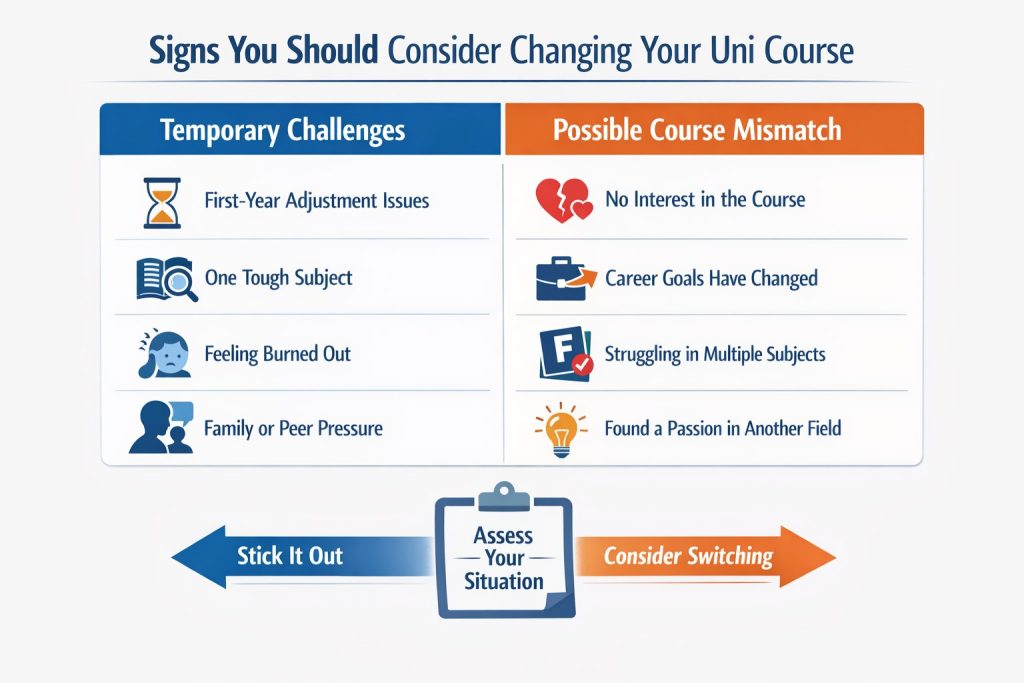
Certain patterns may suggest that changing your course is worth exploring.
Persistent Lack Of Interest
If you consistently feel disengaged from your course even after making a genuine effort, that may be a sign the subject does not suit your interests.
Your Career Goals No Longer Align
Sometimes students discover that the career they now want requires a different academic background. If your goals have changed significantly, switching programs may be the more practical option.
Ongoing Academic Struggles Despite Effort
One or two weak results are not unusual. But if you keep struggling across several core subjects even after asking for help, the course may not align well with your strengths.
You Have Found A Stronger Interest Elsewhere
University can introduce you to fields you had never seriously considered before. Discovering a stronger interest in another discipline can be a valid reason to reassess your current path.
You Cannot See Yourself Continuing
If the thought of studying the same course for the next two or three years feels unrealistic rather than just stressful, it may be time to look more closely at your options.
Situations Where You Should Probably Stay In Your Course
Not every difficult period means you should change your university course.
First-Year Adjustment Challenges
The transition from school or pre-university study to university is a major one. Many students initially struggle with:
- Independent learning
- Assignment deadlines
- New teaching styles
- Less structured support
These difficulties often improve with time and better study habits.
One Difficult Subject
Most degree programs include some modules that feel especially difficult. A single tough subject does not automatically mean the entire course is wrong for you.
Temporary Burnout
Stress, exhaustion, and academic pressure can make any course feel unbearable for a while. Before deciding to switch, it is worth asking whether you are dealing with a course mismatch or a temporary period of burnout.
External Pressure
Some students start thinking about changing courses because of family expectations, comparison with friends, or pressure to follow a “better” path. Decisions based mainly on outside pressure may not lead to long-term satisfaction.
Practical Factors Malaysian Students Should Evaluate
Before making a final decision, look at the practical consequences carefully.
Credit Transfer Possibilities
Credit transfer can reduce the time and cost of switching, but it is not guaranteed. MQA explains that transfer depends on factors such as equivalent credit value, minimum grade requirements, and curriculum similarity. (Source: Malaysian Qualifications Agency)
If the old and new programs are very different, you may lose more credits than expected.
Financial Implications
Changing courses can increase your total cost of study because of:
- Additional semesters
- Different tuition fees
- Extended living expenses
- New administrative charges in some institutions
Students using PTPTN should be especially careful. PTPTN does allow course-change appeals, but funding continuation is subject to rules and approval. (Source: PTPTN)
University Policies
Each university has its own procedures for internal transfers. Some allow course changes more easily in the early stages of study, while others require prerequisites, minimum results, available places, or administrative fees. (Source: Monash University Malaysia; Taylor’s University)
International Student Regulations
International students should confirm the process directly with their institution and Education Malaysia or EMGS. A course or university change may involve pass cancellation, a shortened pass, or a new student-pass-related application depending on the exact case. (Source: Education Malaysia; EMGS)
When Is The Best Time To Change Your University Course?
Timing can make a big difference.
First Year
This is often the simplest stage to explore a course change because you are less likely to have completed many specialised subjects. That can make credit transfer easier and reduce disruption to your graduation plan. (Source: Malaysian Qualifications Agency; Monash University Malaysia; Taylor’s University)
Second Year
Changing is still possible, but there is a higher chance that some subjects will not transfer cleanly, which may delay graduation.
Final Year
Switching in the final year is usually much more complicated. By then, most of your completed credits are closely tied to your original program, so transferring into a different course may not be practical.
That is why students who are seriously considering a change should review their options as early as possible.
Examples Of Course Changes Students Commonly Consider
Students sometimes change direction after discovering that another field suits them better.
Common examples include:
- Engineering students moving into software-related fields
- Accounting students shifting toward marketing or analytics
- Science students moving into psychology, communication, or management
The exact path will vary by institution, eligibility, and credit transfer rules, but the general pattern is the same: students often make better decisions once they understand both the course and the careers linked to it.
Common Misconceptions About Changing University Courses
Changing Courses Means You Failed
Not necessarily. In many cases, changing courses reflects self-awareness and better decision-making, not failure.
Your First Uni Course Determines Your Entire Career
A degree matters, but many careers are shaped over time through internships, experience, short courses, and changing interests.
It Is Always Too Late To Change
Earlier changes are usually easier, but that does not mean later changes are impossible. It depends on the university’s rules, your academic standing, and how much credit can be transferred. (Source: Malaysian Qualifications Agency; Monash University Malaysia; Taylor’s University)
How To Decide If Changing Your Uni Course Is The Right Move
If you are unsure, ask yourself a few honest questions:
- Do you dislike the subject itself, or are you mainly overwhelmed right now?
- Have you spoken to lecturers, advisors, or student support staff?
- Does your preferred career actually require a different degree?
- Can you accept a possible delay in graduation?
- Have you checked the financial and transfer implications properly?
It is a good idea to speak to academic advisors or career counselors before making a final choice. Universities such as Universiti Malaya provide counselling and career support services to help students think through academic and career decisions. (Source: Universiti Malaya Counselling; Universiti Malaya Career Development)
Making the Right Choice for Your Education
Feeling uncertain about your university course is not unusual. What matters is understanding whether your doubts come from temporary pressure or a deeper mismatch between your interests, strengths, and career goals.
If the issue is temporary, support and time may be enough. But if your course no longer fits where you want to go, changing programs can be a sensible step, provided you have checked the academic, financial, and administrative consequences first.
A careful decision now can save you from spending years on a path that does not suit you.
If your institution wants to communicate student-focused topics more clearly and credibly, PRESS PR Agency can help shape content that is informative, relevant, and easy to understand. Through strategic PR services and thoughtful storytelling, PRESS helps brands and organisations build trust with the audiences that matter most. Grab the opportunity to partner with PRESS, Malaysia’s best PR agency, today!
Disclaimer: This article is for general informational purposes only and should not be taken as academic, financial, or immigration advice. University transfer rules, PTPTN funding, and international student requirements may vary by institution and individual circumstances, so students should confirm the latest details directly with their university and the relevant authorities before making a decision.