
PolyBuzz is an AI chatbot that sits at the intersection of AI curiosity, fandom-style roleplay, escapism, and emotional interaction, which helps explain why more people may be encountering it recently.
A few years ago, most people associated AI chatbots with customer service popups or productivity tools. In 2026, that has changed dramatically. AI is now increasingly tied to entertainment, roleplay, companionship, and emotional interaction.
One platform that has quietly become more visible recently is PolyBuzz AI.
Across short-form social content, Reddit threads, and Discord communities, AI companion and roleplay chatbots have become more visible in everyday online culture. Some users treat PolyBuzz as a fun storytelling platform. Others use it casually to pass time after work or school. A smaller number describe feeling attached to specific AI personalities.
In Malaysia, where internet and social media use are already highly mainstream, it’s easy for apps like this to spread quickly through online communities, especially among younger, mobile-first audiences.
Read More: Did The AI Boom REALLY Create New Jobs for Malaysian Fresh Grads?
What Exactly Is Polybuzz AI?
PolyBuzz AI is an AI chatbot and roleplay platform that allows users to interact with virtual personalities through conversational AI. Unlike traditional AI assistants that mainly focus on answering questions or helping with work-related tasks, PolyBuzz is built around immersive interaction and entertainment.
Users can create conversations with fictional personalities, anime-inspired characters, AI companions, and customized personas. The platform also supports roleplay-style storytelling where users can build ongoing scenarios and interactive fictional worlds.
Many review sites and communities compare PolyBuzz to:
- Character.AI
- Replika
- Chai
- Janitor AI
Polybuzz is commonly positioned around character roleplay, companionship-style chat, and emotionally engaging conversations.
Traditional AI Chatbots vs Polybuzz AI
| Traditional AI Chatbots | Polybuzz AI |
|---|---|
| Productivity-focused | Entertainment-focused |
| Answers questions | Simulates personalities |
| Utility-based interaction | Emotional and immersive interaction |
| Task-oriented | Storytelling and companionship |
This distinction matters because users are approaching PolyBuzz very differently compared to productivity AI tools. Instead of using it for work or research, many people use it for entertainment, escapism, creativity, or emotional comfort.
What Can Polybuzz Actually Do?
One reason PolyBuzz attracts attention is because different users interact with it in completely different ways.
Some use it casually for entertainment. Others spend hours building fictional storylines or chatting with AI personalities that feel emotionally responsive. Writers sometimes use the platform to experiment with dialogue and storytelling ideas, while fandom communities may use it as an extension of anime or gaming culture.
Popular Uses Of Polybuzz
| Use Case | Example |
|---|---|
| Character Roleplay | Chatting with fantasy or anime characters |
| AI Companionship | Simulated emotional conversations |
| Interactive Storytelling | Creating long-running fictional scenarios |
| Casual Entertainment | Memes, jokes, random conversations |
| Creative Writing | Dialogue and character experimentation |
A university student might use PolyBuzz after a stressful day simply because the interaction feels light and entertaining. An anime fan may enjoy interacting with fictional archetypes inspired by favorite characters. Some users even create detailed fantasy worlds involving kingdoms, sci-fi universes, romance plots, or gaming-inspired adventures.
This is partly why AI companion platforms are becoming difficult to categorize. They are not purely social media platforms, but they are not exactly games either. Instead, they combine AI, entertainment, fandom culture, storytelling, and emotional interaction into one highly interactive experience.
Read More: How AI-misinformation Becomes the Norm in Malaysia
Why Is Polybuzz Growing In Popularity In Malaysia?
The interest around PolyBuzz (and similar AI companion apps) makes more sense when you look at how digital behavior is changing. It’s not only about AI becoming more advanced. It’s also about how people discover entertainment and how online culture spreads.
Social Media Is Fueling Curiosity
Short-form content platforms help AI chatbot apps spread because the content is naturally shareable.
Funny AI conversations, romantic chatbot interactions, bizarre roleplay scenarios, and emotionally surprising replies can generate huge engagement online. These clips spread quickly because they feel entertaining, strange, and sometimes unexpectedly relatable.
Many people discover AI chatbot apps through viral social content rather than traditional technology coverage.
Malaysia Has Active Online Interest Communities
Polybuzz also fits naturally into existing online community behavior, especially spaces built around characters, storylines, and shared fandom interests.
In many fandom circles, character-driven interaction is already normal: people write fanfiction, roleplay on Discord, build headcanons, and share character-based memes. AI roleplay platforms overlap with these habits because they let users interact with “characters” in a personalized way.
For anime and gaming fans especially, chatting with AI characters can feel less like “using technology” and more like extending an existing entertainment experience.
AI Feels More Accessible Than Before
Another major factor is that AI no longer feels niche or intimidating.
A few years ago, AI discussions mainly happened in tech circles. Today, everyday users regularly interact with AI image generators, AI search assistants, and chatbot tools across apps and platforms.
Many users initially try PolyBuzz out of simple curiosity:
“Can AI actually talk naturally now?”
Once the conversations feel surprisingly human-like, many continue exploring the platform because the experience feels more immersive than expected.
Why Do People Use AI Companion Chatbots?
This is probably the most important question behind the entire trend.
People aren’t only using AI companion apps because the technology is impressive. They use them because the experience can meet emotional, psychological, or social needs in a low-pressure way.
Entertainment And Escapism
For many users, PolyBuzz is simply fun.
It offers interactive storytelling, fantasy immersion, personalized entertainment, and fictional interaction in ways older chatbots could not. Instead of passively consuming stories through movies or games, users can actively participate inside the experience.
That level of interaction naturally creates stronger emotional engagement.
Emotional Comfort
Some users describe AI companions as easier to talk to than strangers online or even people in real life.
AI chatbots don’t judge appearance, reject conversations, or suddenly disappear. They are always available and usually respond instantly. For socially anxious or emotionally exhausted users, that low-pressure interaction can feel comforting.
Even if users understand the AI is artificial, the emotional experience can still feel meaningful in the moment.
Loneliness And Digital Isolation
Loneliness is one factor often discussed alongside the rise of AI companions, as global health bodies report that loneliness is widespread worldwide.
Modern digital culture has created a strange contradiction where people can be constantly connected online yet still feel emotionally isolated.
In Malaysia, screen-first routines are common: studying digitally, working across apps, and consuming solo entertainment. At the same time, maintaining real-world relationships can feel difficult due to:
- Time pressure
- Financial stress
- Burnout
- Social exhaustion
AI companions fit neatly into this environment because they provide instant interaction without social friction.
Some users aren’t necessarily looking for replacement relationships. Instead, they may simply want:
- Conversation
- Distraction
- Emotional comfort
- Companionship-like interaction
That distinction matters because many users still understand the difference between AI interaction and real human relationships.
Malaysia’s Digital Lifestyle Shift
The growing interest in AI companions also reflects broader lifestyle changes.
Urban digital lifestyles increasingly revolve around smartphones, online communities, streaming platforms, gaming ecosystems, and social media interaction. Younger Malaysians often socialize digitally more than previous generations did.
This doesn’t automatically mean society is becoming antisocial. But it does change how emotional connection and interaction happen online.
Examples of digital shifts and their possible impact
| Trend | Possible Impact |
|---|---|
| Remote Work And Study | Increased screen-time and isolation |
| Social Media Fatigue | Emotional exhaustion |
| Rising Living Costs | Stress and burnout |
| Online-First Entertainment | Reduced offline interaction |
AI companions become appealing partly because they offer predictable interaction and low-pressure engagement after long days of social stress or digital overload.
Are AI Companion Apps Dangerous?
The conversation around AI companions is becoming increasingly divided.
Some people see them as harmless entertainment, while others worry they may contribute to emotional dependency or social withdrawal. The reality is likely somewhere in between.
Major psychology and health organizations have warned that emotionally engaging AI chatbots can increase risks like emotional dependency and further isolation, particularly with heavy use or when people treat chatbots as substitutes for real support systems.
Potential Risks Of AI Companion Platforms
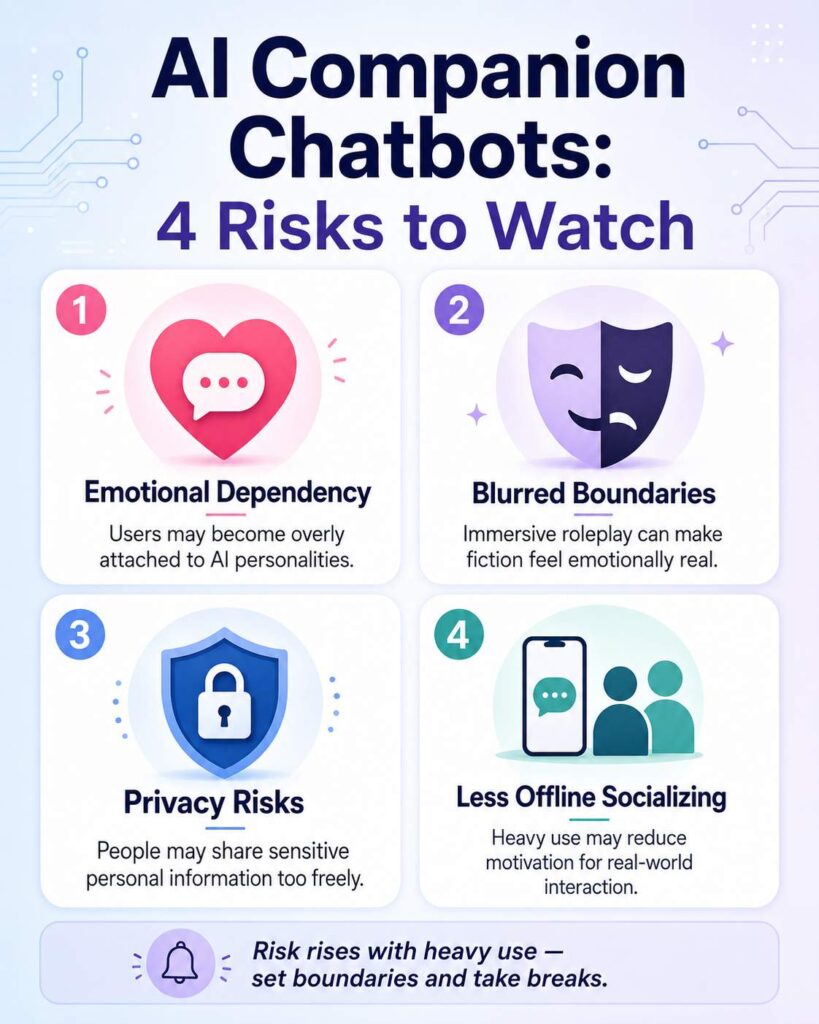
- Emotional Dependency: Some users may become overly emotionally attached to AI personalities.
- Blurring Fiction And Reality: Highly immersive roleplay may affect emotional boundaries for certain individuals, especially younger users.
- Privacy Concerns: Users sometimes share deeply personal information without fully understanding how chatbot platforms handle data.
- Reduced Real-World Interaction: Excessive reliance on AI conversations could potentially reduce motivation for offline social interaction.
At the same time, it’s important to avoid assuming that all use is harmful. Like gaming or social media, the impact usually depends on frequency, expectations, emotional maturity, and personal boundaries.
How To Use AI Chatbots More Responsibly
AI companion platforms probably aren’t disappearing anytime soon. That means healthier usage habits matter.
A balanced approach is often the safest one. AI chatbots can be entertaining, creative, and emotionally engaging, but they should exist alongside real-world human interaction rather than replacing it.
A Few Practical Precautions
- Remember that AI simulates emotion rather than genuinely feeling emotion.
- Avoid relying entirely on AI conversations for emotional support.
- Be cautious about sharing sensitive personal information.
- Take breaks if usage becomes emotionally consuming or excessive.
- Maintain offline hobbies, friendships, and social activities.
- Younger users should be especially mindful about emotional attachment.
If you’re dealing with serious mental health distress, it’s generally better to seek support from a qualified professional or trusted real-world support system.
Why Polybuzz Represents A Bigger AI Trend
Polybuzz is part of a much larger shift happening online.
AI is no longer limited to search tools, automation, or productivity software. Increasingly, AI is becoming conversational, personality-driven, emotionally responsive, and entertainment-focused.
Future digital ecosystems may involve deeper interaction between:
- Humans
- AI companions
- Virtual communities
- Personalized entertainment systems
That might sound futuristic, but platforms like PolyBuzz suggest the shift is already underway.
The growing interest in AI companion apps shows that many people no longer want AI to simply provide information. They want AI to feel interactive, responsive, and emotionally engaging. That fundamentally changes the role AI plays in everyday life.
AI Companions and Why They Matter
PolyBuzz AI is gaining visibility because it combines entertainment, fandom-style roleplay, emotional interaction, and AI curiosity into one highly engaging platform. While many users enjoy the storytelling and character chat aspects, interest in AI companion apps also reflects broader conversations around loneliness, digital lifestyles, and how people increasingly seek connection in online spaces.
As AI-driven interaction becomes more mainstream, brands and media organisations may also need to better understand evolving online behavior and emotional engagement trends. PRESS PR Agency helps businesses stay visible in changing digital conversations through strategic PR, storytelling, and reputation-focused media coverage. Don’t miss out on partnering with PRESS, your trustworthy PR agency, today!
Sources
- PolyBuzz AI — Official Website (accessed May 2026)
- PolyBuzz AI — FAQ (accessed May 2026)
- PolyBuzz AI — Discover / Character Directory page (accessed May 2026)
- Google Play Store — “PolyBuzz: Chat with AI Friends” listing (accessed May 2026)
- World Health Organization (WHO) — Commission on Social Connection: Report page “From loneliness to social connection…” (published 30 June 2025)
- World Health Organization (WHO) — Commission on Social Connection overview page (accessed May 2026)
- American Psychological Association (APA) — Health advisory on AI chatbots and wellness apps (accessed May 2026)
- American Psychological Association (APA) Monitor on Psychology — “AI chatbots and digital companions…” (published Jan 2026)
- DataReportal — Digital 2025: Malaysia (published 3 March 2025)
- Department of Statistics Malaysia (DOSM) — ICT Use and Access by Individuals and Households Survey Report 2025 (published 2025)
Frequently Asked Questions About Polybuzz and Its Popularity in Malaysia
What Is Polybuzz AI?
Polybuzz AI is an AI chatbot platform focused on roleplay, storytelling, AI companions, and fictional character interactions.
Why Is Polybuzz Becoming Popular In Malaysia?
Polybuzz may be spreading through entertainment-driven discovery: short-form social content, online communities, and character-based fandom behavior, alongside broader interest in AI chatbots in 2026.
Is Polybuzz Similar To Character.AI?
Yes. Both platforms allow users to chat with AI-generated personalities and fictional characters, although Polybuzz is commonly positioned around immersive roleplay and companionship-style experiences.
Why Do People Use AI Companion Apps?
People use AI companion apps for entertainment, emotional comfort, roleplay, storytelling, and casual conversation with low social pressure.
Are AI Chatbots Emotionally Safe?
They can be safer when used with boundaries, but heavy use can increase risks like emotional dependency or social withdrawal, especially if users treat chatbots as substitutes for real support.
Can AI Companions Replace Human Relationships?
Most experts do not believe AI companions can fully replace real human relationships, although they may supplement entertainment or provide temporary comfort for some people.