

If you’ve ever been told to “gostan sikit” while parking, you’ve already encountered one of Malaysia’s most interesting slang words. It sounds like English, but not quite, and that’s exactly what makes it so uniquely local.
Gostan isn’t just a random Malaysian slang term. It’s widely explained as coming from maritime English, showing how language travels, adapts, and eventually becomes something new. Whether you’re Malaysian and curious about your own everyday speech, or a visitor trying to make sense of local phrases, understanding gostan gives you a clearer picture of how Malaysian slang evolves.
Malaysia’s linguistic environment makes this kind of evolution almost inevitable. The country is widely described as a bilingual and multilingual society, where people regularly switch between Bahasa Malaysia, English, and other community languages in everyday life.
A publication by the Department of Statistics Malaysia (DOSM) notes that much of the population has been bilingual in Bahasa Malaysia and English, alongside other widely spoken languages. In that kind of constant language contact, it’s no surprise that localised terms like “gostan” emerge and stick.
What Does “Gostan” Mean in Malaysian Slang?
Gostan means to move backwards or reverse, most commonly in the context of vehicles.
In everyday Malaysian usage, gostan is most often heard when giving directions. Instead of saying “reverse,” many locals default to this term because it feels more natural in casual conversation.
You’ll often hear it paired with Manglish elements like “sikit,” “lah,” or “a bit,” which makes it flow easily in speech. It’s short, intuitive, and widely understood, which explains why it has stayed relevant across generations.
It’s also somewhat context-driven. In Malaysia and Singapore, the “reverse/backwards” meaning is by far the most common, especially for parking, tightening a turn, or adjusting in a small space. In broader Manglish usage, you may also hear it stretched into other informal meanings depending on context, but the driving/parking sense is the one most people recognise instantly.
Where Did “Gostan” Come From?
Gostan is widely explained as deriving from the nautical command “go astern”, meaning to move a ship backwards.
In maritime English, “astern” refers to the rear direction of a vessel. Commands like “go astern” were part of ship handling and navigation, especially in tight manoeuvres.
Given Malaysia’s long history as a maritime trading hub and port economy, it’s easy to see how English nautical terms could have been heard, repeated, and gradually absorbed into local speech, especially among communities that interacted with English-speaking sailors, traders, and colonial administration.
But it didn’t remain unchanged. Over time, the phrase adapted to local pronunciation patterns and everyday needs. That’s the key point: imported language doesn’t just “arrive” and stay frozen. It shifts, settles, and becomes local.
How Did “Go Astern” Become “Gostan”?
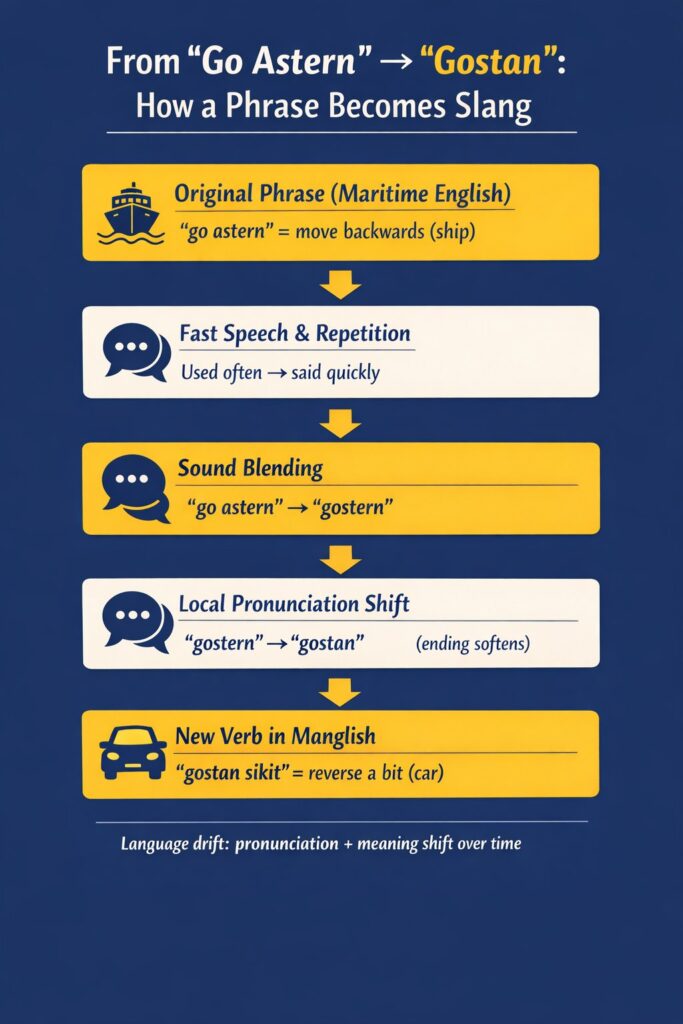
The shift from “go astern” to “gostan” is a classic case of phonetic simplification and linguistic reanalysis.
Here’s what likely happened:
- Phrase compression: “Go astern” was used often and said quickly
- Sound blending: Spoken fast, it can blur into something like “gostern”
- Local pronunciation influence: The ending shifts toward “gostan” in casual speech
- Reanalysis: Speakers treat it as a single verb, not a two-word command
This kind of shift is common in multilingual settings. When people move quickly between languages, they naturally prioritise ease, speed, and clarity over preserving original forms.
Read More: Organisation or organization: English Grammar Explained
Why Malaysians Still Use “Gostan” Today
Gostan remains popular because it’s efficient, familiar, and culturally embedded.
Language tends to favour what’s easy to say and easy to understand. “Gostan” is quick, and it fits neatly into Manglish sentence structures.
There’s also a cultural layer. Words like “gostan” don’t just communicate meaning, they signal local identity. Using them can subtly say, “I’m part of this place,” even if you’re not thinking about it consciously.
And because this is spoken, informal language, it’s naturally more flexible than formal writing. Official communication may standardise terms, but everyday speech follows what feels natural to speakers.
Examples of How “Gostan” Is Used
Gostan is mainly used in informal, spoken situations, especially while giving directions.
Common examples include:
- Parking guidance: “Gostan sikit, sikit… okay stop!”
- Missed turn: “You passed already, gostan back.”
- Tight space adjustment: “Gostan a bit more, then can fit.”
You’ll notice these often mix English with Malay particles like “sikit.” That’s code-switching, one of the most common features of Malaysian speech, where multiple languages show up within a single sentence.
“Gostan” as a Real Verb (How Malaysians Treat It Grammatically)
One reason gostan feels so “native” is that Malaysians use it like a proper verb, not a borrowed phrase. In casual speech, it behaves like a flexible action word that can slot into different sentence patterns, especially the quick, clipped patterns people use when driving.
You’ll hear it with:
- Quantity/degree markers: “gostan sikit,” “gostan more,” “gostan a bit”
- Direction markers: “gostan back,” “gostan there,” “gostan this side”
- Instruction rhythm: short repeats like “gostan… gostan… ok stop”
What’s happening here is something linguists often notice in loanwords: once a word becomes useful, speakers start shaping it to fit local grammar habits. In Manglish, that often means mixing English verbs with Malay particles (sikit, lah, already) and using the simplest structure that still gets the message across fast.
It’s also why the word sticks around. A term that’s easy to “plug in” grammatically spreads faster than one that feels stiff or formal.
What Does “Gostan” Tell Us About Language Drift?
Gostan shows that language drift is natural, inevitable, and not something to “fix”.
Language drift happens when words change over time in pronunciation, structure, or meaning. In a multilingual country like Malaysia, this tends to happen faster because languages are constantly interacting.
Key Things To Understand About Language Drift
- It’s natural: All languages evolve across generations
- It’s not “bad English”: It reflects adaptation, not failure
- It’s usage-driven: Real communication shapes meaning
- It’s often unconscious: People rarely notice it happening
How Gostan Fits Into This
- Original meaning: Nautical command used for ships
- Current common meaning: Reversing vehicles
- Transformation: Phrase → single word
- Result: A fully localised slang term
From a linguistic perspective, gostan is a neat example of phonological simplification and semantic narrowing, where a term becomes more specific over time.
Why “Gostan” Doesn’t Feel Like a Mistake to Locals
To an outsider, gostan can look like “broken English.” But to locals, it functions more like a shared shorthand. Everyone in the car understands the instruction immediately, and that instant clarity is the real test of whether a word “works.”
This is also why Manglish words often survive even when people know the “correct” standard term. It’s not about lacking vocabulary, it’s about choosing the most efficient tool for the moment. In a high-speed context like driving, the simplest, most familiar term wins.
And because Malaysia is a place where switching languages is normal, “hybrid” words don’t feel odd. They feel practical. Gostan sits right in that sweet spot: English-flavoured enough to be recognised, local enough to feel effortless.
Is “Gostan” Manglish or Singlish?
Gostan exists in both Manglish and Singlish, and is widely understood across Malaysia and Singapore.
You’ll hear it in Singapore too, and many people recognise it instantly in both places. In Malaysia, it often blends smoothly with Malay particles and Manglish rhythm, which can make it feel especially “at home” in Malaysian speech.
That cross-border presence is a good reminder that language evolves through shared culture and contact, not just within national borders.
When Should You (And Shouldn’t You) Use “Gostan”?
Gostan works best in casual speech and should be avoided in formal contexts.
Use it when:
- Talking to friends or family
- Giving casual driving directions
- Speaking in Manglish
Avoid it when:
- Writing formal emails or documents
- Speaking in professional settings with non-local audiences
- Communicating in situations where standard terms reduce confusion
In formal situations, “reverse” is clearer and more universally understood.
Other Malaysian Slang Words That Evolved Similarly
Gostan is part of a broader pattern of language mixing and adaptation in Malaysia.
Here are a few examples:
- Tapau: Common in Malaysian/Singapore English for taking food away; major English dictionaries trace it via Malay tapau to Chinese (Cantonese) dá bāau, “to pack (food) to take away.”
- Kantoi: Common Malay slang meaning “busted” or “caught (red-handed),” generally treated as informal/spoken usage.
- FFK: Often explained locally as coming from a Cantonese expression used to mean standing someone up or cancelling. Its exact pathway varies by community and retelling, which is typical for slang.
These show how Malaysian slang often develops through borrowing, simplification, and everyday repetition, until the word feels completely native.
How to Gostan The Right Way
Gostan may sound like imperfect English at first glance, but it’s actually a strong example of how language evolves naturally in a multicultural society. From a maritime command to everyday slang, it reflects both Malaysia’s history and the way people communicate now.
If you’re looking to turn cultural insights like this into compelling, audience-ready narratives, PRESS PR Agency, your trustworthy Malaysian PR firm, helps brands craft stories that connect through language and local nuance. Their PR services are built to transform everyday cultural moments into impactful messaging.
Sources
- Department of Statistics Malaysia (DOSM), Productivity Unplugged: The Challenges of Malaysia’s Transition into a High Income Country (Occasional Paper), 1 June 2018
- Institute of Language Teaching & Learning (ILTI), ILTI News, Vol. 28 (published online; date varies by archive listing)
- Singlish.net, “Gostan” (definition entry), 29 May 2017
- Oxford English Dictionary (OED), “tapau, v.” (dictionary entry; publication/update date varies by edition)
- Wikipedia, “Manglish” (reference entry; last edited date varies)
Frequently Asked Questions About Gostan and Its Usage
Is Gostan Proper English?
No. Gostan isn’t standard English. It’s a local slang term widely explained as coming from “go astern,” used informally in Malaysia and Singapore.
Why Do Malaysians Say Gostan Instead Of Reverse?
Because it’s short, natural in casual speech, and widely understood in Manglish conversations.
Is Gostan Used In Singapore Too?
Yes. It’s also used in Singapore, especially in Singlish, though frequency and phrasing can vary.
Can Tourists Use The Word Gostan?
Yes, in informal settings. It can help you sound more local, but it’s best avoided in formal situations.
What Is The Literal Meaning Of “Go Astern”?
It’s a nautical instruction meaning to move a ship backwards.
Is Gostan Considered Manglish Or Broken English?
It’s more accurate to describe it as Manglish (and also used in Singlish). It reflects natural language evolution in multilingual communities.