

If your business depends on trust, visibility, or public perception, you likely need a PR team, especially in Malaysia’s increasingly competitive, fast-moving market.
In the past, many Malaysian businesses relied heavily on word of mouth, referrals, or basic advertising. That is no longer enough. Today, customers search, compare, and validate before making decisions. They look for brands that appear in credible coverage, are mentioned by trusted sources, and feel established.
This is where public relations comes in.
PR is not just about getting your name into newspapers. It is about shaping how your business is perceived across media and search, and it can also support how your brand appears in AI-influenced search experiences (such as Google’s AI Overviews) by increasing the quality and credibility of public information around your expertise and reputation.
Quick Comparison Table: Industries That Benefit Most from PR in Malaysia
| Industry | Why PR Matters | Risk Without PR | Typical PR Focus |
|---|---|---|---|
| Healthcare | Builds trust through education and credible expertise | Patients hesitate; misinformation spreads | Patient education, expert positioning, compliant messaging |
| Fintech | Explains governance and builds confidence in a regulated space | Trust gaps; slower adoption | Transparency messaging, thought leadership, issue readiness |
| F&B | Drives discovery beyond ads | Low awareness; discount dependence | Launch buzz, reviews/features, brand story |
| Real Estate | Supports confidence for high-value decisions | Longer sales cycles; rumours hurt | Project updates, credibility proof, issue management |
| Education | Builds parent trust without overpromising | Low enquiries; hard to stand out | Outcomes stories, leadership credibility, community PR |
| E-commerce | Differentiates beyond listings | Price wars; low loyalty | Brand narrative, product education, earned visibility |
| Tourism | Shapes perception and demand | Under-discovery; weak off-peak bookings | Experience storytelling, seasonal campaigns, partnerships |
| SMEs | Helps smaller brands look credible fast | Overshadowed by big brands | Local authority, founder story, customer proof |
| Tech Startups | Turns innovation into understandable credibility | Stuck with early adopters | Milestones, founder positioning, explainers |
| GLCs/Corporates | Maintains trust under scrutiny | Reputation issues escalate | Stakeholder updates, accountability messaging, crisis comms |
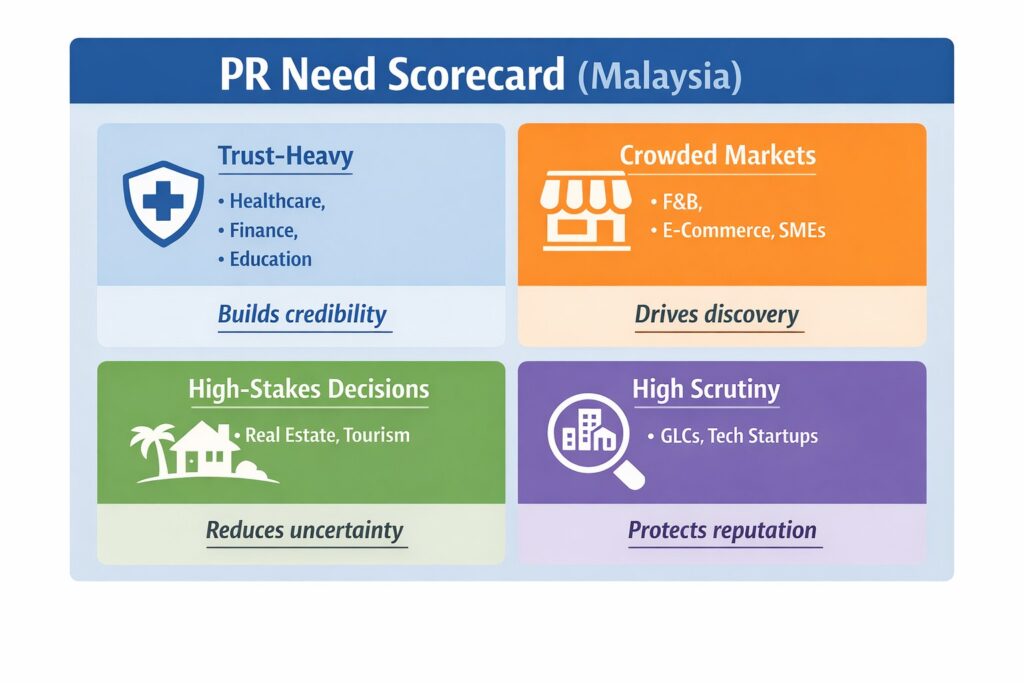
How We Selected These Industries
Not every business needs PR at the same level, but some industries struggle to grow sustainably without it.
We selected these industries based on five factors:
Level of trust required
Industries like healthcare and finance rely heavily on credibility. One negative perception can delay decisions or reduce adoption.
Competition intensity
Sectors such as F&B and e-commerce are crowded. Without visibility, even strong brands get ignored.
Regulatory sensitivity
Industries governed by bodies like Bank Negara Malaysia (BNM) and the Ministry of Health (MOH) require careful, accurate communication.
Media potential
Industries with frequent updates, launches, or public-interest stories benefit more from earned coverage.
Customer decision complexity
High-ticket decisions like property or education require reassurance, not just promotional messaging.
What PR Actually Does Today (Beyond Press Releases)
Modern PR in Malaysia functions as a trust-and-visibility engine, not just a publicity tool.
Many businesses still think PR means sending out press releases and hoping for coverage. In reality, PR today integrates closely with branding, search visibility, and reputation management.
A strong PR strategy can:
- Build third-party credibility through credible features and expert quotes
- Position your business as an authority in your niche
- Earn coverage that may generate high-quality links and discoverability signals that support SEO over time
- Improve your brand’s eligibility to be referenced in AI-generated search features (though there is no guarantee)
- Help manage issues early before they become a full crisis
In Malaysia, where consumers often rely on trust signals, social proof, and legitimacy before spending, PR becomes a long-term advantage, not a “nice-to-have.”
1) Healthcare (Private Clinics, Specialists, Hospitals)
Healthcare decisions are driven by trust, not convenience, making PR one of the most critical growth levers.
In Malaysia, patients rarely choose a clinic randomly. They look for signals such as doctor credentials, clinic reputation, and perceived expertise.
PR helps healthcare providers:
- Build authority through expert commentary and educational insights
- Publish patient-friendly content that answers real concerns (without overpromising)
- Gain visibility via credible platforms that reinforce legitimacy
A clinic that is quoted in a health feature, participates in public education, or contributes to awareness campaigns often gains faster trust than one that stays invisible.
Without PR, even highly qualified practitioners risk being overlooked simply because they are not seen or recognised.
Important Malaysia compliance note
Healthcare communications should be handled carefully. In Malaysia, advertising and promotion of healthcare facilities/services can be subject to MOH / Medicine Advertisements Board guidance and professional/ethical requirements, especially when it comes to claims, outcomes, and promotional messaging. A compliant PR approach focuses on education, safety, and accuracy.
2) Financial Services and Fintech
Trust is the currency of financial services, and PR is how that trust is built at scale.
Malaysia’s financial sector, including many financial and payment-related activities, is governed by regulatory frameworks overseen by Bank Negara Malaysia, including laws such as the Financial Services Act 2013 and Islamic Financial Services Act 2013.
Consumers are naturally cautious, especially with newer fintech platforms. They want to know: is this legitimate, is it compliant, and is it safe to use?
PR helps financial businesses:
- Communicate transparency and governance clearly (without implying approvals or guarantees)
- Establish authority in complex topics through expert-led narratives
- Address public concerns quickly during incidents, rumours, or uncertainty
For fintech startups, PR can strongly influence adoption because a platform that appears in credible coverage often feels “safer” than one that has no public footprint.
Without PR, even innovative solutions struggle to gain traction due to uncertainty and low trust.
3) Food and Beverage (F&B)
In F&B, visibility is everything, and PR drives that visibility.
Malaysia’s F&B scene is famously active, and staying top-of-mind is tough. This isn’t just a “feeling”; the market is structurally crowded. DOSM reported 136,453 F&B services establishments operating in 2022, which shows how competitive visibility can be.
PR helps F&B brands:
- Get featured in lifestyle, local discovery, and food publications
- Generate buzz around new openings, collaborations, and seasonal menus
- Build a brand story beyond “just good food” (concept, origin, chef, community angle)
A restaurant that consistently appears in credible features and curated lists has a major advantage over one that relies only on walk-ins or paid ads.
Without PR, even excellent concepts struggle to build sustained awareness.
4) Real Estate and Property Developers
Property decisions are high-risk and high-value, making perception critical.
Buying property in Malaysia is a major financial commitment. Buyers want reassurance on developer credibility and track record, project progress and delivery confidence, and long-term value.
PR helps developers:
- Shape narratives around new projects and milestones
- Highlight credibility, progress updates, awards, and partnerships
- Support issue prevention (e.g., rumours, delays, disputes) through clear communication
Media visibility can influence perception and demand, especially when buyers compare multiple projects with similar features.
Without PR, projects may face slower sales cycles and lower confidence even if the product is strong.
5) Education (Private Schools, Colleges, Institutions)
Parents and students choose institutions based on reputation, not just curriculum.
In Malaysia, education choices are emotionally driven and reputation-sensitive. People are looking for proof of outcomes and environment, not only academic promises.
PR helps education providers:
- Showcase student success stories and real outcomes
- Highlight teaching approach, leadership, and achievements
- Build long-term institutional credibility through public engagement
A school that contributes to education discussions (parenting issues, learning trends, scholarship programmes, etc) often becomes the “familiar name” when parents shortlist options.
Without PR, institutions struggle to stand out in a crowded market, even if their results are good.
6) E-commerce and Retail Brands
In saturated marketplaces, branding matters more than pricing.
Malaysia’s e-commerce ecosystem is led by major marketplaces like Shopee and Lazada, alongside newer players and fast-moving channels. This means many brands sell similar products at similar prices, and the easiest tactic becomes discounting.
PR helps brands:
- Build identity beyond product listings
- Earn coverage that differentiates them from “generic sellers”
- Create stories that connect emotionally (founder story, quality angle, mission, local credibility)
Without PR, brands often get trapped in price wars, which erode margins and make growth harder over time.
7) Tourism and Hospitality
Tourism depends on perception, and PR shapes that perception.
Hotels, destinations, and travel experiences rely on visibility to attract bookings. Competition for attention is real across Southeast Asia, and perception affects whether travellers even consider you.
PR helps tourism businesses:
- Secure features that put destinations on travellers’ radar
- Highlight unique experiences, culture, sustainability, and local stories
- Drive seasonal demand through campaigns and timely narratives
Without PR, even attractive destinations remain under-discovered, especially outside peak seasons.
8) SMEs and Local Businesses
PR allows SMEs to compete with larger, more established brands.
Many Malaysian SMEs have strong offerings but lack visibility. Larger brands dominate because they appear more “trusted” and familiar, even when SMEs are equally good.
PR helps SMEs:
- Build local authority (being “the known name” in a niche)
- Gain credibility through third-party exposure
- Increase recognition and trust without huge ad budgets
Without PR, SMEs remain overshadowed, not because they’re weak, but because they’re unseen.
9) Technology and Startups
Innovation needs visibility to gain traction, partnerships, and investment.
Malaysia’s startup ecosystem is growing, and founders compete hard for attention: from investors, enterprise partners, government programmes, and customers.
PR helps startups:
- Announce product launches, milestones, funding, and partnerships
- Position founders as credible thought leaders
- Build trust fast—especially in crowded categories
- Translate technical value into clear, relatable benefits
Without PR, startups often struggle to move beyond early adopters because the wider market needs credibility signals before they commit.
10) Government-Linked Companies (GLCs) and Corporates
Public perception directly affects long-term stability and stakeholder trust.
GLCs and large corporates operate under constant public scrutiny. A small misstep can escalate quickly, especially online.
PR helps these organisations:
- Communicate transparently with stakeholders
- Manage issues effectively with clear, timely messaging
- Maintain public trust through consistent narratives and accountability
Without PR, reputation risks can grow faster than the organisation can respond, impacting investor confidence, employee morale, and public sentiment.
When Does a Business Actually Need a PR Team?
PR becomes essential when visibility and trust directly influence growth.
You should consider PR when:
- You are launching a new product or entering a new market
- Your industry relies heavily on trust or regulation
- Your competitors are already visible in credible coverage
- You want long-term authority (not just short-term sales)
- You need to manage public perception proactively
A useful rule of thumb: if one bad review, one rumour, or one misinformation incident could materially harm your growth. PR is not optional.
The Importance of PR
In Malaysia, PR is no longer just about exposure; it is about being seen, trusted, and chosen in a crowded, credibility-driven market.
If your business depends on trust and visibility, PR is the bridge that connects public credibility, search discoverability, and customer confidence. At PRESS PR Agency, your trustworthy Malaysian PR agency, we help Malaysian businesses turn coverage into authority and visibility into measurable growth through strategic, results-driven PR campaigns. Don’t miss out on the opportunity to partner with PRESS and build your authority.
Sources
- Department of Statistics Malaysia (DOSM) — Economic Census 2023: Services Sector (includes F&B services establishments count; data year referenced: 2022).
- Bank Negara Malaysia (BNM) — Legislation (including the Financial Services Act 2013 and Islamic Financial Services Act 2013; regulatory frameworks relevant to financial sector activities).
- Ministry of Health Malaysia (MOH), Medicine Advertisements Board (MAB) — Advertising Guidelines for Healthcare Facilities and Services (version indicated as 3/2023).
- Google — Generative AI in Search / AI Overviews announcement (May 2024).
- Google Search Central — AI features and your website (guidance on AI features; no inclusion guarantees).
- Google Search Central — Link best practices / crawlable links (links and discoverability signals).
- Chartered Institute of Public Relations (CIPR) — What is PR? (definition and scope).
- Public Relations and Communications Association (PRCA) — Definition of public relations.
- Tourism Malaysia — Tourism statistics (official statistics portal).
- Ministry of Science, Technology and Innovation (MOSTI) — Malaysia Startup Ecosystem Roadmap (SUPER) 2021–2030.
FAQs About Industries that Need PR
What Is PR and Why Is It Important in Malaysia?
PR shapes public perception, builds trust, and improves visibility through credible third-party exposure—especially important in trust-heavy and competitive industries.
Which Industries Benefit Most From PR in Malaysia?
Healthcare, fintech, F&B, real estate, education, and SMEs often benefit the most due to trust, competition, and visibility needs.
Is PR Only for Large Companies?
No. SMEs often benefit strongly because PR helps them earn credibility and visibility without matching big-brand ad budgets.
How Does PR Support SEO and AI Search?
PR can earn credible coverage that generates high-quality links and trusted references. This can support search visibility and may improve the likelihood of being included in AI-driven search features, though inclusion is never guaranteed.
When Should a Business Invest in a PR Team?
When launching, scaling, entering a competitive market, or when credibility and visibility become critical to growth.
What Is the Difference Between PR and Marketing?
Marketing focuses on direct conversions. PR focuses on trust, credibility, and long-term brand perception, often strengthening marketing performance over time.