
Salary changes are among the most sensitive workplace issues. For employees, a lower paycheck affects financial security and morale. For employers, it can quickly become a legal and employee-relations issue if handled badly.
Businesses may sometimes review compensation because of restructuring, cost pressure, role changes, or financial difficulty. But salary deduction and salary reduction are not the same thing, and the law does not treat them the same way.
In Peninsular Malaysia, wage deductions are mainly governed by the Employment Act 1955. Employers in Sabah and Sarawak should also check the applicable local labour ordinances.
This guide explains what counts as a pay cut, how salary deduction works, when employers may lawfully adjust pay, and what steps HR teams should follow to reduce legal risk. (Sources: Employment Act 1955; Malaysia.gov Labour Law)
What Counts as a Pay Cut?
A pay cut happens when an employee receives less compensation than what was previously agreed under the employment terms.
Common examples of a pay cut
- Reduction in base salary
- Lower fixed allowance that forms part of regular income
- Demotion with lower pay
- Reduced working hours that lower overall earnings
- Changes to commission or incentive structures where those earnings are contractually framed
For example, if an employee earning RM5,000 per month is told that the monthly salary will now be RM4,200 due to restructuring, that is a pay cut.
Salary is usually treated as part of the employment contract, so employers should be cautious about changing it without agreement. (Source: Employment Act 1955)
Salary Deduction vs Salary Reduction
Employers often use these terms loosely, but legally and practically they are different.
Salary deduction
Salary deduction means a specific amount is withheld from wages for a lawful reason.
Typical examples include:
- EPF contributions
- SOCSO contributions
- EIS contributions
- Monthly tax deduction (PCB)
- Recovery of wage advances allowed by law
- Recovery of certain overpayments made by mistake
In Peninsular Malaysia, these deductions are mainly dealt with under Section 24 of the Employment Act 1955, together with other written laws that require statutory deductions. (Source: Employment Act 1955)
Salary reduction
Salary reduction means the employee’s agreed pay is being lowered.
Examples include:
- Reducing base salary during restructuring
- Lowering salary after a role downgrade or demotion
- Proposing a temporary pay cut during financial difficulty
- Revising a fixed pay component downward
This is usually a contract issue, not just a payroll issue. A lawful deduction does not automatically require the same process as a contractual pay cut.
Malaysian Laws Governing Salary Deduction
For Peninsular Malaysia, the main law governing wage deductions is the Employment Act 1955.
Section 24 sets out when deductions may be made from wages. It does not give employers a free hand to deduct pay whenever they think it is reasonable.
Deductions commonly recognised under the law
Section 24 allows certain deductions, including:
- Deductions authorised by another written law
- Recovery of overpayments made by mistake within the immediately preceding three months
- Recovery of advances of wages made under Section 22
- Other deductions allowed under the statutory framework
In practice, EPF, SOCSO, EIS and PCB are generally deducted because they are required or authorised under separate written laws. (Source: Employment Act 1955)
What employers should not assume
Employers should not assume they can deduct wages simply because:
- An employee made a mistake
- A manager wants to impose a financial penalty
- A company policy says a deduction is allowed
- There was a performance issue
A wage deduction must still have a proper legal basis. (Source: Employment Act 1955)
Maximum Deduction Limits
In most cases, total deductions made under Section 24 in any one month must not exceed 50% of the wages earned in that month.
There are limited exceptions, including final wage deductions for sums due on termination and certain housing-related deductions made with prior written permission. Employers should not rely on the 50% rule casually. The legal basis for the deduction still matters. (Source: Employment Act 1955)
When Employers Can Legally Reduce Salary
Salary reductions affect a core term of employment, so the key issue is usually whether the change is properly managed and agreed.
Demotion or role downgrade
If an employee is moved to a lower role, salary may sometimes be reviewed to match the new position.
Employers should make sure:
- The role change is genuine
- The reason is clear
- Proper process is followed where misconduct or performance is involved
- The revised terms are documented clearly
Business restructuring
A restructuring exercise may involve changes to job scope, reporting lines, or compensation. Where the role changes substantially, employers should:
- Explain the restructuring clearly
- Show how the role is changing
- Issue revised job terms in writing
- Obtain written agreement to the revised pay arrangement
Read More: Why Every SME Needs an Employee Handbook (And What to Include)
Economic or financial pressure
During difficult periods, some employers may propose temporary salary reductions instead of retrenchment.
This may be more defensible where the employer:
- Explains the financial situation honestly
- Applies the measure fairly
- States whether the cut is temporary
- Reviews the arrangement after a defined period
- Obtains written agreement
Performance-based pay adjustments
Where pay includes commissions, incentives, or variable compensation, changes may affect overall income.
Even then, employers should not assume every reduction is safe. The answer depends on how the pay structure is written and whether the term is discretionary or contractual.
When Pay Cuts May Be Illegal
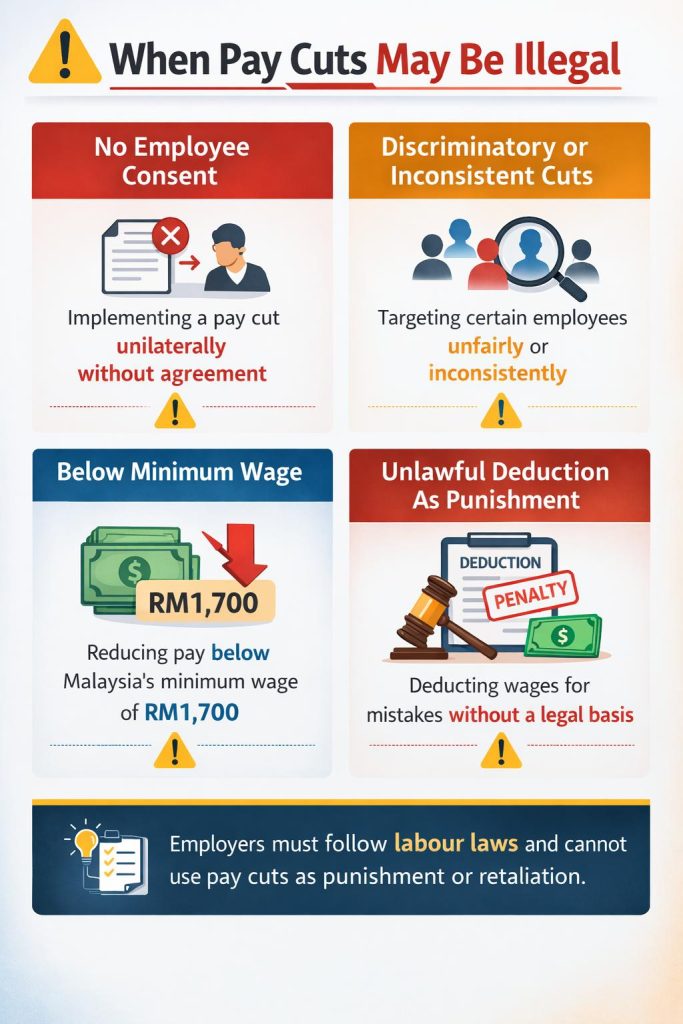
A pay cut can become legally risky when it is imposed unilaterally, applied unfairly, or pushes pay below legal minimum standards.
Reducing salary without employee agreement
This is one of the biggest risk areas.
Problems usually arise where an employer:
- Announces a reduced salary without discussion
- Implements a new payroll amount without signed agreement
- Tells employees to accept the cut or leave
- Makes an immediate reduction without proper documentation
Depending on the facts, this may lead to breach of contract disputes and may also support a claim of constructive dismissal. Employees who say they were dismissed without just cause or excuse may file a representation under Section 20 through the Industrial Relations framework. (Sources: JPPM Section 20 Dismissal; Employment Act 1955)
Discriminatory or inconsistent pay cuts
Employers should apply salary changes consistently and fairly.
Risk increases where:
- Only selected employees are targeted without objective reason
- Similar roles are treated differently without explanation
- Salary changes appear linked to irrelevant personal factors
Pay cuts that breach minimum wage rules
Malaysia has a statutory minimum wage.
Under the Minimum Wages Order 2024, the minimum monthly wage is RM1,700, subject to the order’s application and phase-in rules. Employers should not reduce pay below the applicable minimum wage. (Source: Minimum Wages Order 2024)
Salary deductions used as punishment
Employers should not use wage deductions as an informal punishment tool.
A deduction for an employee’s “mistake” is not automatically lawful just because management wants to impose a penalty. If there is no valid legal basis for the deduction, the employer may be exposed to complaints or repayment claims. (Source: Employment Act 1955)
Step-by-Step Process Employers Should Follow
When considering a pay cut or salary adjustment, employers should use a structured process.
1. Identify the real business reason
Start by documenting why the change is being considered, such as a drop in revenue, reorganisation, role redesign, or cost control.
2. Review contracts and legal position
Check employment contracts, offer letters, commission terms, HR policies, and the applicable labour laws. Do not assume one legal rule applies nationwide in the same way. (Sources: Employment Act 1955; Malaysia.gov Labour Law)
3. Communicate clearly with employees
Explain why the change is being proposed, whether it is temporary or permanent, what part of pay is affected, and when it will start.
4. Obtain written agreement
Use clear documents such as contract variation letters, temporary salary adjustment letters, revised employment terms, or signed acknowledgements.
5. Update internal records
Once agreement is in place, update employment documentation, payroll records, HR files, and internal approvals.
6. Monitor and review
If the reduction is temporary, set a review date so the measure does not become open-ended.
Legal Risks Employers Should Understand
Improper deductions and poorly managed pay cuts can trigger multiple problems.
Constructive dismissal claims
An employee may argue that the employer fundamentally changed the employment relationship through a unilateral salary reduction or forced acceptance of lower pay. Whether a claim succeeds depends on the facts, but salary cuts imposed without proper handling can create real risk. (Source: JPPM Section 20 Dismissal)
Breach of contract disputes
If an employer reduces salary without agreement or without a valid contractual basis, the employee may dispute the change and seek to recover unpaid amounts.
Labour complaints and enforcement issues
Unlawful deductions may lead to complaints to the labour authorities, including claims for wage repayment or compliance action.
Damage to morale and retention
Poorly handled pay changes can also lead to lower trust, higher turnover, lower productivity, and reputation damage.
Alternatives to Salary Reduction
Before reducing salaries, employers may want to consider less disruptive options.
- Reduced working hours with proper agreement
- Temporary unpaid leave arrangements
- Hiring freeze
- Reduction in non-essential spending
- Redeployment to other functions
- Voluntary salary adjustment schemes
- Review of discretionary benefits or bonus structures
These options may help businesses manage costs while preserving employee trust.
Best Practices for Employers
Employers that handle salary changes responsibly usually follow a few consistent principles.
Keep the approach practical and fair
- Communicate early
- Explain the business reason
- Apply the policy consistently
- Avoid surprise payroll changes
- Keep records of discussions and agreements
- Review temporary measures instead of letting them run indefinitely
Do not rely on assumptions
Do not assume that:
- A difficult business climate automatically permits a pay cut
- A contract change is valid because it was announced internally
- A deduction is lawful because it seems commercially reasonable
- A manager’s verbal instruction is enough
Salary Reduction, Done the Right Way
Salary deduction and salary reduction are sensitive but common issues for employers. The key is to recognise that they are not the same thing.
In Peninsular Malaysia, wage deductions are mainly regulated under the Employment Act 1955, while salary reductions usually involve a contractual change that should be handled carefully. Employers in Sabah and Sarawak should also check the relevant local labour ordinances before taking action. (Sources: Employment Act 1955; Malaysia.gov Labour Law)
Employers that communicate clearly, obtain written agreement, and document every step are in a much stronger position to manage change without creating avoidable disputes.
When salary changes or restructuring need to be communicated carefully, PRESS PR Agency offers PR services to help shape the right message, protect your reputation, and maintain stakeholder trust. Work with PRESS to get your company’s message heard the right way.
Disclaimer: This article is for general informational purposes only and should not be treated as legal advice. Employers should seek qualified legal or HR advice before making salary changes in specific cases.