Key Takeaway
- What It Is: Cadillac Pilates uses a trapeze-table apparatus with springs, bars, and straps to support or challenge movement.
- Best For: Injury rehabilitation, spinal mobility, and advanced flexibility.
- Format: Usually taught as 1-on-1 private sessions or “Tower” group classes in Malaysia.
- Primary Benefit: Offers support for beginners and acrobatic challenges for experts.
- Safety First: If you have recent injury, severe pain, or instability history, treat it like training—not entertainment—and screen before attempting advanced spring/bar work.
- Cost: Generally higher than standard Pilates due to the requirement for private instruction
Table of Contents
ToggleCadillac Pilates is a specialized equipment-based exercise performed on a raised table featuring a metal frame, springs, and hanging bars.
Unlike the moving carriage of a Reformer, the Cadillac is stable, making it ideal for rehabilitation, isolating specific muscle groups, and advanced aerial acrobatics.
What Exactly Is Cadillac Pilates (Trap Table) In Plain Terms?
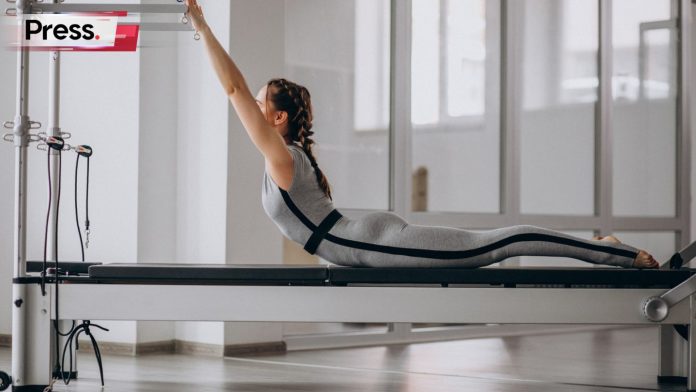
Cadillac Pilates is an apparatus-based Pilates session done on a “trapeze table” with a raised frame, bars, and springs.
The Cadillac—also called the trapeze table or trap table—may look intimidating, but it’s one of the most supportive and adjustable Pilates apparatus. Designed by Joseph Pilates for rehabilitation, it’s a padded table surrounded by a metal frame with springs, bars, and straps.
Think of it as a table with an overhead cage. Springs can assist movement or add resistance, allowing exercises to be scaled more precisely than mat work.
Main parts you’ll hear about in class:
- Push-Through Bar: For spinal and shoulder mobility.
- Roll-Down Bar: Helps guide controlled articulation.
- Trapeze (“Fuzzies”): Loops for hanging or supported work.
- Leg & Arm Springs: Adjustable resistance for limb strength.
Malaysia note (what you’ll actually see in studios):
In KL/PJ especially, you’ll typically encounter two variations:
- The Full Cadillac: The complete four-poster bed, most common in private studios or physiotherapy-led settings.
- The Tower (Wall Unit): A space-saving wall-mounted version. Many studios market “Tower Classes”, which can cover a large portion of Cadillac-style work in a more affordable group format, so it’s worth confirming whether your booking is full Cadillac or tower.
In the right hands, the Cadillac can be gentle enough for recovery yet demanding enough for elite strength work.
Cadillac vs. Reformer: What is the Difference?
This is the most common question among Malaysian practitioners. While both use spring resistance, the mechanics are fundamentally different.
The Reformer challenges you with instability (the moving carriage). The Cadillac supports you with stability (the static bed).
Feature | Pilates Reformer | Pilates Cadillac (Trapeze Table) |
Base Surface | Moving carriage (slides back and forth). | Stable, stationary mattress. |
Primary Challenge | Balance and coordination. | Joint isolation and range of motion. |
Best For | Flow, stamina, and full-body integration. | Rehabilitation, deep stretching, and aerial moves. |
Class Format | Very common in group classes. | Mostly private (1-on-1) or Tower classes. |
Spinal Impact | Requires some core control to start. | Safest for spinal injuries (sakit belakang). |
If you are recovering from an injury, instructors will often start you on the Cadillac to stabilize your movement before graduating you to the instability of the Reformer.
Read More: Reformer Pilates in Malaysia: Benefits, Cost & Safety Guide
Is Cadillac Pilates Good For Beginners (Or Only Advanced)?
Yes, beginners can do Cadillac Pilates, if the session is coached and scaled, not treated like a “try anything” playground.
The apparatus can provide assistance that helps you find alignment and move with control. But Cadillac also includes options that are higher-skill (certain bar/spring movements), so “beginner-friendly” depends more on the instructor’s progressions than the machine itself.
Beginner-ready checklist (quick self-screen):
- You want coaching on form, breathing, and control (not just calorie burn).
- You’re okay with slower, more technical sessions at the start.
- You can describe your past injuries clearly (and you’ll mention them before class).
If you want a fast-paced class vibe, Cadillac may not match your expectations—unless the studio explicitly programs it that way.
What Does A Cadillac Pilates Session Usually Look Like?
Most Cadillac sessions are structured around controlled strength + supported mobility, with frequent setup changes.
You’ll typically spend time learning how the springs feel, how to position safely, and how to move without “hanging” on joints. Expect more coaching cues and fewer “follow-along” sequences than big group formats.
Common exercise categories you may see:
- Core and trunk stability using spring assistance/resistance
- Shoulder and hip mobility with controlled range
- Leg strength with strap/spring loading
- Supported spinal movement patterns (where appropriate)
Because the equipment is configurable, your session may look very different from your friend’s, even at the same studio.
Top Benefits of Cadillac Pilates
1. Superior for Rehabilitation
Because the bed does not move, it provides a safe environment for those with limited mobility. The springs can be positioned to assist movement (making it easier) rather than just resisting it. This makes it a preferred tool in Malaysian physiotherapy for slip discs or post-surgery recovery.
2. Corrects Muscle Imbalances
On a machine like a barbell press, your stronger arm often compensates for the weaker one. On the Cadillac, arm and leg springs work independently. You cannot “cheat” the movement, forcing your weaker side to catch up.
3. Decompresses the Spine
The “hanging” exercises—where you hang from the upper bars—use gravity to gently traction the spine. This creates space between vertebrae, offering significant relief for office workers suffering from compression due to prolonged sitting.
4. Adaptable for All Bodies
The Cadillac is high off the ground, making it accessible for seniors or those who struggle to get down onto a floor mat.
Can Cadillac Pilates Help Back Pain (Sakit Belakang)?
Pilates (as a method) has evidence for improving pain and disability in chronic low back pain, but results depend on proper exercise selection and progression.
Cadillac Pilates is not automatically “better” for back pain. Its advantage is that the apparatus can be used to modify loading and range, when the instructor programs it correctly.
Manufacturer safety guidance also emphasizes appropriate use and consulting a licensed health professional when suitability is uncertain.
Practical rule (Malaysia-realistic):
If your back pain includes red flags (recent trauma, progressive numbness/weakness, fever/unexplained weight loss, severe night pain), don’t “trial class” your way through it—get medical assessment first. Many non-surgical treatments for back pain show only modest benefits, so matching the right intervention matters.
Who Should Be Extra Cautious (Or Get Advice First)?
Cadillac Pilates is still exercise—if your risk is higher, treat your first session like a screening appointment.
Consider clinician advice first if you have:
- Recent fracture, surgery, or significant joint/spinal instability
- Significant neurological symptoms (radiating numbness/weakness)
- Uncontrolled cardiovascular symptoms during exercise
- Pregnancy where you need pregnancy-trained instruction and modifications (don’t assume every class is set up for this)
If a studio cannot explain how they modify movements for your situation, that’s a selection signal.
Cost And Accessibility Of Cadillac Pilates In Malaysia
Cadillac pricing in Malaysia is driven more by session format (private vs duet vs group) than the machine name itself. Because the apparatus is large and requires close supervision, full Cadillac classes are rarely run as big groups.
Estimated Klang Valley Benchmarks
- Private (1-on-1): RM150–RM350/hour
Full access to the trapeze table with a dedicated instructor. - Duet (2-on-1): RM120–RM200 per person
- Tower Group Class: RM60–RM120
Usually uses the wall-mounted unit, not the full canopy bed, but covers much of the same repertoire.
You may see attractive trial promotions, especially around festive or sale periods, but regular package pricing can look very different afterward.
Where Malaysians Typically Find Cadillac
Most setups live in boutique studios or physiotherapy-integrated centres around Bangsar, Mont Kiara, Damansara Heights, and TTDI. Large commercial gyms rarely invest in the equipment due to space and coaching requirements.
What To Confirm Before You Pay (So You Don’t Get “Kena”)
- Is it the full Cadillac, or tower attachments on another machine?
- Is your booking private, duet, or group? What’s the max size?
- Are there expiry dates, cancellation penalties, or add-on charges?
Five minutes of checking can save you hundreds later.
Top Cadillac Pilates Studios In Malaysia
Here are some well-reviewed Pilates studios across Malaysia where you can find Cadillac (trapeze table) or equipment-based Pilates sessions (including full apparatus or tower-style work):
Studio | Primary Locations | Approx. Price (Per Class)* | Best For |
Pilates Collective | Mont Kiara, Sri Petaling, Ara Damansara | RM60–RM120 (group) | Multiple branches; some centres run tower or full equipment options |
Urban Spring Pilates | The LINC KL | RM80–RM150 | Well-equipped boutique environment; check schedule for Cadillac access |
Pilatique Pilates & Physiotherapy Studio | Damansara Heights | RM150–RM300 (private) | Rehab-aware programming with physio integration |
52 Pilates | KLCC | RM60–RM120 | Central location; mix of reformer and equipment sessions |
Line Pilates & Academy | Mont Kiara | RM100–RM250 | Instructor training centre; strong apparatus focus |
MOOV Pilates | SS15 Courtyard | RM70–RM130 | Smaller classes; personalised attention |
Hills Pilates | Plaza Arkadia / Bukit Jalil | RM80–RM120 | Structured progression; community vibe |
Body in Common | Kota Damansara | RM120–RM250 | Physio + Pilates crossover for careful loading |
*Prices are general public indications observed from studio marketing and can vary by package, instructor tier, peak/off-peak timing, and whether the session is private, duet, or group.
When researching studios, ask whether their sessions specifically include Cadillac/trapeze table work, or if “equipment classes” are primarily reformer-based with occasional tower units. Some studios may integrate Cadillac as part of a mix rather than as a dedicated class.
How To Choose A Cadillac Pilates Studio In Malaysia
A good Cadillac experience is less about aesthetics and more about instructor control, class size, and programming clarity.
Use this short decision framework:
1) Check the apparatus claim
Studios often list multiple equipment types (Cadillac, chair, barrel, reformer). Confirm the Cadillac/trapeze table will be used in your booked session.
2) Ask one safety question (and judge the answer)
“Can you explain how you’ll scale today’s session if I have [pain/injury/low experience]?”
If the reply is vague (“Don’t worry, it’s safe for everyone”), that’s a red flag.
3) Prefer private/duet if your goal is rehab-style control
Not because group is “bad”, but because Cadillac setups can be technical and individualised.
Cadillac Pilates Vs “Just Pilates”: Does It Replace Cardio Or Gym?
Cadillac Pilates is excellent for strength, control, and mobility, but it doesn’t automatically meet aerobic activity targets on its own.
WHO guidance recommends adults aim for 150–300 minutes/week of moderate-intensity aerobic activity (or equivalent), plus strength work.
If your goal is heart fitness or weight-loss-through-cardio, you’ll likely need to add brisk walking, cycling, swimming, or other aerobic work alongside Cadillac sessions.
Cadillac Pilates Do’s And Don’ts
Most disappointments happen because expectations don’t match the way the apparatus is actually taught. Use this as a quick reality check before you book.
Do
- Do expect scalable difficulty.
Cadillac isn’t just rehab. With the right spring settings, it can deliver serious strength work. - Do assume coaching matters.
Safety comes from exercise choice, setup, and supervision—not the word “Pilates.” - Do understand most sessions are grounded.
The dramatic upside-down Instagram moves are typically advanced progressions, not beginner norms. - Do speak up about pain or medical history early.
Instructors can only modify what they know. - Do master control before chasing range.
Clean basics build the foundation for everything else. - Do read package terms carefully.
Trial promos rarely represent long-term pricing.
Don’t
- Don’t label Cadillac as “only for rehab.”
Springs can load movements heavily when programmed that way. - Don’t think Pilates automatically equals safe.
Poor progression or rushed setups can still irritate joints or injuries. - Don’t assume any Pilates will fix back pain.
Many people improve, but outcomes depend on individual suitability. - Don’t be intimidated by social media.
Advanced acrobatics are optional, not mandatory. - Don’t mistake it for just stretching.
Resistance from the springs can challenge muscles similar to strength training, often with less joint impact. - Don’t hide injuries until midway through class.
Late information limits safe modifications.
If you avoid these traps, your first Cadillac experience is far more likely to feel structured, personalised, and worth the investment.
Final Verdict: Should You Try It?
If you have hit a plateau in your regular practice, are recovering from an injury, or simply want to experience the “champagne of Pilates,” the Cadillac is worth the investment. It offers a level of spinal articulation and deep stretching that no other equipment can match.
For more info, follow PR agency Malaysia.
Disclaimer: All of the content was thoroughly fact-checked and verified by our editorial team to ensure accuracy, clarity, and reliability.
Legal Disclaimer: All brand names, trademarks, and logos displayed on this website are the intellectual property of their respective owners. Their use herein is solely for identification purposes without written consent or direct affiliation from the respective owner.
FAQs About Cadillac Pilates In Malaysia
Cadillac Pilates vs reformer, which is better?
Neither is “better” universally. Cadillac is often more setup-driven with precise assistance options; reformer is more movement-flow-driven with a sliding carriage.
Is Cadillac Pilates safe for beginners?
Yes, it is often safer than the Reformer for beginners because the bed is stable. However, you should never attempt to use the equipment without a certified instructor, especially the hanging elements.
What should I wear?
Wear form-fitting activewear so the instructor can see your alignment. Avoid zippers or jewelry that could snag on the leather upholstery. Grip socks are mandatory in most Malaysian studios for hygiene and safety.
How often should I do it?
Since Cadillac sessions are usually private (and more expensive), many practitioners do one Cadillac session per week to focus on technique, supplemented by 1-2 group Reformer or Mat classes.
Do I need to do cardio if I do Cadillac Pilates 2–3x/week?
If heart fitness is a goal, yes—Pilates alone may not meet weekly aerobic targets. Aim for the WHO 150–300 minutes/week guideline (or equivalent).
Do I need to be flexible to join?
No. You join Pilates to get flexible. The springs on the Reformer can actually assist you if you have tight hamstrings.