
Malaysia’s e-invoicing mandate applies broadly across sectors, requiring businesses to issue structured digital invoices through approved systems. The requirement covers all operational models from companies and SMEs to freelancers once the nationwide rollout is completed. In short, any organisation generating taxable income in Malaysia will eventually need to adopt e-invoicing.
This guide explains which business types are included, how obligations apply to different categories, and what operational models need to prepare for compliance.
E-Invoicing Compliance Snapshot: Who Must Adopt It?
Business Type | Required to Comply | Notes |
Companies (Sdn Bhd, Bhd) | Yes | Applies across all industries and revenue levels |
SMEs & micro businesses | Yes | Once full rollout completes |
Freelancers & self-employed | Yes | Applies to all billable services |
Online sellers | Yes | Includes marketplace and social commerce |
Partnerships & sole proprietors | Yes | Applies to all transaction types |
Foreign companies with Malaysian branches | Yes | Must issue compliant e-invoices for Malaysian transactions |
Non-profits / NGOs | Yes (if issuing invoices) | Transaction-based requirement |
Dormant companies | No (unless transactions exist) | No issuance required if no activity |
Which Types of Businesses Are Required to Implement E-invoicing in Malaysia?
All businesses generating income in Malaysia must adopt e-invoicing once the mandate reaches full implementation.
E-invoicing does not depend on company size or industry classification. Any entity issuing invoices or receiving payments for goods and services is included.
This covers:
- Private limited companies
- SMEs in retail, services, or manufacturing
- Micro businesses with minimal staff
- Online and home-based sellers
- Professional services (consultants, coaches, designers, trainers)
- Healthcare, education, logistics, F&B, and technology businesses
- Real estate agents, contractors, and service providers
- Corporations with multiple branches or subsidiaries
The mandate focuses on standardising invoice exchange for transparency and consistency across Malaysia’s digital reporting ecosystem.
Further reading: The Benefits of E-Invoicing in Malaysia
Does Business Size Determine Whether You Need to Use E-invoicing?
Business size affects rollout timing, not long-term obligation.
Malaysia introduced e-invoicing in phases based on annual revenue thresholds. Larger organisations adopt earlier, while SMEs and micro businesses follow after the initial stages.
However, once the nationwide mandate completes, every business regardless of revenue, must use e-invoicing.
Why Size Does Not Affect Long-term Requirements:
- Tax obligations apply to all income-generating entities
- E-invoicing supports standardised reporting
- Uniform data simplifies validation and audit processes
Business size only impacts transition timing and preparation complexity, not the requirement itself.
Are Online Sellers and E-commerce Businesses Required to Issue E-invoices?
Yes. Online transactions fall fully under Malaysia’s e-invoice framework.
This includes:
- Marketplace sellers (Shopee, Lazada, TikTok Shop)
- Social media sellers (Instagram, Facebook, WhatsApp)
- Website-based stores
- Subscription businesses
- Digital service providers (courses, software, consulting)
Online businesses issue large volumes of small-value invoices, making automation essential. Structured e-invoices help avoid manual backlogs and enable cleaner reporting across multiple sales channels.
Do Freelancers, Self-employed Individuals, and Gig Workers Need E-invoicing?
E-invoicing applies to all self-employed individuals once the mandate is universal.
This includes:
- Designers, writers, editors
- Tutors, coaches, trainers
- Photographers and videographers
- Event service providers
- Therapists, beauticians, and wellness practitioners
Even if invoices are issued infrequently, they must be submitted through the approved digital system after rollout completion.
Are Foreign Companies Operating in Malaysia Required to Submit E-invoices?
Foreign entities must comply if they conduct taxable transactions within Malaysia.
This includes:
- Overseas companies with Malaysian branches
- Cross-border service providers rendering taxable services
- Foreign suppliers selling to Malaysian customers
- Global digital platforms charging Malaysian businesses
E-invoicing ensures accurate tax reporting even for imported services or non-resident suppliers.
Are Any Businesses Exempt From Malaysia’s E-invoicing Rules?
Only entities with zero taxable activity are outside the requirement.
Examples:
- Dormant companies without transactions
- Entities with no commercial activity in a given period
Non-profit organisations, charities, and associations must issue e-invoices if they charge for goods or services.
Temporary exemptions may apply during specific phases, but long-term exemptions are unlikely as the mandate aims for comprehensive coverage.
7 Types of Transactions Require E-invoices Under Malaysia’s Framework
All commercial transactions are included, regardless of sector or value.
Required for:
- B2B (business-to-business)
- B2C (business-to-consumer)
- Cross-border transactions
- Imported services
- Exports
- Self-billed transactions
- Credit notes and debit notes
Special cases include:
- Retainer fees
- Subscription renewals
- Service packages
- Advance payments and deposits
E-invoicing ensures every transaction is recorded with consistent structure.
How Should Businesses Prepare for Mandatory E-invoicing in Malaysia?
Successful transition depends on system readiness, accurate data, and workflow consistency.
Preparation steps:
- Review current invoicing workflow
Identify manual steps that can be automated. - Check system compatibility
Ensure accounting or ERP software supports e-invoice generation. - Standardise customer and supplier data
Clean up naming formats, tax IDs, and contact information. - Map digital workflows
Build clear processes for validation, approval, and submission. - Train internal teams
Finance and operations teams should understand key changes. - Test the system before full rollout
Trial runs reduce interruption during mandatory adoption.
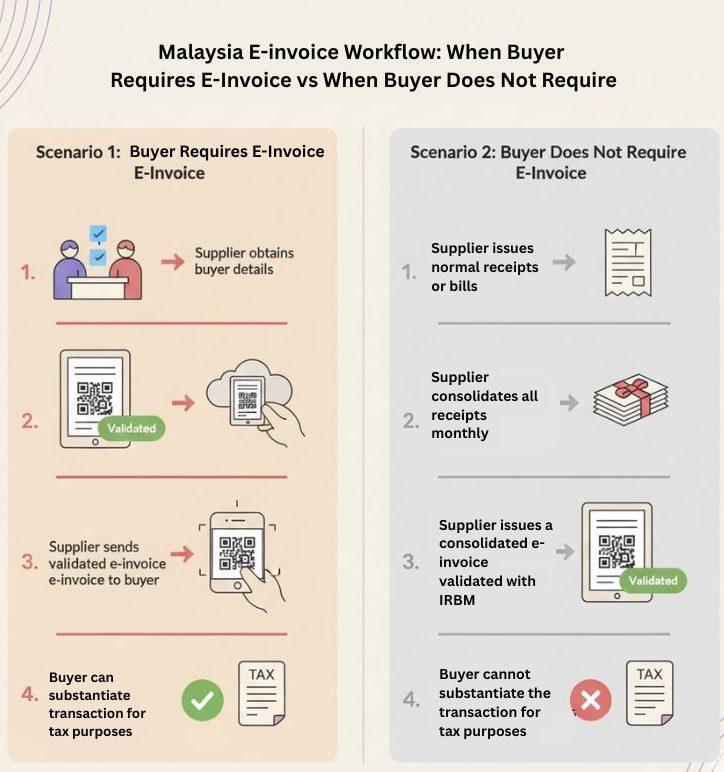
Conclusion: Which Businesses Must Do E-invoicing in Malaysia
E-invoicing applies broadly to all Malaysian businesses, regardless of size, industry, or digital maturity. Companies, SMEs, freelancers, online sellers, and foreign entities with local operations are all included once the mandate is fully implemented. Preparing early ensures smoother compliance, better accuracy, and stronger operational efficiency as Malaysia transitions toward a unified digital tax ecosystem.
As more organisations seek clarity and public awareness on these requirements, collaborating with communication experts like Press Digital PR Agency can help businesses share updates, educate customers, and build confidence throughout the transition to e-invoicing. Press helps brands communicate their digital readiness with authority, amplify trust, and stay visible in a landscape where staying quiet means falling behind.