
A public relations crisis can hit fast, and in Malaysia’s digital environment, it can spread even faster.
One viral TikTok, one misleading screenshot, or one customer complaint amplified on social platforms can shift public perception overnight. Private messaging channels make this harder, as forwarded messages and rumours often spread without context or verification.
What makes crises especially difficult today is that they are not always driven by facts alone. They are often driven by interpretation, emotion, speed, and virality.
Whether the issue is real, exaggerated, or false, the damage usually comes down to one thing: loss of trust.
Read More: What is Message-Market Fit in Malaysia: 2026 PR Guide
What Is a Public Relations Crisis and Why It Matters More in 2026
A public relations crisis is any situation that damages public trust and brand perception, whether the claims involved are fully accurate, partly misleading, or still being investigated.
That means even the following can become a serious reputational issue:
- A misunderstanding
- A pricing perception issue
- A poorly worded statement
- A viral complaint shared without full context
A crisis is not defined only by what happened. It is also defined by how people interpret it.
Why Public Relations Crises Are More Dangerous Today
Several factors make reputation damage harder to contain than before:
- Content often spreads faster than verification
- Outrage often gets more engagement than clarification
- AI-generated summaries and chatbot outputs can repeat or amplify misleading narratives. (Source: Springer, research on AI and misinformation)
- Public memory is often shaped by short viral moments rather than full explanations
A reputation can take years to build and be damaged very quickly.
“It takes 20 years to build a reputation and five minutes to ruin it” – Warren Buffett, widely cited quote.
In Malaysia, this effect is amplified by:
- Very high internet and social media use (Source: DataReportal Digital 2026 Malaysia; DOSM ICT Use and Access Report 2024).
- Fast-moving peer-to-peer sharing across social and messaging platforms
- Heavy exposure to platform-shaped commentary and online opinion (Source: Reuters Institute Digital News Report 2025, Malaysia).
That means businesses are responding not just to customers or journalists, but to a fast-moving public narrative.
Why This Matters Even More in Malaysia
Malaysia’s digital environment makes crisis response especially time-sensitive.
News, opinions, screenshots, and reactions can move quickly across platforms. A complaint that begins as a single post can become a wider trust issue once it is discussed across multiple communities (Source: DataReportal Digital 2026 Malaysia; Reuters Institute Digital News Report 2025, Malaysia).
Local context also matters. Malaysian audiences often pay close attention to:
- Fairness
- Transparency
- Pricing clarity
- How respectfully a company treats customers
- Whether the response feels sincere or scripted
A brand may be technically correct and still lose public trust if the situation feels unfair or dismissive.
Why Being Right Is Not Enough: Perception, Misinformation, and Belief Bias
One of the biggest misconceptions in Public Relations is this:
“If we are correct, people will understand.”
In reality, people respond to how something feels, not only to what is true.
1. Expectation Gap
This happens when:
- The business is technically correct
- But the customer still feels misled or unfairly treated
Example: A customer orders a drink expecting it to cost RM3. It arrives priced at RM5.50. The price may have been displayed, but the expectation in their mind was different.
The reaction is often not “that is correct.” It becomes “this place is overpriced.”
2. Distorted Reality
This is where things get more dangerous.
- A cropped screenshot removes key details
- An old issue is reshared as if it is current
- A viral caption exaggerates the situation
- A private message adds unverified “insider” claims
Because these formats feel personal and easy to share, they often spread faster than formal clarifications.
3. Why People Don’t Change Their Minds Easily
Even when brands provide proof, perception often sticks.
- First impressions anchor belief
- People favour information that confirms what they already think
- Emotional reactions can outweigh careful explanations
This is consistent with the principle of confirmation bias, where people interpret new information through existing beliefs (Source: University of Minnesota Extension; Nickerson, Confirmation Bias: A Ubiquitous Phenomenon in Many Guises).
That is why correcting facts alone is rarely enough. Brands are trying to rebuild confidence, not just win an argument.
Who Should Be Involved in Crisis Recovery
A common mistake is treating public relations as a communications-only problem.
In reality, trust recovery is operational as much as reputational.
Role | Responsibility |
Leadership | Own accountability and set direction |
PR /Communications | Manage messaging and public narrative |
Legal | Protect compliance and reduce unnecessary risk |
Operations | Fix the root cause |
Customer Support | Handle live concerns and frontline responses |
If leadership says one thing and frontline teams say another, credibility breaks down quickly.
What Strong Crisis Response Looks Like
A credible response usually has four elements:
- Acknowledgement: Recognise the issue and its impact
- Clarity: Explain what is known, what is being reviewed, and when the next update will come
- Corrective action: Show what is being fixed operationally
- Consistency: Keep leaders, PR, and customer-facing teams aligned
People do not judge only the statement. They also judge whether the business appears organised, honest, and in control (Source: Institute for Public Relations, Crisis Management and Communications).
When and Where to Respond
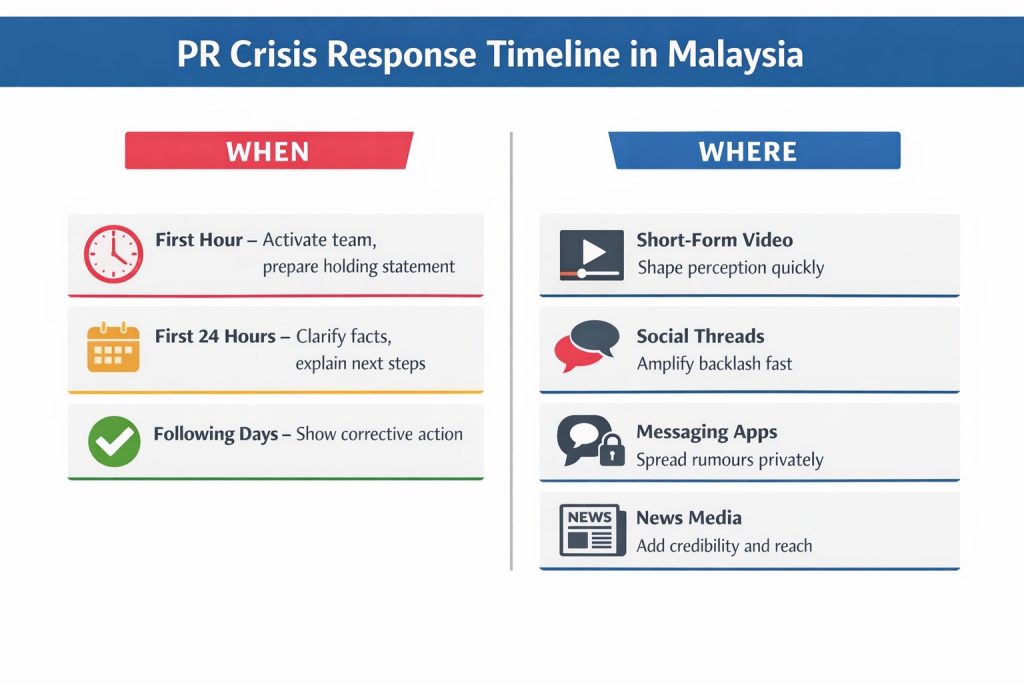
Timing: The First Response Window
The first response does not need to be perfect, but it must be disciplined.
- First hour: Activate the crisis team and prepare a holding statement
- First 24 hours: Communicate what happened, what is being reviewed, and what happens next
- Following days: Show visible corrective action and keep updates consistent
This aligns with crisis-response guidance that emphasises the first hour and first 24 hours as critical (Source: PRSA, 5 Steps for Navigating the First Hour of a Crisis; PRSA, 24-Hour Response Protocol).
Where You Respond
Different channels shape perception differently:
- Short-form video platforms: Can shift opinion quickly
- Fast-moving social threads: Can amplify criticism
- Community platforms: Can widen discussion
- Messaging apps: Can spread screenshots and rumours privately
- News media: Adds legitimacy and can lock a story into memory
Each channel requires a different format, but the core message must stay consistent.
How to Repair Reputation: The 5R Framework
- Recognise: Acknowledge the issue clearly and show empathy.
- Respond: Address the main concern directly and early.
- Repair: Fix the root cause through visible operational improvements. Apology alone is usually not enough. Corrective action is what makes the response credible (Source: Coombs, crisis communication research; Institute for Public Relations).
- Rebuild: Engage affected customers, offer practical resolutions, and keep communication open.
- Reframe: Once the issue is stabilised, show what has changed and why the brand is more accountable now.
Crisis Recovery Playbook
Step 1: Immediate Containment
- Pause non-essential campaigns
- Align leadership and internal teams
- Prepare a single source of truth for staff
Step 2: Public Acknowledgement
- Respond quickly
- Lead with empathy
- Keep the message simple
Step 3: Fact vs Perception Mapping
Separate the issue into:
- Reality: What actually happened
- Perception: What people believe happened
- Gap: Where misunderstanding or missing context exists
Step 4: Visible Proof
Use proof where possible:
- Show the process
- Share updated policies
- Provide documentation or timelines
Step 5: Third-Party Reinforcement
Use credible outside voices where appropriate, such as media, experts, or customer feedback.
Step 6: Long-Term Rebuild
Keep messaging steady, continue showing improvements, and strengthen internal processes.
When Legal Caution Creates Reputational Risk
Many companies delay responding because they want every sentence to be legally perfect, to avoid liability.
That is understandable, but silence can create its own damage. In fast-moving digital environments, no response can look like avoidance or indifference. A better approach is to release a clear holding statement early, avoid speculation, and commit to a follow-up update.
(Source: PRSA, 24-Hour Response Protocol)
Read More: How to Rebrand A Malaysian Business Well: 2026 Branding Guide
Challenges Malaysian Companies Face During PR Recovery
Malaysian businesses often face:
- Fast misinformation spread through private sharing
- Multilingual communication challenges
- High sensitivity to pricing and fairness
- Distrust toward generic corporate responses
- Strong influence of online personalities and commentary culture
Because of this, crisis recovery in Malaysia often requires clearer messaging, stronger proof, and more localisation than brands expect.
Costs of a Public Relations Crisis in Malaysia
A crisis affects more than headlines.
Direct Costs
- Revenue decline
- Refunds or compensation
- Customer loss
- Campaign disruption
Indirect Costs
- Reputation damage
- Lower employee morale
- Higher customer service pressure
- Increased paid media or promotional costs
Long-Term Costs
- Reduced customer trust
- Slower growth
- Higher acquisition costs
Reputation recovery often takes years. Early signs of improvement may appear after two to three years, while fuller recovery can take three to four years depending on severity and response quality (Source: PRSA, reputation recovery guidance).
How to Measure Trust Recovery
Trust is intangible, but recovery can still be tracked.
A simple dashboard can include:
- Sentiment trends over time
- Repeat customer rate
- Complaint resolution time
- Brand search demand
- Media tone and quality of coverage
- Share of positive, neutral, and negative mentions
The goal is to see whether public response is moving from suspicion toward confidence.
Case Scenario: Viral “Overpriced Food” Complaint
What Went Wrong
- The price may have been displayed
- But expectations were not managed
- No value context was given
- The public discussion focused on feeling overcharged
What Should Be Done
- Acknowledge the concern without sounding dismissive
- Explain sourcing, quality, or preparation clearly
- Show the value behind the pricing
- Review whether the menu or ordering flow creates confusion
- Address perception directly rather than arguing technical correctness
The goal is not just to prove the brand was right. The goal is to restore trust.
Best Practices for 2026 PR Crisis Management
- Lead with empathy before explanation
- Respond before speculation fills the gap
- Use proof, not just reassurance
- Align legal, operations, and communications early
- Keep the message consistent across all channels
- Treat trust recovery as both a communications and operations issue
Recovery After Making a Mistake
Recovering from a PR crisis is not about fixing a single message. It is about rebuilding trust through clear communication, visible corrective action, and steady follow-through.
In Malaysia’s fast-moving digital landscape, brands need more than an apology. They need a structured response, internal alignment, and proof that the underlying issue has been addressed.
If your brand is navigating a crisis or preparing for one, working with an experienced team like PRESS PR Agency can help you respond with clarity, protect reputation, and rebuild trust more effectively across Malaysia’s evolving media environment. Get in touch with PRESS, your most trustworthy Malaysian PR agency, as soon as possible, and keep your brand protected.
Disclaimer: This article is for general informational purposes only and does not constitute legal, financial, or regulatory advice. For an active or high-risk crisis, businesses should seek advice from qualified legal counsel and experienced crisis communications professionals.