

If you’re running an SME in Malaysia in 2026, it probably feels like this: costs keep creeping up, customers are more price-sensitive, hiring is still hard, and admin work keeps growing even when your team has not.
Global instability adds another layer. When conflict disrupts shipping lanes or energy infrastructure, oil prices, freight costs, lead times, and supplier pricing can all become more volatile. That volatility does not stay overseas. It can show up in your supplier quotes, delivery timelines, and customer demand here in Malaysia. (Source: Reuters)
This is not another generic “top 5 challenges” list. This guide connects the most common SME challenges in Malaysia, explains what is driving them in 2026, and gives you practical moves you can apply without a huge team or transformation budget. (Source: Bank Negara Malaysia; Department of Statistics Malaysia; Reuters)
The 2026 reality for Malaysian SMEs
A lot of SME stress in 2026 comes from local cost pressure mixed with global uncertainty.
Inflation is still a live issue
Malaysia’s Consumer Price Index rose 1.6% in January 2026 year-on-year. That may look manageable on paper, but SMEs still feel it through packaging, rent, services, and everyday operating costs. (Source: Department of Statistics Malaysia, Consumer Price Index January 2026)
What this means for SMEs
- Small increases across many cost lines add up fast.
- Margins get squeezed even when sales look stable.
- Pricing decisions become harder to delay.
Oil and Energy Shocks are Back on the Radar
In mid-March 2026, oil prices jumped sharply as conflict-related disruption involving Iran and the Strait of Hormuz hit global energy markets. Reuters reported Brent above US$104 a barrel on 15 March 2026, while the International Energy Agency announced the release of more than 400 million barrels from emergency reserves to help stabilise supply. Even if prices cool later, the uncertainty alone can affect freight, packaging, and supplier pricing. (Source: Reuters)
What this means for SMEs
- Delivery and freight costs can move suddenly.
- Suppliers may revise quotes faster than usual.
- Businesses with weak cash buffers feel the pain first.
BNM is Watching External Risks Closely
Bank Negara Malaysia said on 5 March 2026 that Malaysia’s growth outlook remains subject to uncertainties surrounding global developments, including the recent conflict in the Middle East. Earlier BNM publications also noted that escalating Middle East tensions contributed to financial market volatility. (Source: Bank Negara Malaysia, Monetary Policy Statement 5 March 2026; Bank Negara Malaysia, Economic, Monetary and Financial Developments 2024)
What this means for SMEs
- External risks are not just headline news.
- They can affect inflation, sentiment, and planning confidence.
- Tighter forecasting matters more than ever.
SMEs Remain the Engine of the Economy
MSMEs contributed 39.5% of Malaysia’s GDP in 2024 and accounted for 48.7% of total employment, equivalent to 8.10 million persons. That means macro pressure affects a very large base of businesses, while competition for customers and staff remains intense. (Source: Department of Statistics Malaysia, MSMEs Performance 2024)
What this means for SMEs
- You are not struggling alone.
- The market is crowded and cost-sensitive.
- Better execution matters more than ever.
The Core Problem Behind Many SME Struggles: Cash Flow and Working Capital
Many SMEs do not struggle because demand is weak. They struggle because money moves too slowly.
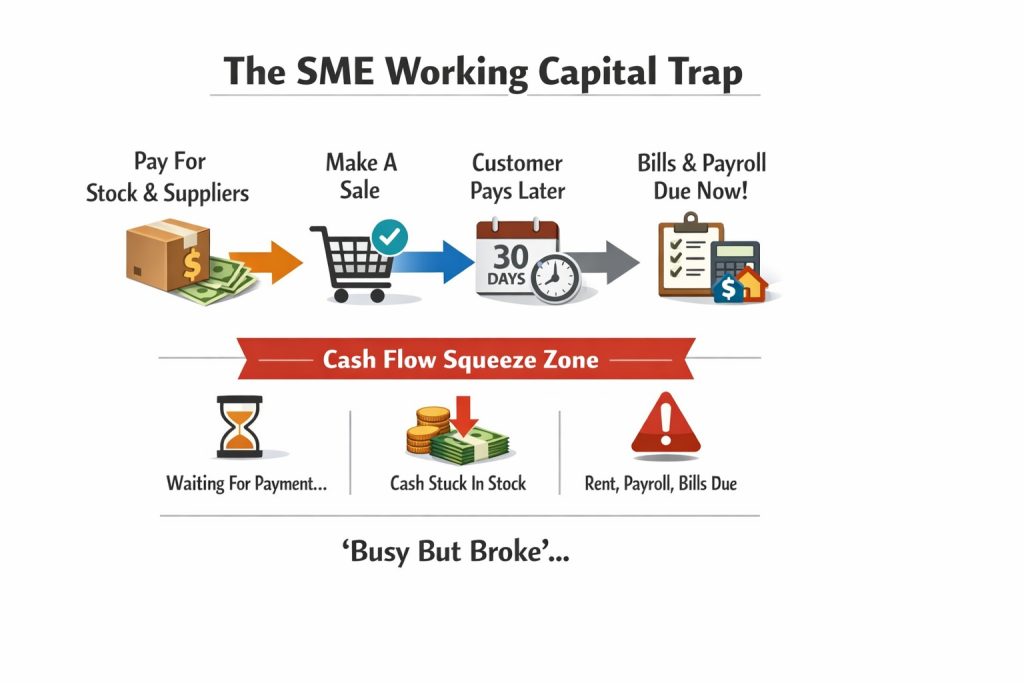
This is the working capital trap:
- You buy inventory or pay suppliers upfront.
- You make the sale, but customers take time to pay.
- Meanwhile, rent, payroll, and bills keep coming.
That mismatch creates the classic “busy but broke” feeling.
The cash conversion cycle (in plain language)
- Inventory: How long your cash sits in stock before it becomes sales
- Receivables: How long customers take to pay you.
- Payables: How long you get before you must pay suppliers.
If receivables are slow and inventory is bloated, your business can look healthy on revenue while cash stays tight.
Common symptoms
- Always chasing late payments.
- Stock moving unevenly, with some items sitting too long.
- Relying on last-minute borrowing to cover payroll.
- Feeling unable to hire even when demand exists.
Quick wins that actually move the needle
Set a weekly cash check-in
Track:
Cash in bank.
Expected collections over the next 2 weeks.
Bills due over the next 2 weeks.
Tighten receivables with a simple follow-up cadence
Use a repeatable reminder flow:
3 days before due date.
On due date.
3 days overdue.
Escalate after that.
Shrink dead stock
Bundle it, discount it strategically, or stop reordering slow items.
Separate owner spend from business cash
Pay yourself a fixed amount. Do not treat the business account like a personal wallet.
If energy prices rise or supplier pricing shifts suddenly, businesses with weak working capital feel the pain first, while businesses with cleaner cash cycles are better placed to absorb shocks. (Source: Reuters; Bank Negara Malaysia)
Costs Are Up, so Margin Management is Now a Weekly Habit
When costs rise, a common reflex is: “We just need more sales.” But more sales at weak margins can make cash flow worse.
In 2026, margin management is a weekly discipline.
Cost areas that often creep quietly
- Packaging and delivery.
- Supplier price adjustments linked to fuel or imported inputs.
- Subscriptions and software tools.
- Labour overtime and turnover costs.
- Financing costs if borrowing becomes more expensive.
Practical margin levers
Reprice smartly
Small increases with clear value framing usually work better than random hikes.
Fix your product mix
Push higher-margin items more often. Do not treat every SKU or service equally.
Control discounting
Discount with a purpose, not as a default response.
Renegotiate supplier terms
Even a small extension in payment terms can ease cash pressure.
BNM’s policy messaging in early 2026 reinforces the need to watch inflation, external risks, and business stability, which makes cost and pricing discipline especially relevant for SMEs. (Source: Bank Negara Malaysia, Monetary Policy Statement 5 March 2026)
Talent and Retention
Yes, pay matters. But SMEs also lose people when work is messy.
When processes are unclear, people get tired, mistakes increase, and better staff often leave first.
Why SMEs feel turnover pain more
- Every role is multi-hat, so one resignation creates a big hole.
- Training time is expensive and often undocumented.
- Culture and standards often live in the founder’s head.
Retention upgrades that do not require big budgets
Write a one-page role scorecard
List the top 5 responsibilities and top 3 success metrics.
Create a 14-day onboarding checklist
For example:
Day 1: Tools, access, SOPs.
Day 3: Shadowing.
Day 7: Review.
Day 14: Independence check.
Use micro-incentives tied to output
Reward accuracy, speed, quality, customer feedback, or upsells.
Build a simple progression path
Even in a small team, people want to know what comes next.
If external cost pressure rises, productivity matters even more because you cannot always solve the problem by hiring more people. (Source: Bank Negara Malaysia; Reuters)
Digitalisation that Actually Helps: Build Visibility First, Then Automation
The best SME digitalisation is usually simple.
Your goal is not to “go digital.” Your goal is to:
- Reduce errors.
- Reduce admin time.
- Improve collection speed.
- Stop leakage.
The minimum viable digital stack
Invoicing and basic accounting workflow
You need a clear view of what has been billed, paid, and overdue.
Payment collection options
The easier you make it for customers to pay, the faster you tend to collect.
Inventory tracking (if you sell physical goods)
Even simple tracking helps avoid overbuying and stockouts.
Basic customer tracking (CRM light)
You need a reliable way to track leads and follow-ups.
Weekly dashboard
Track:
- Sales.
- Estimated gross margin.
- Cash collected.
- Overdue invoices.
The traps to avoid
- Buying too many tools too quickly.
- Not assigning an owner for data discipline.
- Ignoring cybersecurity because the business feels “too small.”
Cyber risk is not something SMEs should ignore. CyberSecurity Malaysia and MyCERT regularly publish incident summaries and ransomware advisories that emphasise baseline protections such as offline backups, strong passwords, patching, and staff awareness training. (Source: MyCERT; CyberSecurity Malaysia)
Compliance is Becoming a Workflow Problem
In 2026, compliance is becoming more operational and process-driven.
E-invoicing is the big operational shift
Malaysia’s e-invoicing rollout is phased by annual turnover. Under IRBM’s updated timeline:
- Taxpayers with annual turnover above RM25 million and up to RM100 million started on 1 January 2025.
- Taxpayers with annual turnover above RM5 million and up to RM25 million started on 1 July 2025.
- Taxpayers with annual turnover up to RM5 million started on 1 January 2026.
- Taxpayers with annual turnover below RM1 million are exempt, subject to IRBM rules and exceptions. (Source: Inland Revenue Board of Malaysia, e-Invoice Implementation Timeline; Inland Revenue Board of Malaysia, General FAQs on e-Invoice)
For SME owners, the practical takeaway is simple:
- Your invoicing process must become more consistent.
- Your customer and supplier data must be cleaner.
- Someone must own the workflow internally.
The compliance setup that reduces stress
Assign one compliance owner
Not necessarily a new hire, but someone must be accountable.
Standardise your invoice flow
Use the same format, fields, and steps each time.
Clean your master data
Make sure names, registration details, addresses, and descriptions are accurate.
Centralise documents
Use one folder system for contracts, invoices, receipts, and supporting records.
Market and Competition: The “same same” Problem
Customers have more choices, see more ads, and have less patience. So businesses that look and sound like everyone else often end up competing on price.
Signs you’re stuck in “same same”
- Your marketing talks about features, not outcomes.
- Your offers are too broad.
- You rely heavily on discounts.
- Your online presence does not show proof.
Fix positioning without rebranding everything
Choose one primary customer type
A clearer best-fit audience makes your message sharper.
Choose one core promise
For example:
- Faster delivery.
- Better support.
- Higher quality.
- Lower risk.
Show proof
Use testimonials, before-and-after examples, or short case snapshots.
Be discoverable where intent lives
Focus on local search, practical FAQs, and content that answers real buyer questions.
A simple 90-day plan for Malaysian SME owners (Stabilise → Simplify → Scale)
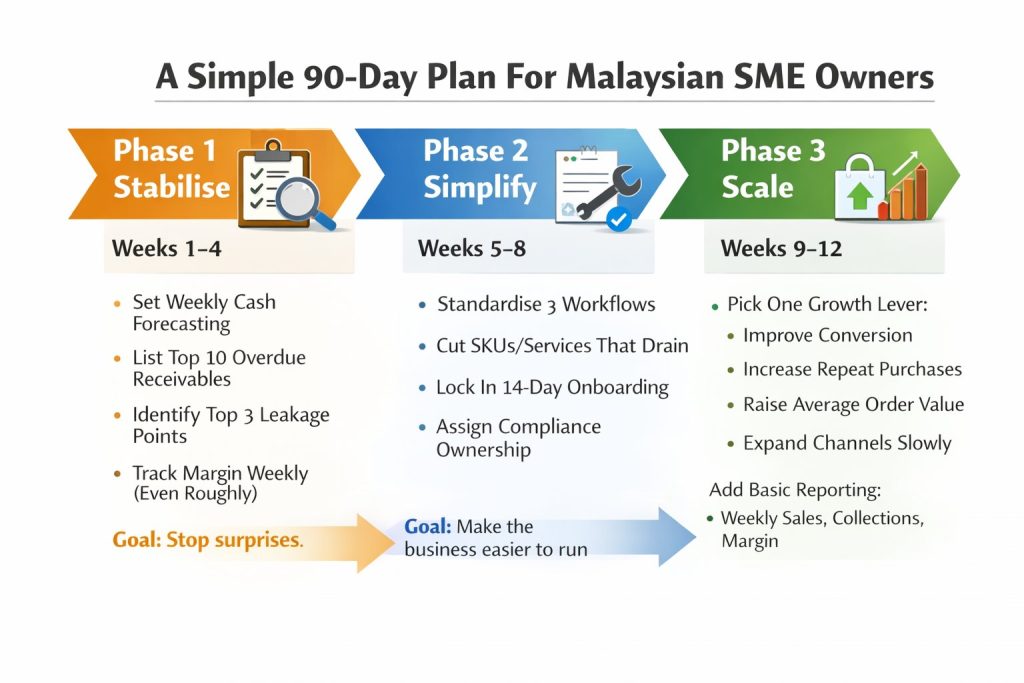
If you only use one part of this article, make it this.
Phase 1: Stabilise (Weeks 1–4)
- Set weekly cash forecasting.
- List top 10 overdue receivables.
- Identify top 3 leakage points.
- Track margin weekly, even if rough.
Goal: Stop surprises.
Phase 2: Simplify (Weeks 5–8)
- Standardise 3 core workflows.
- Tighten the sales → invoicing → collection process.
- Cut SKUs or services that drain time and give weak margins.
- Lock in a 14-day onboarding checklist.
- Assign compliance ownership.
Goal: Make the business easier to run.
Phase 3: Scale (Weeks 9–12)
Pick one growth lever only:
- Improve conversion with a better offer and follow-up.
- Increase repeat purchases with simple retention messaging.
- Raise average order value through bundles or add-ons.
- Expand one channel, not three at once.
Then add a basic reporting habit:
- Weekly sales.
- Weekly collections.
- Estimated margin.
- Top 3 operational issues.
Goal: Grow without chaos.
Businesses with tighter operations, cleaner data, and clearer cash visibility can adapt faster when costs, lead times, or demand shift. (Source: Reuters; Inland Revenue Board of Malaysia)
Growing and Overcoming SME Challenges
SME challenges in Malaysia in 2026 are real, but they are also familiar patterns.
When you tackle them in the right order (cash flow first, then margins, then people and workflows, then tools and growth), your business becomes calmer, more resilient, and easier to scale.
If you want more qualified leads without relying only on ads, PRESS PR Agency can help strengthen your visibility with practical SEO services tailored to Malaysian SMEs. It is a steady way to build trust, rank for high-intent searches, and attract customers who are already looking for what you do.
Disclaimer: This article is for general informational and educational purposes only and should not be treated as financial, investment, legal, tax, or professional advice. For guidance specific to your situation, refer to the latest official guidance from the relevant Malaysian authorities and consult a licensed professional where appropriate.