
For years, PR worked on a fairly simple assumption.
The company had official spokespeople, the PR team handled journalists, marketing managed social media and employees generally got on with their jobs somewhere behind all of that.
Well, that line has become blurrier thanks to social media.
Today, someone can get laid off at 10am and have a LinkedIn post about the experience circulating before lunch. Youtube videos of “Why I left Company X” with a thumbnail of a sad former employee can get thousands of views, and of course, an employee can complain about management on Glassdoor.
Whether you like it or not, employees hold THE power to turn your stellar reputation a company spent years curating, into an absolute train wreck of a disaster by a post of a button.
How Are Employees Affecting Company Reputation?
Employees affect reputation because they now communicate publicly in places where customers, journalists, future employees and business partners can see what they say.
LinkedIn is probably the most obvious example.
An employee talking genuinely about a project they worked on can probably do more for employer branding than a carefully designed corporate graphic saying “our people are our greatest asset”.
Other times, not so much.
One frustrated employee writing about how badly a restructuring was handled can receive hundreds of comments from former colleagues saying they had the same experience.
At that point, you no longer have one unhappy employee and you have a terrible public reputation problem.
Layoffs Are Now Public Events
A company might announce that it is undergoing “strategic restructuring to optimise operational efficiency”.
An employee might post: “I found out this morning that my role has been eliminated after four years with the company.”
Those are technically talking about the same event but it’s presented differently.
When ByteDance reduced hundreds of roles in Malaysia in 2024, including employees working around content moderation, Reuters reported that affected staff were only informed by email.
That kind of restructuring used to remain largely between employees, HR and management but affected workers today can immediately talk about it publicly through LinkedIn and other platforms.
This matters because:
- Journalists read LinkedIn too.
- So do future employees.
- So do customers.
If your corporate statement says the process was carefully managed while dozens of former employees publicly describe it as chaotic, cold or confusing, guess which side people are going to start paying attention to?
Internal communications during layoffs should absolutely be treated as part of reputation management because how they are treated during the layoff will be documented.
Glassdoor, Reddit and The Other Version of Your Company
We talked about LinkedIn but now let’s talk about the true test of your reputation.
Glassdoor, Reddit, TikTok, Facebook groups and even WhatsApp communities all create spaces where people talk about companies under an anonymous safeguard.
So if you have twenty former employees independently complaining about the same management issue, you can probably guess how other people will see the management as.
For employers we recommend:
- Pay attention to repeating patterns: is it the same manager or system causing the issue? Communication? Culture?
- Bring it back internally: Compare it against exit interviews and employee feedback and act on it.
- Really and we mean REALLY try to understand: Some employees might harbor bitter resentment, understand why, what got them there and what YOU could do to change that.
Employees Do Not Even Need to Post Anything Themselves
So, we all know that one viral meme or click of your company can take you to stardom. Conversely, it can bring titans down from grace.
In 2024, Auntie Anne’s Malaysia became part of a viral story after content showed an employee kissing pretzel dough at its Mid Valley outlet.
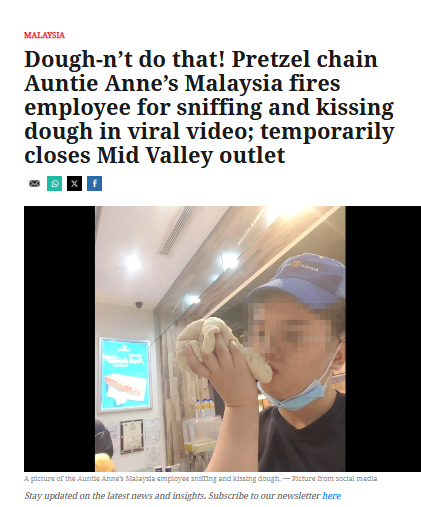
The employee’s actions suddenly became a food safety issue associated with the entire brand. The outlet was temporarily closed for cleaning and disinfection, while the employee was terminated.
One employee, one video and now the whole brand kena.
This is now the reality for every customer-facing business, yes you can’t escape this. You are dealing with customers who are carrying very good cameras in their pockets.
An argument that previously would have ended at the counter can now be watched by several hundred thousand people later that evening.
FamilyMart Malaysia faced a similar situation in 2026 when a video involving one of its employees and a delivery rider circulated online.
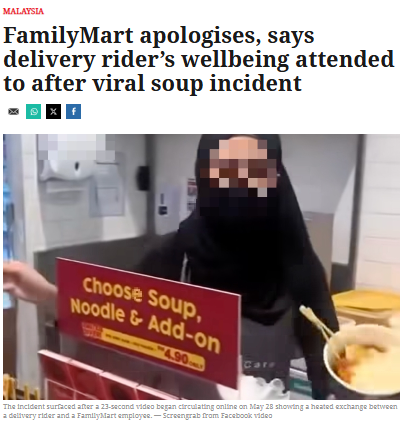
Again, the employee did not need to be running a corporate social media account to become part of the company’s public reputation.
The uniform did that for them.
Senior Employees Are Even Harder to Separate From the Brand
A junior employee posting something controversial can certainly create problems, but things become much more complicated when the person is a CEO, director, COO or other senior executive.
They can write “views are my own” in their biography or in an editorial, but that does not mean the public has to agree.
“People naturally assume that senior leaders influence company culture, decision-making and values.”
Malaysia saw this issue in 2025 when myBurgerLab terminated its then-COO Andrew Chong following backlash over a post made on his personal social media account.
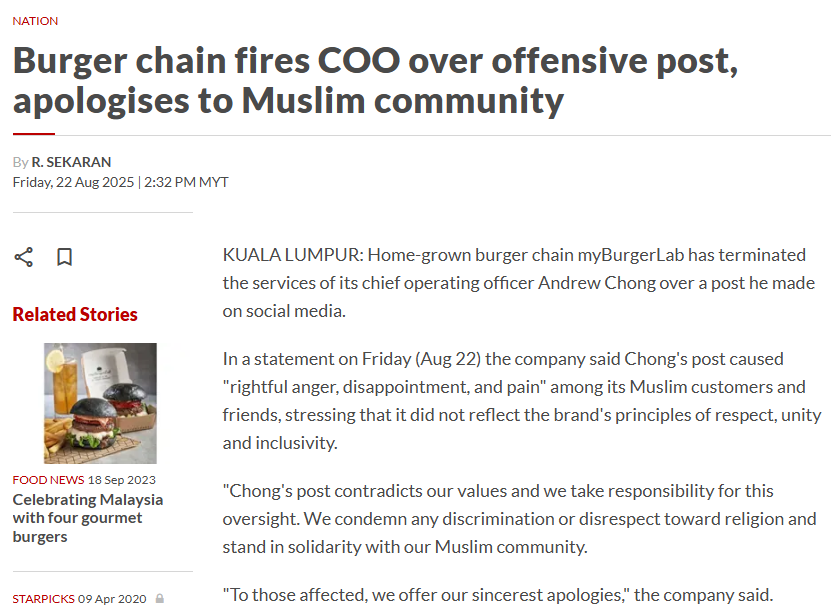
The company subsequently distanced itself from the remarks and stated that they did not reflect its values.
Notice the comment came from an individual’s account, but the organisation still had to respond.
The more senior someone becomes, the harder it is to completely separate their personal reputation from the company they represent.
Fair or not, their job title follows them around.
Internal Communications Are Not Always Internal Anymore
Companies should probably assume that important internal communications may eventually become public.
Even when employees are under NDAs, sensitive information can still be screenshotted, forwarded, recorded or leaked.
That includes:
- Layoff announcements
- Internal memos
- WhatsApp messages
- Town hall recordings
- Emails from senior management
- Slack or Teams conversations
- Staff notices
This does NOT mean every internal email should suddenly sound like it was written by a lawyer, please don’t do that either, your employee will hate you for it.
But if you are communicating something highly sensitive, ask yourself a very simple question:
Would we still be comfortable with this message if a journalist read it tomorrow?
If the answer is no, you should rewrite it.
Should Companies Tell Employees What They Can Post?
Yes, but within reason.
A proper employee social media policy is useful. After all, staff should understand confidentiality, customer privacy, harassment, commercially sensitive information and who is authorised to officially speak on behalf of the organisation.
But there is a difference between having clear rules and trying to control every opinion employees express online.
Companies sometimes respond to employee reputation risks by becoming extremely restrictive.
- Don’t mention work.
- Don’t talk about the company.
- Don’t discuss your experience.
- Don’t say anything negative.
You are not running a dictatorship here, you are running a business.
Employees have their own professional identities and experiences, and attempting to silence legitimate criticism can make a company look considerably worse if those attempts become public.
Employee Advocacy Can Be Very Good PR Too
We have spent quite a lot of time talking about what can go wrong, but employees can also be some of the best advocates a company has.
And importantly, people can usually tell the difference between genuine enthusiasm and compulsory LinkedIn posting.
If twenty employees all suddenly post the exact same caption saying:
“Thrilled to be part of an organisation that continues to empower innovation and unlock meaningful value!💪💪”
We know what happened because marketing or the socmed team sent them the caption.
Real employee advocacy feels different.
- It could be an engineer talking about something they helped build for a CSR project
- A designer sharing the campaign they worked on during the past year
- A graduate explaining what they learnt during their first year and the colleagues they befriended.
An employee posting photos from an event because they genuinely enjoyed being there.
Those messages are often more believable because they come from actual people rather than the corporate account.
Employee advocacy therefore works for exactly the same reason employee criticism can be so powerful. People trust people.
What Should PR Teams Do About All This?
HR, internal communications, management and PR should be talking to each other, especially when something significant is happening inside the organisation. If you are preparing to announce layoffs publicly, what are employees being told internally?
- If a crisis is developing, do frontline employees know what to do when customers start asking questions?
- If management is communicating a major change, has anyone considered how that message might look if it becomes public?
- If senior executives are active on social media, do they understand the reputational weight that comes with their position?
And importantly, are you listening to what employees are already saying?
Because employee sentiment should not only become important after somebody’s LinkedIn post has 3,000 likes.
At PRESS, we are a PR Agency, we think we made it pretty clear by now. And we wholeheartedly believe that the killer of trust is the absence of communication.
Employees are not spreadsheets numbers where you can micromanage as if you’re playing a resource management game. One unhappy employee can ruin years of goodwill, we have seen this happen before and we will continue seeing it.
Just make sure your company doesn’t end up on that list.
Frequently Asked Questions About Employee PR Strategy
Can employees damage a company’s reputation through social media?
Yes. Employees can affect company reputation through LinkedIn posts, TikTok videos, Reddit discussions, Glassdoor reviews, customer interactions and even comments made on personal accounts.
Should companies have an employee social media policy?
Yes, but it should focus on clear risks such as confidential information, customer privacy, harassment, internal data and who is authorised to speak on behalf of the company.
Should a company respond to negative employee reviews online?
Not always. One negative review may not require a public response, especially if it is anonymous or based on a personal dispute. However, repeated complaints about the same issue should be taken seriously and investigated internally.
Can an employee’s personal social media post become a PR issue for the company?
Yes, particularly if the employee is senior, well known or easily associated with the organisation. A personal disclaimer such as “views are my own” does not necessarily stop customers or the public from connecting those views with the company.
What should companies do if an internal message is leaked?
First, assess what was actually leaked and whether the information is accurate. The company should then determine whether employees, customers, journalists or other stakeholders need clarification.
How can employees become positive brand advocates?
Employees can strengthen a company’s reputation by sharing genuine experiences, projects, workplace achievements and professional insights. The most effective employee advocacy tends to feel natural rather than scripted.