
AI writing tools have made it incredibly easy to generate a mission statement within seconds. The problem is that many of them sound exactly the same.
Phrases like “empowering innovation,” “driving transformation,” and “delivering excellence” have become so overused that they no longer feel meaningful. Customers, employees, and even investors are becoming better at spotting overly polished corporate language that sounds artificial rather than authentic.
For Malaysian businesses, this matters more than ever.
Your mission statement often appears across websites, proposals, recruitment materials, investor decks, and PR campaigns. If it sounds robotic or generic, the entire brand can feel less trustworthy and less memorable.
The good news is that writing a strong mission statement does not require sounding corporate or overly inspirational. In many cases, the best mission statements are the ones that sound clear, specific, and genuinely human.
Read More: Starting a New Business in Malaysia: What to Know
What Is A Mission Statement?
A mission statement is a short explanation of what a business does, who it serves, and why it exists.
Unlike slogans or taglines, mission statements are meant to guide long-term company direction. They influence branding, internal culture, recruitment messaging, PR positioning, and customer perception.
Here is a simple comparison:
| Element | Purpose | Example |
|---|---|---|
| Mission Statement | Explains what the business does and why it exists | “Helping Malaysian SMEs simplify accounting compliance.” |
| Vision Statement | Describes future goals | “To become Southeast Asia’s most trusted SME accounting platform.” |
| Tagline | Marketing-focused phrase | “Accounting Made Simpler.” |
A strong mission statement should help people quickly understand:
- What the company actually does
- Who the business serves
- What problem the company solves
- Why the business exists beyond revenue
Read More: New to Business? Here’s How to Register a Company in Malaysia
Why AI-Generated Mission Statements Often Sound Fake
AI-generated mission statements are not automatically bad. The issue is that many businesses rely on AI outputs without adding enough human context.
As a result, the final statement often feels generic, repetitive, or emotionally distant.
Buzzwords Replace Meaning
One of the biggest warning signs is excessive corporate jargon.
Phrases like:
- Customer-centric innovation
- Sustainable transformation
- Excellence-driven ecosystem
- Empowering scalable growth
- Future-ready solutions
may sound polished, but they rarely tell people what the company actually does.
Most customers do not speak this way in real life. Employees usually do not either.
The Statement Could Apply To Any Business
Many AI-generated mission statements are too broad.
For example:
“We strive to deliver innovative solutions that empower businesses globally.”
This could describe almost any company.
Compare that with:
“We help Malaysian retailers reduce inventory mistakes through practical POS systems.”
The second version sounds more believable because it reflects a real operational problem.
AI Often Removes Personality
Real businesses usually have specific stories, frustrations, customer experiences, and operational realities.
AI-generated content tends to smooth out those human details in favour of safer, more generic wording.
That is why many mission statements sound polished but emotionally empty.
Why Mission Statements Still Matter In 2026
Some businesses assume mission statements are outdated because modern consumers care more about pricing, reviews, and products. However, mission statements still influence trust and positioning.
Research consistently links clarity of purpose to stronger internal alignment. For example, Gallup has reported that improving employees’ connection to their organisation’s mission or purpose is associated with lower turnover and higher profitability. Deloitte Insights has also highlighted that mission-driven companies tend to show stronger retention and innovation outcomes. Mission statements remain a widely used strategic tool for shaping organisational identity and alignment, which is why they still matter in 2026.
Mission statements commonly affect:
| Business Area | Why It Matters |
|---|---|
| Recruitment | Attracts aligned employees |
| Branding | Shapes public perception |
| Website Messaging | Clarifies positioning |
| Investor Communication | Reinforces direction |
| Company Culture | Creates internal consistency |
| AI/Search Visibility | Can support understanding (clear positioning helps systems interpret your offer and may improve how you’re summarised in AI-assisted search) |
As AI-assisted search and browsing features continue expanding, clear company positioning is becoming increasingly important.
Who Should Be Involved In Writing A Mission Statement?
One common mistake is allowing only one executive or one AI prompt to create the final version. The best mission statements often involve multiple perspectives.
Founders And Leadership
Founders usually understand the original purpose behind the business, including the frustrations or market gaps that inspired it.
Those insights often create stronger messaging.
Customer-Facing Teams
Sales staff and customer support teams often understand customer frustrations better than management teams.
Their feedback can make mission statements sound more practical and believable.
Marketing And PR Teams
Marketing and PR professionals help ensure the mission statement aligns with website messaging, campaigns, social media, and public branding.
Employees
Employees can often tell immediately whether a mission statement genuinely reflects company culture or simply sounds like corporate filler.
If employees do not believe it internally, customers may struggle to believe it externally.
Signs Your Mission Statement Sounds Too AI-Generated
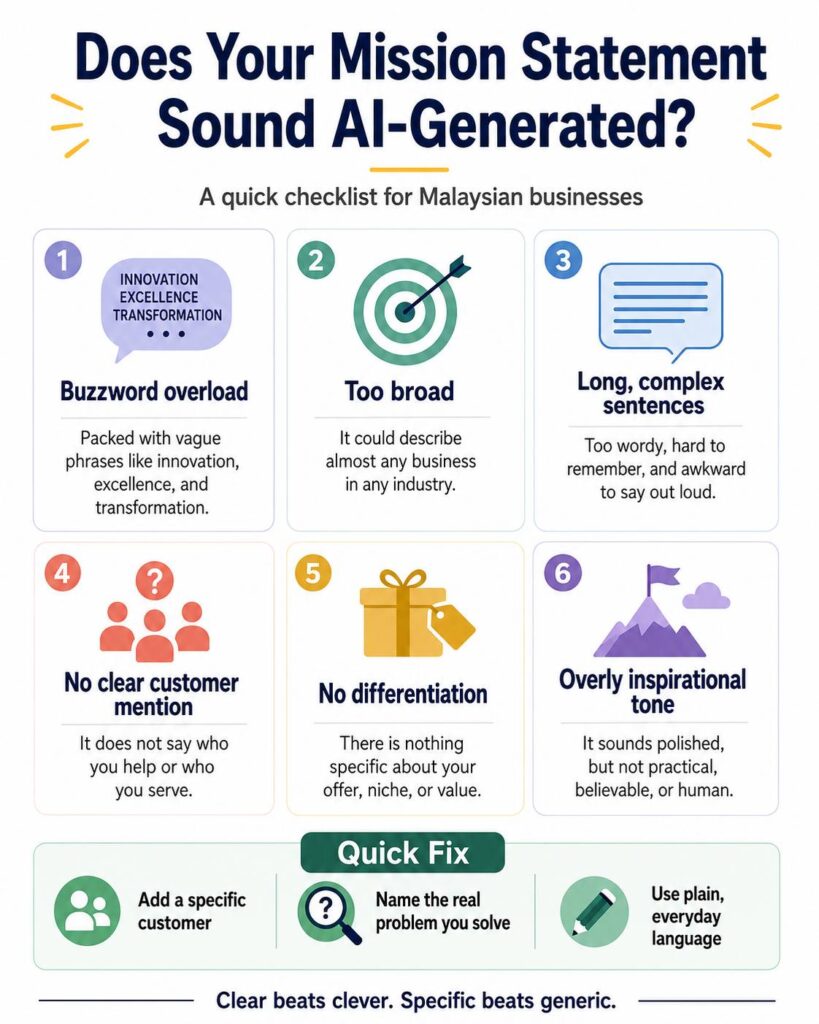
Before publishing a mission statement, businesses should review whether it sounds artificial.
Here are some common warning signs:
| Red Flag | Why It Weakens Trust |
|---|---|
| Overuse of buzzwords | Sounds vague and impersonal |
| Extremely broad claims | Feels unrealistic |
| Long complicated sentences | Hard to remember |
| No mention of customers | Lacks connection |
| Could describe any business | Weak differentiation |
| Excessive inspirational wording | Sounds manufactured |
Example of a weak statement:
“We strive to empower innovative solutions through excellence and customer-centric transformation.”
Example of a stronger version:
“We help Malaysian retailers simplify inventory management so they can spend less time fixing stock problems and more time growing their business.”
The second version sounds more human because it reflects a specific business challenge.
How To Write A Mission Statement Without Sounding Like AI
Start With Real Customer Problems
Instead of trying to sound impressive, focus on actual customer frustrations.
Ask questions like:
- What problems do customers repeatedly mention?
- Why did the business originally start?
- What operational gap are we solving?
- What do customers consistently praise us for?
- Why do customers stay loyal?
Businesses that write from operational reality usually sound more authentic naturally.
For example, a logistics company may realise customers care more about delivery reliability and communication than “innovation.”
That operational insight should shape the mission statement directly.
Read More: What Does a Company Secretary Do in Malaysia Explained
Use Everyday Language
One of the easiest ways to avoid sounding AI-generated is to use simpler language.
Compare these examples:
| Overly Corporate | More Human |
|---|---|
| “Delivering scalable customer-centric innovations” | “Helping businesses reduce daily operational headaches” |
| “Driving transformational digital ecosystems” | “Making online payments easier for local businesses” |
| “Creating synergistic enterprise growth” | “Helping SMEs grow without wasting marketing budgets” |
Simple language often feels more trustworthy because it sounds natural.
Include Who You Actually Serve
Mission statements become stronger when they identify a clear audience.
Weak example:
“We help businesses grow.”
Stronger example:
“We help Malaysian SMEs improve online visibility through SEO and digital PR.”
Specificity immediately improves credibility.
Avoid Sounding Overly Inspirational
Not every business needs dramatic emotional language. Some industries benefit more from sounding dependable and practical.
For example, an industry like accounting would prefer something reliable and clear. The healthcare industry needs trust-focused mission statements. Logistic statements must show the company is efficient and dependable. And so on.
Trying too hard to sound inspirational can sometimes reduce authenticity.
Keep It Short And Memorable
Mission statements should be concise enough for employees and customers to remember easily.
A common guideline is around 10 to 30 words, but clarity matters more than forcing a strict word count. If the statement requires multiple explanations, it may be too complicated.
Read It Out Loud
A surprisingly effective test is reading the mission statement aloud.
If it sounds awkward or robotic when spoken, it probably needs revision.
Good mission statements usually sound conversational even when written professionally.
Use AI As A Drafting Tool, Not The Final Writer
AI tools can still be useful when used correctly.
Helpful uses include:
- Brainstorming ideas
- Simplifying wording
- Creating multiple variations
- Testing different tones
- Improving structure
However, businesses should still manually refine the final version.
A practical workflow often looks like this:
- Write raw ideas manually
- Feed detailed business context into AI
- Generate multiple variations
- Remove generic buzzwords
- Add operational specificity
- Read aloud naturally
- Test internally with staff
Examples Of Better Mission Statement Approaches
Here are examples showing how businesses can sound more human and believable.
| Weak Version | Improved Version |
|---|---|
| “Empowering innovation for a sustainable future” | “Helping Malaysian homeowners reduce electricity costs through smarter solar adoption” |
| “Delivering excellence in customer engagement” | “Making customer support faster and less frustrating for online shoppers” |
| “Leading digital transformation globally” | “Helping local businesses compete online without needing massive marketing budgets” |
| “Creating next-generation financial solutions” | “Helping freelancers manage invoices and payments more easily” |
The stronger versions focus on real outcomes instead of vague corporate language.
Common Challenges Malaysian Businesses Face
Copying Large Corporate Brands
Many SMEs unintentionally imitate multinational corporate language. The result is messaging that feels disconnected from smaller local businesses and their customers.
A local café, law firm, accounting company, or logistics provider usually benefits more from sounding practical and relatable than overly corporate.
Overusing AI Without Enough Context
AI outputs become generic when prompts lack detail.
Weak prompt:
“Write a professional mission statement for my company.”
Better prompt:
“Write a mission statement for a Malaysian accounting firm helping SMEs manage e-Invoicing compliance affordably.”
The more operational detail provided, the stronger the AI output becomes.
Confusing Mission Statements With Advertisements
Mission statements should not sound like aggressive marketing copy.
Avoid excessive claims like:
- Industry-leading
- World-class excellence
- Revolutionary innovation
- Best-in-class solutions
Overpromotional language often reduces trust instead of improving it.
Ignoring Local Context
Many Malaysian businesses forget to reflect local realities.
Mentioning operational understanding, industry focus, or local audiences can make mission statements feel far more credible.
Examples include:
- SMEs
- Halal businesses
- e-Invoicing compliance
- Manufacturing sectors
- Local retail challenges
- Regional logistics
These details create stronger positioning.
Should Businesses Hire PR Or Branding Professionals?
Some businesses can create strong mission statements internally. Others may benefit from external guidance, especially during rebranding projects or larger PR campaigns.
Professional support may help when:
| Situation | Why External Help Helps |
|---|---|
| Rebranding projects | Creates consistent messaging |
| Investor presentations | Improves positioning clarity |
| Website redesigns | Aligns brand voice |
| PR campaigns | Strengthens public narrative |
| Fast-growing startups | Clarifies long-term identity |
External PR and branding professionals often identify messaging inconsistencies that internal teams may overlook.
The Role Of Mission Statements In SEO And AEO
Mission statements can indirectly support SEO and AEO when integrated naturally across websites, About pages, business profiles, PR campaigns, and structured content.
Clear positioning helps search engines and AI systems better interpret:
- What the company does
- Who it serves
- Geographic relevance
- Industry expertise
- Brand identity
This becomes more relevant as AI-assisted search and browsing features expand and as people increasingly use AI assistants to research, compare, and summarise businesses.
Businesses that communicate clearly often improve both human trust and machine interpretation at the same time.
Getting Your Mission Statement Right
Writing a mission statement without sounding like AI is less about avoiding technology and more about sounding genuinely human. Businesses that focus on real customer problems, operational clarity, and authentic language usually create stronger mission statements naturally.
The best mission statements are not necessarily the most sophisticated or inspirational. They are the ones that employees believe, customers understand, and businesses can genuinely live up to over time.
For brands planning broader positioning, media visibility, or reputation-building campaigns, PRESS PR Agency can help businesses develop clearer brand narratives and public messaging strategies through professional PR services tailored for modern digital visibility. Contact PRESS, Malaysia’s number one PR agency, today to learn more.
Sources
- Gallup (2021): Reporting on purpose/mission connection and business outcomes such as turnover and profitability
- Deloitte Insights (2015): Mission-driven companies, retention, and innovation outcomes
- Journal of Management & Organization (2018): Systematic review of mission-statement research
- Google Search Central: SEO fundamentals and how search systems interpret content
- Reuters (2025): Coverage of AI-assisted browsing/search features expanding via major platforms
- OpenAI Help Center: General information on ChatGPT as an AI assistant used for research and summarisation
- BoardEffect (2026): Practical guidance on mission statement structure and length
Frequently Asked Questions About Crafting a Mission Statement That Sounds Natural
What Makes A Mission Statement Sound AI-Generated?
Mission statements often sound AI-generated when they rely heavily on buzzwords, vague promises, and overly polished corporate language without specific business context.
How Long Should A Mission Statement Be?
A common guideline is around 10 to 30 words, but clarity matters more than forcing a strict word count.
Can AI Help Write A Mission Statement?
Yes. AI can help brainstorm ideas, simplify wording, and generate drafts, but businesses should still manually edit the final version for authenticity.
Should Small Businesses In Malaysia Have A Mission Statement?
Yes. Even smaller businesses can benefit from stronger positioning, clearer branding, and improved trust among customers and employees.
What Is The Difference Between A Mission Statement And A Vision Statement?
A mission statement explains what the business currently does and why it exists, while a vision statement focuses on long-term future goals.
Where Should Businesses Display Their Mission Statement?
Mission statements are commonly displayed on company websites, About pages, investor presentations, recruitment materials, PR campaigns, and social media profiles.